Home visiting: more hype than hope

Image: homvee.acf.gov

by Marie Cohen

Home visiting has been a highly popular intervention for the prevention of child abuse and neglect and for addressing a much broader set of social problems as well. But the research has never supported the efficacy of home visiting programs as a whole for improving child and family outcomes. The latest study of four popular home visiting programs found that all these programs have negligible impacts after five to seven years. But there was no hint of this message in the government’s press release or the report itself. The bipartisan belief in home visiting is prevening a needed examination of home visiting’s impact and the level of resources devoted to it.

A Brief History of US Home Visiting

While home visiting has existed since Elizabethan times in England, its history in the U.S. began in the late nineteenth century with charities seeking to address urban poverty by changing the behavior of poor families. While it is now considered to be the solution to a number of different social problems mostly related to poverty, modern home visiting was conceived as a way to prevent child abuse and neglect. Publication of Henry Kempe’s The Battered Child in 1968 brought about the recognition of child maltreatment as a national problem. To address child abuse, Kempe called for universal prevention through a network of home health visitors. Inspired by Kempe, Hawaiiโ€™s Healthy Start Project (HSP) began in 1975. In 1977, David Olds began testing his Nurse Home Visiting program in Elmira, New York. The first Parents as Teachers program was created in 1991. In 1992, the National Committee to Prevent Child Abuse (now Prevent Child Abuse America) rolled out Healthy Families America (HFA).

In 1993, the Future of Children, an influential academic journal produced by Princeton University and the Brookings Institution until 2021, devoted an issue to home visiting. In the summary article, the authors cautioned that the research so far was limited and had mixed results, but opined that the results were โ€œpromising enoughโ€ to recommend the expansion of existing programs and the continuation of evaluation efforts. Home visiting programs burgeoned in the wake of that issue, with funding from federal, state, and foundation sources.

In 1999, The Future of Children released its second issue on home visiting, containing evaluations of six demonstration programs. The results were sobering. In their analysis of all six studies, Deanna Gomby and colleagues concluded that “[I]n most of the studies described, programs struggled to enroll, engage and retain families. When program benefits were demonstrated, they usually accrued only to a subset of the families originally enrolled in the programs, they rarely occurred for all of a programโ€™s goals, and the benefits were often quite modest in magnitude.” The one exception was the Nurse Home Visiting Program, (now Nurse-Family Partnership), which differed from the other programs in being delivered by nurses rather than paraprofessionals, and which produced some sizable impacts on child abuse and neglect and second births to mothers.

But the home visiting juggernaut was already in motion. Programs continued to grow, funded by multiple sources, and most of the growth was not in the most promising (and expensive) Nurse-Family Partnership. The National Center to Prevent Child Abuse, renamed Prevent Child Abuse America in 1999, made HFA its signature program despite the lack of evidence that it prevents child abuse. According to the National Home Visiting Resource Center, “evidence-based home visiting was implemented in all 50 states, the District of Columbia, 5 territories, 32 Indigenous communities, and 65 percent of U.S. counties” by 2024. These programs reached over 284,000 families through more than three million home visits in that year, and another 70,000 families were reached by 11 “emerging models.” Of the more than three million home visits provided, approximately 14 percent were provided virtually, down from nearly 23 percent in 2024, as services gradually returned to in-person after the pandemic. Today, there are multiple home visiting programs with different target groups, curricula, goals, and personnel. In addition to the 24 models recognized by the federal government, there are an unknown number of “emerging models” which have not yet earned the label of “evidence-based.”

Undaunted by the scant evidence of success, Congress established, with bipartisan support, the Maternal, Infant and Early Childhood Home Visiting Program (MIECHV) as part of the Affordable Care Act of 2010. The goals of the program are to improve the health of mothers and children, prepare children for success in school, improve families’ economic well-being, connect families to other resources in the community, prevent crime and domestic violence and prevent child injuries, abuse and neglect. The funds can be used to implement any one of 24 models that meet the eligibility criteria established by HHSโ€™ Administration for Children and Families (ACF). An evaluation of this program was required by the legislation.

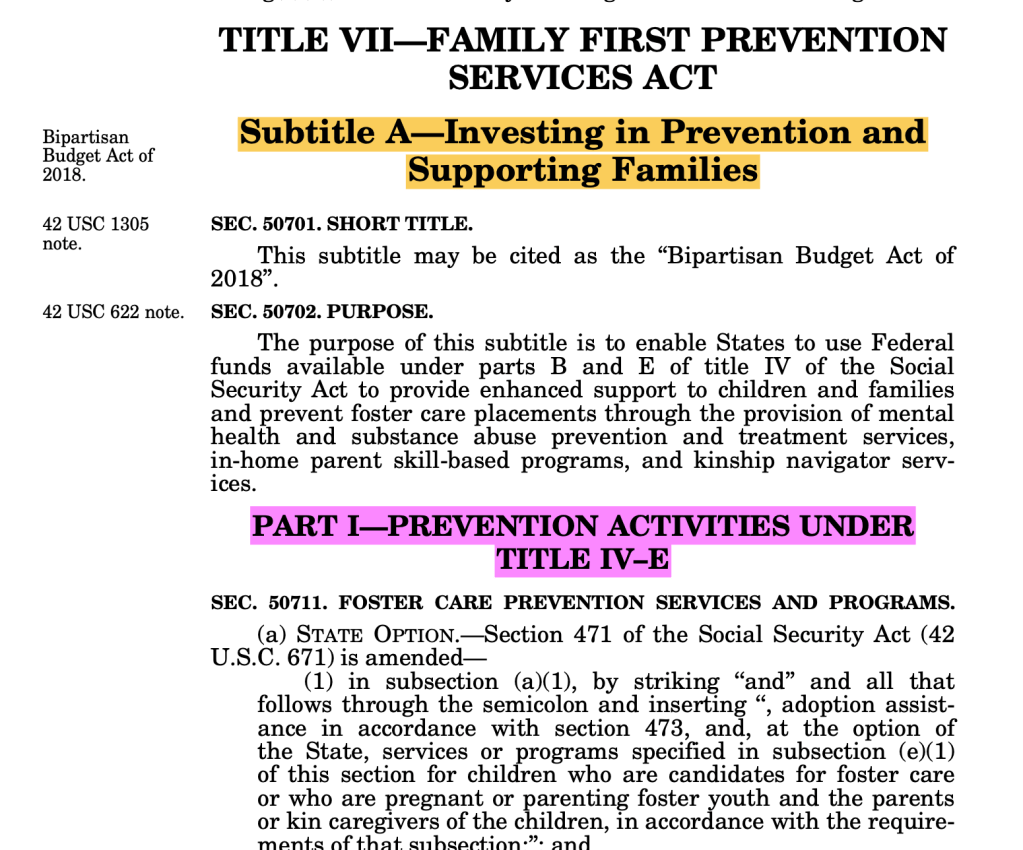
Home visiting programs also became a popular intervention in child welfare with the growing emphasis on keeping children with their families. This began in 1994 with the Title IV-E waivers and continued with the Family First Prevention Services Act (FFPSA), signed by President Trump in 2018. FFPSA allowed states to use Title IV-E funds, formerly reserved for foster care and subsidized adoptions, to support children and families and prevent foster care placements through in-home parent skill-based programs, as well as mental health, drug treatment and kinship navigator services. Programs had to be approved by the new Title IV-E Prevention Services Clearinghouse as โ€œevidence-basedโ€ before they could be included in a state’s Family First Prevention Services Plan. According to a research brief from Chapin-Hall at the University of Chicago, at least one home visiting model was included in the Family First Prevention Plans in 28 states as of April 2023. Most commonly included were Parents as Teachers (28) and Healthy Families America (23), with Nurse Family Partnership in third place with 15 programs, and SafeCare in fourth with seven programs.

Home visiting also became popular in growing efforts by child welfare agencies to invest in preventing child abuse and neglect before it occurs, or at least before a family comes to the attention of child protective services. A small source of federal funds, the Community Based Child Abuse Prevention Program (CBCAP), was established by Congress in 1996 to fund such prevention programs and is commonly used to fund home visiting as well.

The bipartisan enthusiasm for home visiting has been unwavering. Created under Obama, MIECHV has been supported by every succeeding administration. Total federal funding on this program is slated to increase from $500 million in 2023 to $800 million in 2027.Earlier this year, the Senate even passed (unanimously) a bipartisan resolution designating April 21 through April 25, 2025 as National Home Visiting Week. Even the Trump Administration has heartily endorsed the home visiting. Yet, the much-vaunted evidence for the value of home visiting really consists of a series of modest impacts affecting different outcomes, often based on less reliable indicators like self-reports, and dwarfed by a sea of findings of no effect. Even the one program (Nurse-Family Partnerhip), that had the most promising early resultsm has no stood up to recent replications–though additional trials with the population that seems to benefit most may be warranted.

Home visiting program evaluations

There have been multiple studies of home visiting programs, including both randomized controlled trials (RCT’s) and comparison group studies, and together these studies have generated hundreds of papers. Therefore, Child Welfare Monitor (CWM) drew from a summary of research on Nurse-Family Partnership from the Arnold Ventures Social Programs that Work website; the evidence assembled on the website of the Title IV-E Prevention Services Clearinghouse for Healthy Families America, Parents as Teachers, and SafeCare; and the Home Visiting Evidence of Effectiveness (HomVEE) Review conducted by the Administration on Children and Families of HHS for Early Head Start Home-Based Option. CWM consulted the original studies as needed, focusing on RCTs because randomization is the best way to rule out selection bias as the explanation for any differences between the intervention group and the control group. Otherwise, one cannot know whether the group that participated in the program differed in significant but unmeasured ways from the members of the comparison group. Appendix I includes more details about the program evaluations. Appendix II focuses on the challenges in measuring child abuse and neglect and what the research suggests.

Nurse-Family Partnership

Nurse -Family Partnership (NFP) connects first-time mothers and their babies with a specially trained nurse, who works with the mother and child from early in the pregnancy through the child’s second birthday. It differs from other models in using registered nurses to deliver the visits, making it more expensive and dependent on a scarcer group of providers. Nurse Family Partnership (NFP) has been the subject of RCTs in Elmira, NY (launched in 1988); Memphis, TN (launched in 1990), Denver, CO (1994) and in a larger statewide trial in South Carolina that started in 2016. It has also been tried internationally in British Columbia, the Netherlands, the United Kingdom and Germany; though the differences between populations and systems make these results less applicable to the United States, they can be seen as suggestive. The participants in the demonstrations were all first-time mothers but other criteria for inclusion varied by study. Among the effects that were replicated in two or more of the studies identified by the Arnold Venturesโ€™ Social Programs That Work website were reductions in medical treatment for injuries and accidents in Elmira and Memphis), reductions in subsequent births to mothers in their late teens and early twenties (in Elmira, Denver, and Memphis), and an improvement in cognitive or academic outcomes for the children of mothers with lower psychological resources, like intelligence, mental health, and self-confidence (in Memphis and Denver). There were few significant impacts on children’s emotional and behavioral outcomes and mothers’ life trajectories in terms of employment, income and crime, and those impacts were not repeated in more than one study.

A recent scaled-up NFP replication in South Carolina was disappointing, producing no significant positive effects on any of the three primary outcomes studied: the rate of adverse birth outcomes, mothersโ€™ rate of subsequent births within 21 months, and child health, measured as “a composite of mortality or health care utilization associated with major injury or concern for abuse or neglect.” Nor did the researchers find any significant improvements for a prespecified subsample of “socially vulnerable families” that were similar to the families for which earlier studies found positive impacts. There were also no significant findings for the secondary outcomes, which related to healthcare utilization. These results were sobering, and the researchers suggest that the rapid scaling up of the program and the broader population served may have contributed to the weaker results. David Olds, the founder of NFP, suggests1 that the program’s effectiveness was affected by the relative inexperience of the nurses (due to the rapid implementation), the use of impersonal recruitment methods (unlike Elmira and Memphis, where nurses personally recruited mothers in clinic waiting rooms), and the relatively more advantaged clientele. The program included any pregnant woman who qualified for Medicaid in South Carolina, which funded 46 percent of births in that state in 2023 and includes women up to 200 percent of the poverty level. So it was a less disadvantaged group than was included in the other US demonstrations, and earlier studies suggested that the more disadvantaged benefited more from this program.2 Thus, further study of NFP with a highly disadvantaged population should be considered.

Healthy Families America (HFA)

Healthy Families America, an initiative of the national organization, Prevent Child Abuse America, is a flexible program that allows local communities to choose their eligibility criteria, parenting materials, and staff. Services last for a minimum of three years and up to five years. Based on three RCTs of Healthy Families America, the Title IV-E Prevention Services Clearinghouse counted 18 favorable “contrasts” (their term for comparisons between the intervention and control groups) compared to four unfavorable contrasts and 211 contrasts displaying no effect. Among the 18 favorable contrasts, 11 were on self-reports of maltreatment or child behavioral and emotional functioning. Of the other impacts, all were from only one RCT. Many outcome categories showed no favorable impacts. These included child safety measured by administrative reports; child safety based on injuries, Emergency Room use or hospitalizations; child permanency based on out-of-home placements; child social functioning; child physical development and health; parent/caregiver substance abuse; and economic and housing stability. One of the four RCTs (Healthy Families Oregon) showed no positive impacts at all.

Parents as Teachers

Parents as Teachers is delivered by “parent educators” who work with families from pregnancy through kindergarten. The Clearinghouse identified one American RCT of this program, one RCT from Switzerland, and one matched comparison group study. The one US RCT, which evaluated two separate demonstrations in California, found that PAT had “little effect on parenting knowledge, attitudes or behaviors as measured in these demonstrations. Nor were significant effects noted on child health or health care.” The demonstration did find small positive effects (a two-month gain at the age of three) on “self-help development” in one of the two sites but no significant effects on cognitive development at either site. In the Swiss study, the clearinghouse found one significant effect on one of two measures of the child’s expressive language.

SafeCare

SafeCare is a brief home visiting model that is delivered in 18 one-hour sessions. SafeCare is designed for parents and caregivers of children birth through five who are either at-risk for or have a history of child neglect and/or physical abuse. It was included in the Title IV-E Prevention Plans of seven states in April 2023. The contrasts reported by the Clearinghouse include only one favorable effect–on foster care placement–based on a matched comparison group study and not an RCT and one unfavorable effect (on child welfare reports), along with 19 findings of no effect.

Early Head Start-Home-Based Option

Early Head Start Home-Based Option provides weekly visits to pregnant women, infants, and toddlers until the child is three years old. The goal is to promote school readiness of young children by enhancing their cognitive, social and emotional development. The federal reviewers of Early Head Start’s Home-Based Option used nine publications based on a large federal RCT of the program at 17 sites as well as the early results of the federal study of MCHIEV programs, which is described below. There were no favorable findings on maternal or child health; child maltreatment; or delinquency, family violence and crime. There were a few favorable impacts on child development and school readiness; positive parenting practices; and family economic self-sufficiency scattered among multiple findings of no effect. These effects were not consistent across age groups or outcomes where one would expect some alignment (like reading to children vs. reading at bedtime). These impacts appeared to be small, although the lack of standardized effect sizes complicates interpretation. In the final report on Early Head Start, the authors stated that at “the end of the program, when children were three, impacts were modest in size and Early Head Start children continued to perform below national norms on cognitive and language assessments.” By the time the children reached fifth grade, all but one favorable impact earlier reported was gone.

The MIHOPE Study

The legislation establishing the Maternal, Infant and Early Childhood Home Visiting Program (MIECHV) required an evaluation of the program in its early years. The study, named the Mother and Infant Home Visiting Program Evaluation (MIHOPE), included 88 local programs in 12 states and was carried out by an evaluation nonprofit called MDRC. All of the programs were based on one of the four models most commonly chosen by states in their initial MIECHV plans–Early Head Start Home-based Option, Healthy Families America, Nurse-Family Partnership, and Parents as Teachers. A total of 4,229 families enrolled in the demonstrations between 2012 and 2015. Strangely, even though the sample sizes were large enough to estimate the effects of each program model, the researchers opted to report findings for all four models taken as a whole, a decision that has been criticized by experts and funders because of the significant programmatic differences between the models. Early findings released in 2019 from when the children were 15 months old were disappointing. There was little difference between the experimental and control groups. About a third of the 63 outcomes measured were statistically significant and though most comparisons did favor the home-visited groups, the effect sizes were extremely small–too small to be of any practical significance. The authors reported that for most outcomes the effects were slightly smaller than the average effects found in past studies of the models (which were already modest).

On September 11, 2025, the Administration on Children and Families released the long-term results of the MIECHV program evaluation conductd five to seven years after enrollment, when children were in kindergarten or first grade. Summing up their findings in a press release, ACF asserted that “MIECHV-funded home visiting significantly improved maternal and family wellbeing for participants five-to-seven years after enrolling in services…MIHOPE found statistically significant and positive effects of home visiting” for the five categories of maternal and family well-being outcomes. For the three categories of child outcomes, the researchers found “some evidence of positive effects,” but only one was statistically significant and positive.

Unfortunately, the researchers did not distinguish between a statistically significant effect and an effect which is large enough to be meaningful. A more sober analysis by the Coalition for Evidence-Based Policy shows that home visiting produced “negligible outcomes” for each of the eight expected impacts. The review points out that the average effect size across the six statistically significant or near-significant categories of effects was 0.03 – the equivalent of moving the average child or mother from the 50th to the 51st percentile. The study did not report model-specific effect sizes, but the reviewers noted that they are likely to be small or modest given that few reached statistical significance. It is also worth mentioning that many of the outcomes came from maternal answers to a caregiver survey, introducing the possibility of bias..

It is also concerning that the evaluation team at MDRC used a different analysis plan to assess impacts for the kindergarten study than it did for the earlier results. The new analysis plan was dated January, 2025 (but not released until May 2025). The new methodology combined all the 66 outcomes studied into eight new “research questions” some of the outcomes were included under more than one research question. The researchers chose to focus not on the significance of each individual impact, as was done in the earlier report. Instead, they decided to use a method called “omnibus testing” to compute an overall significance level for each research question.3 By choosing this method, they were able to find significant results (at the 0.10 level) for five of the eight research questions, where looking at each outcome would have shown only eight significant outcomes out of 86, or less than 10 percent of the outcomes. Since the new analysis plan was dated January 2025, it seems likely that it was developed after an analysis of the data (which was collected in 2021 and 2022) under the old plan yielded unsatisfactory results.4 The Imprint has published a more detailed critique of the MIHOPE study by Sarah Font and Emily Putnam-Hornstein called The Odd Bipartisan Effort to Oversell the Evidence for Home Visiting.

Why have home visiting programs been so unsuccessful at changing outcomes for most children and families?

As Deanna Gomby stated back in 1990, “home visiting programs have struggled to engage and retain families.” Research has documented low levels of enrollment and engagement of families at risk of maltreatment in voluntary services in general and home visiting in particular. According to the MIHOPE implementation report, 17 percent of the home visiting group never even received one visit, as compared to 12 to 22 percent in previous studies. All the models expected families to participate at least until the child’s second birthday, with services available for two or three years longer in three of the programs. Yet, only 46 percent of families were still participating in home visits 12 months after their first visit, consistent with previous research. On average, families who received at least one home visit went on to participate for an average of eight months. While participating, families received fewer visits than expected by the models in which they were enrolled. In the first 12 months, less than 60 percent of families received at least half of the visits prescribed by their model, a result consistent with prior research. Part of the problem might be that many people who need the kind of help that home visiting is designed to provide do not want to let a stranger into their home to scrutinize their parenting and family functioning. Child Welfare Monitor has heard in the District of Columbia and elsewhere that there is an oversupply of home visiting slots, with too few people wanting to participate.

Misleading Congress, the Media and the Public

Ever since the initial excitement about home visiting, there have been high hopes for this service delivery method and unwillingness among policymakers on both sides of the aisle to discard their hopes. At the same time, the federal government along with many advocacy groups, has endorsed a vision of “evidence-based practices” that asks only for a minimal number of statistically significant impacts, with no concern about the size of the impacts or the nature of the evidence–whether it is self-reported, self-contradictory, or unsupported by more than one study. As a result, studies that show only a few modest impacts that may be statistically significant but not meaningful in size or corroborated by other studies can be cited as evidence of program success.

Unfortunately, program evaluations are technical enough that readers who are not schooled in the intricacies of research methods are often forced to rely on the researchers’ interpretation of their findings. The usually well-informed Congressional Research Service has stated that “A large body of research suggests that some home visiting models or services can benefit children and their parents.” Less surprisingly, the press is easily misled. Due to lack of time or expertise in the intricacies of social science research, reporters often simply report what is in the press release announcing new research results. For example, the Imprint, a widely circulated outlet for child welfare content, repeated in its podcast the government’s misleading proclamation about good news from the MIHOPE study.

—–

No matter how painful the process, legislators, agency officials and advocates should remove their blinders about home visiting. It is time to phase out the MIECHV program. State and local governments should begin scaling down their home visiting programs and funneling the money to other uses that are currently underfunded. In this time of budget scarcity, it is time to stop throwing good money after bad. We need new ideas and meaningful evaluations that can bring about the implementation of programs that actually work. If money is being wasted on home visiting services that are not making a difference, or not even being used, surely there are better uses of these scarce funds.

Appendix I

In the absence of time to review the hundreds of publications on the Nurse Family Partnership Program, I used the excellent evidence summary on the Arnold Ventures Social Programs that Work website. For the studies of HFA, Parents as Teachers, and SafeCare, I relied mostly on the compilation of study results provided by the Title IV-E Prevention Services Clearinghouse. For Early Head Start, which was not included in the Clearinghouse, I used the Home Visiting Evidence of Effectiveness review conducted by the Office of Policy Research and Evaluation (OPRE) of the US Department of Health and Human Services.

Nurse Family Partnership

Each of the four U.S. RCT’s of NFP had a different population and eligibility criteria for participants. Elmira is in a small, semirural county in New York State which had the highest rate of child abuse and neglect in the state at the time of the study. In 1980, the community was rated the lowest Standard Metropolitan Statistical Area in the United States for economic conditions. Program participants In Elmira were either teens, unmarried, or low-income, and all were White. They were actively recruited by nurses at the prenatal clinic, private obstetricians’ offices, Planned Parenthood, schools, and other health and human services agencies. In Memphis, the program admitted pregnant women with no previous live births who did not have a chronic illness that might affect the fetus and who had at least two of the following risk factors: being unmarried, having less than 12 years of education, and being unemployed. Ninety-two percent of the women enrolled were Black, 98 percent were unmarried, 64 percent were eighteen years old or younger and 85 percent came from households with incomes at or above the poverty level. In Denver, women were recruited at any point in their pregnancy if they had no previous live births and either qualified for Medicaid or had no health insurance. Almost half of the two groups were Hispanic, another 35 percent were Caucasian, and 16-17 percent were Black. The South Carolina demonstration recruited pregnant women who were 15 years or older and eligible for Medicaid, which meant their incomes were less than two percent of the poverty level. The participants were mainly non-Hispanic Black (54.9 percent) and non-Hispanic White (35.0). In addition to enrolling a different population, each study looked at a different set of outcomes, and sometimes at different times as well, making it hard to compare the results. The findings of the demonstrations are summarized below.

  • Child safety based on child welfare administrative reports: There was no statistically significant difference among confirmed child maltreatment reports between the experimental and control groups in Elmira. But there is some evidence that the Elmira program reduced child maltreatment among the participants who were most at risk, those who were teenagers, poor and unmarried. Among this group, 19 percent (or a total of eight) of the poor, unmarried teens had a verified maltreatment report compared to only one of their nurse-visited counterparts. But this effect was statistically significant at the p-0.7 level, not the standard level of 0.05. And there were no treatment-control differences in verified maltreatment reports during the two years after the program ended. However, the Elmira study did find a large impact on verified CPS reports when the children were 15; nurse-visited children had received on average of 0.29 verified CPS reports compared to 0.54 in the comparison group. This result is difficult to explain and one wonders if it was due to chance.This outcome was not examined in Memphis or Denver. The Netherlands study also found a large, statistically significant impact on child welfare administrative reports, where the researchers found that 11 percent of the visited children had a CPS report compared to 19 percent of the control group children during the first three years of their lives.
  • Child safety based on health care for injuries and ingestions: Nurse visited children in Elmira had fewer emergency room visits for injuries and ingestions in their second year of life than the control group. (This was not measured during the first year, when they were less mobile and able to get into trouble. No effect size was provided). When they were between 25 and 50 months old, they had 40 percent fewer mentions for injuries and ingestions in their medical records and 45 percent fewer mentions of child behavioral or parental coping problems. In Memphis the researchers found that in the first two years of life, nurse-visited children had an average of 0.43 health encounters for injuries or ingestions compared to 0.56 for the control group, or 23 percent fewer encounters. They also spent an average of 0.04 days hospitalized for injuries and ingestions, compared to 0.18 days for the control groupโ€“ a 78% decrease. A more recent evaluation of a large scale implementation of NFP in South Carolina found no difference between the experimental and control groups on child health, measured as “a composite of mortality or health care utilization associated with major injury or concern for abuse or neglect.” In the UK Study, there were no differences in the rates of emergency hospital visits for the experimental and control groups.
  • Child wellbeing based on behavioral and emotional functioning: This outcome was not included in Elmira at two and four years. But there were large favorable effects on self-reported arrests and convictions for the Elmira children at age 15-19–a finding that was not reported anywhere else and was not matched by effects on other outcomes like high school graduation, teen pregnancy, engagement in work or school at 19, or self-reported substance use or welfare receipt, all of which could have been expected to covary with the arrests and convictions. So it is not clear whether these results occurred by chance. In Memphis there were no effects found on children’s reported behavioral problems at two years, nor were there any results on youth behavioral functioning when they got older. There were significant favorable effects on child emotional functioning in Denver at two years and four years. By ages six to nine in Denver, behavioral and emotional effects were consistently favorable but did not reach statistical significance at standard levels, perhaps because the sample size was not large enough.
  • Child wellbeing based on cognitive functions and abilities: In Elmira there were no statistically significant cognitive effects on children in the first two years, although the researchers observed “improved intellectual functioning of nine to 11 points on the developmental tests for children from the highest risk families. Although only marginally significant statistically, the researchers observed that it is of clinical importance. Treatment effects in this range are consistent with those obtained for children of this age enrolled in intensive early childhood intervention programs aimed specifically at enhancing cognitive development.” In Memphis, there were no effects at two years on children’s mental development but there were substantial statistically significant effects on academic performance at age 12 for the children whose mothers were in the lower half of the sample on intelligence, mental health and self-confidence. In Denver, there were favorable effects on the cognitive development of children born to mothers with low psychological resources in the two-year follow-up. This group also did better cognitively at ages six to nine but the findings only occasionally reached statistical significance and may be due to attrition differences between the intervention and control groups. But at age 18 there were “sizable, significant” effects on two of three cognitive outcomes for this subgroup in Memphis. Cognitive effects were not studied for Elmira or Denver 18-year-olds.
  • Maternal life course: When the children were aged 15, the Elmira study found that nurse-visited mothers had 19 percent fewer births than control mothers, an average of 1.3 births compared to 1.6. In Memphis, the mothers had 16 percent fewer births in the first six years of the program. They had caught up by the time the children were 12, but the increase in birth spacing is still a significant favorable outcome. In Denver, home-visited women had fewer subsequent pregnancies (29 percent vs. 41 percent) and births (12 percent vs. 19 percent) by their children’s second birthdays. There was no impact on the rate of second pregnancies after two years in the South Carolina, British Columbia, and UK studies. Where reported, there were no effects on adverse birth outcomes, maternal employment, likelihood of partnership or marriage with the child’s father, substance abuse, psychological distress or foster care placements (mentioned only in Memphis).

Healthy Families America

The contrasts presented by the Title IV-E. Clearinghouse were based on four RCT’s that were rated highly for design and execution by clearinghouse staff. The results of each RCT are based on multiple research papers published for each major study. Reviewing the Clearinghouse’s tabulation of the data, and sometimes comparing it to the actual publications to which it referred, raised several questions about the overall effectiveness of the program:

  • Child safety measured by child welfare administrative reports: There were no favorable or unfavorable outcomes, as compared with 43 contrasts showing no statistically significant effect.
  • Child safety, based on maternal self-reports about whether they maltreated their children: There were five favorable contrasts, 38 contrasts with no effect, and one unfavorable contrast. It is hard to be confident about the validity of self-reports of maltreatment, as one could easily imagine the program participants having learned more about what to report, and under-reporting behaviors (such as spanking) that they had been taught were undesirable. The large number of contrasts with no effect is worth noting.
  • Child safety based on injuries needing medical care, hospitalizations, and emergency use: There were no favorable or unfavorable impacts and 11 contrasts showing no effect.
  • Child permanency based on out-of-home placements: There were six contrasts showing no effect, and none showing a positive or negative effect.
  • Child well-being: Behavioral and Emotional Functioning: Five contrasts showed a positive effect, two with no effect, and none with a negative effect. All of the five positive effects were reported by Healthy Families Alaska and were fairly large. But all of these were based on the caregiver’s report of the child’s behavior, and self-reports are not sufficient on their own for making conclusions about impact. Moreover, these outcomes and measures were not replicated in any other study.
  • Child well-being: social functioning: The Clearinghouse reports no favorable or unfavorable effects and and two contrasts showing no effect.
  • Child well-being: cognitive functions and abilities: There were two favorable impacts, one unfavorable impact, and 6 contrasts showing no effect. The two favorable impacts came from Alaska and were not found in any other evaluations.
  • Child well-being: physical development and health: The Clearinghouse reported no favorable or unfavorable impacts and six contrasts with no impact.
  • Child well-being: delinquent behavior. There was one favorable effect in the one contrast available, which was “child skips school often.” A look at the publication containing this result, which was a report on the RCT of Healthy Families New York (HFNY) seven years after random assignment, showed that fewer children self-reported skipping school, but this result was not supported by reports from their mothers.
  • Child well-being: educational attainment: The Clearinghouse reported one favorable impact and two findings of no impact. All three findings came from one publication from the HFNY RCT. The researchers found that children in the HFNY group were about half as likely to be retained in first grade (3.54 percent) than children in the control group (7.10 percent), based on official school data. However, there were no impacts found for the other two educational attainment outcomes used by the Clearinghouse–performing above or below grade level in reading or math. Moreover, this contrast was not available from any other study.
  • Adult well-being: positive parenting practices: There were three favorable impacts and 24 findings of no impact. All of the favorable impacts were from another report on HFNY that was based on observations of how the mothers interacted with their children as they completed three tasks–a puzzle solving task, a delay of gratification task, and a cleanup task. I was not able to judge the size of the effects; all were statistically significant at the 0.05 level. However, there were no significant effects on observed presence of harsh parenting during the same tasks. Moreover, this outcome was not included in the evaluation of any other program.
  • Adult well-being: parent/caregiver mental/emotional health. The Clearinghouse found three favorable impacts and 16 contrasts showing no impacts from a total of three RCT’s.
  • Adult well-being: Parent/Caregiver Substance abuse: There were no favorable or unfavorable effects, and 15 instances where no statistically significant effect was found.
  • Adult well-being: family functioning: There were three favorable impacts, one unfavorable impact, and 28 instances of no impact. The three favorable impacts stemmed from three different contrasts related to Intimate Partner Violence (IPV)–overall maternal IPV victimization rate (child age 1-3), maternal IPV victimization rate: physical assault (child aged 1 to 3), and maternal IPV perpetration rate: physical assault (child age 1 to 3). The size of the effect was not provided and there were nine other maternal IPV contrasts when the child was aged 1 to 3 that showed no effect. There were were no impacts on IPV when the child was older.
  • Adult well-being: economic and housing stability. There were no favorable impacts, five contrasts showing no impact, and one showing an unfavorable impact.

Parents as Teachers

The results presented by the Title IV-E Clearinghouse are based on two RCT’s and one study based on a matched comparison group. Even when counting all these programs, the results are not impressive.

  • For child safety based on administrative reports, the Clearinghouse noted two contrasts with a favorable effect and two with no effect. The effect size and implied percentile effect calculated by the Clearinghouse were very small. Moreover, these results were based on a matched comparison group rather than an RCT, casting doubt on the validity of the results.
  • Child permanency (out-of-home placement): The clearinghouse cited no favorable or unfavorable findings and one finding of no effect.
  • Child well-being: social functioning. The original article cited by the Clearinghouse, based on an RCT in two California sites, reported that PAT children in one of the sites benefited significantly, advancing by about two months of the control group in self-help development but did not report significant results for the other site or for social development at either site.
  • Child well-being: cognitive functions and abilities: Based on the American and Swiss RCT’s, The Clearinghouse reported two favorable findings and 10 findings of no effect. But one of the findings was actually of no effect for the PAT-only group; it was the โ€œPAT plus case management groupโ€ that experienced an impact.
  • Child well-being: Physical development and health: The clearinghouse reported no favorable or unfavorable effects and three findings of no effect from one RCT.
  • Adult well-being: positive parenting practices: The Clearinghouse reported no favorable or unfavorable effects and one finding of no effect from an RCT.
  • Adult well-being: family functioning: The Clearinghouse reported no favorable effects, 8 findings of no effect, and one unfavorable effect, all from one RCT.
  • Adult well-being: economic and housing stability. The Clearinghouse reported no favorable effects, one unfavorable effect, and nine findings of no effect, all from one RCT.

SafeCare

SafeCare is a brief home visiting model that is delivered in 18 one-hour sessions. SafeCare is designed for parents and caregivers of children birth through five who are either at-risk for or have a history of child neglect and/or physical abuse.It was included in the Title IV-E Prevention Plans of seven states in April 2023. The contrasts reported by the Clearinghouse include only one favorable effect–on foster care placement–based on a matched comparison group study and not an RCT and one unfavorable effect (on child welfare reports), along with 19 findings of no effect.

Early Head Start Home-based Option

The Early Head Start Home-based option serves low-income women and families with children under three years old. They receive a minimum of weekly 90-minute home visits and two group socialization activities per month. The findings discussed here are based on the HHS Office of Policy Research and Evaluation (OPRE) review of the research on home visiting. OPRE reports that it reviewed 23 “manuscripts” and identified nine of those manuscripts that were based on “impact studies rated high or moderate quality.” By focusing on “manuscripts” instead of studies, OPRE obscured the fact that seven of these manuscripts were actually based on the same study–a large federal demonstration of EHS programs in 17 sites conducted between 1996 and 2002. Of the nine manuscripts, five were based on the full study and two were based on results from one Utah site only. The other two studies reviewed were based on results of the MIHOPE study of four home-visiting models when the children were 15 months old. All but two of the manuscripts were rated high by the OPRE staff in quality for methodology. The manuscripts based on the Utah study and the grade five follow-up for the national study were rated “moderate” in quality because of high attrition. In the nine publications reviewed, there were no favorable findings on maternal or child health; child maltreatment; or delinquency, family violence and crime. There were a few favorable impacts on child development and school readiness; positive parenting practices; and family economic self-sufficiency. These effects were not consistent across age groups or similar outcomes (like reading to children vs. reading at bedtime.) These impacts appeared to be small, although the lack of standardized effect sizes makes the importance of the effects hard to estimate.

  • For child development and school readiness, the reviewers reported five favorable findings from the 17-site study and the Utah study. All the other 66 contrasts related to child development and school readiness in the two studies showed no effect. By the time the children in the main study reached fifth grade, no effects remained.
  • For positive parenting practices, the reviewers reported 10 favorable findings from the 17-site study and the Utah study. In total, there were 64 findings of no effect in this area. By the time children reached fifth grade, one favorable impact (which was not noted for the three or five year-olds) was observed.
  • For family economic self-sufficiency, the reviewers reported 16 favorable findings, one unfavorable finding and 88 findings of no effect from 3 publications in a total of two studies. No economic effects remained by the time the children were in fifth grade.

Appendix II: Home visiting and child maltreatment

Analyzing the effect of any program on child maltreatment poses unique difficulties because it is such a difficult outcome to measure. Obviously, the evaluators cannot see what goes on in a household after the visitor has gone home. Evaluators have used three types of measures to estimate the effects of home visiting programs on child maltreatment–verified child protective services (CPS) reports, health care encounters for injuries or ingestions (or simply emergency room visits), and self-reports of abusive or neglectful behaviors through surveys like the Conflict Tactics Scale.

The most obvious measure of abuse and neglect is official Child Protective Services (CPS) data, but there are several problems with CPS data as a measure of maltreatment. The number of maltreatment reports that are confirmed (substantiated) by CPS is most frequently used, but it is known to be an understatement. Many cases go unreported, and reported cases are often not substantiated. Another problem is that verified abuse is a relatively rare event in a population and a study may not have enough participants to detect it. Finally, h visitors are mandatory reporters and their presence in the home introduces surveillance bias; these families are under more surveillance than families in the control group and may receive more reports for that reason.

Olds and his colleagues did not find statistically significant differences in substantiated CPS reports for the whole program group during the two year period that families participated in the Elmira demonstration or in the subsequent two years. But they found some evidence that the Elmira program did reduce child maltreatment among the participants who were most at risk–those who were teenagers, poor and unmarried. About 19 percent (or a total of eight) of the the poor, unmarried teens had a verified maltreatment report compared to four percent (or one) of their nurse-visited counterparts. But this effect was statistically significant at the p-0.07 level, not the standard level of 0.05. And there were no treatment-control differences in verified maltreatment reports for this subgroup or the whole treatment group during the two years after the program ended. The researchers speculated that this may be due to increased surveillance on the nurse-visited group, because the nurses connected them to other providers before the programs ended.

However, a surprising finding emerged when the children were 15 years old. By that age, nurse-visited children had received on average of 0.29 verified CPS reports compared to 0.54 in the comparison group–a large and highly statistically significant difference. The investigators hypothesized that as young first-time parents mature and develop, small positive changes that [occur while they are in the program] can build and multiply over time, yielding larger effects in later years.” The mechanism by which the Elmira program had such delayed effects is hard to understand. Perhaps it occurred by chance. But in any case, a replication would be necessary to give it credence, and this outcome was not measured in Memphis or Denver.

As an alternative to CPS data, some researchers have used data on health care encounters for children’s injuries or ingestions. Many of these encounters may reflect abuse or neglect but they also would include cases that are not due to either abuse or neglect and would leave out many instances of maltreatment as well. But it is certainly a good indicator of safe parenting. In the four-year followup of the NFP Elmira group, when the children were 25 to 50 months old, the researchers found that nurse-visited children had 40 percent fewer injuries and ingestions (according to notations in their medical records) and and 45 percent fewer notations of or child behavioral or parental coping problems. Nurse-visited children also made 35 percent fewer visits to the emergency room. In the NFP Memphis trial, the evaluators found that nurse-visited children had an average of 0.43 health encounters for injuries or ingestions compared to 0.56 for the control group, or 23 percent fewer encounters in the first two years of their lives. They also spent an average of 0.04 days hospitalized for injuries and ingestions, compared to 0.18 days for the control group. But a more recent evaluation of a large scale implementation of NFP in South Carolina, described above, found no difference found between the experimental and control groups in its composite measure of child mortality and major injury related to abuse or neglect.

Other studies have used parent self-report measures such as the Conflict Tactics Scale. This measure is less valid than the other two because many parents are reluctant to report abusing or neglecting their children. A few studies found positive effects on such measures but without any corroboration from more objective measures.


Notes

  1. Conversation between Marie Cohen and David Olds, October 22, 2025
    โ†ฉ๏ธŽ
  2. Similar disappointing results from a study in the United Kingdom may have been influenced by a control group that received an average of 16 home visits from a public health nurse and 11 visits from a midwife through the child’s second birthday, as well as targeting a lower-risk population than most of the other studies. A study in British Columbia found no reductions in its primary outcome – child injuries by age two years – or in subsequent maternal pregnancies by the child’s second birthday. The authors speculate that British Columbia’s more comprehensive health and social services may explain the lack of effects. โ†ฉ๏ธŽ
  3. The authors organized the outcomes into five “research questions” focusing on maternal outcomes and three research questions focusing on “child outcomes.” The “maternal outcomes” included “outcomes that could be improved through direct interaction between parents and home visitors;” maternal mental and behavioral health; parent-child interactions; conflict, violence, aggression and maltreatment;” and families’ economic circumstances. The child outcomes included “children’s social-emotional functioning in the home context; children’s social-emotional functioning at school; and children’s cognitive, language and early math skills. โ†ฉ๏ธŽ
  4. Conversation with Emily Putnam-Hornstein, who made me aware of the revised 2025 research plan. โ†ฉ๏ธŽ

This post was edited on November 10, 2025 to add a sentence and links about enrollment and engagement in home visiting and a link to an article about the MIHOPE report.
The power of wishful thinking: The continued promotion of Healthy Families America as a child abuse prevention program

by Marie Cohen

The original version of this post was published on April 4, 2022. I decided to update and re-publish it after reading a press release from Prevent Child Abuse America stating that “PCAAโ€™s signature home visiting program, Healthy Families America, has been proven to reduce child abuse and intimate partner violence while improving long-term health and educational outcomes.” While I cannot evaluate the claim about domestic violence, the post below show that Healthy Families America has not been “proven” to reduce child abuse.

I have written before about the power of wishful thinking and how it causes people to disregard research and real-life results. A program called Healthy Families America (HFA) offers a good example of the power of wishful thinking. The nation’s oldest and largest charity (now called Prevent Child Abuse America or PCAA) dedicated to the prevention of child abuse launched HFA based on weak evidence that a program in Hawaii could prevent child maltreatment. The first experimental study of the Hawaii program found no impact on child maltreatment but did nothing to derail the launch of HFA, which grew into the centerpiece of PCAA. Studies of HFA programs around the country have found little evidence of reductions in child maltreatment, but the program has continued to grow. The story of HFA is a lesson in the power of wishful thinking and the failure of evidence (or lack thereof) to counteract it.

As told in a helpful history of home visiting, all modern programs can trace their origins to Henry Kempe, whose book, The Battered Child, brought about the recognition of child maltreatment as a national problem. To address child abuse, Kempe called for universal prevention through a network of home health visitors. Inspired by Kempe, modern home visiting began with Hawaii’s implementation of the Healthy Start Project (HSP) in 1975. HSP was developed on the island of Oahu. It had two components: early identification (at the birthing hospital) of families with newborns at risk of child abuse and neglect and home visiting by trained paraprofessionals for those families classified as at-risk who agreed to participate. This initial program was never evaluated, but anecdotal information suggested it was successful in promoting effective parenting, and six similar programs were established on neighboring islands.

The Hawaii Legislature authorized a three-year pilot program focusing on one neighborhood in Oahu, which began in 1985. There was no control group in the pilot study, and the researchers used CPS reports and changes in family stress in participating families to measure program effectiveness. During the three-year pilot, there were few reports of physical abuse, neglect or imminent harm for program participants. Because evaluations of other home visiting programs had found much higher rates of reported maltreatment in comparison group families, these results were viewed as evidence that the program had a positive impact. According to the authors of the first rigorous evaluation of HSP, “The pilot study results might have been given too much weight, given the lack of a control group and the short period of follow-up for most families.” Nevertheless, the results of this unpublished study were enough evidence for the Legislature to expand HSP throughout Hawaii starting in 1989.

Home visiting in general was gathering steam in the 1980s and early 1990’s. In 1990, the U.S. General Accounting Office (GAO) issued a report promoting home visitation as a “promising early intervention strategy for at-risk families.” In its summary of research evidence, GAO focused mostly on health and developmental benefits for children, rather than maltreatment prevention. In 1991, the U.S. Advisory Board on Child Abuse and Neglect issued a report recommending a pilot of universal voluntary neonatal home visitation, stating that the efficacy of home visiting as a preventive measure was “already well-established.” The Board cited the results of a federally-funded demonstration begun 17 years earlier as well as the the nurse home visitation program started by David Olds in 1977. But HSP was not mentioned.

Despite the lack of a rigorous evaluation, the National Committee to Prevent Child Abuse (NCPCA, now called Prevent Child Abuse America), which bills itself as the nation’s “oldest and largest organization committed to preventing child abuse and neglect before it happens,” had become interested in using HSP as the nucleus of a national home visiting program. But first, NCPCA conducted a one-year randomized trial of HSP. The trial suffered from severe methodological limitations, including “less than ideal followup,” differential dropout rates in the program and control groups, the failure to blind interviewers to experimental or control status, and reliance on program staff rather than researchers to measure some outcomes. Nevertheless, the trial concluded that HSP reduced child maltreatment, and this apparently gave NCPCA the assurance it needed to invest in the model.

NCPCA launched Healthy Families America in 1992, with financial support from Ronald MacDonald House Charities. Rather than impose a single service model, HFA was based on a set of principles or critical elements, which included initiation of services prenatally or at birth, assessment of the needs of all new parents in the target area, voluntary nature of services, at least weekly services for families with the highest needs, availability of services for three to five years, comprehensive nature of services, and cultural competence, among others. The typical HFA program included an assessment of all new or first-time parents in a given community at the time their babies are born or prenatally.”

In the meantime, the Hawaii Department of Health recognized the limitations of both the pilot study and the NCPCA study and initiated a more rigorous evaluation of HSP in 1994. This was a randomized controlled trial, with at-risk families identified at the hospital and randomly assigned to the experimental and control groups. In 1999 the results of the Evaluation of Hawaii’s Healthy Start Program were released as part of an issue of the Future of Children journal containing evaluations of six different home visiting models.  No overall positive program impact emerged after two years of service in terms of child maltreatment (according to maternal reports and child protective services reports). Early HFA evaluation results, published in the same issue, also failed to find effects on abuse and neglect in three randomized trials, which included the HSP evaluation discussed above and another Hawaii HSP study.

David Olds had had begun testing his Nurse Home Visiting Program in 1977 and already had long-term results on the program in Elmira, NY, as well as shorter-term results for a replication in Memphis, Tenn. That program, now known as Nurse Family Partnership, was very different from HFA. It was restricted to first-time teenage mothers and the home visitors were nurses rather than paraprofessionals. The nurses followed detailed protocols for each visit. The researchers found that among low-income unmarried women (but not other participants), the program reduced the rate of childhood injuries and ingestions of hazardous substances that could be associated with child abuse or neglect. Follow-up of the Elmira group when the children were 15 found that the nurse-visited mothers were significantly less likely to have at least one substantiated report of maltreatment. These results are particularly impressive because they overrode a tendency for nurse-visited families to be reported for maltreatment by their nurse visitors. The researchers concluded that the use of nurses, rather than paraprofessionals, was key to the success of the program.

In their analysis of all six studies published in the Future of Children volume on home visiting, Deanna Gomby et al. concluded that while the HFA and HSP evaluations showed some change in maternal attitudes and self-reported behaviors related to abuse and neglect, only the Nurse Home Visiting Program showed impacts on abuse and neglect other than from self-reports. Gomby and her co-authors also concluded that the results of all six home visiting evaluations were discouraging for those who had high hopes for home visiting for solving an array of problems. All the programs “struggled to enroll, engage and retain families.” Program benefits generally accrued to only a subset of enrolled families and were often quite modest. The authors explained the disappointing results by concluding that human behavior is hard to change, particularly when problems are community-wide. They recommended that “any new expansion of home visiting programs be reassessed in light of the findings presented in this journal issue” and stated that home visiting services are “best funded as part of a broad set of services for families and children.”

But the home visiting juggernaut was already in motion nationwide. And NCPCA, renamed Prevent Child Abuse America in 1999, had already made HFA its centerpiece program. Home visiting grew, and HFA grew with it. In 2010, Congress created the Maternal, Infant and Early Childhood Home Visiting Program (MIECHV), which was re-authorized in 2018 with funding of $400 million per year through FY 2022. HFA is one of the models that are most frequently implemented with MIECHV dollars. Home visiting programs can also receive funding through Medicaid, Title IV-B and IV-E of the Social Security Act, and many other funding sources. HFA now serves over 70,000 families per year at an average cost of over $3,000 for a family in its first year of home visiting.

The infusion of funding for HFA research resulted in a multitude of research projects (both randomized trials and less rigorous studies) and resulting publications. Nevertheless, research has yet to find solid evidence that these programs have an impact on child maltreatment: The California Evidence-Based Clearinghouse for Child Welfare (CEBC), the pre-eminent child welfare program clearinghouse, reviewed 19 research reports on HFA. Its website as of April 2022 gave the program a rating of “4” on a scale of 1 to 5 for prevention of child abuse and neglect, meaning the evidence fails to demonstrate that HFA has an effect on abuse and neglect. Interestingly, that rating no longer appears on the CEBC website, but the earlier version is preserved by the Wayback Machine. As of April 2025, HFA is no longer listed at all in the CEBC’s document titled Home Visiting Programs for Prevention of Child Abuse and Neglect. When I emailed the CEBC to ask about the missing rating, I received an email stating that Healthy Families America “is still currently under review in the Prevention of Child Abuse and Neglect topic area. The rating for this topic area was pulled from the website during the rereview process. Some programs take longer to review due to the amount of research and other factors.”

HFA was not designed to work with families that have already been found to abuse or neglect their children but that did not stop child welfare agencies from spending federal and state funds delivering HFSA to families under the Family First Prevention Services Act (FFPSA). Despite the lack of evidence of its impact on maltreatment, HFA received a rating of “Well Supported” from the clearinghouse established by FFPSA to determine whether a program can receive federal funding under Title IV-E of the Social Security Act. To get such a rating, the program must show improved outcomes based on at least two randomized trials or rigorous quasi-experimental studies. But these outcomes could be any sort of “important child and parent outcome,” (not just reduction of child abuse or neglect) and there is no standard for how to measure each outcome. Based on its review of all HFA studies that met their criteria for inclusion, the Clearinghouse found 23 favorable effects, 212 findings of no effect, and four unfavorable effects across 16 outcomes. This included five favorable effects on child safety based on parents’ self-reports of maltreatment, with no favorable effects on other measures of child safety. Self-report is generally frowned upon as a measure of child maltreatment, for obvious reasons. A positive impact of HFA might reflect that participants in HFA were more eager than control group members to provide the “right answer” to questions about maltreatment.

The “well-supported” rating from the Title IV-E clearinghouse allowed states to spend Title IV-E funds on services to families with a child welfare in-home case. To take advantage of this new market, HFA announced in September 2018 that families referred by the child welfare system were now able to enroll as long as the child in question was 24 months of age or younger, as opposed to the original requirement that services start at or before birth. To serve these families, HFA introduced special child welfare protocols. HFA advertises these protocols on its website, stating that “HFAโ€™s evidence and the flexibility of enrollment make HFA a great prevention choice for states and child welfare organizations seeking to strengthen families and reduce the number of children placed in foster care.” (Note that there is no mention of reducing abuse and neglect!)

Today, the diversity of HFA programs makes evaluation of the program as a whole impossible. According to the website, “HFA puts communities in the driverโ€™s seat. Local HFA programs are able to choose their eligibility criteria, parenting materials, and hire the staff they deem best to do the job. With the amount of flexibility offered, HFA has been able to be successfully implemented in a wide variety of communities.” It is hard to imagine what the evaluation of one HFA program means about the effectiveness of other programs under the same name.

Critical examination of the HFA website shows that the organization skews its portrayal of available research to present it in the most favorable light and avoids direct statements that the program prevents child abuse and neglect. On its Evidence page, HFA claims the “highest rating possible from CEBC in the category “Home Visiting Programs for Child Well-Being,” without mentioning that in the category “Home Visiting Programs for the Prevention of Child Abuse and Neglect,” HFA is currently unrated after the statement that it was unable to demonstrate an effect was removed. The page goes on to group the effects of HFA into three categories, stating that participants “build nurturing relationships with their children,” “champion their children’s health and development,” and “cultivate a flourishing future for their family.” Reductions in abuse and neglect are not mentioned in the description of how parents “build nurturing relationships with their children.”

It is disappointing that an organization that defines its mission as child abuse prevention, decided to fund HFA before it was proven to prevent child maltreatment and continued with this commitment even after the disappointing evaluations of 1999 might have led them to diversify their investment. That PCAA continues to use charitable contributions made for the prevention of child abuse and neglect to fund a program that has not been proven to accomplish this goal, raises serious ethical questions. Twenty-three members of the 45-person staff (which has grown by five staff in three years !) listed on the Prevent Child Abuse website have duties linked to Healthy Families America.

The story of HFA is not an unusual one. I have written about the similar disregard for evidence in the promotion of models such as Homebuilders and blind foster care removals. Such stories are all too frequent. They show us how wishful thinking can drive leaders to disregard research, especially after they have made a premature decision to commit to one program or course of action.

Seven children and all she needed was a van: large families and the blindness of the child welfare establishment

By Marie Cohen

Working in the field of child protection, it is sometimes hard to avoid the feeling of living in some type of alternate reality, where bizarre statements are accepted and obvious questions go unasked. A case in point was a hearing on the Family First Prevention Services Act (FFPSA) that took place on May 22, 2024 under the leadership of Senator Ron Wyden of Oregon, one of the original sponsors of the FFPSA. This hearing and the fundamental misunderstanding about FFPSA that it uncovered has already been discussed in a previous post on this blog. But today’s post focuses on one particularly jarring vignette–the story of a mother, her seven children, and a van–and what it means about how child welfare policy is made and discussed today.

David Reed, the Deputy Director of Child Welfare Services in Indiana, introduced the story of this family in his testimony. Reed was trying to illustrate how the provision of economic and concrete supports can make children safer–an application of the theory that much of what is called child neglect is actually only poverty, which has been questioned previously in this blog. Reed explained the Indiana Family Preservation Services (IFPS) model requires that “concrete support be provided to families when not doing so would result in children having to come into foster care.” He gave an example of how this worked in a specific case:

DCS was called about a neglect allegation involving a single mother who had seven children, all of whom were school-aged or younger. This mother worked but struggled financially. DCS was called because she was unable to take all seven of her children in rural Indiana to school and/or daycare at the same time so that she could go to work. She took them in โ€œshiftsโ€ leaving some children home alone. This resulted in the neglect allegation and the opening of a DCS case. The provider delivering INFPS to this family recognized what this mom really needed to ensure that her children could all be transported togetherโ€”a bigger vehicleโ€”and used the concrete supports built into INFPS to purchase her a used minivan. That $3,000 van โ€œsolvedโ€™ the reason for DCSโ€™ involvement and very likely prevented seven children from coming into foster care, which is exactly what most likely would have happened prior to INFPS.

There is something strange about this example. Is it really possible that this mother needed nothing but a van in order to parent her children adequately? The rarity of seven-child families and the association of such large families with family dysfunction, including abuse and neglect, raise doubts about this mother’s appropriateness as a poster child for the provision of material supports as a solution to child maltreatment.

The rarity of a seven-child family

Seven children is such unusual number that it raises questions about why this mother had so many children and how she managed to care for them. The National Center for Health Statistics has estimated that 28 percent of women aged 40-49 (near the end of their childbearing years) who had given birth to children had only one child, 40 percent had two children, 27 percent had three children, and only 13 percent had four or more children.1 It is likely that the proportion with seven or more children is a tiny fraction of that 13 percent–and that is a percentage of women aged 40-48. We don’t know this woman’s age, but the younger she is, the more of an outlier she is, and the more questions this story should raise about her needs.

The association of extremely large families with dysfunction

A family of seven is not just unusual; it is often a marker for family dysfunction and pathology. Despite the rarity of families with five or more children, anyone who has worked in child welfare or juvenile justice knows that children from extra-large families are overrepresented among their clients. These families frequently consist of mothers with children by multiple fathers, with both parents often suffering from mental illness and/or drug abuse, and domestic violence is commonly present. These mothers are often too disorganized or too influenced by drugs and alcohol to use contraception; moreover, they may consciously or unconsciously get pregnant to hold onto a new man. In its Study of the Root Causes of Juvenile Justice System Involvement,” the District of Columbia’s Criminal Justice Coordinating Council interviewed youth service providers with first-hand experience working with justice-involved and at-risk youth. Quotes from these interviews include:


A social service provider described one type of youth they see becoming justice involved, โ€œYou have those that the family may have multiple children and if mom has 13 kids and Iโ€™m the oldest and mom is high or dad is not involved, then they need to eat because they are looking at me. So, I need to be able to figure out how to get the next meal.

One interviewee who works with the juvenile justice system describedthe youth as coming from families with โ€œFour, five, six, seven childrenโ€ and growing up where there are โ€œThree kids in a room, total bedlam all the time,โ€ and as a result โ€œThey raise each other in the streets … because … a lot of times hanging out at home isnโ€™t the pleasant environment.โ€

Research has consistently supported the association of larger families and closer birth spacing with higher rates of child abuse and neglect. In a groundbreaking 2024 article, Ahn et al report on their analysis of 20 years of data on almost 200,000 first-time mothers in California. They found a strong correlation between the number of children born to a mother and the likelihood that she would be reported to CPS in the next 20. The percentage of first-time mothers reported to CPS increased from 18.5 percent for mothers with one child to 25.4 percent for mothers with two children, 39.2 percent for mothers with three children, and 63.1 percent for mothers with four or more children.

Missing the Obvious?

Obviously not all large families are characterized by dysfunction and pathology. But common sense tells us that large family size can add to stress that in turn can lead to maltreatment. Moreover, having multiple children that one cannot afford may reflect other dysfunctions that may in turn be associated with child maltreatment. Yet somehow it never occurred to Senator Wyden or any of his colleagues at the hearing to ask whether this mother had any problems with mental health, drugs or domestic violence. Senator Wyden even mused aloud that federal law discriminates against large families, complaining that the child tax credit does not reimburse families based on the number of children they have! It appeared that he actually wanted to encourage unlimited childbearing regardless of the mother’s emotional or financial readiness.

And what about Mr. Reed, who actually provided this case as his only example of how material assistance can help resolve a child maltreatment report? According to the DCS website, Mr. Reed is a “licensed clinical social worker who has spent most of his career working with foster youth and children involved with the child welfare system.” One would think he had noticed that children from very large families were overrepresented among his clients. It is also worth noting, though slightly off-topic, that if this was the best example he could find, then his argument that many neglect cases can be solved with one-time material assistance appears to be in danger of collapsing for lack of support.

Perhaps one reason for Wyden’s and Reed’s blind spot is the current ideological tendency of what might be called the child welfare establishment, including the federal Administration on Children and Families, state leaders, and large and wealthy foundations and advocacy groups like Casey Family Programs. Many posts on this blog show how these groups’ focus on race and identity has restricted discussion about how to help prevent child abuse and neglect, among other problems. There seems to be a special taboo attached to any discussion about family size as it relates to child maltreatment, or any prescription for family planning as part of the solution. This taboo likely stems at least in part from our countryโ€™s shameful history of attempting to restrict childbearing by Black and poor women through means includingย forced sterilizationย and attempts to mandate that welfare recipients use an early injectable contraceptive called Norplant. But when efforts to be sensitive to past trauma to specific groups prevents the implementation of programs to improve the lives of at-risk children, it is time to set taboos aside.

What could be achieved by seeing extra-large families through clear eyes rather than a lens that is distorted by bias? Frontline workers faced with this type of client could look a little harder to see if the lack of a van was the real issue. Even if it was, requiring the mother to adopt one of today’s safe, long acting contraceptives in return for the gift of a van would hardly be unreasonable. In general, incorporating voluntary family planning, perhaps as a condition of receiving desired benefits, into family case plans might be a good start. Senator Wyden might not know this, but a new pregnancy for a mother who is trying to get her children back from foster care is one of the frequent setbacks observed by front-line workers.


The failure to regard unusually large numbers of children as a possible sign of pathology may reflect a genuine innocence about conditions in low-income urban and rural communities–conditions that are perfectly known to people in those communities and those who work there, but perhaps not to a US Senator like Wyden or his colleagues. A more cynical view is that self-imposed oblivion is needed to stay on the right side of advocacy groups and foundations that dominate the mainstream discourse on child welfare and provide funding to state and local agencies that are willing to toe the line. Whether it is ignorance or fear of losing the support of interest groups, national and local leaders’ disregard of the perils of repeated unplanned childbearing is hurting the very children these leaders claim they want to help.

  1. There is an error in the posted PDF of this report. The percentage of all women aged 40-49 who gave birth to three children was given as 2.4 percent instead of 22.4 percent. This was confirmed by an email to Marie Cohen from Brian Tsai, Public Affairs Specialist, Center for Disease Control and Prevention, November 21, 2024. โ†ฉ๏ธŽ

School shootings and fentanyl overdoses: the uncounted costs of neglecting maltreated children

A fourteen-year-old boy and a fifteen-year-old girl are charged as adults, one for a mass shooting and the other for selling a fentanyl tablet that killed an older teenager. These two young people had something in common–a long history of neglect (and sometimes abuse) by their parents and a failure to intervene by child welfare services despite multiple reports that children were in danger. Ignoring chronically maltreated children when they could have been saved and then locking them up for life is both inhumane and costly. We must intervene to help maltreated children before they are irrevocably damaged by years of abuse and neglect.

On September 4, 2024, fourteen-year-old Colt Gray shot and killed two teachers and two students at Apalachee High School in Winder, Georgia with an AR-15 style rifle given to him by his father. He has been charged as an adult and is awaiting trial. It did not take long for the media to uncover that Colt had grown up in a chronically abusive and neglectful home. As the Washington Post put it in a devastating article, “Coltโ€™s parents, each addicted to drugs and alcohol, were perpetually inattentive, often cruel and sometimes entirely absent, according to family members, neighbors, investigators, police reports and court records.” In November 2022, Colt’s mother, Marcee Gray, left his father, Colin Gray, and moved to southern Georgia with her two younger children. It appears that DCFS had opened a case at some point because In October of 2023, a spot drug-test revealed Marcee’s renewed drug use. Colin Gray was ordered to retrieve the other children, or they would be placed in foster care. Shortly thereafter, it appears that the case was closed.

There is no information from media reports about whether DCFS evaluated Colin Gray for his fitness to take care of his three children or to monitor their well-being in his care before closing the child welfare case. Yet, relatives reported to the New York Post that Colin Gray relentlessly bullied his son, calling him names like “sissy” and “bitch.” The Washington Post reported that Colt first came to the attention of authorities at the age of 11, when his school flagged him for searching the internet for ideas on how to kill his father. In Colin Gray’s custody, Colt never attended eighth grade and was not even registered for school until February 2 of that year. That Christmas, Colin Gray gave Colt his own AR-15 style rifle, in an attempt to “toughen him up,” as relatives told the New York Post. By his fourteenth birthday in January, Colt’s grandmother reported that he was searching the internet for what was wrong with him; she offered to pay for therapy and take him there but his father never signed him up. In July of 2023, Marcee returned from rehab and Colin allowed her to move back in. Colt’s mental health deteriorated even further after his mother’s return, and he talked of hurting himself or others. He registered for high school two weeks late and rarely attended. โ€œColt was like the thrown-away child,โ€ said his grandmother, who tried in vain to get his father and the school to help him. Five days after his father failed to take him to a crisis mental health center despite his grandmother’s plea, Colt brought his rifle to school and took four lives.

Also charged as an adult was 15-year-old Maylia Sotelo of Green Bay, Wisconsin, the subject of a devastating article by Lizzie Presser of Pro Publica.  Maylia’s home had been a “hangout for users and dealers.” Her three older sisters had all been kicked out or left due to their mother’s violence. Maylia’s had been referred to child protective services 20 times before she was finally removed from her home at the age of 14. In a pattern typical of chronic maltreatment, the reports concerned multiple types of neglect, sexual abuse, and physical abuse. Before Maylia turned one, CPS documents show that her mother overdosed on cocaine and Adderall with seven children in her home. When she was five years old, a caller reported that her mother was โ€œhigh as a kiteโ€ and her boyfriend was violent. The next year, another report indicated that there was no food in the home and that the mother was using heroin in front of her children.

When Malia was seven, CPS substantiated a report that a man โ€œopened his pants, pulled out his penis and masturbatedโ€ in front of one of Mayliaโ€™s sisters. That same year, a woman overdosed on crack in the house and Mayliaโ€™s mother โ€œwould not call rescue or the police because [she] did not want her children removed,โ€ according to a social worker’s notes. And a school employee reported that Maylia missed half the school year. When Maylia was 14 and her mother became psychotic, Maylia and her sister were finally removed from the home and placed with relatives. But they were given no counseling or assistance with school, according to Pro Publica. Maylia had been smoking weed since fifth grade, then began selling it. By the beginning of tenth grade, she was selling “blues,” pills that were billed as percocet but actually contained filler and fentanyl. She sold a pill to an 18-year-old named Jack McDonough. When he died of an overdose, Maylia was arrested for first-degree reckless homicide.

It is obvious that both Colt Gray and Maylia Sotelo were chronically maltreated children who suffered from multiple types of maltreatment over a period of years. It is also obvious that the systems designed to protect them failed both of these young people. Both families clearly required intervention that did not come when it was needed, though we do not have enough details to make an informed critique of the system’s response. When the child welfare system finally intervened in Malia’s case, it may have been hard to change her trajectory, and it appears that she was left with relatives and received monitoring or services to address her traumatic history. In Colt’s case, the intervention may have also come too late to prevent serious psychological damage. And once they became involved, caseworkers appeared to be focused on his mother and ended the case with the placement of all three children with their father, a parent who had been equally neglectful and failed to take action to protect the children from his wife’s abuse.

Perhaps more intensive in-home services provided earlier could have helped Colt’s and Maylia’s parents address the issues that led them to abuse or neglect their children. If not, perhaps Maylia’s earlier removal from her toxic home, and Colin’s removal to a better environment than either of his parents could provide might have saved these children from the sad fate that awaited them. The approach that is currently in fashion – exemplified by the much touted Family First Prevention Services Act (FFPSA) of 2018 – prescribes the avoidance of foster care at almost any cost. It does, however, promise that parents receive support in parenting their children, whether it is mental health, drug treatment, or parenting training. Child welfare systems have long been providing such support to families in the form of in-home services, and FFPSA was supposed to provide the resources to improve these services. Unfortunately, FFPSA did not acknowledge or support the crucial role of frequent home visits to ensure the children are safe and that they can be removed into foster care if the parents do not cooperate with their plans for addressing their issues and improving their parenting.

Sadly, there is no evidence that increases in family support or child safety monitoring are forthcoming. States are proudly citing drops in their foster care caseloads, with no reporting on what is happening to the children left at home. States are not required to release data on the number of cases opened for in-home services, so we have no idea whether the abused and neglected children who are not being removed are getting any supervision or their parents receiving services. But as I have written, data from the states with the largest and third largest foster care caseloads indicates that the number of children receiving in-home services has not increased to make up for the drop in children removed to foster care; instead it has decreased along with foster care placements, resulting in a decline in the number of children being served overall.

Studies have documented the connection between child maltreatment and crime.1 Failing to intervene with at-risk children before they resort to crime and subsequently incarcerating them results in unnecessary human suffering, not to mention greater financial costs, than intervening early. If we do not want to remove more children, we must provide intensive services to parents and close monitoring of their children’s safety–and be ready to remove the children as soon as it becomes clear that parents are not going to change before the children are irreparably harmed. Such monitoring is key, because we really do not know what, if anything, works in preventing future maltreatment among parents who have maltreated their children.

This is not the first time that the failure of CPS has been noted in the wake of a heinous crime. I previously wrote about Lisa Montgomery, who was executed on January 12, 2021. She murdered a pregnant woman, cut out the baby, and took it home. It turned out that Lisa Montgomery had a long and horrific history of physical and sexual abuse throughout her childhood, including beatings and bizarre punishments by her mother, rape by her stepfather, and prostitution by both. Sadly, it seems that we have not made much progress since Lisa’s childhood, and current ideological trends run the risk of leaving even more children unprotected in the future.

Notes

  1. See Janet Currie and Erdal Tekin, Does Child Abuse Cause Crime? NBER Working Paper 12171, https://www.nber.org/digest/jan07/does-child-abuse-cause-crime and Todd I. Herrenkohl et al., Effects of Child Maltreatment, Cumulative Victimization Experiences, and Proximal Life Stress on Adult Crime and Antisocial Behavior, https://www.ojp.gov/pdffiles1/nij/grants/250506.pdf.

The fundamental misconception at the heart of the Family First Act

On May 22, 2024, the Senate Finance Committee (SFC) held a hearing entitled “The Family First Prevention Services Act [FFPSA]: Successes, Roadblocks, and Opportunities for Improvement.” The hearing focused on Part I of FFPSA, which is titled “Prevention Activities Under Title IV-E.” In his opening statement, Senator Ron Wyden, the prime author of the Act along with the late Orrin Hatch, recognized that FFPSA has so far not had the anticipated effect. “Six years on,” he acknowledged, “many states are still not taking advantage of the funding available to them.” He suggested that the problems were due to foot-dragging by the feds and states. But Wyden was wrong. The problem is not with the implementation of FFPSA but in the content of the bill itself. States have been hard-put to devise plans for implementing the new services because the bill was designed to fix a problem that did not exist–the alleged absence of child welfare services designed to help families stay together.

Sometime in the early years of the current century, a group of powerful advocates who thought that too many children were being placed in foster care came up with a proposal for change that they called “child welfare finance reform.” They thought the existence of a dedicated funding source for foster care and not for services to families that might keep children out of care impeded the provision of these services and might even provided an incentive to place children in foster care. A Google search for the earliest use of the term “child welfare finance reform” produced a 2010 report by the influential Casey Family Programs, entitled The Need for Federal Finance Reform. In that paper, Casey stated:

the major federal funding source for foster care, Title IV-E, primarily pays for maintaining eligible children in licensed foster care, rather than providing services for families before and after contact with the child welfare system. The fact that no IV-E funding can be used for prevention or post-reunification services has created a significant challenge to achieving better safety and permanency outcomes for children.

The idea of allowing Title IV-E to fund “prevention” or post-reunification services took hold. It was initially tested using waivers authorized between 2012 and 2014 to allow selected states to use Title IV-E funds to implement “evidence based practices” to prevent foster care placement. Despite the underwhelming results of these demonstration programs,1 FFPSA was introduced in 2016 in the House and Senate by the leadership of the House Ways and Means and Senate Finance Committees. The law was enacted in February 2018 as part of the federal Bipartisan Budget Act of 2018 (P.L. 115-123). It expanded the allowable uses of Title IV-E funding, formerly used to pay only for foster care, to include what the Act called “Prevention Services,” meaning services to prevent foster care.2 These services were defined to include mental health services, substance abuse treatment, and “in-home parenting skills training.”

In the recent hearing, Senator Wyden explained his view of the need for FFPSA and what it actually did.

Sometimes, in order to prevent the need for foster care, mom and dad might need a little help. Maybe a parent needs mental health care or substance use disorder treatment, or parenting training and support, or maybe the family needs to do family therapy. … So under Family First, we created new federal funding for those services.

Wyden’s formulation of the issue suggests that these mental health and parenting services and drug treatment were not available before FFPSA. But is simply not true. Mental health care, substance abuse treatment, and parenting training and support were all being provided with the help of federal funds — but just not through Title IV-E. States had other sources of federal reimbursement for these programs, such as Title IV-B, the Social Services Block Grant, and TANF. But above all, these services were funded by Medicaid, a federal entitlement program that receives the same federal match as Title IV-E. Because most parents involved with child welfare are covered by either Medicaid or (more rarely) private insurance, they could be referred to these services. These referrals were part of a set of child welfare services often called “in-home services,” “family preservation services,” “intact family services,” or “family maintenance services.” As the Child Welfare Information Gateway, an information clearinghouse of the U.S. Children’s Bureau, put it in a 2021 Issue Brief:

Most children involved with the child welfare system are not separated from their families but instead receive services while living at home. These child welfare “in-home services” are designed to strengthen and stabilize families that come to the attention of child protective services (CPS).

While FFPSA had taken effect when the issue brief was published, few states had implemented it and almost no money had been spent, so it is a testament to the prevalence of in-home services before any effects of FFPSA. In-home services were and are generally provided to families after an investigation found that the children are “at risk,” but not in immediate danger, which would require removal. A key element of in-home practice is safety assessment and management, which was given short shrift by the writers of FFPSA. Another key element was interventions for specific problems, like drug treatment, mental health services and age-specific parenting skills training–interventions which were mostly provided through referrals to other agencies.

I’m not saying that all families were getting all the services they needed. There is a longstanding undersupply of drug treatment and mental health services, as well as domestic violence services, which were inexplicably left out of FFPSA. Equally problematic is the poor quality of many of the services available, as many high-quality providers choose not to accept Medicaid due to low reimbursement rates and excessive paperwork. Federal reviews have found that child welfare agencies across the country have problems in accessing the services provided by other agencies, including long waiting lists, lack of quality providers, and lack of specialized services in rural areas. Perhaps the drafters of FFPSA assumed that it would allow state child welfare agencies to create their own supply of drug treatment, mental health and parenting programs strictly for child welfare clients.

But the use of Title IV-E funds authorized by FFPSA to add to the supply of services covered by Medicaid and other funders was soon blocked when Congress itself (with the involvement of the House Ways and Means Committee, which had also advanced FFPSA) decided that Title IV-E to be the “payer of last resort” for “Title IV-E prevention services.” This means that Title IV-E cannot be used to pay for any service that would have been paid for by another provider (like Medicaid) before FFPSA was passed. This change to Title IV-E of the Social Security Act was added on to a bill to address the opioid crisis that passed on October 24, 2018, apparently after members of Congress realized that FFPSA was unclear on what program paid first. It is hard to believe that the drafters of the bill did not anticipate this issue. since most of the other funding sources (like Medicaid and Title IV-B) are also under the jurisdiction of Senate Finance and House Ways and Means Committees. In any case, it is unclear why they did not move to amend FFPSA as soon as they recognized the problem.

Making matters worse, FFPSA required that all funded programs be “promising,” “supported,” or “well supported” as defined by a list of criteria set forth in the law, and that half of the funds be spent on programs that meet the more stringent criteria for being “supported” or “well supported.” This meant that some of the poorer and more rural states states as well as Indian tribes, were hard-put to find programs that existed in their states, were culturally appropriate and also met the criteria for being funded. Ironically, while FFPSA’s criteria for methodology are strict enough to rule out many programs, the bar for being considered “promising,” “supported” or “well-supported” is actually very low for any program that meet evaluation criteria. Many of the programs selected have few and small impacts, and common evidence-based services like Cognitive Behavioral Therapy and buphenorphine therapy for Opioid Use Disorder are not included in the list of practices that have been approved by the Title IV-E Prevention Services Clearinghouse. But that is a subject for another post.

The result of all this confusion and red tape was that the bill that was supposed to have a momentous impact, giving rise to an explosion of services for children at risk of being taken into foster care and their parents, has arrived with a whimper rather than a bang. ACF estimated that only 18,400 children in the entire country were served by Title IV-E prevention services programs in FY 2023, five years after it took effect, at a cost of $167 million. That’s hardly the massive impact that Wyden was expecting. It’s not hard to understand why the effect of FFPSA has been so underwhelming. States have been hard-put to find programs that meet the Act’s evidence requirements and are not already paid for by Medicaid.

What could Congress have done instead? They could have made changes to Medicaid to improve options for parents at risk of losing their children to foster care. Even if they preferred to change Title IV-E, they could have extended funding to case management, which the core service provided by child welfare and the backbone for all the other services that child welfare provides–case management. Case management is the only service that the child welfare system usually provides directly rather than through referrals and for which it actually pays. Child welfare social workers are above all case managers. It is the case manager who refers the parent to the other providers, motivates them to continue to participate, monitors their participation by communicating with the service provider, and most importantly, monitors the safety of the children in the home. One could say that in-home services is the main program that clients receive and encompasses other programs to which they may be referred.

The funding of case management through Title IV-E might have helped address an ominous development that is occurring in some large states–the simultaneous decline in both foster care and in-home cases. While, FFPSA was supposed to encourage states to substitute in-home services for foster care, there is evidence from some large states that endangered children are being left at home with no services or monitoring at all. (The evidence is limited because FFPSA does not require states to report on the number of cases that are opened for in-home services and how many children and adults are receiving such services.) The abandonment of these at-risk children may be due in part to the workforce crisis afflicting child welfare and other human services, which results in unmanageable caseloads and possibly pressure not to open cases. But the provision of matching funds for case management would help states provide higher salaries and better conditions, which might help increase the workforce.

It appears that Chairman Wyden still does not recognize the fundamental fallacy behind FFPSA’s “prevention services” and the problems it caused. In his opening statement at the hearing, he lamented that “last year, the federal government spent just $182 million on prevention services, while we spent over $4 billion on traditional foster care. Clearly, priorities are out of whack. The government can and must do better to get this funding out the door to states that ask for it.” But the bill’s drafters should look to their own responsibility before he blames “the government” for its implementation. It’s time to fix the flaws in FFPSA which stem from the fundamental misconception at its heart,

Notes

  1. An evaluation that incorporated the final state reports found that 80 percent of the interventions studied has mixed positive and “unexpected” findings. About one-fifth had statistically significant positive effects across all major outcomes on which they were evaluated…” โ†ฉ๏ธŽ
  2. This title is somewhat deceptive as what is being prevented is placement in foster care, which is an intervention rather than a behavior. It is kind of strange to direct one intervention at another intervention provided by the same agency. If they want to prevent foster care, they can just not place kids in it! What they should have targeted for prevention is child abuse and neglect. โ†ฉ๏ธŽ

As foster care removals plummet, where’s the promised help for families?

Year after year, states and the federal government continue to release annual data showing a decline in the number of children in foster care, congratulating themselves on keeping families together. They seem to have forgotten that reductions in foster care were supposed to be accompanied by increased services so that children could be safely maintained at home. Unfortunately, there seems to be little to no interest on the part of the federal Children’s Bureau, Members of Congress, advocates, or the media in whether such services are actually being provided.

The newest report from the Adoption and Foster Care Analysis and Reporting System (AFCARS) showed that the number of children in foster care dropped to 368,530 on September in 2022–a drop of 5.8 percent over the previous year 15.6 percent since 2018. โ€œWe are encouraged by the continued decrease in the number of children entering foster care and staying in foster care and we will continue working with our state, tribal and territorial partners to ensure an emphasis on family well-being and safe family reunification,โ€ said Jeff Hild, the Principal Deputy Assistant Secretary of the Administration on Children and Families (ACF) in a press release heralding the new numbers. ACF gave credit to the Family First Prevention Services Act (FFPSA), which “helped change the conversation to be about prevention of foster care placements and preservation of families.” 

It seems premature to celebrate the shrinkage of the foster care rolls as a triumph without knowing what is happening to the children remaining at home who would have been removed in a different year. How many of these children are living with abuse or neglect that will leave lasting scars or impair their development, if not endanger their lives? Supporters of the Family First Prevention Services Act (FFPSA), which passed in 2018, said that declining foster care counts would result from providing support to parents who needed help to address the problems (like substance abuse, mental illness and poor parenting skills) that led to their maltreatment of their children.

After an allegation of abuse or neglect is substantiated, an agency can place a child in foster care or open a case for in-home services, among other options.1 FFPSA made it possible to use the same federal funds for foster care and in-home services, allowing children to stay at home safely while their parents addressed the issues that put them at risk. A major purpose of FFPSA was to enable states to use federal funds that were formerly available only for foster care to pay for parenting support, mental health, and drug treatment that would enable children to stay safely with their families. The rationale for this change was that allowing foster care funds to be used for such services was necessary to enable states to keep kids out of foster care.

However, FFPSA has not made massive federal resources available for such services. ACF estimates that only 18,400 children in the entire country were served by Title IV-E prevention services programs in FY 2023, at a cost of $167 million. But perhaps states are using their own funds to pay for these services? After all, foster care is more expensive than services provided to families in their homes. Both require case management, but instead of the cost of room and board for foster youth, providing in-home services usually involve referring parents to mental health and drug treatment services often funded by Medicaid or paying for parenting support programs that cost less than foster care. (Of course the supporters of FFPSA ignored this basic fact and claimed the legislation would revolutionize child welfare!). States were already providing these services before FFPSA and they could have increased them without the promised federal funding.

But believe it or not, nobody knows if more children and their families are receiving in-home services as the foster care rolls decline, since the federal government doesn’t ask states for this information. While states were already required to report the number of children entering foster care, leaving it, and in care at a point in time, FFPSA did not add a requirement to provide the same data on services provided to children and families in their homes, now that they were also covered by federal Title IV-E funds.2 Hoping some states might track this data of their own accord, I searched the data publications and dashboards on the websites of the ten states with the largest number of children in foster care according to the most recent AFCARS report,3 but I was able to obtain this data for only California and Texas.

California has by far more children in foster care than any other state, 45,924 children at the end of September, 2022, which was 12.4 percent of the national total. Fortunately, there is extraordinarily good data from the California Child Welfare Indicators Project (CCWIP), a collaboration between University of California at Berkeley and the California Department of Social Services. The CCWIP dashboards include data on the number of entries into foster care and the opening of Family Maintenance cases, as in-home cases are called in California. Entries into foster care declined precipitously from April 2019 to March 2020 and continued declining, though more slowly, through March 2024. Family Maintenance case openings also declined continuously throughout the period. Thus, there was no increase in Family Maintenance case openings to compensate for the decline in removals. Or put in a different way, the total number of cases opened for child welfare services dropped from 46,264 at the beginning of the period to 29,969 at the end–a drop of 35 percent. Rather than a shift from foster care to in-home services, there has been a shrinkage of children reached by child welfare services overall.

Source: California Child Welfare Indicators Project, Entries, https://ccwip.berkeley.edu/childwelfare/reports/Entries/MTSG/r/ab636/l and Case Openings, https://ccwip.berkeley.edu/childwelfare/reports/CaseOpenings/MTSG/r/ab636/l.

Texas has the third largest state foster care caseload, after Florida. The Texas data are a bit more confusing. The number of children entering foster care dropped from 16,028 in 2021 to 9,623 in 2022, an incredible 40 percent, while the number of children entering in-home services declined steeply as well, resulting in a 35.7 percent drop in all case openings. Both drops may well have been related to a new Texas law that took effect on September 1, 2021 and changed the definition of neglect to an action or lack of action that puts a child in “immediate danger” of harm, rather than “substantial risk” of harm as the previous language read. The bill also put restrictions on child removals, requiring that children can be removed only from parents who display โ€œblatant disregardโ€ for their actions, or whose inaction โ€œresults in harm to the child or creates an immediate danger to the childโ€™s physical health or safety.โ€ Interestingly, in 2022, foster care entries actually rose slightly in Texas, while family preservation entries sprung back to where they were in FY2021, resulting a substantial increase in total case openings that year. Nevertheless, the overall trend over time was a decrease in foster care entries, family preservation case openings and the total number of children receiving help through open in-home or out-of home cases. That total dropped from 72,181 to 48,619 over five years–a drop of 32.6 percent–almost the same as the drop in California’s child welfare case openings.

Source: Texas Department of Family and Protective Services, CPS Conservatorship, Removals, https://www.dfps.texas.gov/About_DFPS/Data_Book/Child_Protective_Services/Conservatorship/Removals.asp, and CPS Family Preservation, Children Entering Services, https://www.dfps.texas.gov/About_DFPS/Data_Book/Child_Protective_Services/Family_Preservation/Children_Entering_Services.asp

Florida, the state with the second largest number of children in foster care, reports on the numbers of children entering foster care but not on the number entering in-home cases. One can, however, compare the number of children in foster care at a point in time with the number of children and young adults receiving in-home services. Both numbers have been decreasing and the number of children receiving in-home services has been consistently about half of the number of children in foster care. But these numbers don’t tell us whether declining entries to foster care have been offset by increasing entries to in-home services. In general, foster care cases last longer than in-home cases. Not knowing the average length of stays in foster care and in-home cases, and how they have changed over time, one cannot tell whether in-home case openings have made up for the reduced number of entries into foster care.

The Florida data show why point-in-time data cannot be used to answer the question of whether the decline in foster care entries has been accompanied by a rise in in-home case openings. Unfortunately, none of the other eight states with the highest caseloads provide this data on their websites. Illinois and Indiana provide point-in-time data on foster care and in-home participants. The other five states with the largest caseloads–Ohio, New York, Pennsylvania, Arizona, and North Carolina–display no data on in-home case participants at all.

If California and Texas are typical, states have not been increasing their provision of in-home services to make up for declines in foster care. Instead, the total number of abused and neglected children being helped by in-home or out-of-home services (or foster care) has declined by as much as a third in five years. But we cannot assume that California and Texas represent the entire nation. It is unfortunate that the writers of FFPSA did not requiring states to include data on in-home case openings and total caseloads, given that the legislation allowed federal funds to be used for this purpose. States have not begun tracking and reporting on this data on their own, and are triumphantly proclaiming the drop in foster care without even reporting on whether in-home services are being provided instead. When Congress considers desperately-needed fixes to FFPSA, a requirement that states report in-home case data analogous to the foster care data in the AFCARS system should be included in the new legislation.

Notes

  1. Other options include referring a family to a community provider or even doing nothing nothing if the abuse or neglect was assumed to be a one-time event unlikely to occur. The family may also refuse in-home services, and the agency would then have to decide whether to file a court petition to require such services โ†ฉ๏ธŽ
  2. States must provide to National Child Abuse and Neglect Data System (NCANDS) information on how many children receive “postresponse services,” meaning services after a child protection investigation. But unfortunately, “postresponse services” includes foster care and provides a duplicated count, counting children every time they are the subject of an investigation, so it is not useful in telling us how many children receive in-home services. โ†ฉ๏ธŽ
  3. State foster care data can be accessed from https://www.acf.hhs.gov/cb/report/trends-foster-care-adoption. According to the latest information, the ten states with the largest number of children in foster care on September 30, 2022 were California, Florida, Texas, Illinois, Ohio, New York, Missouri, Pennsyhlvania, Arizona, and Indiana. โ†ฉ๏ธŽ

The misuse of “lived experience” in child welfare

“Those closest to the problem have the answers to solving it. Every child welfare policy and project should prioritize incorporating the expertise, perspectives and experiences of the people whose lives have been directly impacted by the system. We call this ‘centering lived experience.'” There is a lot of truth in these words from an organization called Think of Us and a lot of good in the current focus in child welfare and other fields on considering the actual experience of people affected by systems when developing new policies and practices for these systems. But the emphasis on lived experience has potential pitfalls. When experiences that support a particular perspective are highlighted and those that contradict it are not, and when evidence from data and research are ignored in favor of narratives that may be outliers, there is a risk of adopting policies and practices that hurt, rather than help, children and families.

As described in a brilliant article by Naomi Schaefer Riley and Sarah Font, it is “individuals and groups with a platform” like foundations, government agencies, and journalists, that “select โ€‹the people with lived experience to serve on advisory boards, testify to Congress, give media interviews, or otherwise disseminate their story.” The “lived experiences” that are selected tend to support the views of what I call the “child welfare establishment,” which includes federal, and many state and local child welfare agency leaders; foundations and nonprofits; consulting firms; and influential commentators and writers. They tend to believe that foster care is harmful and rarely necessary, and that on the rare occasions when children are youth must be placed in foster care, they should almost never be placed in “congregate care” placements such as group homes or residential treatment centers.

Let us start with the idea that foster care is rarely necessary, and the child protective services (or the “family policing system” as author Dorothy Roberts and others put it) removes children from loving parents who just need a little bit of help, thus harming rather than helping children. The story of Vanessa Peoples illustrated this thesis so well that it was shared by numerous media outlets before being picked up by Dorothy Roberts to begin her book, Torn Apart, about how the child welfare system “destroys Black families.” Peoples was a mother of three small children who was apparently doing everything right; she was married, going to nursing school, about to rent a townhouse and was even a cancer patient. But Peoples attracted the attention of both the police and child welfare and ended up hogtied and carted off to jail by police, placed on the child abuse registry, and subjected to months of monitoring by CPS after she lost sight of her toddler at a family picnic in June 17 when a cousin was supposed to be watching him.

From the information provided by Roberts and others, it sounds like Peoples’ was the victim of a hyperactive agency and police department, but it is also possible that critical details were omitted from the narrative. Moreover, Roberts did not include any narratives from people with a very different experience, like this one from Kiana Deane writing in The Imprint: “For me, meth became the pernicious thief that stole my home, my sense of belonging and, at times, my well-being. Being placed in a foster home saved me. Though foster parenting is not for everyone, I couldnโ€™t imagine a world without the protection of the foster care system.” The Kiana Deanes are not asked to testify before Congress, highlighted in books by trending authors, or interviewed by the mainstream media for stories on foster care. (But kudos to The Imprint, which has published many narratives from youths who are grateful that they were placed in foster care.)

Then there’s the issue of group homes versus foster family homes. We all “know” that group homes and residential treatment centers are houses of horror because that is the only thing we ever hear. In the two hearings it held on the Family First Act, the Senate Finance Committee heard from only one person with “lived experience” in a group home, and that was Lexie Gruber, who told Senators about the locked food cabinets, punitive disciplinary system, over-medication, and the lack of emotional support that characterized her group home experience in Connecticut. But Senators did not hear from anyone like Imani Young, who wrote in The Imprint: “Eventually, OCFS (the Office of Children and Family Services) brought me to a wonderful placement called St. Christopherโ€™s. …While in the NY child welfare system, I wanted to feel safe, comfortable, respected and not neglected, and St. Christopherโ€™s made me feel all of THOSE above. They taught me independent living skills, helped me manage my money, got the counseling I needed, and taught me that thereโ€™s more to life.”  

Other than the selective presentation of lived experiences to be highlighted, another problem with using individual narratives to develop policy is that each person presents their own version of their story, which may leave out crucial details. It is rare for a journalist, author, or Congressional committee to check up on the accuracy of a story that supports the broader narrative they are seeking to portray. Vanessa Peoples’ wanted to portray herself as an innocent victim who did nothing to merit the intervention of CPS, and Roberts had no interest in finding inaccuracies in her story. Lexie Gruber, too, was intent on making the case against group care. She did not talk about the support that she must have gotten from the group home in order to get into college, or any other positive aspects of the care she received.

When the media, congressional committees or advocacy groups select only one set of lived experiences to highlight, real harm can result. Take the passage of the flawed Family First Prevention Services Act (FFPSA) in 2018 after only two hearings with a “curated” group of invited speakers who were clearly chosen to support passage of the bill. Lexie Gruber was the only former foster youth who spoke at the hearing on group homes and other congregate care placements, which was titled No Place to Grow Up: How to Safely Reduce Reliance on Foster Care Group Homes. When it was finally passed in 2018, FFPSA contained drastic restrictions on federal reimbursements for group homes and other residential placements. I wrote in a recent post about how those restrictions have contributed to a placement crisis around the country, with the most troubled foster youth spending weeks or months in offices, hotels, jails, hospitals and other inappropriate and harmful settings. I don’t claim that hearing from Lexie Gruber caused Congress to impose drastic restrictions on group homes, but it was certainly used to support that action.

Don’t get me wrong. Every individual’s story has value. Such stories allow us to visualize the reality behind dry data and statistics. But, to make policy, we need to know whether a story we hear is an outlier or representative of the average experience. It’s not that outliers don’t matter; we need to have protections to ensure that the worst possible outcomes (like the killing of 16-year-old Cornelius Fredericks in a residential treatment center run by Sequel Youth and Family Services) don’t occur. But making policy assuming the outliers represent the majority can lead to disastrous outcomes, like the congregate care provisions of FFPSA.

In contrast to individual narratives, surveying a representative sample of people with lived experience in a particular setting or system can provide information that is useful for policy purposes. Such information is not guaranteed to be accurate; survey response rates are often suboptimal and those who do respond may differ systematically from those who don’t. Nevertheless, such surveys are a much more accurate way of assessing lived experience than relying on individual anecdotes.

And it happens that in child welfare, surveys of older foster care youth and alumni present a much more positive picture than what has been presented by the child welfare establishment and the media. In four studies of former foster care youth reviewed by Barth et al, majorities said that they were lucky to have been placed in care. Most recently, the CalYOUTH study followed a cohort of 727 youth who were in foster care at age 17, with personal interviews every other year until they were 23 years old. At 23, 68.4 percent of the 621 respondents said that they were lucky to have been placed in foster care. And 57.4 percent were “generally satisfied” with their experience in foster care.

There are few studies of youth perspectives on residential care, but a recently published study in a leading child welfare journal reports on the experience of 450 youths placed in 127 licensed residential care programs in Florida between 2018 and 2019. The youths responded to a validated quality assessment that asked them to rate their facilities on elements of service quality in seven domains based on evidence and current best practice standards. Overall, youth provided high ratings of their residential programs on all seven domains. The mean ratings indicated that youths felt their facilities were “mostly to completely” meeting the standards across all domains.1

This does not mean that there are no children who could have stayed safely with their families and not been placed in foster care had the right help been provided. Nor does it mean that there are no terrible group homes. The current placement crisis (to which FFPSA has contributed) means that more youths will be placed in neglectful or even abusive homes or facilities than if this crisis did not exist. But when advocates of one point of view choose to share only those experiences that support their viewpoint, the use of lived experience to support particular policy proposals can lead to policy choices that are harmful to the people they are intended to help.

Note

  1. But not all surveys are based on large, scientifically-chosen samples. For example, the nonprofit,Think of Us, which has the aim of “centering lived experience,” published a report called Away from Home: Youth Experiences of Institutional Placements in Foster Care. That report is based on the responses of 78 young people residing in what it called “institutional placements, which included group homes, homes for pregnant and parenting teens, and therapeutic residential treatment facilities around the country. Among the conclusions of the report were that institutional placements were prisonlike (“carceral”), punitive and traumatic for their residents and failed to meet child welfare mandates to provide safety and wellbeing. The methodology section, relegated to an Appendix, reveals that the 78 participants were recruited through an “open call for participation through youth advisory boards and community partners.” Assuming that these are advisory boards and community partners of Think of Us, and knowing that the nonprofit and its CEO are associated with the dominant viewpoint on group care, one has to wonder whether the recruitment process produced an unbiased sample.

Child Abuse Prevention Month becomes “Family Strengthening Month” in two states: will more follow?

I’m not a big fan of these months, days, and weeks dedicated to specific causes, whether they be Social Work Month, Child Abuse Prevention Month or Foster Care Month. These days, weeks, and months often allow us to feel good by paying lip service to a group or a the cause on social media without taking any concrete steps to help the group or address the problem. But when states begin renaming Child Abuse Prevention Month, there is reason to ask whether this change is a significant reflection of a changed child welfare zeitgeist.

Ronald Reagan declared April to be National Child Abuse Prevention Month in 1983, and the designation soon took hold around the country, with public and private agencies displaying blue pinwheels, sharing information about child maltreatment, and urging the public to get involved in preventing child abuse and neglect. But no longer is that the case in Utah, where April has been renamed Family Strengthening Month, or Montana, where it has been declared Strengthening Families Month.

In Utah, a document called, a bit confusingly: Family Strengthening Month: A Toolkit for 2022 Child Abuse and Neglect Prevention Month, begins with an attempt to answer the question, “Why Family Strengthening Month?” Diane Moore, the director of Utah’s Division of Child and Family Services (DCFS) starts by asserting that “focusing on…. an individual family’s failure ignores any societal or economic influence, and the potential for communities to take action to strengthen families to safely care for their own children.” This statement is confusing. Almost every commentator in the field recognizes that socioeconomic factors influence child abuse and neglect. And asking communities to support families has been a focus of child abuse prevention month on the federal level for some time.

Moore goes on to state that 55% of confirmed allegations are related to some type of neglect in Utah. The preponderance of neglect is often used by left-of-center leaders and commentators as support for the argument that child protection agencies are finding parents guilty of neglect when the real problem is poverty. But Utah is a Republican state, and Moore is not about to blame child maltreatment on poverty. Instead, she states that “High stress, substance abuse, social isolation, and lack of support for parents are among the most common risk factors associated with child abuse and neglect.” Not a word about poverty, unless “lack of support for parents” is an euphemism for it. So it’s not clear what purpose is served by the mention of neglect, or what the “economic influences” mentioned in the first sentence might be.

Moore goes on to say that “When we truly care about the safety and well being of children, then we must equally care about the safety and well being of the adults in those childrenโ€™s lives.” This statement is questionable as well. Children are more vulnerable than adults, especially the youngest children, and the power imbalance is huge. Moreover, children are our future, and will parent the next set of children. Most parents put the needs of their children before their own needs, so why wouldn’t society do the same? That being said, I agree that parents must be safe and well if they are to keep their children safe and well. But if I have to choose between the well-being of a child and that of an abusive or neglectful parent, I’ll go with the wellbeing of the child any day.

Finally, Moore concludes that “We want to do more in Utah than just prevent abuse and neglect. We want to back away from that line of crisis by leaning in as communities and neighbors in order to ensure that every family has the resources and support they need to be truly successful.” More than “just” prevent abuse and neglect? If that were easy, I’d certainly be happy to aim for more, but I think we are a long way from doing that.

So Utah’s justification of the name-change depends on a set of vague and questionable statements. Then what is the real reason to take the focus off child maltreatment and replace it with “strengthening families”? This change is certainly in tune with the current climate n child welfare. We are supposed to lead with family strengths rather than weaknesses, prioritize keeping families together and minimize government intrusion in family life. If those are the priorities, child abuse and neglect prevention may have to take a back seat. We might even be willing to tolerate more abuse and neglect in order to keep families together – a bit of collateral damage, so to speak. The social worker and supervisor working with Noah Cuatro‘s family wanted to concentrate on its strengths, not its weaknesses. So they ignored the signs of abuse, and Noah was killed by his parents. Collateral damage.

It is interesting that two red states were the first to drop the “Child Abuse Prevention Month” designation. As a child advocate, I have been more critical of Democratic leaders and commentators, because they have tended to be more extreme, with statements equating neglect with poverty proposals like abolishing the “family policing system.” But I’ve been equally hard on the Trump and the Biden appointees to the Administration on Children and Families, because their views are essentially the same. And that is because child welfare is an issue where both sides of the aisle often agree on what I think are terrible policies. The focus on parents’ rights rather than children’s needs jibes with the Left’s focus on racism as the cause of almost everything and its reluctance to punish parents who may be victims of poverty. For the right, parents’ rights have always been important: keep your government out of my family, except when it comes to abortion and birth control. That’s how Left and Right could agree on the Family First Act, a terrible bill which transferred the costs of necessary group care to states while paying lip service to family preservation by offering funding for services that were already funded from other sources.

In Texas, Democrats and Republicans agreed in the 2021 legislative session on a slate of reforms designed to restrict CPS intervention into the lives of families. These laws were pushed by a coalition of strange bedfellows indeed: “abolitionists” who want to abolish child welfare along with police and prisons, with conservative groups intent on reducing government intrusion into families.

So it turns out that two “red” states were the first to rename Child Abuse Prevention month to focus on strengthening families. But next to follow suit may be one or more blue states that are eager to demonstrate their progressive bona fides. Who will be the next? Stay tuned.

The power of wishful thinking revisited: the improbable growth of Healthy Families America

I have written before about the power of wishful thinking and how it causes people to disregard research and real-life results. In that earlier commentary, I discussed the successful promotion of a practice called race-blind removals based on data from an article by a scholar who now denies knowledge of their provenance, and which have been shown to be inaccurate. A program called Healthy Families America (HFA), which currently serves over 70,000 families per year according to its website, offers another example of the power of wishful thinking. This program has become the centerpiece of the nation’s oldest and largest charity dedicated to the prevention of child abuse, even though the program has failed to demonstrate its utility in preventing child maltreatment. This organization, now called Prevent Child Abuse America, launched HFA based on weak evidence that a program in Hawaii called Healthy Start Program (HSP) could prevent child maltreatment. The first experimental study of HSP found no impact on child maltreatment but did nothing to derail the launch of HFA. Studies of HFA programs around the country have found little evidence of reductions in child maltreatment, but the program has continued to grow and now serves more families than any other home visiting program. The story of HFA is a lesson in the power of wishful thinking and the failure of evidence (or lack thereof) to counteract it.

As told in a helpful history of home visiting, all modern programs can trace their origins to Henry Kempe, whose book, The Battered Child, brought about the recognition of child maltreatment as a national problem. To address child abuse, Kempe called for universal prevention through a network of home health visitors. Inspired by Kempe, modern home visiting began with Hawaii’s implementation of the Healthy Start Project (HSP) in 1975. As described in the 1999 evaluation by Duggan and colleagues, HSP was developed by the Hawaii Family Stress Center (HFSC) on the island of Oahu. It had two components: early identification (at the birthing hospital) of families with newborns at risk of child abuse and neglect and home visiting by trained paraprofessionals for those families classified as at-risk who agreed to participate. This initial program was never evaluated, but anecdotal information suggested it was successful in promoting effective parenting, and six similar programs were established on neighboring islands.

As described by Duggan et al., the Hawaii Legislature authorized a three-year pilot program focusing on one neighborhood in Oahu, which began in 1985. There was no control group in the pilot study, and the researchers used CPS reports and changes in family stress in participating families to measure program effectiveness. During the three-year pilot, there were few reports of physical abuse, neglect or imminent harm for program participants. Because evaluations of other home visiting programs had found much higher rates of reported maltreatment in comparison group families, these results were viewed as evidence that the program had a positive impact. According to Duggan and her co-authors, “The pilot study results might have been given too much weight, given the lack of a control group and the short period of follow-up for most families.” Nevertheless, the results of this unpublished study were enough evidence for the Legislature to expand HSP throughout Hawaii starting in 1989.

Home visiting in general was gathering steam in the 1980s and early 1990’s. In 1990, the U.S. General Accounting Office (GAO) issued a report promoting home visitation as a “promising early intervention strategy for at-risk families.” In its summary of research evidence, GAO focused mostly on health and developmental benefits for children, rather than maltreatment prevention. In 1991, the U.S. Advisory Board on Child Abuse and Neglect issued a report recommending a pilot of universal voluntary neonatal home visitation, stating that the efficacy of home visiting as a preventive measure was “already well-established.” The Board cited the results of a federally-funded demonstration begun 17 years earlier as well as the the nurse home visitation program started by David Olds in 1977. But HSP was not mentioned.

Despite the lack of a rigorous evaluation, the National Committee to Prevent Child Abuse (NCPCA, now called Prevent Child Abuse America) the nation’s “oldest and largest organization committed to preventing child abuse and neglect before it happens,” had become interested in using HSP as the nucleus of a national home visiting program. But first, NCPCA conducted a one-year randomized trial of HSP, as described by Duggan et al. The trial suffered from severe methodological limitations, including “less than ideal followup,” differential dropout rates in the program and control groups, the failure to blind interviewers to experimental or control status, and reliance on program staff rather than researchers to measure some outcomes. Nevertheless, the trial concluded that HSP reduced child maltreatment, and this apparently gave NCPCA the assurance it needed to invest in the model.

NCPCA launched Healthy Families America in 1992, with financial support from Ronald MacDonald House Charities, arranging visits to 22 states by Hawaii Family Stress Center Staff. The “theory of change,” or theoretical basis for the program, as quoted by Duggan et al, started with the targeting to all newborns and their parents, which allows for diversified service options determined by individual need. Also part of the theory was a commitment to change at the individual and community levels. Rather than impose a single service model, HFA contained a set of critical elements, which included the prenatal initiation of services and the assessment of all new parents. A network was launched to bring together researchers doing experimental and quasi-experimental studies of HFA programs.

Unlike NCPCA, The Hawaii Department of Health recognized the limitations of both the pilot study and the NCPCA study and initiated a more rigorous evaluation of HSP in 1994. This was a randomized controlled trial, with at-risk families identified at the hospital and randomly assigned to the experimental and control groups. In 1999 the results of the Evaluation of Hawaii’s Healthy Start Program were released as part of an issue of the Future of Children journal containing evaluations of six different home visiting models.  No overall positive program impact emerged after two years of service in terms of child maltreatment (according to maternal reports and child protective services reports). Early HFA evaluation results, published in the same issue, also failed to find effects on abuse and neglect in three randomized trials, which included the HSP evaluation discussed above and another Hawaii HSP study.

David Olds had had begun testing his Nurse Home Visiting Program in 1977 and already had long-term results on the program in Elmira, NY, as well as shorter-term results for a replication in Memphis, Tenn. That program, now known as Nurse Family Partnership, was very different from HFA. It was restricted to first-time teenage mothers and the home visitors were nurses rather than paraprofessionals. The nurses followed detailed protocols for each visit. The researchers found that among low-income unmarried women (but not other participants), the program reduced the rate of childhood injuries and ingestions of hazardous substances that could be associated with child abuse or neglect. Follow-up of the Elmira group when the children were 15 found that the nurse-visited mothers were significantly less likely to have at least one substantiated report of maltreatment. These results are particularly impressive because they overrode a tendency for nurse-visited families to be reported for maltreatment by their nurse visitors. The researchers concluded that the use of nurses, rather than paraprofessionals, was key to the success of the program. In their analysis of all six studies published in the volume, Deanna Gomby et al.ย concluded that while the HFA and HSP evaluations showed some change in maternal attitudes and self-reported behaviors related to abuse and neglect, only the Nurse Home Visiting Program showed impacts on abuse and neglect other than from self-reports.

Gomby and her co-authors also concluded that the results of the six home visiting evaluations were discouraging for those who had high hopes for home visiting for solving an array of problems. All the programs “struggled to enroll, engage and retain families.” Program benefits generally accrued to only a subset of enrolled families and were often quite modest. The authors explained the disappointing results by concluding that human behavior is hard to change, particularly when problems are community-wide. They recommended that “any new expansion of home visiting programs be reassessed in light of the findings presented in this journal issue” and stated that home visiting services are “best funded as part of a broad set of services for families and children.”

But the home visiting juggernaut was already in motion nationwide. And NCPCA had already made HFA its centerpiece program. Home visiting grew, and HFA grew with it. In 2010, Congress created the Maternal, Infant and Early Childhood Home Visiting Program (MIECHV), which was re-authorized in 2018 with funding of $400 million per year through FY 2022. According to the HFA website, HFA is the model most frequently implemented with MIECHV dollars. Home visiting programs can also receive funding through Medicaid, Title IVB and IVE of the Social Security Act, and many other funding sources.

The infusion of funding for HFA research by NCPCA initiative set in motion a multitude of research projects (both randomized trials and less rigorous studies) that continues to result in publications. Nevertheless, HFA research has yet to find solid evidence that these programs have an impact on child maltreatment: The California Evidence-Based Clearinghouse for Child Welfare (CEBC), the pre-eminent child welfare program clearinghouse, reviewed 19 research reports on HFA. It gave the program a rating of “4” on a scale of 1 to 5 for prevention of child abuse and neglect, meaning the evidence fails to demonstrate that the HFA has an effect on abuse and neglect. HFA did receive a rating of 1 for “child well-being,” based on its impacts on outcomes like physical health, child development, and school readiness. In contrast, Nurse Family Partnership was rated as “1,” “well-supported by the research evidence, for the prevention of child abuse and neglect, as well as for child well-being.

Despite the lack of evidence of its impact on maltreatment, HFA received a rating of “Well Supported” from the new clearinghouse established by the Family First Prevention Services Act (“Family First”) to determine whether a program can receive federal funding under Title IV-E of the Social Security Act. To get such a rating, the program must show improved outcomes based on at least two randomized trials or rigorous quasi-experimental studies. But these outcomes could be any sort of “important child and parent outcome,” (not just child abuse or neglect) and there is no standard for how to measure each outcome. Based on its review of all HFA studies that met their criteria for inclusion, the Clearinghouse found 23 favorable effects, 212 findings of no effect, and four unfavorable effects across 16 outcomes. This included five favorable effects on child safety based on parents’ self-reports of maltreatment, with no favorable effects on other measures of child safety. Self-report is generally frowned upon as a measure of child maltreatment, for obvious reasons. A positive impact of HFA might reflect that participants in HFA were more eager than control group members to provide the “right answer” to questions about maltreatment.

The “well-supported” rating from the Title IV-E clearinghouse opened up a new source of funding for HFA. Passage of Family First as Title VII of the Bipartisan Budget Act of 2018, allowed states to spend Title IV-E funds on programs on services to families with a child welfare in-home case. To take advantage of this new demand, HFA announced in September 2018 that families referred by the child welfare system were now able to enroll until 24 months of age. To serve these families, HFA introduced special child welfare protocols, with limited evidence that that the program was effective for parents who had already abused or neglected their children.* The program had already departed from its initial mission of screening all families with newborns in a geographic area. Even without the child welfare protocols, each program can choose its own admission criteria and there is no universal screening; potential participants are generally referred by health or child welfare agencies, who often can choose between several home visiting programs when referring a client.

Another part of HFA’s original theory of change was a “dual commitment to change at the individual and community levels.” As described by Daro and Harding in their 1999 evaluation of HSA, this meant that HFA “must move beyond direct efforts to help families and begin to serve as a catalyst for reshaping existing child welfare and health care efforts and improving coordination among other prevention and family support initiatives.” This vision has clearly gone by the wayside as HFA has become one choice in a menu of home visiting programs offered by local jurisdictions. Far from trying to enhance and coordinate available community offerings, HFA is busy trying to maximize its share of the pie through its public relations effort, exemplified by the self-promotional statements on its website.

It is disappointing that Prevent Child Abuse America (“Prevent Child Abuse,” formerly NCPCA), an organization that defines its mission as child abuse prevention, decided to fund HFA before it was proven to prevent child maltreatment and without apparently considering other approaches also being tested at the time. And it is concerning that the organization continued with this commitment even after the disappointing evaluations of 1999 might have led them to diversify their investment beyond HFA or even beyond home visiting or to focus more on advocacy rather than services. And finally, that Prevent Child Abuse continues to use charitable contributions made for the prevention of child abuse and neglect to fund a program that has not been proven after 40 years to accomplish this goal, raises serious ethical questions. Twenty-two of the 40 staff listed on the Prevent Child Abuse website have positions with Healthy Families America. Perhaps the charity has backed itself into a corner; it would be difficult to escape this commitment without serious repercussions.

Some federal administrators do not seem to be much more interested in evaluation results than Prevent Child Abuse. The legislation authorizing MCHIEV required a randomized controlled trial (RCT), which may provide useful information on the relative merits of these programs in addressing different outcomes. But strangely, HHS indicated in a response to a critique from the Straight Talk on Evidence Blog that it is not interested in a “horse race” between the models but rather is interested in assessing home visiting in general. This odd statement is an indicator of the kind of thinking that allowed Prevent Child Abuse to invest in HFA for 40 years despite the lack of evidence that it does “Prevent Child Abuse.”

The story of Healthy Families America is not an unusual one. My discussion of the Homebuilders program could also be called “the power of wishful thinking.” Such stories are all too frequent. They show us how wishful thinking can drive leaders to disregard research, especially after they have made a premature decision to commit to one program or course of action.

*One study of Healthy Families New York, published in 2018, looked at a subgroup of 104 mothers who already had a substantiated CPS report, and found a decrease in abuse and neglect among the mothers who were in the experimental group. However, the sample was small and was not planned in advance, so the authors recommend further testing home visiting programs as prevention of repeat maltreatment for child welfare-involved mothers.

No Way to Treat a Child: a needed corrective to the dominant narrative

No Way to Treat a Child: How the Foster Care System, Family Courts, and Racial Activists Are Wrecking Young Lives

These days, It is a bit difficult to be a left-leaning liberal while also being an advocate for abused and neglected children. I would never have expected that a Senior Fellow at the American Enterprise Institute (AEI), Naomi Schaefer Riley, would be one of my closest allies in child advocacy. Or that my proudest achievement since starting this blog would be my service on a child welfare innovation working group that she organized out of AEI, or that, with a few quibbles over details, I would agree with the main points of her new book. But that is the case in these strange times, in which many of my fellow liberals appear effectively indifferent to the fate of children whose parents they view as victims of a racist “family policing system.”

Naomi Schaefer Riley is a journalist, a former editor for the Wall Street Journal, and the author of five previous books. In her new book, No Way to Treat a Child: How the Foster Care System, Family Courts, and Racial Activists Are Wrecking Young Lives, uses examples, data and quotes from experts to show in heartbreaking detail how policymakers from the left and the right have converged in creating a child welfare system that puts adults first. Much of this occurs because in deciding how to treat abused or neglected children, the people who create and carry out child welfare law and policy “consider factors that are completely unrelated to and often at odds with a child’s best interests,” as Riley puts it.

Take family preservation and reunification, for example. Instead of placing the safety of the child as the highest priority, Riley illustrates that child welfare agencies leave many children in dangerous homes long past the time they should have been removed, with sometimes fatal results. They give parents more and more chances to get their children back, long after the law says that parental rights should be terminated. The book is full of stories of children ripped away from loving foster parents (often the only parents they have ever known) only to be returned to biological parents without evidence of meaningful changes in the behaviors that led to the children being removed.

Not only do today’s advocates of “family first” wrest children away from loving families to return home, but Riley describes how they send other hapless children to join distant relatives that they never knew, on the grounds that family is always best even if the relative does not appear until as much as two years after an infant has been placed in foster care. The fact that a relative may display the same dysfunction that the parent showed may be ignored. I would add, based on personal experience, that in my foster care work I often met grandmothers who seemed to have gained wisdom (and finally, for example, gave up drugs) with age, as well as aunts and uncles who avoided the family dysfunction and went on to lead productive lives, making their homes available to the children of their less well-adjusted siblings. But Riley is right to say we should consider not just blood, but also fitness and bonding before removing a child from a good pre-adoptive home to live with a relative.

As Riley describes, one of the primary factors that is now taking precedence over a child’s best interest is that of race or ethnicity. Riley explains how data on the overrepresentation of Black and Native American children in foster care in relation to their size is being attributed to racism in child protective services, as I have explained elsewhere, ignoring the evidence that the underlying disparities in abuse and neglect are largely responsible for these differences in foster care placement. And they don’t seem to have a problem with holding Black parents to a lower standard of parenting than White children to equalize the ratios. Moreover, many of these “racial activists” are recommending eliminating child welfare systems entirely along with abolishing the police. As Riley states, Native children are the canaries in the coal mine, “for what happens when you hold some parents to a lower standard, as we have done with the Indian Child Welfare Act with devastating effects for Native children.

Another way we subordinate the interests of children is by minimizing their parents’ responsibility for their treatment by saying it is simply due to poverty. Riley addresses the common trope that “neglect,” the reason that 63 percent of children children were removed from their families in 2019, is “just a code word for poverty,” a myth that I have addressed as well. I’d venture that anyone who has worked with families in child welfare knows there is often much more going on in these families than poverty alone, including substance abuse, mental illness, and domestic violence. Riley puts her finger on an important issue when she suggests that part of the problem may be that we use a general category called “neglect” as the reason behind many removals. However, I don’t agree with her recommendation to discard neglect as a reason for removal. As I explain in a recent post, we need to distinguish between the over-arching categories of “abuse” and “neglect” and the specific subcategories of neglect such as lack of supervision, educational neglect, and medical neglect. Contrary to Riley’s suggestion that they are types of neglect, substance abuse and mental illness are factors that contribute to it. This important information should be included in the record but should not be confounded with types of neglect.

Another way that policymakers disregard the best interests of the child is by deciding that foster homes are better than institutions for almost all children instead of recognizing that some children need a more intensive level of care for a limited time, or that others can thrive in group homes that simulate a family setting but provide more intensive attention than a typical foster home can provide. The Family First Prevention Services Act (FFPSA), which went into effect for all states on October 1, does allow for children to be placed temporarily in therapeutic institutions, although it sets some unreasonable limits on these institutions and on placement of children in them. But it does not provide any funding for placement in highly-regarded family-like group settings such as the Florida Sheriff’s Youth Ranches. (I’m not sure why Riley says in later in the book that FFPSA “is looking like another piece of federal legislation that will be largely ignored by states, many of which have already been granted waivers from it.” Those waivers were temporary and there is no way states can ignore the restrictions on congregate care).

In her chapter entitled “Searching for Justice in Family Court, Riley describes the catastrophic state of our family courts, which she attributes to a shortage of judges, their lack of training in child development and child welfare, and their leniency with attorneys and parents who do not show up in court. As a model for reform, Riley cites a family drug court in Ohio that meets weekly, hears from service providers working with parents, and imposes real consequences (like jail time) on parents who don’t follow orders. But this type of intensive court experience is much more expensive. These programs are small, and expanding this service to everyone would require a vast infusion of resources.

I appreciated Riley’s chapter on why CPS investigators are underqualified and undertrained.” Having graduated from a Master in Social Work (MSW) program as a midcareer student in 2009, I could not agree with her more when she states that the “capture of schools of social work and child welfare generally by a social-justice ideology has produced the kind of thinking that guides social welfare policy.” I’d add that someย students are ill-prepared for their studies and may not get what they need while in school to exercise the best judgment, critical thinking, effective data analysis, and other important hard and soft skills. Riley suggests that the function of a CPS worker is really more akin to the police function than to the type of traditional social work function performed by other social workers in child welfare–those who manage in-home and foster care cases. As a matter of fact, Riley quotes my post suggesting that CPS Investigation should be either a separate specialty in MSW programs or could be folded into the growing field of Forensic Social Work.

Riley’s chapter on the promise of using predictive analytics in child welfare shows how concerns that using algorithms in child welfare would exacerbate current discrimination are not borne out by history or real-world results. Use of an algorithm to inform hotline screening decisions in Allegheny County Pennsylvania actually reduced the disparities in the opening of cases between Black and White children. As Riley states, this should not surprise anyone because data has often served to reduce the impact of bias by those who are making decisions. As she puts it, “if you are concerned about the presence of bias among child-welfare workers and the system at large, you should be more interested in using data, not less.”

Perhaps not surprisingly, it is Riley’s two chapters on the role of faith-based organizations in child welfare that made me uncomfortable. Riley describes the growing role of these groups, especially large evangelical organizations, in recruiting, training, and supporting foster and adoptive parents.” Like it or not,” she states, “most foster families in this country take in needy children at least in part because their religious beliefs demand such an action.” But the Christian Alliance for Orphans, an organization often quoted by Riley, was one of the groups behind the “orphan fever” that took hold among mainstream evangelical churches in the first decade of this century. Many families were not prepared for the behaviors of their new children and some turned to a book by a fundamentalist homeschooling guru named Michael Pearl that advocated physical discipline starting when children are less than a year old. Many of the adoptions were failures, some children were illegally sent back to their own countries, some children were abused, and at least two died of the abuse. But Riley’s narrative suggests that many evangelical churches working with foster youth are using a trauma-focused parenting model (Trust-Based Relational Intervention) that is diametrically opposed to the Pearl approach. Nevertheless, the association of evangelical Christianity with a “spare the rod” parenting philosophy as well as the possibility that saving souls is part of the motivation for fostering or adoption, make me a bit queasy about over-reliance on evangelical families as foster parents, and I would have liked to see Riley address this issue.

In her esteem for religious communities and their role in child welfare, Riley is worried that some jurisdictions will bar all organizations with whom they work from discriminating on the basis of sexual orientation or gender identity, driving religions institutions out of business. Since the book was written, however, the Supreme Court has ruled that the City of Philadelphia violated the First Amendment when it stopped referring children to Catholic Social Services for foster care and adoption because the agency would not certify same-sex foster parents. So this threat may be dwindling for the time being. In general, unlike many liberals, I agree with Riley that, as long as there is an agency to work with any potential foster parent, we should “let a thousand flowers bloom” rather than insisting that every agency accept every potential parent.

Riley ends the book with a list of recommendations for making the system more responsive to the needs of children rather than adults. She agrees with liberals that we need an influx of financial resources as well as “better stewardship of the money we already spend.” We need both a massive reform of our child welfare agencies and a family court overhaul, she argues. She wants recruitment of more qualified candidates for child welfare agencies and better training for them. She urges the child welfare system to move away from “bloodlines and skin color” and allow a child to form new family bonds when the family of origin cannot love and protect that child. I certainly hope that policymakers on both sides of the aisle read and learn from this important book.