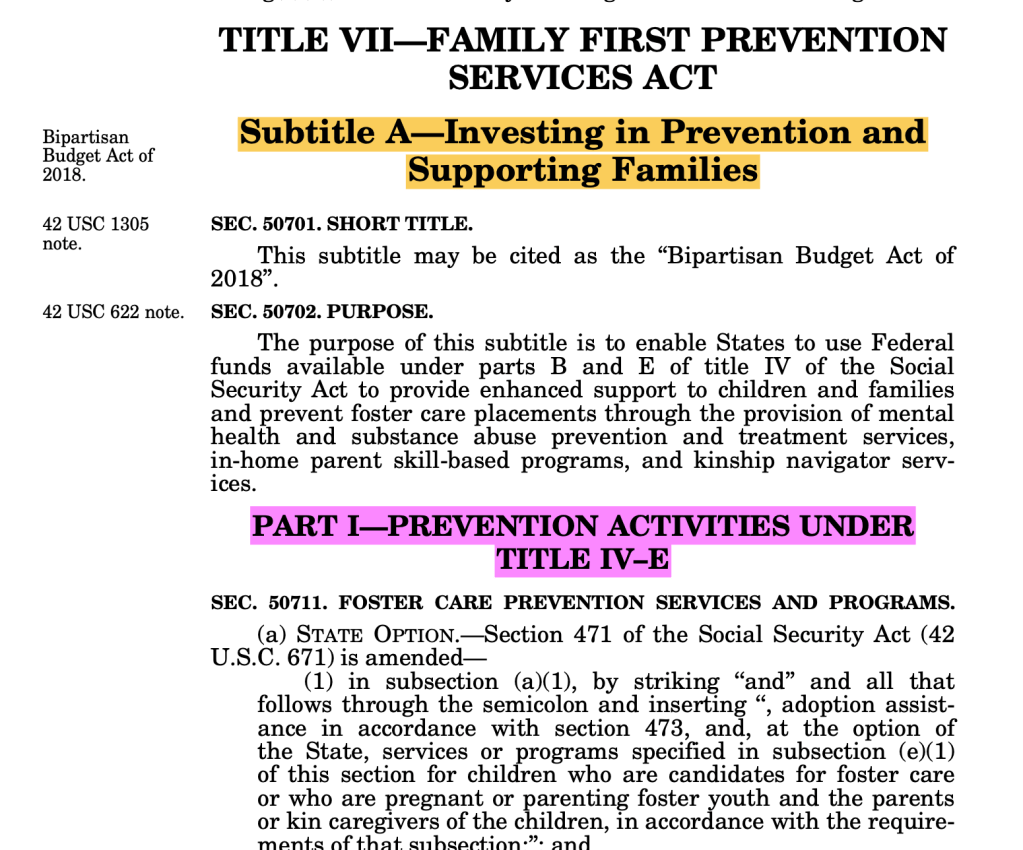
On May 22, 2024, the Senate Finance Committee (SFC) held a hearing entitled “The Family First Prevention Services Act [FFPSA]: Successes, Roadblocks, and Opportunities for Improvement.” The hearing focused on Part I of FFPSA, which is titled “Prevention Activities Under Title IV-E.” In his opening statement, Senator Ron Wyden, the prime author of the Act along with the late Orrin Hatch, recognized that FFPSA has so far not had the anticipated effect. “Six years on,” he acknowledged, “many states are still not taking advantage of the funding available to them.” He suggested that the problems were due to foot-dragging by the feds and states. But Wyden was wrong. The problem is not with the implementation of FFPSA but in the content of the bill itself. States have been hard-put to devise plans for implementing the new services because the bill was designed to fix a problem that did not exist–the alleged absence of child welfare services designed to help families stay together.
Sometime in the early years of the current century, a group of powerful advocates who thought that too many children were being placed in foster care came up with a proposal for change that they called “child welfare finance reform.” They thought the existence of a dedicated funding source for foster care and not for services to families that might keep children out of care impeded the provision of these services and might even provided an incentive to place children in foster care. A Google search for the earliest use of the term “child welfare finance reform” produced a 2010 report by the influential Casey Family Programs, entitled The Need for Federal Finance Reform. In that paper, Casey stated:
the major federal funding source for foster care, Title IV-E, primarily pays for maintaining eligible children in licensed foster care, rather than providing services for families before and after contact with the child welfare system. The fact that no IV-E funding can be used for prevention or post-reunification services has created a significant challenge to achieving better safety and permanency outcomes for children.
The idea of allowing Title IV-E to fund “prevention” or post-reunification services took hold. It was initially tested using waivers authorized between 2012 and 2014 to allow selected states to use Title IV-E funds to implement “evidence based practices” to prevent foster care placement. Despite the underwhelming results of these demonstration programs,1 FFPSA was introduced in 2016 in the House and Senate by the leadership of the House Ways and Means and Senate Finance Committees. The law was enacted in February 2018 as part of the federal Bipartisan Budget Act of 2018 (P.L. 115-123). It expanded the allowable uses of Title IV-E funding, formerly used to pay only for foster care, to include what the Act called “Prevention Services,” meaning services to prevent foster care.2 These services were defined to include mental health services, substance abuse treatment, and “in-home parenting skills training.”
In the recent hearing, Senator Wyden explained his view of the need for FFPSA and what it actually did.
Sometimes, in order to prevent the need for foster care, mom and dad might need a little help. Maybe a parent needs mental health care or substance use disorder treatment, or parenting training and support, or maybe the family needs to do family therapy. … So under Family First, we created new federal funding for those services.
Wyden’s formulation of the issue suggests that these mental health and parenting services and drug treatment were not available before FFPSA. But is simply not true. Mental health care, substance abuse treatment, and parenting training and support were all being provided with the help of federal funds — but just not through Title IV-E. States had other sources of federal reimbursement for these programs, such as Title IV-B, the Social Services Block Grant, and TANF. But above all, these services were funded by Medicaid, a federal entitlement program that receives the same federal match as Title IV-E. Because most parents involved with child welfare are covered by either Medicaid or (more rarely) private insurance, they could be referred to these services. These referrals were part of a set of child welfare services often called “in-home services,” “family preservation services,” “intact family services,” or “family maintenance services.” As the Child Welfare Information Gateway, an information clearinghouse of the U.S. Children’s Bureau, put it in a 2021 Issue Brief:
Most children involved with the child welfare system are not separated from their families but instead receive services while living at home. These child welfare “in-home services” are designed to strengthen and stabilize families that come to the attention of child protective services (CPS).
While FFPSA had taken effect when the issue brief was published, few states had implemented it and almost no money had been spent, so it is a testament to the prevalence of in-home services before any effects of FFPSA. In-home services were and are generally provided to families after an investigation found that the children are “at risk,” but not in immediate danger, which would require removal. A key element of in-home practice is safety assessment and management, which was given short shrift by the writers of FFPSA. Another key element was interventions for specific problems, like drug treatment, mental health services and age-specific parenting skills training–interventions which were mostly provided through referrals to other agencies.
I’m not saying that all families were getting all the services they needed. There is a longstanding undersupply of drug treatment and mental health services, as well as domestic violence services, which were inexplicably left out of FFPSA. Equally problematic is the poor quality of many of the services available, as many high-quality providers choose not to accept Medicaid due to low reimbursement rates and excessive paperwork. Federal reviews have found that child welfare agencies across the country have problems in accessing the services provided by other agencies, including long waiting lists, lack of quality providers, and lack of specialized services in rural areas. Perhaps the drafters of FFPSA assumed that it would allow state child welfare agencies to create their own supply of drug treatment, mental health and parenting programs strictly for child welfare clients.
But the use of Title IV-E funds authorized by FFPSA to add to the supply of services covered by Medicaid and other funders was soon blocked when Congress itself (with the involvement of the House Ways and Means Committee, which had also advanced FFPSA) decided that Title IV-E to be the “payer of last resort” for “Title IV-E prevention services.” This means that Title IV-E cannot be used to pay for any service that would have been paid for by another provider (like Medicaid) before FFPSA was passed. This change to Title IV-E of the Social Security Act was added on to a bill to address the opioid crisis that passed on October 24, 2018, apparently after members of Congress realized that FFPSA was unclear on what program paid first. It is hard to believe that the drafters of the bill did not anticipate this issue. since most of the other funding sources (like Medicaid and Title IV-B) are also under the jurisdiction of Senate Finance and House Ways and Means Committees. In any case, it is unclear why they did not move to amend FFPSA as soon as they recognized the problem.
Making matters worse, FFPSA required that all funded programs be “promising,” “supported,” or “well supported” as defined by a list of criteria set forth in the law, and that half of the funds be spent on programs that meet the more stringent criteria for being “supported” or “well supported.” This meant that some of the poorer and more rural states states as well as Indian tribes, were hard-put to find programs that existed in their states, were culturally appropriate and also met the criteria for being funded. Ironically, while FFPSA’s criteria for methodology are strict enough to rule out many programs, the bar for being considered “promising,” “supported” or “well-supported” is actually very low for any program that meet evaluation criteria. Many of the programs selected have few and small impacts, and common evidence-based services like Cognitive Behavioral Therapy and buphenorphine therapy for Opioid Use Disorder are not included in the list of practices that have been approved by the Title IV-E Prevention Services Clearinghouse. But that is a subject for another post.
The result of all this confusion and red tape was that the bill that was supposed to have a momentous impact, giving rise to an explosion of services for children at risk of being taken into foster care and their parents, has arrived with a whimper rather than a bang. ACF estimated that only 18,400 children in the entire country were served by Title IV-E prevention services programs in FY 2023, five years after it took effect, at a cost of $167 million. That’s hardly the massive impact that Wyden was expecting. It’s not hard to understand why the effect of FFPSA has been so underwhelming. States have been hard-put to find programs that meet the Act’s evidence requirements and are not already paid for by Medicaid.
What could Congress have done instead? They could have made changes to Medicaid to improve options for parents at risk of losing their children to foster care. Even if they preferred to change Title IV-E, they could have extended funding to case management, which the core service provided by child welfare and the backbone for all the other services that child welfare provides–case management. Case management is the only service that the child welfare system usually provides directly rather than through referrals and for which it actually pays. Child welfare social workers are above all case managers. It is the case manager who refers the parent to the other providers, motivates them to continue to participate, monitors their participation by communicating with the service provider, and most importantly, monitors the safety of the children in the home. One could say that in-home services is the main program that clients receive and encompasses other programs to which they may be referred.
The funding of case management through Title IV-E might have helped address an ominous development that is occurring in some large states–the simultaneous decline in both foster care and in-home cases. While, FFPSA was supposed to encourage states to substitute in-home services for foster care, there is evidence from some large states that endangered children are being left at home with no services or monitoring at all. (The evidence is limited because FFPSA does not require states to report on the number of cases that are opened for in-home services and how many children and adults are receiving such services.) The abandonment of these at-risk children may be due in part to the workforce crisis afflicting child welfare and other human services, which results in unmanageable caseloads and possibly pressure not to open cases. But the provision of matching funds for case management would help states provide higher salaries and better conditions, which might help increase the workforce.
It appears that Chairman Wyden still does not recognize the fundamental fallacy behind FFPSA’s “prevention services” and the problems it caused. In his opening statement at the hearing, he lamented that “last year, the federal government spent just $182 million on prevention services, while we spent over $4 billion on traditional foster care. Clearly, priorities are out of whack. The government can and must do better to get this funding out the door to states that ask for it.” But the bill’s drafters should look to their own responsibility before he blames “the government” for its implementation. It’s time to fix the flaws in FFPSA which stem from the fundamental misconception at its heart,
Notes
- An evaluation that incorporated the final state reports found that 80 percent of the interventions studied has mixed positive and “unexpected” findings. About one-fifth had statistically significant positive effects across all major outcomes on which they were evaluated…” ↩︎
- This title is somewhat deceptive as what is being prevented is placement in foster care, which is an intervention rather than a behavior. It is kind of strange to direct one intervention at another intervention provided by the same agency. If they want to prevent foster care, they can just not place kids in it! What they should have targeted for prevention is child abuse and neglect. ↩︎


One thought on “The fundamental misconception at the heart of the Family First Act”