
The power of wishful thinking: The continued promotion of Healthy Families America as a child abuse prevention program

by Marie Cohen

The original version of this post was published on April 4, 2022. I decided to update and re-publish it after reading a press release from Prevent Child Abuse America stating that “PCAAโ€™s signature home visiting program, Healthy Families America, has been proven to reduce child abuse and intimate partner violence while improving long-term health and educational outcomes.” While I cannot evaluate the claim about domestic violence, the post below show that Healthy Families America has not been “proven” to reduce child abuse.

I have written before about the power of wishful thinking and how it causes people to disregard research and real-life results. A program called Healthy Families America (HFA) offers a good example of the power of wishful thinking. The nation’s oldest and largest charity (now called Prevent Child Abuse America or PCAA) dedicated to the prevention of child abuse launched HFA based on weak evidence that a program in Hawaii could prevent child maltreatment. The first experimental study of the Hawaii program found no impact on child maltreatment but did nothing to derail the launch of HFA, which grew into the centerpiece of PCAA. Studies of HFA programs around the country have found little evidence of reductions in child maltreatment, but the program has continued to grow. The story of HFA is a lesson in the power of wishful thinking and the failure of evidence (or lack thereof) to counteract it.

As told in a helpful history of home visiting, all modern programs can trace their origins to Henry Kempe, whose book, The Battered Child, brought about the recognition of child maltreatment as a national problem. To address child abuse, Kempe called for universal prevention through a network of home health visitors. Inspired by Kempe, modern home visiting began with Hawaii’s implementation of the Healthy Start Project (HSP) in 1975. HSP was developed on the island of Oahu. It had two components: early identification (at the birthing hospital) of families with newborns at risk of child abuse and neglect and home visiting by trained paraprofessionals for those families classified as at-risk who agreed to participate. This initial program was never evaluated, but anecdotal information suggested it was successful in promoting effective parenting, and six similar programs were established on neighboring islands.

The Hawaii Legislature authorized a three-year pilot program focusing on one neighborhood in Oahu, which began in 1985. There was no control group in the pilot study, and the researchers used CPS reports and changes in family stress in participating families to measure program effectiveness. During the three-year pilot, there were few reports of physical abuse, neglect or imminent harm for program participants. Because evaluations of other home visiting programs had found much higher rates of reported maltreatment in comparison group families, these results were viewed as evidence that the program had a positive impact. According to the authors of the first rigorous evaluation of HSP, “The pilot study results might have been given too much weight, given the lack of a control group and the short period of follow-up for most families.” Nevertheless, the results of this unpublished study were enough evidence for the Legislature to expand HSP throughout Hawaii starting in 1989.

Home visiting in general was gathering steam in the 1980s and early 1990’s. In 1990, the U.S. General Accounting Office (GAO) issued a report promoting home visitation as a “promising early intervention strategy for at-risk families.” In its summary of research evidence, GAO focused mostly on health and developmental benefits for children, rather than maltreatment prevention. In 1991, the U.S. Advisory Board on Child Abuse and Neglect issued a report recommending a pilot of universal voluntary neonatal home visitation, stating that the efficacy of home visiting as a preventive measure was “already well-established.” The Board cited the results of a federally-funded demonstration begun 17 years earlier as well as the the nurse home visitation program started by David Olds in 1977. But HSP was not mentioned.

Despite the lack of a rigorous evaluation, the National Committee to Prevent Child Abuse (NCPCA, now called Prevent Child Abuse America), which bills itself as the nation’s “oldest and largest organization committed to preventing child abuse and neglect before it happens,” had become interested in using HSP as the nucleus of a national home visiting program. But first, NCPCA conducted a one-year randomized trial of HSP. The trial suffered from severe methodological limitations, including “less than ideal followup,” differential dropout rates in the program and control groups, the failure to blind interviewers to experimental or control status, and reliance on program staff rather than researchers to measure some outcomes. Nevertheless, the trial concluded that HSP reduced child maltreatment, and this apparently gave NCPCA the assurance it needed to invest in the model.

NCPCA launched Healthy Families America in 1992, with financial support from Ronald MacDonald House Charities. Rather than impose a single service model, HFA was based on a set of principles or critical elements, which included initiation of services prenatally or at birth, assessment of the needs of all new parents in the target area, voluntary nature of services, at least weekly services for families with the highest needs, availability of services for three to five years, comprehensive nature of services, and cultural competence, among others. The typical HFA program included an assessment of all new or first-time parents in a given community at the time their babies are born or prenatally.”

In the meantime, the Hawaii Department of Health recognized the limitations of both the pilot study and the NCPCA study and initiated a more rigorous evaluation of HSP in 1994. This was a randomized controlled trial, with at-risk families identified at the hospital and randomly assigned to the experimental and control groups. In 1999 the results of the Evaluation of Hawaii’s Healthy Start Program were released as part of an issue of the Future of Children journal containing evaluations of six different home visiting models.  No overall positive program impact emerged after two years of service in terms of child maltreatment (according to maternal reports and child protective services reports). Early HFA evaluation results, published in the same issue, also failed to find effects on abuse and neglect in three randomized trials, which included the HSP evaluation discussed above and another Hawaii HSP study.

David Olds had had begun testing his Nurse Home Visiting Program in 1977 and already had long-term results on the program in Elmira, NY, as well as shorter-term results for a replication in Memphis, Tenn. That program, now known as Nurse Family Partnership, was very different from HFA. It was restricted to first-time teenage mothers and the home visitors were nurses rather than paraprofessionals. The nurses followed detailed protocols for each visit. The researchers found that among low-income unmarried women (but not other participants), the program reduced the rate of childhood injuries and ingestions of hazardous substances that could be associated with child abuse or neglect. Follow-up of the Elmira group when the children were 15 found that the nurse-visited mothers were significantly less likely to have at least one substantiated report of maltreatment. These results are particularly impressive because they overrode a tendency for nurse-visited families to be reported for maltreatment by their nurse visitors. The researchers concluded that the use of nurses, rather than paraprofessionals, was key to the success of the program.

In their analysis of all six studies published in the Future of Children volume on home visiting, Deanna Gomby et al. concluded that while the HFA and HSP evaluations showed some change in maternal attitudes and self-reported behaviors related to abuse and neglect, only the Nurse Home Visiting Program showed impacts on abuse and neglect other than from self-reports. Gomby and her co-authors also concluded that the results of all six home visiting evaluations were discouraging for those who had high hopes for home visiting for solving an array of problems. All the programs “struggled to enroll, engage and retain families.” Program benefits generally accrued to only a subset of enrolled families and were often quite modest. The authors explained the disappointing results by concluding that human behavior is hard to change, particularly when problems are community-wide. They recommended that “any new expansion of home visiting programs be reassessed in light of the findings presented in this journal issue” and stated that home visiting services are “best funded as part of a broad set of services for families and children.”

But the home visiting juggernaut was already in motion nationwide. And NCPCA, renamed Prevent Child Abuse America in 1999, had already made HFA its centerpiece program. Home visiting grew, and HFA grew with it. In 2010, Congress created the Maternal, Infant and Early Childhood Home Visiting Program (MIECHV), which was re-authorized in 2018 with funding of $400 million per year through FY 2022. HFA is one of the models that are most frequently implemented with MIECHV dollars. Home visiting programs can also receive funding through Medicaid, Title IV-B and IV-E of the Social Security Act, and many other funding sources. HFA now serves over 70,000 families per year at an average cost of over $3,000 for a family in its first year of home visiting.

The infusion of funding for HFA research resulted in a multitude of research projects (both randomized trials and less rigorous studies) and resulting publications. Nevertheless, research has yet to find solid evidence that these programs have an impact on child maltreatment: The California Evidence-Based Clearinghouse for Child Welfare (CEBC), the pre-eminent child welfare program clearinghouse, reviewed 19 research reports on HFA. Its website as of April 2022 gave the program a rating of “4” on a scale of 1 to 5 for prevention of child abuse and neglect, meaning the evidence fails to demonstrate that HFA has an effect on abuse and neglect. Interestingly, that rating no longer appears on the CEBC website, but the earlier version is preserved by the Wayback Machine. As of April 2025, HFA is no longer listed at all in the CEBC’s document titled Home Visiting Programs for Prevention of Child Abuse and Neglect. When I emailed the CEBC to ask about the missing rating, I received an email stating that Healthy Families America “is still currently under review in the Prevention of Child Abuse and Neglect topic area. The rating for this topic area was pulled from the website during the rereview process. Some programs take longer to review due to the amount of research and other factors.”

HFA was not designed to work with families that have already been found to abuse or neglect their children but that did not stop child welfare agencies from spending federal and state funds delivering HFSA to families under the Family First Prevention Services Act (FFPSA). Despite the lack of evidence of its impact on maltreatment, HFA received a rating of “Well Supported” from the clearinghouse established by FFPSA to determine whether a program can receive federal funding under Title IV-E of the Social Security Act. To get such a rating, the program must show improved outcomes based on at least two randomized trials or rigorous quasi-experimental studies. But these outcomes could be any sort of “important child and parent outcome,” (not just reduction of child abuse or neglect) and there is no standard for how to measure each outcome. Based on its review of all HFA studies that met their criteria for inclusion, the Clearinghouse found 23 favorable effects, 212 findings of no effect, and four unfavorable effects across 16 outcomes. This included five favorable effects on child safety based on parents’ self-reports of maltreatment, with no favorable effects on other measures of child safety. Self-report is generally frowned upon as a measure of child maltreatment, for obvious reasons. A positive impact of HFA might reflect that participants in HFA were more eager than control group members to provide the “right answer” to questions about maltreatment.

The “well-supported” rating from the Title IV-E clearinghouse allowed states to spend Title IV-E funds on services to families with a child welfare in-home case. To take advantage of this new market, HFA announced in September 2018 that families referred by the child welfare system were now able to enroll as long as the child in question was 24 months of age or younger, as opposed to the original requirement that services start at or before birth. To serve these families, HFA introduced special child welfare protocols. HFA advertises these protocols on its website, stating that “HFAโ€™s evidence and the flexibility of enrollment make HFA a great prevention choice for states and child welfare organizations seeking to strengthen families and reduce the number of children placed in foster care.” (Note that there is no mention of reducing abuse and neglect!)

Today, the diversity of HFA programs makes evaluation of the program as a whole impossible. According to the website, “HFA puts communities in the driverโ€™s seat. Local HFA programs are able to choose their eligibility criteria, parenting materials, and hire the staff they deem best to do the job. With the amount of flexibility offered, HFA has been able to be successfully implemented in a wide variety of communities.” It is hard to imagine what the evaluation of one HFA program means about the effectiveness of other programs under the same name.

Critical examination of the HFA website shows that the organization skews its portrayal of available research to present it in the most favorable light and avoids direct statements that the program prevents child abuse and neglect. On its Evidence page, HFA claims the “highest rating possible from CEBC in the category “Home Visiting Programs for Child Well-Being,” without mentioning that in the category “Home Visiting Programs for the Prevention of Child Abuse and Neglect,” HFA is currently unrated after the statement that it was unable to demonstrate an effect was removed. The page goes on to group the effects of HFA into three categories, stating that participants “build nurturing relationships with their children,” “champion their children’s health and development,” and “cultivate a flourishing future for their family.” Reductions in abuse and neglect are not mentioned in the description of how parents “build nurturing relationships with their children.”

It is disappointing that an organization that defines its mission as child abuse prevention, decided to fund HFA before it was proven to prevent child maltreatment and continued with this commitment even after the disappointing evaluations of 1999 might have led them to diversify their investment. That PCAA continues to use charitable contributions made for the prevention of child abuse and neglect to fund a program that has not been proven to accomplish this goal, raises serious ethical questions. Twenty-three members of the 45-person staff (which has grown by five staff in three years !) listed on the Prevent Child Abuse website have duties linked to Healthy Families America.

The story of HFA is not an unusual one. I have written about the similar disregard for evidence in the promotion of models such as Homebuilders and blind foster care removals. Such stories are all too frequent. They show us how wishful thinking can drive leaders to disregard research, especially after they have made a premature decision to commit to one program or course of action.

Seven children and all she needed was a van: large families and the blindness of the child welfare establishment

By Marie Cohen

Working in the field of child protection, it is sometimes hard to avoid the feeling of living in some type of alternate reality, where bizarre statements are accepted and obvious questions go unasked. A case in point was a hearing on the Family First Prevention Services Act (FFPSA) that took place on May 22, 2024 under the leadership of Senator Ron Wyden of Oregon, one of the original sponsors of the FFPSA. This hearing and the fundamental misunderstanding about FFPSA that it uncovered has already been discussed in a previous post on this blog. But today’s post focuses on one particularly jarring vignette–the story of a mother, her seven children, and a van–and what it means about how child welfare policy is made and discussed today.

David Reed, the Deputy Director of Child Welfare Services in Indiana, introduced the story of this family in his testimony. Reed was trying to illustrate how the provision of economic and concrete supports can make children safer–an application of the theory that much of what is called child neglect is actually only poverty, which has been questioned previously in this blog. Reed explained the Indiana Family Preservation Services (IFPS) model requires that “concrete support be provided to families when not doing so would result in children having to come into foster care.” He gave an example of how this worked in a specific case:

DCS was called about a neglect allegation involving a single mother who had seven children, all of whom were school-aged or younger. This mother worked but struggled financially. DCS was called because she was unable to take all seven of her children in rural Indiana to school and/or daycare at the same time so that she could go to work. She took them in โ€œshiftsโ€ leaving some children home alone. This resulted in the neglect allegation and the opening of a DCS case. The provider delivering INFPS to this family recognized what this mom really needed to ensure that her children could all be transported togetherโ€”a bigger vehicleโ€”and used the concrete supports built into INFPS to purchase her a used minivan. That $3,000 van โ€œsolvedโ€™ the reason for DCSโ€™ involvement and very likely prevented seven children from coming into foster care, which is exactly what most likely would have happened prior to INFPS.

There is something strange about this example. Is it really possible that this mother needed nothing but a van in order to parent her children adequately? The rarity of seven-child families and the association of such large families with family dysfunction, including abuse and neglect, raise doubts about this mother’s appropriateness as a poster child for the provision of material supports as a solution to child maltreatment.

The rarity of a seven-child family

Seven children is such unusual number that it raises questions about why this mother had so many children and how she managed to care for them. The National Center for Health Statistics has estimated that 28 percent of women aged 40-49 (near the end of their childbearing years) who had given birth to children had only one child, 40 percent had two children, 27 percent had three children, and only 13 percent had four or more children.1 It is likely that the proportion with seven or more children is a tiny fraction of that 13 percent–and that is a percentage of women aged 40-48. We don’t know this woman’s age, but the younger she is, the more of an outlier she is, and the more questions this story should raise about her needs.

The association of extremely large families with dysfunction

A family of seven is not just unusual; it is often a marker for family dysfunction and pathology. Despite the rarity of families with five or more children, anyone who has worked in child welfare or juvenile justice knows that children from extra-large families are overrepresented among their clients. These families frequently consist of mothers with children by multiple fathers, with both parents often suffering from mental illness and/or drug abuse, and domestic violence is commonly present. These mothers are often too disorganized or too influenced by drugs and alcohol to use contraception; moreover, they may consciously or unconsciously get pregnant to hold onto a new man. In its Study of the Root Causes of Juvenile Justice System Involvement,” the District of Columbia’s Criminal Justice Coordinating Council interviewed youth service providers with first-hand experience working with justice-involved and at-risk youth. Quotes from these interviews include:


A social service provider described one type of youth they see becoming justice involved, โ€œYou have those that the family may have multiple children and if mom has 13 kids and Iโ€™m the oldest and mom is high or dad is not involved, then they need to eat because they are looking at me. So, I need to be able to figure out how to get the next meal.

One interviewee who works with the juvenile justice system describedthe youth as coming from families with โ€œFour, five, six, seven childrenโ€ and growing up where there are โ€œThree kids in a room, total bedlam all the time,โ€ and as a result โ€œThey raise each other in the streets … because … a lot of times hanging out at home isnโ€™t the pleasant environment.โ€

Research has consistently supported the association of larger families and closer birth spacing with higher rates of child abuse and neglect. In a groundbreaking 2024 article, Ahn et al report on their analysis of 20 years of data on almost 200,000 first-time mothers in California. They found a strong correlation between the number of children born to a mother and the likelihood that she would be reported to CPS in the next 20. The percentage of first-time mothers reported to CPS increased from 18.5 percent for mothers with one child to 25.4 percent for mothers with two children, 39.2 percent for mothers with three children, and 63.1 percent for mothers with four or more children.

Missing the Obvious?

Obviously not all large families are characterized by dysfunction and pathology. But common sense tells us that large family size can add to stress that in turn can lead to maltreatment. Moreover, having multiple children that one cannot afford may reflect other dysfunctions that may in turn be associated with child maltreatment. Yet somehow it never occurred to Senator Wyden or any of his colleagues at the hearing to ask whether this mother had any problems with mental health, drugs or domestic violence. Senator Wyden even mused aloud that federal law discriminates against large families, complaining that the child tax credit does not reimburse families based on the number of children they have! It appeared that he actually wanted to encourage unlimited childbearing regardless of the mother’s emotional or financial readiness.

And what about Mr. Reed, who actually provided this case as his only example of how material assistance can help resolve a child maltreatment report? According to the DCS website, Mr. Reed is a “licensed clinical social worker who has spent most of his career working with foster youth and children involved with the child welfare system.” One would think he had noticed that children from very large families were overrepresented among his clients. It is also worth noting, though slightly off-topic, that if this was the best example he could find, then his argument that many neglect cases can be solved with one-time material assistance appears to be in danger of collapsing for lack of support.

Perhaps one reason for Wyden’s and Reed’s blind spot is the current ideological tendency of what might be called the child welfare establishment, including the federal Administration on Children and Families, state leaders, and large and wealthy foundations and advocacy groups like Casey Family Programs. Many posts on this blog show how these groups’ focus on race and identity has restricted discussion about how to help prevent child abuse and neglect, among other problems. There seems to be a special taboo attached to any discussion about family size as it relates to child maltreatment, or any prescription for family planning as part of the solution. This taboo likely stems at least in part from our countryโ€™s shameful history of attempting to restrict childbearing by Black and poor women through means includingย forced sterilizationย and attempts to mandate that welfare recipients use an early injectable contraceptive called Norplant. But when efforts to be sensitive to past trauma to specific groups prevents the implementation of programs to improve the lives of at-risk children, it is time to set taboos aside.

What could be achieved by seeing extra-large families through clear eyes rather than a lens that is distorted by bias? Frontline workers faced with this type of client could look a little harder to see if the lack of a van was the real issue. Even if it was, requiring the mother to adopt one of today’s safe, long acting contraceptives in return for the gift of a van would hardly be unreasonable. In general, incorporating voluntary family planning, perhaps as a condition of receiving desired benefits, into family case plans might be a good start. Senator Wyden might not know this, but a new pregnancy for a mother who is trying to get her children back from foster care is one of the frequent setbacks observed by front-line workers.


The failure to regard unusually large numbers of children as a possible sign of pathology may reflect a genuine innocence about conditions in low-income urban and rural communities–conditions that are perfectly known to people in those communities and those who work there, but perhaps not to a US Senator like Wyden or his colleagues. A more cynical view is that self-imposed oblivion is needed to stay on the right side of advocacy groups and foundations that dominate the mainstream discourse on child welfare and provide funding to state and local agencies that are willing to toe the line. Whether it is ignorance or fear of losing the support of interest groups, national and local leaders’ disregard of the perils of repeated unplanned childbearing is hurting the very children these leaders claim they want to help.

  1. There is an error in the posted PDF of this report. The percentage of all women aged 40-49 who gave birth to three children was given as 2.4 percent instead of 22.4 percent. This was confirmed by an email to Marie Cohen from Brian Tsai, Public Affairs Specialist, Center for Disease Control and Prevention, November 21, 2024. โ†ฉ๏ธŽ

The fundamental misconception at the heart of the Family First Act

On May 22, 2024, the Senate Finance Committee (SFC) held a hearing entitled “The Family First Prevention Services Act [FFPSA]: Successes, Roadblocks, and Opportunities for Improvement.” The hearing focused on Part I of FFPSA, which is titled “Prevention Activities Under Title IV-E.” In his opening statement, Senator Ron Wyden, the prime author of the Act along with the late Orrin Hatch, recognized that FFPSA has so far not had the anticipated effect. “Six years on,” he acknowledged, “many states are still not taking advantage of the funding available to them.” He suggested that the problems were due to foot-dragging by the feds and states. But Wyden was wrong. The problem is not with the implementation of FFPSA but in the content of the bill itself. States have been hard-put to devise plans for implementing the new services because the bill was designed to fix a problem that did not exist–the alleged absence of child welfare services designed to help families stay together.

Sometime in the early years of the current century, a group of powerful advocates who thought that too many children were being placed in foster care came up with a proposal for change that they called “child welfare finance reform.” They thought the existence of a dedicated funding source for foster care and not for services to families that might keep children out of care impeded the provision of these services and might even provided an incentive to place children in foster care. A Google search for the earliest use of the term “child welfare finance reform” produced a 2010 report by the influential Casey Family Programs, entitled The Need for Federal Finance Reform. In that paper, Casey stated:

the major federal funding source for foster care, Title IV-E, primarily pays for maintaining eligible children in licensed foster care, rather than providing services for families before and after contact with the child welfare system. The fact that no IV-E funding can be used for prevention or post-reunification services has created a significant challenge to achieving better safety and permanency outcomes for children.

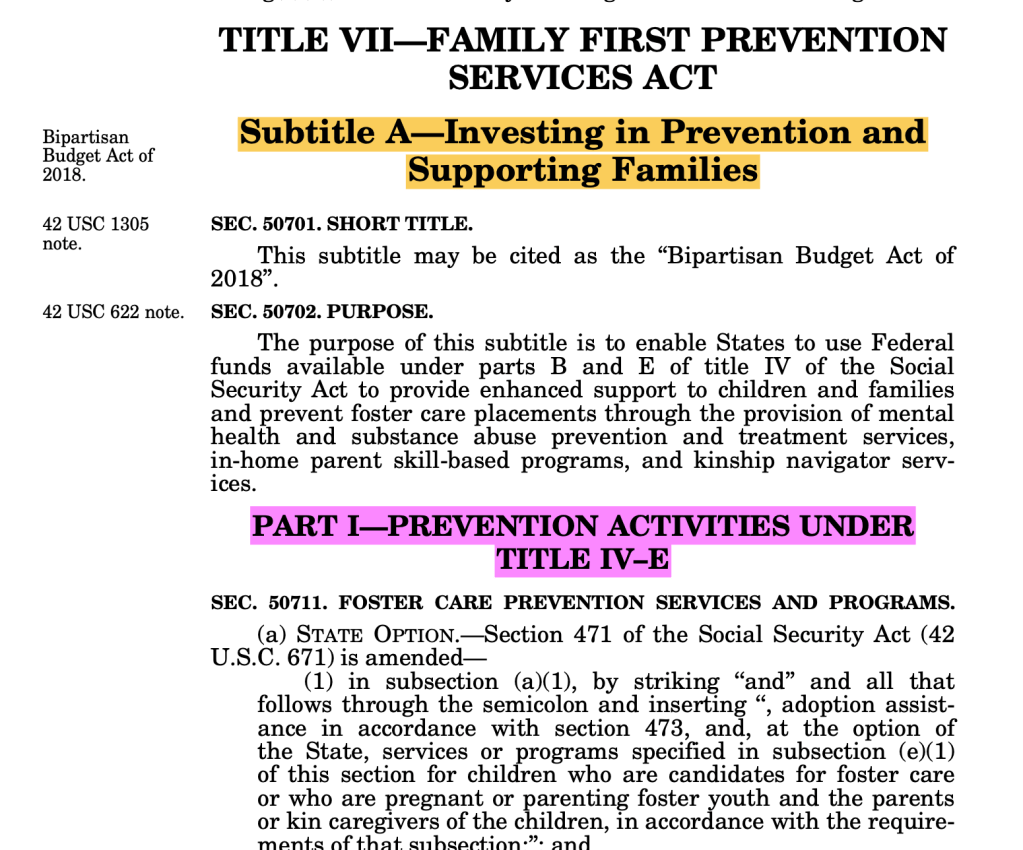
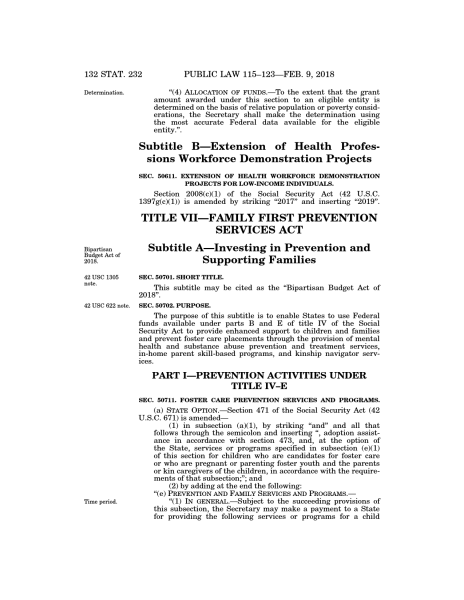
The idea of allowing Title IV-E to fund “prevention” or post-reunification services took hold. It was initially tested using waivers authorized between 2012 and 2014 to allow selected states to use Title IV-E funds to implement “evidence based practices” to prevent foster care placement. Despite the underwhelming results of these demonstration programs,1 FFPSA was introduced in 2016 in the House and Senate by the leadership of the House Ways and Means and Senate Finance Committees. The law was enacted in February 2018 as part of the federal Bipartisan Budget Act of 2018 (P.L. 115-123). It expanded the allowable uses of Title IV-E funding, formerly used to pay only for foster care, to include what the Act called “Prevention Services,” meaning services to prevent foster care.2 These services were defined to include mental health services, substance abuse treatment, and “in-home parenting skills training.”

In the recent hearing, Senator Wyden explained his view of the need for FFPSA and what it actually did.

Sometimes, in order to prevent the need for foster care, mom and dad might need a little help. Maybe a parent needs mental health care or substance use disorder treatment, or parenting training and support, or maybe the family needs to do family therapy. … So under Family First, we created new federal funding for those services.

Wyden’s formulation of the issue suggests that these mental health and parenting services and drug treatment were not available before FFPSA. But is simply not true. Mental health care, substance abuse treatment, and parenting training and support were all being provided with the help of federal funds — but just not through Title IV-E. States had other sources of federal reimbursement for these programs, such as Title IV-B, the Social Services Block Grant, and TANF. But above all, these services were funded by Medicaid, a federal entitlement program that receives the same federal match as Title IV-E. Because most parents involved with child welfare are covered by either Medicaid or (more rarely) private insurance, they could be referred to these services. These referrals were part of a set of child welfare services often called “in-home services,” “family preservation services,” “intact family services,” or “family maintenance services.” As the Child Welfare Information Gateway, an information clearinghouse of the U.S. Children’s Bureau, put it in a 2021 Issue Brief:

Most children involved with the child welfare system are not separated from their families but instead receive services while living at home. These child welfare “in-home services” are designed to strengthen and stabilize families that come to the attention of child protective services (CPS).

While FFPSA had taken effect when the issue brief was published, few states had implemented it and almost no money had been spent, so it is a testament to the prevalence of in-home services before any effects of FFPSA. In-home services were and are generally provided to families after an investigation found that the children are “at risk,” but not in immediate danger, which would require removal. A key element of in-home practice is safety assessment and management, which was given short shrift by the writers of FFPSA. Another key element was interventions for specific problems, like drug treatment, mental health services and age-specific parenting skills training–interventions which were mostly provided through referrals to other agencies.

I’m not saying that all families were getting all the services they needed. There is a longstanding undersupply of drug treatment and mental health services, as well as domestic violence services, which were inexplicably left out of FFPSA. Equally problematic is the poor quality of many of the services available, as many high-quality providers choose not to accept Medicaid due to low reimbursement rates and excessive paperwork. Federal reviews have found that child welfare agencies across the country have problems in accessing the services provided by other agencies, including long waiting lists, lack of quality providers, and lack of specialized services in rural areas. Perhaps the drafters of FFPSA assumed that it would allow state child welfare agencies to create their own supply of drug treatment, mental health and parenting programs strictly for child welfare clients.

But the use of Title IV-E funds authorized by FFPSA to add to the supply of services covered by Medicaid and other funders was soon blocked when Congress itself (with the involvement of the House Ways and Means Committee, which had also advanced FFPSA) decided that Title IV-E to be the “payer of last resort” for “Title IV-E prevention services.” This means that Title IV-E cannot be used to pay for any service that would have been paid for by another provider (like Medicaid) before FFPSA was passed. This change to Title IV-E of the Social Security Act was added on to a bill to address the opioid crisis that passed on October 24, 2018, apparently after members of Congress realized that FFPSA was unclear on what program paid first. It is hard to believe that the drafters of the bill did not anticipate this issue. since most of the other funding sources (like Medicaid and Title IV-B) are also under the jurisdiction of Senate Finance and House Ways and Means Committees. In any case, it is unclear why they did not move to amend FFPSA as soon as they recognized the problem.

Making matters worse, FFPSA required that all funded programs be “promising,” “supported,” or “well supported” as defined by a list of criteria set forth in the law, and that half of the funds be spent on programs that meet the more stringent criteria for being “supported” or “well supported.” This meant that some of the poorer and more rural states states as well as Indian tribes, were hard-put to find programs that existed in their states, were culturally appropriate and also met the criteria for being funded. Ironically, while FFPSA’s criteria for methodology are strict enough to rule out many programs, the bar for being considered “promising,” “supported” or “well-supported” is actually very low for any program that meet evaluation criteria. Many of the programs selected have few and small impacts, and common evidence-based services like Cognitive Behavioral Therapy and buphenorphine therapy for Opioid Use Disorder are not included in the list of practices that have been approved by the Title IV-E Prevention Services Clearinghouse. But that is a subject for another post.

The result of all this confusion and red tape was that the bill that was supposed to have a momentous impact, giving rise to an explosion of services for children at risk of being taken into foster care and their parents, has arrived with a whimper rather than a bang. ACF estimated that only 18,400 children in the entire country were served by Title IV-E prevention services programs in FY 2023, five years after it took effect, at a cost of $167 million. That’s hardly the massive impact that Wyden was expecting. It’s not hard to understand why the effect of FFPSA has been so underwhelming. States have been hard-put to find programs that meet the Act’s evidence requirements and are not already paid for by Medicaid.

What could Congress have done instead? They could have made changes to Medicaid to improve options for parents at risk of losing their children to foster care. Even if they preferred to change Title IV-E, they could have extended funding to case management, which the core service provided by child welfare and the backbone for all the other services that child welfare provides–case management. Case management is the only service that the child welfare system usually provides directly rather than through referrals and for which it actually pays. Child welfare social workers are above all case managers. It is the case manager who refers the parent to the other providers, motivates them to continue to participate, monitors their participation by communicating with the service provider, and most importantly, monitors the safety of the children in the home. One could say that in-home services is the main program that clients receive and encompasses other programs to which they may be referred.

The funding of case management through Title IV-E might have helped address an ominous development that is occurring in some large states–the simultaneous decline in both foster care and in-home cases. While, FFPSA was supposed to encourage states to substitute in-home services for foster care, there is evidence from some large states that endangered children are being left at home with no services or monitoring at all. (The evidence is limited because FFPSA does not require states to report on the number of cases that are opened for in-home services and how many children and adults are receiving such services.) The abandonment of these at-risk children may be due in part to the workforce crisis afflicting child welfare and other human services, which results in unmanageable caseloads and possibly pressure not to open cases. But the provision of matching funds for case management would help states provide higher salaries and better conditions, which might help increase the workforce.

It appears that Chairman Wyden still does not recognize the fundamental fallacy behind FFPSA’s “prevention services” and the problems it caused. In his opening statement at the hearing, he lamented that “last year, the federal government spent just $182 million on prevention services, while we spent over $4 billion on traditional foster care. Clearly, priorities are out of whack. The government can and must do better to get this funding out the door to states that ask for it.” But the bill’s drafters should look to their own responsibility before he blames “the government” for its implementation. It’s time to fix the flaws in FFPSA which stem from the fundamental misconception at its heart,

Notes

  1. An evaluation that incorporated the final state reports found that 80 percent of the interventions studied has mixed positive and “unexpected” findings. About one-fifth had statistically significant positive effects across all major outcomes on which they were evaluated…” โ†ฉ๏ธŽ
  2. This title is somewhat deceptive as what is being prevented is placement in foster care, which is an intervention rather than a behavior. It is kind of strange to direct one intervention at another intervention provided by the same agency. If they want to prevent foster care, they can just not place kids in it! What they should have targeted for prevention is child abuse and neglect. โ†ฉ๏ธŽ

As foster care removals plummet, where’s the promised help for families?

Year after year, states and the federal government continue to release annual data showing a decline in the number of children in foster care, congratulating themselves on keeping families together. They seem to have forgotten that reductions in foster care were supposed to be accompanied by increased services so that children could be safely maintained at home. Unfortunately, there seems to be little to no interest on the part of the federal Children’s Bureau, Members of Congress, advocates, or the media in whether such services are actually being provided.

The newest report from the Adoption and Foster Care Analysis and Reporting System (AFCARS) showed that the number of children in foster care dropped to 368,530 on September in 2022–a drop of 5.8 percent over the previous year 15.6 percent since 2018. โ€œWe are encouraged by the continued decrease in the number of children entering foster care and staying in foster care and we will continue working with our state, tribal and territorial partners to ensure an emphasis on family well-being and safe family reunification,โ€ said Jeff Hild, the Principal Deputy Assistant Secretary of the Administration on Children and Families (ACF) in a press release heralding the new numbers. ACF gave credit to the Family First Prevention Services Act (FFPSA), which “helped change the conversation to be about prevention of foster care placements and preservation of families.” 

It seems premature to celebrate the shrinkage of the foster care rolls as a triumph without knowing what is happening to the children remaining at home who would have been removed in a different year. How many of these children are living with abuse or neglect that will leave lasting scars or impair their development, if not endanger their lives? Supporters of the Family First Prevention Services Act (FFPSA), which passed in 2018, said that declining foster care counts would result from providing support to parents who needed help to address the problems (like substance abuse, mental illness and poor parenting skills) that led to their maltreatment of their children.

After an allegation of abuse or neglect is substantiated, an agency can place a child in foster care or open a case for in-home services, among other options.1 FFPSA made it possible to use the same federal funds for foster care and in-home services, allowing children to stay at home safely while their parents addressed the issues that put them at risk. A major purpose of FFPSA was to enable states to use federal funds that were formerly available only for foster care to pay for parenting support, mental health, and drug treatment that would enable children to stay safely with their families. The rationale for this change was that allowing foster care funds to be used for such services was necessary to enable states to keep kids out of foster care.

However, FFPSA has not made massive federal resources available for such services. ACF estimates that only 18,400 children in the entire country were served by Title IV-E prevention services programs in FY 2023, at a cost of $167 million. But perhaps states are using their own funds to pay for these services? After all, foster care is more expensive than services provided to families in their homes. Both require case management, but instead of the cost of room and board for foster youth, providing in-home services usually involve referring parents to mental health and drug treatment services often funded by Medicaid or paying for parenting support programs that cost less than foster care. (Of course the supporters of FFPSA ignored this basic fact and claimed the legislation would revolutionize child welfare!). States were already providing these services before FFPSA and they could have increased them without the promised federal funding.

But believe it or not, nobody knows if more children and their families are receiving in-home services as the foster care rolls decline, since the federal government doesn’t ask states for this information. While states were already required to report the number of children entering foster care, leaving it, and in care at a point in time, FFPSA did not add a requirement to provide the same data on services provided to children and families in their homes, now that they were also covered by federal Title IV-E funds.2 Hoping some states might track this data of their own accord, I searched the data publications and dashboards on the websites of the ten states with the largest number of children in foster care according to the most recent AFCARS report,3 but I was able to obtain this data for only California and Texas.

California has by far more children in foster care than any other state, 45,924 children at the end of September, 2022, which was 12.4 percent of the national total. Fortunately, there is extraordinarily good data from the California Child Welfare Indicators Project (CCWIP), a collaboration between University of California at Berkeley and the California Department of Social Services. The CCWIP dashboards include data on the number of entries into foster care and the opening of Family Maintenance cases, as in-home cases are called in California. Entries into foster care declined precipitously from April 2019 to March 2020 and continued declining, though more slowly, through March 2024. Family Maintenance case openings also declined continuously throughout the period. Thus, there was no increase in Family Maintenance case openings to compensate for the decline in removals. Or put in a different way, the total number of cases opened for child welfare services dropped from 46,264 at the beginning of the period to 29,969 at the end–a drop of 35 percent. Rather than a shift from foster care to in-home services, there has been a shrinkage of children reached by child welfare services overall.

Source: California Child Welfare Indicators Project, Entries, https://ccwip.berkeley.edu/childwelfare/reports/Entries/MTSG/r/ab636/l and Case Openings, https://ccwip.berkeley.edu/childwelfare/reports/CaseOpenings/MTSG/r/ab636/l.

Texas has the third largest state foster care caseload, after Florida. The Texas data are a bit more confusing. The number of children entering foster care dropped from 16,028 in 2021 to 9,623 in 2022, an incredible 40 percent, while the number of children entering in-home services declined steeply as well, resulting in a 35.7 percent drop in all case openings. Both drops may well have been related to a new Texas law that took effect on September 1, 2021 and changed the definition of neglect to an action or lack of action that puts a child in “immediate danger” of harm, rather than “substantial risk” of harm as the previous language read. The bill also put restrictions on child removals, requiring that children can be removed only from parents who display โ€œblatant disregardโ€ for their actions, or whose inaction โ€œresults in harm to the child or creates an immediate danger to the childโ€™s physical health or safety.โ€ Interestingly, in 2022, foster care entries actually rose slightly in Texas, while family preservation entries sprung back to where they were in FY2021, resulting a substantial increase in total case openings that year. Nevertheless, the overall trend over time was a decrease in foster care entries, family preservation case openings and the total number of children receiving help through open in-home or out-of home cases. That total dropped from 72,181 to 48,619 over five years–a drop of 32.6 percent–almost the same as the drop in California’s child welfare case openings.

Source: Texas Department of Family and Protective Services, CPS Conservatorship, Removals, https://www.dfps.texas.gov/About_DFPS/Data_Book/Child_Protective_Services/Conservatorship/Removals.asp, and CPS Family Preservation, Children Entering Services, https://www.dfps.texas.gov/About_DFPS/Data_Book/Child_Protective_Services/Family_Preservation/Children_Entering_Services.asp

Florida, the state with the second largest number of children in foster care, reports on the numbers of children entering foster care but not on the number entering in-home cases. One can, however, compare the number of children in foster care at a point in time with the number of children and young adults receiving in-home services. Both numbers have been decreasing and the number of children receiving in-home services has been consistently about half of the number of children in foster care. But these numbers don’t tell us whether declining entries to foster care have been offset by increasing entries to in-home services. In general, foster care cases last longer than in-home cases. Not knowing the average length of stays in foster care and in-home cases, and how they have changed over time, one cannot tell whether in-home case openings have made up for the reduced number of entries into foster care.

The Florida data show why point-in-time data cannot be used to answer the question of whether the decline in foster care entries has been accompanied by a rise in in-home case openings. Unfortunately, none of the other eight states with the highest caseloads provide this data on their websites. Illinois and Indiana provide point-in-time data on foster care and in-home participants. The other five states with the largest caseloads–Ohio, New York, Pennsylvania, Arizona, and North Carolina–display no data on in-home case participants at all.

If California and Texas are typical, states have not been increasing their provision of in-home services to make up for declines in foster care. Instead, the total number of abused and neglected children being helped by in-home or out-of-home services (or foster care) has declined by as much as a third in five years. But we cannot assume that California and Texas represent the entire nation. It is unfortunate that the writers of FFPSA did not requiring states to include data on in-home case openings and total caseloads, given that the legislation allowed federal funds to be used for this purpose. States have not begun tracking and reporting on this data on their own, and are triumphantly proclaiming the drop in foster care without even reporting on whether in-home services are being provided instead. When Congress considers desperately-needed fixes to FFPSA, a requirement that states report in-home case data analogous to the foster care data in the AFCARS system should be included in the new legislation.

Notes

  1. Other options include referring a family to a community provider or even doing nothing nothing if the abuse or neglect was assumed to be a one-time event unlikely to occur. The family may also refuse in-home services, and the agency would then have to decide whether to file a court petition to require such services โ†ฉ๏ธŽ
  2. States must provide to National Child Abuse and Neglect Data System (NCANDS) information on how many children receive “postresponse services,” meaning services after a child protection investigation. But unfortunately, “postresponse services” includes foster care and provides a duplicated count, counting children every time they are the subject of an investigation, so it is not useful in telling us how many children receive in-home services. โ†ฉ๏ธŽ
  3. State foster care data can be accessed from https://www.acf.hhs.gov/cb/report/trends-foster-care-adoption. According to the latest information, the ten states with the largest number of children in foster care on September 30, 2022 were California, Florida, Texas, Illinois, Ohio, New York, Missouri, Pennsyhlvania, Arizona, and Indiana. โ†ฉ๏ธŽ

Family First at five: Not much to celebrate

Photo by Ivan Samkov on Pexels.com

When the Family First Prevention Services Act (FFPSA) passed as part of the Bipartisan Budget Act of 2018, it was hailed by many as a revolutionary step in the history of U.S. child welfare. Five years after the Act took effect, child welfare leaders have been weighing in with statements like this one from Rebecca Jones Gaston, Commissioner of the Administration on Children, Youth and Families: “Following its passage five years ago, the Family First Prevention Services Act has transformed our approach to child welfare and benefited families across the many states that have used it to provide concrete support and services.”1 But for those closer to ground-level and less invested in demonstrating the act’s success, there’s not much to celebrate.

FFPSA had two major goals: to keep children out of foster care altogether through services to families and to keep more of those who do have to enter care in family homes. In terms of the first goal, the law’s impacts on services to families have been almost negligible. And in its effort to keep foster children in families, FFPSA has exacerbated the critical shortage of appropriate placements for our most troubled youth, many of whom may need placements in larger settings. In this post, I examine these two goals and their outcomes in greater detail.

FFPSA’s Part I made it possible to allocate funds under Title IV-E of the Social Security Act, previously directed mainly to foster care, to services aimed at keeping children out of care. The law allowed spending on mental health, substance abuse prevention and treatment, and in-home parenting services, “when the need of the child, such a parent, or such a caregiver for the services or programs are directly related to the safety, permanency, or well-being of the child or to preventing the child from entering foster care.”

As I explained in my 2019 post, Family First Act: a False Narrative, a Lack of Review, a Bad Law, Part I was based largely on the false premise that current law, by allowing TItle IV-E funds to pay for foster care and not for services to prevent it, incentivized states to remove children rather than keep families together. While it is true that IV-E funds were not available to pay for services to children and families in their homes, that does not mean that no money was available to help keep families together or that states had an incentive to place children in foster care. In fact, states had long been using Medicaid and other funds for services to prevent placement of children in foster care. In Federal Fiscal Year 2017, according to federal data, out of the children who received services after a CPS investigation or alternative response, only 201,680 were placed in foster care, while 1,332,254 (or more than five times as many children) received in-home services such as case management, family support, and family preservation services.2

Disregarding the role that other funding already played in child welfare, the framers of FFPSA required that Title IV-E would be the “payer of last resort,” so that any services already paid for by Medicaid could not be paid for by Family First. By doing this, they ensured that states with a generous Medicaid programs would be hard-pressed to find any service already existing in the state on which to spend their TItle IV-E money. If not for this provision, such states might have chosen to supplement Medicaid funding for some of these services. Perhaps some states would have allowed Title IV-E funds to be used to pay high-quality providers who do not accept Medicaid funding due to the program’s low reimbursement rates and high paperwork burden. (During my time as a foster care social worker in the District of Columbia, we had contracts with high-quality providers who did not accept Medicaid in order to provide therapy for our most complex clients).

The choice to fund only parenting, mental health and drug treatment services by the framers was another design flaw of FFPSA. The absence of a domestic violence service among the funded services is striking. It is universally acknowledged that drug abuse, mental illness and domestic violence are the “big three” factors that result in foster care placement. But for some reason, the words “domestic violence” are nowhere to be found in FFPSA. Perhaps even more striking is the failure to include one of the most promising services to prevent foster care–high-quality child care. As I have written, not only does quality early care and education prevent foster care placement through multiple pathways, but it also provides an extra set of eyes on the child in case of continued abuse or neglect–greatly needed if FFPSA is to achieve its goal of keeping children both safe and out of foster care. Think of what a difference Congress could have made by providing matching funds to provide quality child care to all families with in-home cases!

Perhaps the most unfortunate feature of FFPSA’s Part I is the requirement that all funds must be spent on “promising, supported or well-supported practices,” with 50 percent of the total spent spent on “well-supported practices” — a percentage that increases after 2026. The law imposes strict requirements for designating a program as promising, supported or well-supported. It set up a clearinghouse to assess the data on existing programs and approve those that met the criteria. As Dee Wilson points out in one of his essential commentaries, the law gets it exactly backwards. We have very little evidence about what works to prevent foster care placement. What we need is to invest in innovative approaches to doing this safely. But FFPSA prevents the use of TItle IV-E funds for this purpose.

Thanks to the various restrictions imposed by FFPSA, the clearinghouse is woefully incomplete. For example, Cognitive Behavioral Therapy (CBT), the therapy of choice for depression and anxiety, which has not been approved nor is it on the list of programs to be examined by the clearinghouse. (“Trauma-Focused CBT,” a newer and much narrower and short-term model, has been approved.) No residential drug treatment program has been approved or is even slated to be considered. The requirement that the practice have a manual may be at fault for the failure to include CBT and residential drug treatment programs, but I’d like to hear from readers who may be better-informed. Buphenorphine therapy for opioid use disorder, which is often preferred to methadone therapy (which is approved by the clearinghouse)because it does not require daily clinic visits, has not been approved and is not slated for consideration, according to the Clearinghouse.. Of course, these popular programs are often funded by Medicaid anyway, so they would be ruled out by the last resort provision as well.

With all these restrictions on Title IV-E spending, it is not surprising that states have been hard-put to find useful ways to spend Title IV-E funds to keep families together. In an important article, Sean Hughes and Naomi Schaefer Riley cited the latest available federal data showing that just 6,200 children across the entire country received an FFPSA-funded service in FFY 2021, costing a grand total of $29 million. That is truly underwhelming given that about 600,000 children were found to be victims of maltreatment in FFY 2021.

The other major purpose of FFPSA was outlined in Part IV, entitled “Ensuring the Necessity of a Placement that is not in a Foster Family Home.” The purpose of this part was to keep more children out of “congregate care,” a term used to designate settings other than foster homes, such as group homes and residential treatment centers. FFPSA made it more difficult to place a child in a congregate placement by imposing conditions on Title IV-E reimbusement for such placements, and by limiting reimbursement after two weeks to facilities that qualify as “Quality Residential Treatment Programs (QRTP’s), a new category defined by the act. QRTP’s must meet strict criteria that many facilities that were caring for foster youth at the time of FFPSA’s passage could not meet without major changes. The act also (perhaps inadvertently) further restricted the number of congregate care beds available to foster youth by creating a conflict with a Medicaid provision called the “Institutions for Mental Diseases (IMD) exclusion” that prevents Medicaid paying the cost of care for children who are placed in facilities with more than 16 beds.

Like Part I, Part IV of FFPSA was in large part based on a false narrative. The myth this time was that every child does better in a family rather than in a more institutional setting. But as I described here, there are many foster youths who cannot function in an ordinary foster home, at least until after a stay in a high-quality residential treatment program or group home. These are the same young people who bounce from home to home and end up in hotels, offices, jails, and other inappropriate settings, but FFPSA made no provision for them.

Even if too many children had been placed in residential care without sufficient clinical justification (which is probably the case in at least some states), it would not be responsible to shut down congregate care placements before ensuring that appropriate foster homes were available for all the children being displaced. But just as the deinstitution movement of the 1960s closed mental hospitals before putting alternatives in place, FFPSA disregarded the question of where children would go when congregate settings disappeared.

As I described here, FFPSA exacerbated trends that were already underway. Group homes and residential treatment centers were already shutting down due to growing publicity about abusive incidents at some facilities, failure of reimbursement rates to keep up with costs, and resignation of staff due to poor pay and working conditions. Tragically, this reduction in residential capacity coincided with increased demand for care due to the youth mental health crisis and increasing levels of need in the foster care population due at least in part to delays in removing children from abusive and neglectful homes. The restrictions put in place by FFPSA added to the problem. As Hughes and Schaefer Riley put it, “If you want to understand why foster children across the country are being housed in a range of inappropriate temporary settings, including county and state offices, hospitals, hotels and shelters, FFPSA is a significant factor.” 

The trends just mentioned have contributed to a foster care placement crisis that has if anything worsened since I described it last October. In Illinois, the Department of Children and Family Services (DCFS) is being sued by the Cook County Public Guardian for allowing foster children to remain locked up in juvenile detention even after theyโ€™ve been ordered released. In Maryland, a disability rights group has just filed suit against the Department of Human Services and other agencies for keeping foster children in hospitals and restrictive institutions beyond medical necessity for weeks, months, or even as long as a year. In a must-read article, Dee Wilson documents a 370 percent increase in hotel/office stays in his state of Washington since 2018 despite a federal court order to stop the practice. At an average cost of up $2,000 per night (including the cost of paying two social workers and a security guard), overnight hotel placements cannot possibly be cheaper than group homes or residential treatment centers. Similar problems are reported around the country, differing only in which inappropriate settings each state is relying on.

As is often the case, California paved the way for FFPSA by passing its Continuum of Care Reform, designed to curb the use of congregate placements, in 2015. A new article in the Los Angeles Times recounts the results. The number of children living in congregate care has dropped from 3,655 to 1,727 since implementation of the law, but the state has failed to find the foster homes to replace the congregate care settings. As a result, Los Angeles County has placed more thanย 200 foster youths in hotels, sometimes for months. County officials report that two social workers have been assaulted by foster youths in separate incidents this year at hotels. Moreover, it appears that care at the existing congregate facilities has grown worse as larger numbers of troubled youths are placed together in fewer facilities. The results of California’s reform and of FFPSA were predictable and indeed predicted by some commentators (including this writer), but these predictions were ignored.

As Dee Wilson puts it, “The implementation of Family First legislation has accelerated the demise of residential care, which has decreased 25% nationally during the past five years. It has been the goal of the federal Childrenโ€™s Bureau and influential foundations to reduce the use of residential care (which has a bad reputation among advocates and most scholars) and they have succeeded; but without developing — or sometimes even proposing – viable alternatives.”

Anyone who chooses to celebrate the “revolution” wrought by FFPSA is living in a dream world. It’s time for Congress to recognize and correct the many errors it made in passing the law. At a minimum, Congress should add funding for early care and education and domestic violence programs to the models that can receive funding under Title IV-E, loosen the standards for evidence-based practices, modify the last-resort provision to allow payment for services to providers who do not accept Medicaid, eliminate some of the restrictions on congregate care, and provide incentives for states to boost their capacity of quality residential programs. Until such changes are made, there will be nothing to celebrate.

.

  1. Alexia Suarez (asuarez@wearerally.com), [YOUโ€™RE INVITED] Expert panel on the Family First Prevention Services Act. Email message, May 15, 2023.
  2. These are duplicated counts as children are counted again each time they are the subject of an investigation and receive post-response services.

The power of wishful thinking revisited: the improbable growth of Healthy Families America

I have written before about the power of wishful thinking and how it causes people to disregard research and real-life results. In that earlier commentary, I discussed the successful promotion of a practice called race-blind removals based on data from an article by a scholar who now denies knowledge of their provenance, and which have been shown to be inaccurate. A program called Healthy Families America (HFA), which currently serves over 70,000 families per year according to its website, offers another example of the power of wishful thinking. This program has become the centerpiece of the nation’s oldest and largest charity dedicated to the prevention of child abuse, even though the program has failed to demonstrate its utility in preventing child maltreatment. This organization, now called Prevent Child Abuse America, launched HFA based on weak evidence that a program in Hawaii called Healthy Start Program (HSP) could prevent child maltreatment. The first experimental study of HSP found no impact on child maltreatment but did nothing to derail the launch of HFA. Studies of HFA programs around the country have found little evidence of reductions in child maltreatment, but the program has continued to grow and now serves more families than any other home visiting program. The story of HFA is a lesson in the power of wishful thinking and the failure of evidence (or lack thereof) to counteract it.

As told in a helpful history of home visiting, all modern programs can trace their origins to Henry Kempe, whose book, The Battered Child, brought about the recognition of child maltreatment as a national problem. To address child abuse, Kempe called for universal prevention through a network of home health visitors. Inspired by Kempe, modern home visiting began with Hawaii’s implementation of the Healthy Start Project (HSP) in 1975. As described in the 1999 evaluation by Duggan and colleagues, HSP was developed by the Hawaii Family Stress Center (HFSC) on the island of Oahu. It had two components: early identification (at the birthing hospital) of families with newborns at risk of child abuse and neglect and home visiting by trained paraprofessionals for those families classified as at-risk who agreed to participate. This initial program was never evaluated, but anecdotal information suggested it was successful in promoting effective parenting, and six similar programs were established on neighboring islands.

As described by Duggan et al., the Hawaii Legislature authorized a three-year pilot program focusing on one neighborhood in Oahu, which began in 1985. There was no control group in the pilot study, and the researchers used CPS reports and changes in family stress in participating families to measure program effectiveness. During the three-year pilot, there were few reports of physical abuse, neglect or imminent harm for program participants. Because evaluations of other home visiting programs had found much higher rates of reported maltreatment in comparison group families, these results were viewed as evidence that the program had a positive impact. According to Duggan and her co-authors, “The pilot study results might have been given too much weight, given the lack of a control group and the short period of follow-up for most families.” Nevertheless, the results of this unpublished study were enough evidence for the Legislature to expand HSP throughout Hawaii starting in 1989.

Home visiting in general was gathering steam in the 1980s and early 1990’s. In 1990, the U.S. General Accounting Office (GAO) issued a report promoting home visitation as a “promising early intervention strategy for at-risk families.” In its summary of research evidence, GAO focused mostly on health and developmental benefits for children, rather than maltreatment prevention. In 1991, the U.S. Advisory Board on Child Abuse and Neglect issued a report recommending a pilot of universal voluntary neonatal home visitation, stating that the efficacy of home visiting as a preventive measure was “already well-established.” The Board cited the results of a federally-funded demonstration begun 17 years earlier as well as the the nurse home visitation program started by David Olds in 1977. But HSP was not mentioned.

Despite the lack of a rigorous evaluation, the National Committee to Prevent Child Abuse (NCPCA, now called Prevent Child Abuse America) the nation’s “oldest and largest organization committed to preventing child abuse and neglect before it happens,” had become interested in using HSP as the nucleus of a national home visiting program. But first, NCPCA conducted a one-year randomized trial of HSP, as described by Duggan et al. The trial suffered from severe methodological limitations, including “less than ideal followup,” differential dropout rates in the program and control groups, the failure to blind interviewers to experimental or control status, and reliance on program staff rather than researchers to measure some outcomes. Nevertheless, the trial concluded that HSP reduced child maltreatment, and this apparently gave NCPCA the assurance it needed to invest in the model.

NCPCA launched Healthy Families America in 1992, with financial support from Ronald MacDonald House Charities, arranging visits to 22 states by Hawaii Family Stress Center Staff. The “theory of change,” or theoretical basis for the program, as quoted by Duggan et al, started with the targeting to all newborns and their parents, which allows for diversified service options determined by individual need. Also part of the theory was a commitment to change at the individual and community levels. Rather than impose a single service model, HFA contained a set of critical elements, which included the prenatal initiation of services and the assessment of all new parents. A network was launched to bring together researchers doing experimental and quasi-experimental studies of HFA programs.

Unlike NCPCA, The Hawaii Department of Health recognized the limitations of both the pilot study and the NCPCA study and initiated a more rigorous evaluation of HSP in 1994. This was a randomized controlled trial, with at-risk families identified at the hospital and randomly assigned to the experimental and control groups. In 1999 the results of the Evaluation of Hawaii’s Healthy Start Program were released as part of an issue of the Future of Children journal containing evaluations of six different home visiting models.  No overall positive program impact emerged after two years of service in terms of child maltreatment (according to maternal reports and child protective services reports). Early HFA evaluation results, published in the same issue, also failed to find effects on abuse and neglect in three randomized trials, which included the HSP evaluation discussed above and another Hawaii HSP study.

David Olds had had begun testing his Nurse Home Visiting Program in 1977 and already had long-term results on the program in Elmira, NY, as well as shorter-term results for a replication in Memphis, Tenn. That program, now known as Nurse Family Partnership, was very different from HFA. It was restricted to first-time teenage mothers and the home visitors were nurses rather than paraprofessionals. The nurses followed detailed protocols for each visit. The researchers found that among low-income unmarried women (but not other participants), the program reduced the rate of childhood injuries and ingestions of hazardous substances that could be associated with child abuse or neglect. Follow-up of the Elmira group when the children were 15 found that the nurse-visited mothers were significantly less likely to have at least one substantiated report of maltreatment. These results are particularly impressive because they overrode a tendency for nurse-visited families to be reported for maltreatment by their nurse visitors. The researchers concluded that the use of nurses, rather than paraprofessionals, was key to the success of the program. In their analysis of all six studies published in the volume, Deanna Gomby et al.ย concluded that while the HFA and HSP evaluations showed some change in maternal attitudes and self-reported behaviors related to abuse and neglect, only the Nurse Home Visiting Program showed impacts on abuse and neglect other than from self-reports.

Gomby and her co-authors also concluded that the results of the six home visiting evaluations were discouraging for those who had high hopes for home visiting for solving an array of problems. All the programs “struggled to enroll, engage and retain families.” Program benefits generally accrued to only a subset of enrolled families and were often quite modest. The authors explained the disappointing results by concluding that human behavior is hard to change, particularly when problems are community-wide. They recommended that “any new expansion of home visiting programs be reassessed in light of the findings presented in this journal issue” and stated that home visiting services are “best funded as part of a broad set of services for families and children.”

But the home visiting juggernaut was already in motion nationwide. And NCPCA had already made HFA its centerpiece program. Home visiting grew, and HFA grew with it. In 2010, Congress created the Maternal, Infant and Early Childhood Home Visiting Program (MIECHV), which was re-authorized in 2018 with funding of $400 million per year through FY 2022. According to the HFA website, HFA is the model most frequently implemented with MIECHV dollars. Home visiting programs can also receive funding through Medicaid, Title IVB and IVE of the Social Security Act, and many other funding sources.

The infusion of funding for HFA research by NCPCA initiative set in motion a multitude of research projects (both randomized trials and less rigorous studies) that continues to result in publications. Nevertheless, HFA research has yet to find solid evidence that these programs have an impact on child maltreatment: The California Evidence-Based Clearinghouse for Child Welfare (CEBC), the pre-eminent child welfare program clearinghouse, reviewed 19 research reports on HFA. It gave the program a rating of “4” on a scale of 1 to 5 for prevention of child abuse and neglect, meaning the evidence fails to demonstrate that the HFA has an effect on abuse and neglect. HFA did receive a rating of 1 for “child well-being,” based on its impacts on outcomes like physical health, child development, and school readiness. In contrast, Nurse Family Partnership was rated as “1,” “well-supported by the research evidence, for the prevention of child abuse and neglect, as well as for child well-being.

Despite the lack of evidence of its impact on maltreatment, HFA received a rating of “Well Supported” from the new clearinghouse established by the Family First Prevention Services Act (“Family First”) to determine whether a program can receive federal funding under Title IV-E of the Social Security Act. To get such a rating, the program must show improved outcomes based on at least two randomized trials or rigorous quasi-experimental studies. But these outcomes could be any sort of “important child and parent outcome,” (not just child abuse or neglect) and there is no standard for how to measure each outcome. Based on its review of all HFA studies that met their criteria for inclusion, the Clearinghouse found 23 favorable effects, 212 findings of no effect, and four unfavorable effects across 16 outcomes. This included five favorable effects on child safety based on parents’ self-reports of maltreatment, with no favorable effects on other measures of child safety. Self-report is generally frowned upon as a measure of child maltreatment, for obvious reasons. A positive impact of HFA might reflect that participants in HFA were more eager than control group members to provide the “right answer” to questions about maltreatment.

The “well-supported” rating from the Title IV-E clearinghouse opened up a new source of funding for HFA. Passage of Family First as Title VII of the Bipartisan Budget Act of 2018, allowed states to spend Title IV-E funds on programs on services to families with a child welfare in-home case. To take advantage of this new demand, HFA announced in September 2018 that families referred by the child welfare system were now able to enroll until 24 months of age. To serve these families, HFA introduced special child welfare protocols, with limited evidence that that the program was effective for parents who had already abused or neglected their children.* The program had already departed from its initial mission of screening all families with newborns in a geographic area. Even without the child welfare protocols, each program can choose its own admission criteria and there is no universal screening; potential participants are generally referred by health or child welfare agencies, who often can choose between several home visiting programs when referring a client.

Another part of HFA’s original theory of change was a “dual commitment to change at the individual and community levels.” As described by Daro and Harding in their 1999 evaluation of HSA, this meant that HFA “must move beyond direct efforts to help families and begin to serve as a catalyst for reshaping existing child welfare and health care efforts and improving coordination among other prevention and family support initiatives.” This vision has clearly gone by the wayside as HFA has become one choice in a menu of home visiting programs offered by local jurisdictions. Far from trying to enhance and coordinate available community offerings, HFA is busy trying to maximize its share of the pie through its public relations effort, exemplified by the self-promotional statements on its website.

It is disappointing that Prevent Child Abuse America (“Prevent Child Abuse,” formerly NCPCA), an organization that defines its mission as child abuse prevention, decided to fund HFA before it was proven to prevent child maltreatment and without apparently considering other approaches also being tested at the time. And it is concerning that the organization continued with this commitment even after the disappointing evaluations of 1999 might have led them to diversify their investment beyond HFA or even beyond home visiting or to focus more on advocacy rather than services. And finally, that Prevent Child Abuse continues to use charitable contributions made for the prevention of child abuse and neglect to fund a program that has not been proven after 40 years to accomplish this goal, raises serious ethical questions. Twenty-two of the 40 staff listed on the Prevent Child Abuse website have positions with Healthy Families America. Perhaps the charity has backed itself into a corner; it would be difficult to escape this commitment without serious repercussions.

Some federal administrators do not seem to be much more interested in evaluation results than Prevent Child Abuse. The legislation authorizing MCHIEV required a randomized controlled trial (RCT), which may provide useful information on the relative merits of these programs in addressing different outcomes. But strangely, HHS indicated in a response to a critique from the Straight Talk on Evidence Blog that it is not interested in a “horse race” between the models but rather is interested in assessing home visiting in general. This odd statement is an indicator of the kind of thinking that allowed Prevent Child Abuse to invest in HFA for 40 years despite the lack of evidence that it does “Prevent Child Abuse.”

The story of Healthy Families America is not an unusual one. My discussion of the Homebuilders program could also be called “the power of wishful thinking.” Such stories are all too frequent. They show us how wishful thinking can drive leaders to disregard research, especially after they have made a premature decision to commit to one program or course of action.

*One study of Healthy Families New York, published in 2018, looked at a subgroup of 104 mothers who already had a substantiated CPS report, and found a decrease in abuse and neglect among the mothers who were in the experimental group. However, the sample was small and was not planned in advance, so the authors recommend further testing home visiting programs as prevention of repeat maltreatment for child welfare-involved mothers.

What can happen when “Family First” goes too far: a Wisconsin story

On October 1, 2021, the Family First Prevention Services Act (FFPSA) took effect for all states that had not yet implemented it. But many jurisdictions had already been realigning their systems in line with the family preservation emphasis of FFPSA before that time – many with great fervor. An article about one Wisconsin county piqued our curiosity, and further investigation suggests the state may be encouraging a disproportionate emphasis on keeping families together at the expense of child safety. Wisconsin is certainly not unique; the focus on keeping families together at almost all costs has been increasingly prevalent in state and county child welfare systems since long before the passage of FFPSA in 2018.

On August 13, the local Gazette published an article reporting that that foster parents and others in Rock County Wisconsin were asking for an investigation into worker turnover and leadership in the county’s child welfare system. Rock County is a county in southern Wisconsin with a population of 163,354 in 2018 and home of the city of Beloit. The article reported that at a recent meeting of the county board, local foster parents complained about employee turnover and a change in philosophy in the County’s child welfare system since the passage of the Family First Act by Congress in 2018. The foster parents alleged that changes in the child welfare system “have led to a mass exodus of longtime county CPS staff.” According to the speakers, the exodus in turn has resulted in a curtailing of investigations and delays in finding services and permanent homes for foster children.

County reports obtained by the Gazette showed that turnover among Child Protective Services (CPS) investigative and ongoing support workers increased from 57 percent in 2016 to 88 percent since that time. The Gazette found that 56 workers had left these jobs since 2016, leaving only three workers still in place who had been there in 2016. In open letters to the board, CPS workers expressed fear that they would “be fired, demoted or marginalized if they voice[d] ideas that run contrary to the countyโ€™s shifts in the foster system.” (The county’s Human Services chief later challenged the information about turnover, telling the Gazette that it had been 70 percent since 2016.)

The Gazette also reported dramatic growth in the backlog of completed investigations. According to data from the state Department of Children and Families (DCF) dashboard, the county had a 94% rate of timely completion of initial child screenings (child maltreatment investigations) in 2016, placing it close to the top of all counties in Wisconsin. But by this year as of September 28, 2021, Rock County had completed only 44.7 percent of initial screenings on time, placing it near the bottom of all counties.

Current trends in child welfare suggest that the change in philosophy to which parents and workers were referring was the increased focus on family preservation incorporated in the Family First Act, which had already been taking hold in many states before they actually implemented it. Information available on the website of Wisconsin’s Department of Children and Families supports that assumption. According to a page titled Child Welfare Strategic Transformation in Wisconsin, [s]ince 2018, Wisconsin has been progressively working toward transitioning the child welfare system to become more in-home, family-focused, and collaborative.” The website also indicates that DCF had “partnered with” a company called Root Inc. (a “change management consulting firm”) “to understand how Wisconsin counties were progressing toward achieving the 4 strategic priorities listed above.” A slide presentation from DCF and Root Inc. indicates that the purpose of the partnership is to “dramatically increase the number of children/families served in home.”

In the first phase of the partnership, according to the slides, Root’s ethnographic researchers studied 13 counties (including Rock County) through interviews, focus groups, and observations and came up with “a set of 17 behaviors that differentiated counties along a continuum of change and transformation.” In choosing the counties for the study, the researchers identified counties that they characterized as “on the way” or “advanced” based on the decline in the rate of their foster care populations, the ratio of entries to exits, and the percentage of calls that lead to removals of children from their families. (They left out counties on the bottom of the continuum of change). The authors of the slides did not provide the classification for each county, but Rock County’s inclusion means it was classified as advanced or at least “on the way.”

The first set of findings about “advanced” counties refers to “Mindsets and Decision-Making.” In these counties, one slide indicates that the “culture prioritizes and reinforces the importance of keeping families in home.” There are six bullets under that heading, which are displayed below. Two are of particular interest. “Decisions to remove are met with critical questioning and even pushback. And in “observation, individuals apologize to their peers when pushing for a [court] petition [for removal of a child].”

Source: Wisconsin Department of Children and Families. Child Welfare Transformation. Available from https://dcf.wisconsin.gov/files/press/2021/wi-dcf-root-insights-03-12-county-detailed.pdf

This language raises some serious concerns. Obviously it is best to keep children at home when it is possible to do it safely. But some children cannot be kept safe at home. And to say a worker should receive pushback, or even apologize, for trying to save a child’s life or prevent injury seems excessive, to say the least

In terms of worker-family relationship, the slides state that advanced counties are “[n]on-judgmental towards actions and optimistic in the belief that families can change.” Specific behaviors cited include that “[w]orkers discuss severe forms of maltreatment with a desire to understand the root causes without passing judgment.” Workers in advanced counties are also said to “easily identify strengths of a family.” In fact, teams in advanced counties “hold each other accountable for negative or pessimistic views of families and work hard to avoid anything that could be perceived as disparaging of a given family.” Moreover, “even with complex cases,” workers in advanced counties “approach a new case with optimism, staying open-minded about the severity of safety concerns and/or the possibility of being able to address challenges.”

It may be good practice for social workers to be optimistic and see family strengths, but unrealistic optimism coupled with blindness to danger signals can leave children vulnerable to severe harm. In Los Angeles County. a belief that social workers should focus exclusively on a family’s strengths led a CPS worker and upper management to disregard glaring evidence that four-year-old Noah Cuatro was being targeted for abuse by his parents. The fact that workers are expected to be “open-minded” even in the face of “severe” safety concerns raises some alarm in a system established to protect children. And asking teams to hold each other accountable to take a rosy view of all the families they serve may be problematic.

To be fair to the authors of the slides, they included in the traits of workers in “advanced” counties some attributes that are important for good child protective services workers, such as knowing “how to probe when kids are being coached,” so they clearly understand that families and children cannot always be believed when they deny that maltreatment has taken place. “Regularly assessing danger threats” is another trait the authors ascribe to workers in “advanced” counties. But the presentation makes a questionable distinction, stating that workers in advanced counties are “laser-focused on identifying and isolating safety threats (as opposed to risk) and desire to expand their skills with respect to isolating and controlling safety.” (The italics are ours). Child welfare systems around the country draw this distinction between safety and risk, defining “safety” as the absence of imminent danger while “risk is defined as danger to the child in some unspecified future. But this distinction is hard to draw and can have the paradoxical result of a child being found “safe” but “at high risk of future harm.”

The idea that child welfare systems may have begun overemphasizing family preservation in the years leading up to and following passage of the Family First Act is not a new one for this blog. We have reported that this reluctance to find fault with parents, remove their children, or terminate parental rights allowed the deaths of children known to child welfare systems around the country, including Zymere Perkins in New York, Adrian Jones and Evan Brewer in Kansas, Gabriel Fernandez in California, and Jordan Belliveau in Florida. Reports have found an extreme reluctance to remove children in Illinois, after the deaths of several children while their families were under supervision by the state. In a case mentioned earlier, the Los Angeles Times‘ found that a core practice model focusing exclusively on family strengths and disregarding obvious red flags resulted in the failure of the agency to implement a court order that would have saved the life of four-year-old Noah Cuatro. We have also discussed how this extreme reluctance to remove a child is related to the current “racial reckoning” and consequent desire to reduce racial disparity in foster care placement.

Returning to Rock County, it may not be surprising that workers who came to child welfare to protect children would leave when confronted with a demand to apologize for requesting to remove a child. On the other hand, all the other counties in Wisconsin are being subjected to the same pressures. Whether the family preservation emphasis is the only cause of Rock County’s loss of veteran staff, or whether there are other factors behind it, Child Welfare Monitor cannot say. However, we can suggest that wholesale departure of a child welfare workforce may be one additional consequence of a system realignment that went too far.

Congress must take steps to ensure availability of therapeutic residential care

Around the country, there is a lack of appropriate placements for the most traumatized and hard-to-place foster youth–a shortage that has reached crisis proportions in many states, including Texas, Washington, and Illinois. These children are spending days, weeks or even months in offices and hotels or languishing in inpatient psychiatric units where there is no semblance of normal life. These young people have been damaged by our negligence and now deteriorate daily without the treatment they need and deserve.  Unfortunately, recent federal legislation is likely to worsen the crisis by withdrawing federal funding for children placed in some of the best therapeutic residential settings.

An unforeseen consequence of the much-heralded Family First Prevention Services Act (FFPSA) of 2018 may exacerbate the shortage of therapeutic placements in many states. FFPSA had twin goals: to shift resources from foster care to family preservation, and within foster care, to shift resources from congregate care settings (anything other than a foster home) to foster homes.  However, the framers of the act did recognize that some children need more intensive care than a foster home can provide, and for them FFPSA defined a new category of placement called a Quality Residential Treatment Program (QRTP). QRTP’s must have a trauma-informed treatment model, involve families, be accredited by an approved organization, and provide at least six months of aftercare. A child can be placed in a QRTP only if a qualified professional determines that the child’s needs cannot be met in a foster home, and the placement must be approved by a judge. Other than specialized settings for teen parents, children who have been sex-trafficked, and supervised independent living settings for foster youths aged 18 and older, QRTP’s are the only non-family placements that can be funded under FFPSA.

Unfortunately, in creating QRTP’s, Congress unintentionally created a conflict with a provision of the Medicaid law that may sharply limit the number of children who can benefit from this new category of therapeutic placement. The problem is that federal Title IV-E foster care funding pays for room and board, but not the costs of medical, dental, behavioral and mental health care for children in foster care. States generally extend Medicaid to all foster youths, allowing the program to cover those costs. But the “IMD exclusion,” a provision included in the original 1965 legislation creating the Medicaid program, prohibits federal Medicaid dollars to be used to pay for any care or services to anyone under 65 who is a patient in an “institution for mental diseasesโ€ except for in-patient psychiatric services provided to children under 21. An Institution for Mental Diseases (IMD), as defined by Section 1905(i) of the Social Security Act, is a โ€œhospital, nursing facility, or other institution of more than 16 beds, that is primarily engaged in providing diagnosis, treatment, or care of persons with mental diseases including medical attention, nursing care, and related services.โ€ (For more on the IMD exclusion, see Fact Sheets by the Legal Action Center and the Training and Advocacy Support Center.)

This “IMD exclusion” reflects the sentiment at the time of Medicaidโ€™s creation in 1965 against the large public institutions where the mentally ill were warehoused at the time. The provision was a driving force behind the transformation of public mental health care from an inpatient to an outpatient model, often known as “deinstitutionalization.” But now, many high-quality therapeutic residential programs have more than 16 beds distributed between separate units or cottages on one campus, and in many states these are exactly the facilities that qualify to be licensed as QRTP’s. Without a legislative fix, QRTP’s of over 16 beds may be considered IMD’s and children placed there will not be eligible for federal Medicaid funding for any of their care, including medical, dental, behavioral and mental health services, whether delivered inside or outside the residential program.  States will then have to pay the entire costs of all care for foster children placed in these settings.

Decisions as to whether a facility is an IMD are made on a facility by facility basis based on federal law, regulations and guidance. But the definitions of IMD’s and QRTP’s, as well as the guidance provided by the Center for Medicare and Medicaid Services (CMS) in the State Medicaid Manual section 4390 on how to determine if a facility is an IMD, suggests that QRTP’s are likely to be considered IMD’s. When California wrote to CMS arguing that its “short-term residential treatment programs” (which they were hoping to designate as QRTP’s) should not be considered IMD’s, CMS responded that it was  “unable to provide California the blanket assurance requested that STRTPs are not IMDs.” While a state Medicaid agency can elect not to consider a facility to be an IMD, CMS can essentially overrule these decisions by requiring a state to review the status of these facilities based on its guidance.

Even before the current crisis over QRTP’s, the IMD exclusion had resulted in the loss of Medicaid coverage for foster children living in therapeutic residential facilities in at least two states. For years, Minnesota was using residential programs that would have met the definition of QRTP’s as an alternative to, or a step down from psychiatric hospitalization. But, as reported by the Star-Tribune, after a review ordered by federal officials, 11 treatment centers with a total of 580 beds lost about $4.5 million in federal Medicaid funding–a cost that had to be picked up by counties. Utah went through an “IMD sweep” in 2010, which resulted in its replacing most of its residential treatment centers serving children in foster care with facilities having less than 16 beds.

The Association of Children’s Residential and Community Services (ACRC) has been contacting states to find out how they are dealing with the IMD/QRTP issue. They found that states fall into several groups:

  • Some states are not concerned about the IMD problem because they are not planning to implement QRTP’s. Some already rely on facilities that are exempt from the IMD exclusion (Psychiatric Residential Treatment Facilities or facilities with fewer than 16 beds) or will use state funds to pay for children placed in residential care.
  • Some states are proceeding on the hope that their QRTP’s will not be declared to be IMD’s even if they have more than 16 beds. This includes six states where all of the programs that have been approved as QRTP’s have more than 16 beds.
  • Some states are discussing whether to limit the size of their QRTP’s but have not yet decided whether to do so. In many of these states, the majority of the potential QRTP’s have more than 16 beds–or the majority of the QRTP beds are in facilities with more than 16 beds.
  • Some states are trying workarounds to avoid the IMD designation. Two states have decided to separately license cottages that are on the same campus, which enables them to use the bed count for the individual cottage rather than the entire facility, thus potentially avoiding an IMD designation. Another state has classified all residential facilities as serving youth at risk of sex trafficking, one of the allowable uses of congregate care. Whether these workarounds will be accepted by CMS or the Administration for Children and Families (in the case of the latter state) remains to be seen.

Colorado has decided to limit its QRTP’s to 16 beds or less, and a FAQ document from the Colorado Department of Human Services provides an interesting case study in how one state has tried to address the QRTP issue. Hoping to find a way to license its existing residential facilities as QRTP’s, Colorado’s Medicaid and child welfare agencies worked together to analyze the federal IMD criteria and its application to QRTP’s. These agencies “explored every possible argument that would allow Colorado to confidently move forward with QRTPs without risking an IMD designation.” But ultimately they agreed that the only way to avoid the designation was to reimburse only QRTP’s with 16 beds or less. Currently almost all of Colorado’s residential facilities that could have been designated as QRTP’s have more than 16 beds. Instead of creating smaller programs, the state is planning to serve fewer children in residential facilities. The question is whether they will have appropriate options for those children who have been determined to need therapeutic residential care. There is considerable concern that they will not.

Without legislation exempting QRTP’s from the IMD exclusion, states will be faced with the choice of paying the full costs of care for children in therapeutic residential care or scrapping their current facilities and starting from scratch. Vulnerable children may end up in greater numbers in hotels, offices, and hospital beds or bouncing between foster homes that are not equipped to care for them.

According to ACRC, there is no evidence that residential programs with 16 beds or less produce better outcomes than programs with a higher capacity. As a matter of fact, there are reasons to think that a larger campus would be able to offer more services (like therapeutic riding or other specialized therapeutic modalities) that would not be possible to offer on a smaller campus. It is also possible that the IMD/QRTP conflict might result in more foster youth receiving a higher level of care through Psychiatric Residential Treatment Facilities (PRTF’s). These are facilities that deliver an inpatient level of care outside a hospital and they are not considered IMD’s. They are exempted from the IMD exclusion and Medicaid can pay all costs for these facilities, including room and board. So FFPSA might have the perverse result of having more children in a more restrictive, less homelike setting.

On July 23, ACRC sent a letter to the House and Senate leadership asking them to pass legislation by October 1, 2021, exempting Qualified Residential Treatment Programs (QRTPs) from the Institution for Mental Diseases (IMD) exclusion. In the letter, ACRC argues that that “without the exemption for QRTPs, thousands of children in foster care who are vulnerable will be pushed into more restrictive placements, non-therapeutic shelters, unlicensed or unstable settings, or they will bounce from placement to placement without addressing their true needs โ€“ which is opposite the intent of the FFPSA.” So far, about 540 organizations have signed onto the letter, and more signatures are coming in daily.

Many groups concerned with the mentally ill have long been advocating for an end to the IMD exclusion altogether, arguing that it is behind the nationwide shortage of psychiatric beds. Rep. Grace Napolitano, Democrat from California, has introduced a bill (H.R. 2611) to eliminate it. CMS and ACF during the Trump Administration also proposed eliminating the exclusion specifically for QRTP’s in its budget for 2021. There are strong arguments for eliminating this exclusion, but the urgency of the QRTP problem requires immediate action, rather than waiting to change a policy that has lasted 50 years.

Unfortunately, there is opposition to lifting the IMD restriction among powerful and wealthy advocates whose ideology appears to blind them to the reality facing our most vulnerable children. William Bell of Casey Family Programs, the nation’s most influential child welfare funder and a leading force behind the Family First Act, urged Congress in testimony to “stand firm” in resisting modifications to the IMD rule. In the real world, where staff work face-to-face with wounded children, the picture looks very different.

The IMD exclusion for QRTP’s threatens to eliminate one of the most promising avenues to address the desperate shortage of therapeutic residential placements for foster youth that already exists in many states. On the state level, legislators must open their hearts and their minds to the pleas of those who are on the front lines caring for our most troubled children. They must increase funding for the therapeutic residential programs the most vulnerable foster youth so desperately need. Congress must help by exempting QRTPโ€™s from the IMD exclusion, enabling the federal government to ensure access to therapeutic residential care–and ensure that the legislation they authored and passed can actually be implemented by states. 

Family First Act: no funding for important drug treatment and mental health services

Family First ActPassage of the Family First Prevention Services Act as part of the Bipartisan Budget Act early in 2018 was hailed as a game changer in child welfare.ย  For the first time, according to the celebrants, Title IV-E funds could be used to pay for services to keep families intact rather than place children in foster care. But the more we learn about Family First and how it is being implemented, the less cause for celebration there seems to be. In my last post, I discussed the problems caused by the decision to make Title IV-E the payer of last resort for foster care prevention services. In this post, I discuss the surprising omission of important mental health and drug treatment programs from the list of programs that have been approved or proposed to be paid for under Family First. The paucity of useful programs in the clearinghouse certainly will detract from the utility of Family First in preventing foster care placements.

In expanding the use of federal IV-matching funds beyond foster care through Family First, Congress wanted “to provide enhanced support to children and families and prevent foster care placements through the provisions of mental health and substance abuse prevention and treatment services, in-home parent skill-based programs, and kinship navigator services.” Family First allowed federal Title IV-E matching funds to be used for programs in these categories that meet criteria for being “evidence-based” as defined by the Act.

The categoriesย  of mental health, drug treatment and parenting programs make sense in light of what we know about why children come into foster care. Anyone who has worked in foster care knowsย that parental drug abuse and mental illness are two of the major circumstances behind child removals, while a third major factor, domestic violence, was inexplicably left out of the Act. The inclusion of parenting programs makes sense because abuse in particular is often related to parents’ lack of knowledge about child development and appropriate disciplinary practices.

Family First established a Title IV-E Prevention Servicesย Clearinghouse, which is being developed under contract by Abt Associates, to review and approve programs for reimbursement using Title IV-E foster care prevention funds. So far, the clearinghouse has approvedย nine programs for inclusion and is in the process of considering 21 more. A careful look at the programs that are included, under review, and not on either list raises some questions.

Take substance abuse treatment, the most common single factor behind child removals according to federal AFCARS data, which indicates that drug abuse was aย factor in 36% of the child removals that took place in Fiscal Year 2018. The opioid crisis, often cited as a reason to pass Family First, seems to have peaked in most areas but is still wreaking havoc in many states and their foster care systems. Medication-assisted treatment is often called the “gold standard” for treating opioid addictionย and is vastly underutilized. But strangely that Abt Associates chose to include in the clearinghouse only Methadone Maintenance Therapy and not the newer buprenorphine treatment, which is not even on the list of programs to be considered for clearinghouse listing.ย  According to the National Institute on Drug abuse, “Methadone and buprenorphine are equally effective at reducing opioid use.” And there are reasons to prefer the newer medication. As the federal Substance Abuse and Mental Health Administration (SAMHSA) states, unlike methadoneย treatment, “which must be performed in a highly structured clinic, buprenorphine is the first medication to treat opioid dependency that is permitted to be prescribed or dispensed in physician offices, significantly increasing treatment access.”

Let’s turn to mental health. It is clear that mental illness is the major factor behind many removals into foster care. AFCARS data indicate that 14% of child removals are associated with a “caregiver’s inability to cope,” but that percentage sounds small to this former social worker. It is likely that many more removals where other factors (like child abuse and substance abuse) are cited are also related to parental mental illness. Parents suffering from untreated depression, bipolar disorder, post-traumatic stress disorder (PTSD), and other mental health disorders often have difficulty providing appropriate care to their children. So it is not surprising that mental health was included as a category of services to prevent foster care under Family First.

What is surprising is the nature of the services that have been chosen so far. The clearinghouse has approved four mental health programs: Functional Family Therapy, Multisystemic Therapy, Parent Child Interaction Therapy, and Trauma-Focused Cognitive Behavior Therapy. All of these programs are geared at addressing the issues of children–not their parents.ย It is very odd that the clearinghouse did not include any services to address common mental disorders, such as depression and PTSD, that afflict many parents who come to the attention of child welfare agencies. After all. the California Evidence-Based Clearinghouse for Child Welfare (CEBC), the leading repository of evidence practices in child welfare, lists nine programs meeting Family First criteria as well supported, supported or promisingย  for treating depression and 11 programs meeting those criteria for trauma treatment for adults. Even odder, among the six mental health programs being considered for inclusion in the Title IV-E clearinghouse, only one (Interpersonal psychotherapy) could be used to treat adults although there is also a version for adolescents and the clearinghouse does not specify which one is under review.

Among the evidence based practices included in the CEBC and not included or under review by the Title IV-E clearinghouse are some well-established programs known to be effective, such as Cognitive Behavioral Therapy for adult depression andย ย Mindfulness Based Cognitive Therapy.ย  Both of these have the top rating of “well-supported” from CEBC for treatment of depression in adults. Another mindfulness-based treatment called Mindfulness Based Stress Reduction is becoming increasingly popular and supported by research for treatment of depression and anxiety. Because it is not generally covered by insurance, using Family First funds could make this treatment available to parents who could not otherwise get it. Eye Movement Desensitization and Reprocessing (EMDR), a popular trauma treatment, is also given the top rating from the California clearinghouse and not included or being reviewed by its Title IV-E counterpart.

On the other hand, the inclusion of two out of three “in-home parent skill based” programs in the Title IV-E Clearinghouse is somewhat surprising. The inclusion of Healthy Families America (HFA) raises questions because it has not yet been able to demonstrate an impact on the prevention of child abuse and neglect. There is one study with a promising result but this study was criticized by CEBC due to a very small sample size, limitation to one region, reliance on parent self-report and other factors. CEBC gave HFA as a rating of “4” (“evidence fails to demonstrate effect”) for the prevention of child abuse and neglect.

Another home visiting program, Nurse Family Partnership (NFP), has limited potential to prevent foster care among the Title IV-E eligible population. NFP is the only home visiting program given the top rating for prevention of child abuse and neglect by the CEBC; however it is approved only for first-time teenage mothers. It cannot by definition be used to prevent a recurrence of abuse or neglect. NFP can be provided under Family First in jurisdictions, like the District of Columbia, that have defined all children of teens in foster care as foster care candidates. But it is not applicable to most families eligible for prevention services under Title IV-E.

In sum, the list of programs that have been cleared by the Title IV-E clearinghouse as well as those that are being reviewed contains some disconcerting omissions and surprising entries. While some of the most exciting and promising mental health and drug treatment programs are not included, some home visiting programs with very limited applicability to the purposes of the Act have been included. When added to the decision to make Medicaid the payer of last resort, these decisions by the clearinghouse make the utility of Family First as a vehicle of foster care prevention even more dubious. Those who agree should join me in requesting that the Title IV-E Clearinghouse review and approve some of the effective practices mentioned in this post.


Title IV-E as Payer of Last Resort: The Achilles Heel of the Family First Act?

Family First ActThe Family First Prevention Services Act Act was widely hailed as allowing for the first time the use of federal Title IV-E child welfare funds for services to prevent a child’s placement in foster care. Unfortunately, the law has been interpreted in a way that has almost negated this central purpose of Family First. Thanks to a technical-sounding determination about Title IV-E’s place in the hierarchy of programs as payers for services, Title IV-E funds are now unavailable to beef up services that are eligible for funding from other programs.

Before implementation of Family First on October 1, 2019, federal matching funds under Title IV-E of the Social Security Act could be used only to match state spending on foster care. Advocates of Family First and its predecessors argued that providing Title IV-E funds for foster care and not services to prevent it encouragedย  jurisdictions to place children in foster care rather than helping their parents address their problems and keep their children at home. As I argued in an earlier post, this was a false narrative that disregarded the fact states were already working with families in their homes using other funds, such as Medicaid, maternal and child health programs, and others.

But the advocates won and Family First was passed. It allowed federal Title IV-E matching funds to be used for evidence-based practices (EBP’s) in the categories of “in home parent skill-based programs,” mental health, and drug treatment programs that meet criteria for being “evidence-based” as defined by the Act. These are all considered to be “prevention services” because they are aimed at preventing placement of children in foster care. (Funds can also be spent on kinship navigator programs to help kin who agree to take custody of children temporarily while their parents pursue services.) The Act also created a clearinghouseย  of programs from which states can choose.ย  The clearinghouse has so far approvedย nine programs for inclusion and is in the process of considering 21 more.

But the contents of the clearinghouse have much less impact in light of decisions made by Congress and the Children’s Bureau, as explained in a useful webinar from the Chronicle of Social Change. As a result of these decisions, Title IV-E became in effect the “payer of last resort” for the foster care prevention services authorized under the Act .

It would be difficult to overestimate the magnitude of this decision to make Title IV-E the payer of last resort for foster care prevention services. Many of the services that are already included in the clearinghouse or being reviewed now are covered by Medicaid or paid for by other programs in many states.ย  This means that states with more generous Medicaid plans (those covering more people and/or more services) and more participation in other federal programs have less opportunity to use Title IV-E funds for foster care prevention services.

Consider the District of Columbia, which has a generous Medicaid program in terms of whom and what it covers. In my five years as a child welfare social worker in the District, I don’t remember a parent who was not eligible for Medicaid. The District was the first jurisdiction to submit a Family First plan and the first to have its plan approved, but it’s hard to understand the District’s eagerness to make the transition. In its plan, the District’s Child and Family Services Agency (CFSA) indicates that of the seven services in its plan that are currently deemed allowable by Title IV-E, sixย are funded through other federal sources–Medicaid and the Maternal, Infant, and Early Childhood Home Visiting Program. Therefore, CFSA will be claiming Title IV-E funds for only one allowable evidence-based program–Parents as Teachers (PAT).

So here is the irony. Family First was supposed to revolutionize child welfare by allowing federal foster care funds to be used for family preservation or foster care prevention, whatever one chooses to call it. Never mind that states have been using Medicaid and other funds for this purpose for many years. And now it turns out that with Title IV-E as a payer of last resort, many states will continue to provide these services with other funds. Family First will make little difference except adding a new layer of bureaucracy: states will now have to include these services in their prevention plans even if they are not funded by Title IV-E!

Things are actually worse under Family First for the 27 states that had waivers under Title IV-E. Under the waivers, states were able to use Title IV-E funds in combination with other funds to expand and improve services–an option not available to them now.

It gets even worse. Under Family First, states must spend at least 50% of their Title IV-E prevention funds on practices defined as “well supported” as defined by the Act. It looks like payments made by Medicaid won’t count toward the 50%, so states will need to find enough “well-supported” practices that are not covered by Medicaid in order to meet this requirement, which may cause great difficulty.

Title IV-E’s status as payer of last resort also appears to prevent Title IV-E from paying a provider who does not accept Medicaid for an EBP that is allowed under Medicaid. It is widely known that low Medicaid reimbursement rates restrict the quality and quantity of mental health services available to Medicaid participants. Both jurisdictions where I have served as a foster care social worker, Maryland and the District of Columbia, use their own funds to pay for top-notch providers who don’t accept Medicaid. In both jurisdictions and I suspect many others, children with the most complex mental health needs are enrolled with one of these high-quality providers rather than left to the mercy of the Medicaid-funded agencies, with their long waits for service and high turnover. We rarely or never paid for mental health services to parents but isn’t that just what Family First should allow jurisdictions to do? Where, otherwise, is the revolution in child welfare that Family First was supposed to bring about?

Title IV-E as payer of last resort means that very little will change, except perhaps in some states with very narrow Medicaid programs and little categorical federal funding.ย  To have any hope of fulfilling its promise to keep families together, Family First should be amended to allow Title IV-E to supplement Medicaid and other funding to provide critically needed services to parents.