
The continued decline in foster care placements: What, if anything, are children and families getting instead?

On May 9, 2025, the US Administration for Children and Families (ACF) announced that the number of children entering foster care had continued to decrease in FFY 2023. Entries to foster care dropped from an estimated 264,000 in FFY 2018 to 175,282 in FFY 2023–a drop of 33.6 percent. But foster care is not the only service provided by child welfare agencies after an investigation or assessment finds that a child needs protection. Instead of being placed in foster care, some children and their families receive “in-home services,” which aim to ameliorate the risks to their safety without removing them from their homes. With the large drop in child removals, it is natural to ask whether home-based services are being provided to more families as fewer children are placed in foster care. Unfortunately, the data to answer to that question is not available on a national basis or for most states.

Clearly we cannot determine what is happening to the children who “would have been placed in foster care” under previous policies and practices. But at least we can ask if declining foster care placements are being offset by the opening of more cases for in-home services–which some states call Intact Family Services, Family Maintenance, or Family Preservation Services, among other terms. These are the services that are provided to children and their parents after an investigation or assessment determines that the situation does not meet the criteria for foster care placement (usually imminent danger to the child) but that the family does need services and monitoring to reduce risks to the children. In a major investigation, Texas Public Radio (TPR) found that a 40 percent drop in child removals by the state’s Department of Family and Protective Services (DFPS) over a six-year period was not accompanied by an increase in family preservation services (as they are called in Texas) but instead by a “radical curtailment” of such services. Children were left in dangerous homes with no services or monitoring.

For many years, many powerful groups like Casey Family Programs blamed the alleged lack of federal reimbursement for services to families, like drug treatment, mental health care, and parenting support, for the removal of many children who could have been helped at home. As I have pointed out, this argument was largely spurious because states were already providing these services using Medicaid and other sources. In any case, the passage in 2018 of the Family First Prevention Services Act (FFPSA) was supported by advocates as a means to alleviate this alleged problem by making funds available for these in-home services. Given the repeated use of that narrative by proponents of FFPSA, it would have been logical to mandate that states report on the numbers of children receiving such in-home services, the characteristics of these children and the services they receive. But such a mandate was not included in the Act.

States are currently required to provide child welfare data to the Children’s Bureau via two separate systems. They must submit foster care and adoption data through the Adoption and Foster Care Analysis and Reporting System (AFCARS). A separate system, the National Child Abuse and Neglect Data System (NCANDS), includes data on abuse, neglect, and child protective services. NCANDS includes numbers of children receiving “postresponse services,” or services provided as a result of needs discovered during an investigation or assessment. But these numbers are provided in a form that is neither meaningful nor comparable to the AFCARS data, and therefore does not allow the comparison of foster care and in-home numbers for each state and the nation.1

Not only does the federal government not ask the states for meaningful data on in-home cases; most states do not provide such data on public-facing platforms. A review of reviewed publicly available data for the 12 states with the largest number of children in foster care yielded only two (California and Texas) that provided enough data on in-home services to answer the question of whether declines in foster care removals have been offset by the opening of in-home cases. The results are discussed below.

California

California has far more children in foster care than any other state, 43,095 children at the end of Federal Fiscal Year 2023, which was 12.6 percent of the national total, according to AFCARS data. Fortunately, California Child Welfare Indicators Project (CCWIP), a collaboration between University of California at Berkeley and the California Department of Social Services, provides excellent data on all child welfare services provided in California. The CCWIP dashboards include data on the number of entries into foster care and the opening of Family Maintenance cases, as in-home cases are called in California. According to CCWIP, entries into foster care declined from 26,766 in Federal Fiscal Year (FFY) 2019 to to 17,071 in FFY 2024. Rather than increasing to make up for the drop in children entering foster care, the number of children with Family Maintenance case openings as the first service component declined from 25,887 to 18,441 over the same period. The total number of children with cases opened for child welfare services dropped from 44,747 to 29,936 over the five-year period–a drop of 33.1 percent.2 Rather than a shift from foster care to in-home services, there has been an reduction in the number of children reached by child welfare services.

Texas

Texas has the third largest state foster care caseload, behind California and Florida. The number of Texas children entering foster care dropped from 16,028 in 2021 to 9,623 in 2022, an incredible 40 percent, and then stayed about the same for the following two years. Confirming the conclusions of TPR, the number of children entering family preservation services dropped from 51,806 in FY 2020 to 39,655 in FY2021 and then to 26,132 in 2022–half of the 2020 total. The drops in foster care and in-home case openings were presumably related to a new Texas law that changed the definition of neglect and put restrictions on child removals. In addition, a 2020 policy change restricted eligibility for Family Preservation Services in Texas, according to the TPR investigation. TPR found that the number of families that DFPS rejected for family preservation services jumped from 300 to about 2,800 in the first year the policy took effect. Perhaps in an effort to rectify the extreme curtailment of services, the number of children with in-home case openings increased in 2023 and 2024, while the number of children entering foster care remained stable. Nevertheless, the overall trend over time was a decrease in foster care entries, and in children with new family preservation cases.3

A look at the two figures above shows a major difference between the California and Texas. In California, substantially more children entered foster care (17,071) than entered family maintenance services (13,473) in FFY 2024. But in Texas, the number of children entering family preservation services (42,855) was more than four times the number of children entering foster care (9,220) in FY 2024. This vast difference makes clear that nationally we have no idea whether more investigations result in foster care or in in-home services. And we don’t know whether the number of children with new in-home cases has increased as the number being placed in foster care has gone down. Moreover, we don’t know what kind of in-home services parents and children are getting. Are children in California’s Family Maintenance Services getting a similar package of services as those in Texas’ Family Preservation Services? We just don’t know. That is not an acceptable state of affairs, especially given the use of federal funds for these services.

In order to make the needed information available, new legislation might be required. Section 479 of the Social Security Act required the establishment of a system to collect data on foster care and adoption in the United States. AFCARS was created based on general guidelines laid out in the law and more detailed regulations promulgated by HHS. But now it is time to expand AFCARS to include data on child welfare services delivered in children’s homes when a case is opened for the provision of such services. The same sorts of data on entries, exits, caseloads, demographics, and reasons for the initiation of services as is required for foster care should be included for in-home servcies. Required variables should also include the types of services provided to each family and whether they are voluntary or mandatory with court involvement.

While data from Texas and California suggest that child welfare has been reducing its footprint since 2018, we cannot assume that this is happening nationwide without data. That is why ACF should request that Congress act to require that states submit data on in-home cases. Even with this information we will not know how effective in-home services are in protecting children andhelping their parents ameliorate the conditions that put their children at risk; there is very little research that addresses this question. More and better research on that issue is needed. But not even knowing whether children who would have once been placed in foster care are now being protected at home while their parents are helped to make them safe is simply not an acceptable situation.

Notes

  1. The numbers provided include foster care as well as in-home services. The number of children provided is a duplicated count. And the number of children receiving each type of services is not provided. ↩︎
  2. These totals are lower than the sum of the children with foster care entries and in-home case openings, presumably because some children entered in-home services and were placed in foster care in the same year. ↩︎
  3. Texas does not provide the total number of children entering services of any type as does California. Adding those entering foster care to those entering in-home services would produce an inflated estimate since we do not know the number of children who may have entered both types of services during the year ↩︎

Child Welfare Monitor DC: 65 percent of investigations closed as “incomplete” in the second quarter of FY 2025

by Marie Cohen

In a post dated January 10, 2025, I reported that 40 percent of investigations conducted by the District of Columbia’s Child and Family Services Agency (CFSA) in Fiscal Year(FY) 2024, which ended on September 30 2024, were “incomplete.” But by annual rather than quarterly data, that post actually understated the magnitude of the problem, which has worsened in the first half of FY 2025. The percentage of investigations that were terminated with a finding of “incomplete” increased to 65 percent in the second quarter of FY2025. The number of substantiated investigations has increased, while foster care placements and in-home case openings have not kept up with the apparent need for services.

The number of reports to child abuse hotlines varies by season, with reports tending to drop off during the summer when schools are closed and then increase again when schools re-open, along with fluctuations during the school year. Thus, data for part of a year should be compared to the same period of the preceding year. As shown in the table below, the number of reports to the CFSA hotline increased by from 11,945 in the first half of FY 2024 to 12,342 in the first half of FY 2025. The number of reports accepted for investigation actually decreased from 2,197 to 1,973, mostly because the hotline was screening out more of them. Nevertheless, the number of investigations conducted increased from 1,774 to 2,089. Thus, there were more reports, fewer reports accepted, and more reports investigated in the first half of FY 2025 than in the same period of the previous year. The reasons for these changes are unknown.

Table 1: Data for First Half of 2025 Compared to First Half of 2024

October-March 2024October-March 2025
Hotline Calls (referrals)11,94512,342
Referrals Accepted for Investigation2,1971,973
Investigations1,7742,089
–Incomplete456 (26%) 1,305 (62%)
–Unfounded949 (54%)327 (16%)
–Substantiated267 (15%)377 (18%)
–Inconclusive94 (5%)74 (4%)
In-Home Cases Opened 125169
Children Placed in Foster Care 110 96
Source: CFSA Data Dashboard

An investigation can have several findings. “Substantiated” means that the investigator (with approval from their supervisor) has concluded that the allegation of maltreatment (or risk of maltreatment) is supported by the evidence. “Unfounded” means there is insufficient evidence to support the allegations. “Inconclusive” means there is some evidence that maltreatment occurred but not enough evidence to support it definitively. “Incomplete” is defined as “an investigation finding for referrals in which there were barriers to being able to complete every aspect of the investigation. This could include obtaining confirmation during the investigation that the family was a resident of another state outside D.C., the parent refusing the social worker access to the home to complete a home assessment, or inability to locate the family.” (For the complete definitions, see the Investigations Page on the CFSA Dashboard). It is important to note that “Incomplete” refers to a finding upon closure of an investigation. It is not refer to an investigation that is ongoing.

The total number of investigations increased from 11,945 in the first half of FY 2024 to 12,342 in the first half of Fiscal Year 2025, as Table 1 shows. And there were some big changes in the numbers of investigations that were incomplete, substantiated and inconclusive. The number of incomplete investigations skyrocketed from 456 to 1,305. The number of unfounded investigations dropped from 949 to 327. And the number of substantiated investigations increased from 267 to 377, which is a large increase of 41 percent. This reflects both an increased number of investigations conducted and an increase in the percentage substantiated from 15 percent to 18 percent.

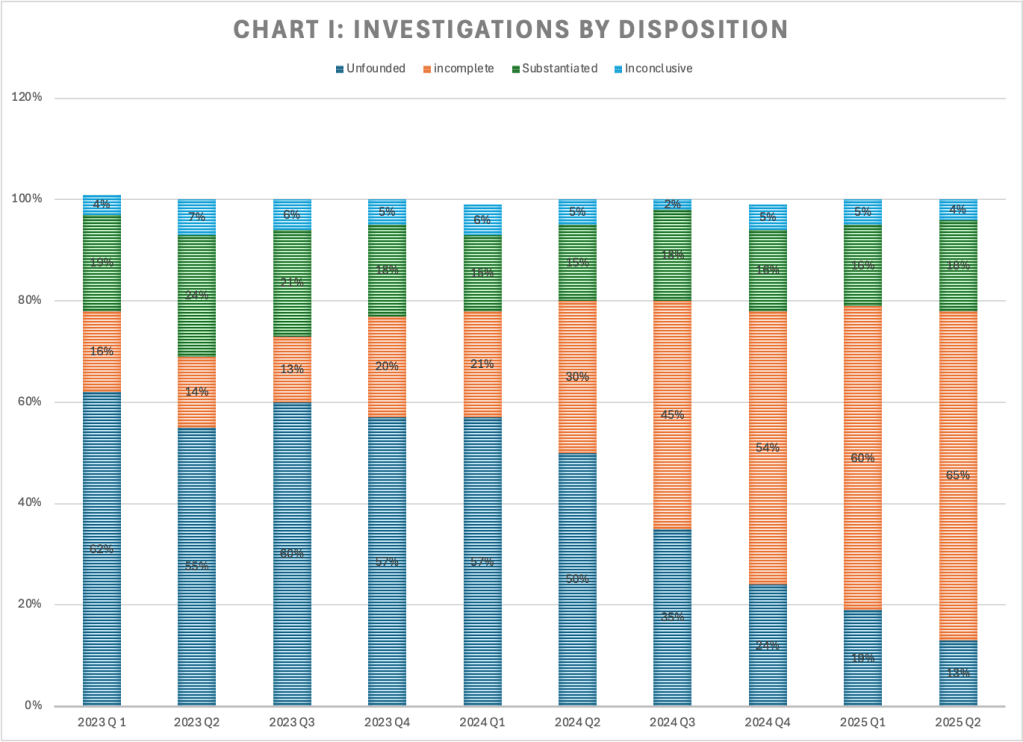
Chart I shows how the percentage of investigations by disposition has changed over the past nine quarters. The percentage of investigations that was incomplete (see the orange segments in the chart below) began to rise in the first quarter of 2024, when it jumped to 20 percent from 13 percent in the previous quarter. It rose to 30 percent in the third quarter of 2024, 45 percent in the third quarter, and 54 percent in the fourth quarter, 60 percent in the first quarter of 2025, and 65 percent in the second quarter of the current fiscal year.

Source: CFSA Dashboard, Investigations of Abuse and Neglect

As the percentage of investigations that are incomplete has increased, the percentage that are unfounded (dark blue in the above chart) has decreased–from 57 percent in the first quarter of 2024 to 13 percent in the first quarter of 2025. That drop of 44 percentage points happened at the same time as the percentage of investigations that were incomplete rose from 21 percent to 65 percent–an increase of 43 percentage points. It appears that investigations that would formerly have been closed as unfounded are now being closed as incomplete. CFSA did not respond to a request for the reasons for this change. The percentage of investigations that are substantiated has changed little since the first quarter of FY 2024.

Once an investigation is substantiated, CFSA may open a case for in-home services, or less often for foster care. As shown in Table I above, 169 in-home cases (each involving one or more children) were opened in the first half of FY 2025, compared to 125 in the first half of FY 2024. And 96 children were placed in foster care in the first half of FY 2025 compared with 110 in the first quarter of FY 2024. Unfortunately these two sets of numbers are not comparable as each in-home case can involve more than one child. But with substantiated reports increasing by over 100, in-home cases increasing by only 44, and foster care removals decreasing, it appears that some of the families with substantiated reports in 2025 are not receiving any CFSA services at all, and that is concerning. Perhaps some of these families are being referred to the collaboratives for services, which are less intensive and delivered by staff with lower credentials. And it is possible that some of these investigations may culminate in an informal kinship placement, but that means no services are provided to the parents or the children.

Clearly the staffing crisis with which CFSA (along with other agencies around the country) is struggling is responsible for the increase in incomplete investigations, and perhaps for the reduced percentage of substantiated cases receiving services as well. At the oversight hearing on February 13, 2025, Interim Director Trice pointed out that the number of investigative social workers has dropped from 100 to below 40. It is no surprise that CFSA’s oversight responses documented that most investigative workers had caseloads above 15. the maximum caseload allowed by CFSA’s Four Pillars Performance Framework. Average caseloads for the 38 investigative workers in the first quarter of FY 2025 were 30 or higher for 10 workers and 20 or higher for a total of 20 workers.

Director Trice reported that the agency is making do by diverting workers from the In-Home units to Investigations, but that is not a good solution. Families with in-home cases are often deeply troubled, with long histories of chronic neglect. According to CFSA’s 2023 Child Fatality Report, two children died while their families had open in-home cases. We cannot afford to divert these critically needed workers. Moreover, it is possible that the diversion of in-home workers to investigations may be part of the reason that in-home case openings did not increase more given the increase in substantiations. With workers not available to handle these cases, the agency may be more reluctant to open them.

What can be done? Creative solutions are needed. It may be necessary to temporarily reduce licensing or degree requirements through a special waiver due to the staffing crisis. Former Director Robert Matthews spoke of obtaining permission from the Board of Social Work Examiners to use workers with Bachelor of Social Work degrees to help investigators (not carry cases), but this plan was not mentioned in this year’s oversight responses. The agency might consider recruiting federal workers who have lost their jobs for these positions. Recruiting retired police officers and military veterans is another idea that has potential. A partnership with local schools of social work, as Maryland and other states maintain, is long past due. Those who agree to take jobs and remain for a given amount of time should receive loan forgiveness and perhaps housing as well. In a housing-hungry citizen, this could be a game changer. CFSA needs to think outside the box to resolve the staffing crisis.

CFSA’s Dashboard data for the first half of FY 2025 raises more questions than it provides answers. The most striking trend is the continuing explosion in the percentage of investigations that were incomplete–which was 65 percent in the second quarter. Also concerning is the failure of in-home case openings and foster care placements to keep up with increased substantiations. Like many other child welfare agencies, CFSA has been devoting much time and attention to programs outside of its core functions, like the warmline and family success centers. In this time of budget stringency and looming recession, it is time for CFSA to focus on its ability to perform its most basic and important function–child protection.

The power of wishful thinking: The continued promotion of Healthy Families America as a child abuse prevention program

by Marie Cohen

The original version of this post was published on April 4, 2022. I decided to update and re-publish it after reading a press release from Prevent Child Abuse America stating that “PCAA’s signature home visiting program, Healthy Families America, has been proven to reduce child abuse and intimate partner violence while improving long-term health and educational outcomes.” While I cannot evaluate the claim about domestic violence, the post below show that Healthy Families America has not been “proven” to reduce child abuse.

I have written before about the power of wishful thinking and how it causes people to disregard research and real-life results. A program called Healthy Families America (HFA) offers a good example of the power of wishful thinking. The nation’s oldest and largest charity (now called Prevent Child Abuse America or PCAA) dedicated to the prevention of child abuse launched HFA based on weak evidence that a program in Hawaii could prevent child maltreatment. The first experimental study of the Hawaii program found no impact on child maltreatment but did nothing to derail the launch of HFA, which grew into the centerpiece of PCAA. Studies of HFA programs around the country have found little evidence of reductions in child maltreatment, but the program has continued to grow. The story of HFA is a lesson in the power of wishful thinking and the failure of evidence (or lack thereof) to counteract it.

As told in a helpful history of home visiting, all modern programs can trace their origins to Henry Kempe, whose book, The Battered Child, brought about the recognition of child maltreatment as a national problem. To address child abuse, Kempe called for universal prevention through a network of home health visitors. Inspired by Kempe, modern home visiting began with Hawaii’s implementation of the Healthy Start Project (HSP) in 1975. HSP was developed on the island of Oahu. It had two components: early identification (at the birthing hospital) of families with newborns at risk of child abuse and neglect and home visiting by trained paraprofessionals for those families classified as at-risk who agreed to participate. This initial program was never evaluated, but anecdotal information suggested it was successful in promoting effective parenting, and six similar programs were established on neighboring islands.

The Hawaii Legislature authorized a three-year pilot program focusing on one neighborhood in Oahu, which began in 1985. There was no control group in the pilot study, and the researchers used CPS reports and changes in family stress in participating families to measure program effectiveness. During the three-year pilot, there were few reports of physical abuse, neglect or imminent harm for program participants. Because evaluations of other home visiting programs had found much higher rates of reported maltreatment in comparison group families, these results were viewed as evidence that the program had a positive impact. According to the authors of the first rigorous evaluation of HSP, “The pilot study results might have been given too much weight, given the lack of a control group and the short period of follow-up for most families.” Nevertheless, the results of this unpublished study were enough evidence for the Legislature to expand HSP throughout Hawaii starting in 1989.

Home visiting in general was gathering steam in the 1980s and early 1990’s. In 1990, the U.S. General Accounting Office (GAO) issued a report promoting home visitation as a “promising early intervention strategy for at-risk families.” In its summary of research evidence, GAO focused mostly on health and developmental benefits for children, rather than maltreatment prevention. In 1991, the U.S. Advisory Board on Child Abuse and Neglect issued a report recommending a pilot of universal voluntary neonatal home visitation, stating that the efficacy of home visiting as a preventive measure was “already well-established.” The Board cited the results of a federally-funded demonstration begun 17 years earlier as well as the the nurse home visitation program started by David Olds in 1977. But HSP was not mentioned.

Despite the lack of a rigorous evaluation, the National Committee to Prevent Child Abuse (NCPCA, now called Prevent Child Abuse America), which bills itself as the nation’s “oldest and largest organization committed to preventing child abuse and neglect before it happens,” had become interested in using HSP as the nucleus of a national home visiting program. But first, NCPCA conducted a one-year randomized trial of HSP. The trial suffered from severe methodological limitations, including “less than ideal followup,” differential dropout rates in the program and control groups, the failure to blind interviewers to experimental or control status, and reliance on program staff rather than researchers to measure some outcomes. Nevertheless, the trial concluded that HSP reduced child maltreatment, and this apparently gave NCPCA the assurance it needed to invest in the model.

NCPCA launched Healthy Families America in 1992, with financial support from Ronald MacDonald House Charities. Rather than impose a single service model, HFA was based on a set of principles or critical elements, which included initiation of services prenatally or at birth, assessment of the needs of all new parents in the target area, voluntary nature of services, at least weekly services for families with the highest needs, availability of services for three to five years, comprehensive nature of services, and cultural competence, among others. The typical HFA program included an assessment of all new or first-time parents in a given community at the time their babies are born or prenatally.”

In the meantime, the Hawaii Department of Health recognized the limitations of both the pilot study and the NCPCA study and initiated a more rigorous evaluation of HSP in 1994. This was a randomized controlled trial, with at-risk families identified at the hospital and randomly assigned to the experimental and control groups. In 1999 the results of the Evaluation of Hawaii’s Healthy Start Program were released as part of an issue of the Future of Children journal containing evaluations of six different home visiting models.  No overall positive program impact emerged after two years of service in terms of child maltreatment (according to maternal reports and child protective services reports). Early HFA evaluation results, published in the same issue, also failed to find effects on abuse and neglect in three randomized trials, which included the HSP evaluation discussed above and another Hawaii HSP study.

David Olds had had begun testing his Nurse Home Visiting Program in 1977 and already had long-term results on the program in Elmira, NY, as well as shorter-term results for a replication in Memphis, Tenn. That program, now known as Nurse Family Partnership, was very different from HFA. It was restricted to first-time teenage mothers and the home visitors were nurses rather than paraprofessionals. The nurses followed detailed protocols for each visit. The researchers found that among low-income unmarried women (but not other participants), the program reduced the rate of childhood injuries and ingestions of hazardous substances that could be associated with child abuse or neglect. Follow-up of the Elmira group when the children were 15 found that the nurse-visited mothers were significantly less likely to have at least one substantiated report of maltreatment. These results are particularly impressive because they overrode a tendency for nurse-visited families to be reported for maltreatment by their nurse visitors. The researchers concluded that the use of nurses, rather than paraprofessionals, was key to the success of the program.

In their analysis of all six studies published in the Future of Children volume on home visiting, Deanna Gomby et al. concluded that while the HFA and HSP evaluations showed some change in maternal attitudes and self-reported behaviors related to abuse and neglect, only the Nurse Home Visiting Program showed impacts on abuse and neglect other than from self-reports. Gomby and her co-authors also concluded that the results of all six home visiting evaluations were discouraging for those who had high hopes for home visiting for solving an array of problems. All the programs “struggled to enroll, engage and retain families.” Program benefits generally accrued to only a subset of enrolled families and were often quite modest. The authors explained the disappointing results by concluding that human behavior is hard to change, particularly when problems are community-wide. They recommended that “any new expansion of home visiting programs be reassessed in light of the findings presented in this journal issue” and stated that home visiting services are “best funded as part of a broad set of services for families and children.”

But the home visiting juggernaut was already in motion nationwide. And NCPCA, renamed Prevent Child Abuse America in 1999, had already made HFA its centerpiece program. Home visiting grew, and HFA grew with it. In 2010, Congress created the Maternal, Infant and Early Childhood Home Visiting Program (MIECHV), which was re-authorized in 2018 with funding of $400 million per year through FY 2022. HFA is one of the models that are most frequently implemented with MIECHV dollars. Home visiting programs can also receive funding through Medicaid, Title IV-B and IV-E of the Social Security Act, and many other funding sources. HFA now serves over 70,000 families per year at an average cost of over $3,000 for a family in its first year of home visiting.

The infusion of funding for HFA research resulted in a multitude of research projects (both randomized trials and less rigorous studies) and resulting publications. Nevertheless, research has yet to find solid evidence that these programs have an impact on child maltreatment: The California Evidence-Based Clearinghouse for Child Welfare (CEBC), the pre-eminent child welfare program clearinghouse, reviewed 19 research reports on HFA. Its website as of April 2022 gave the program a rating of “4” on a scale of 1 to 5 for prevention of child abuse and neglect, meaning the evidence fails to demonstrate that HFA has an effect on abuse and neglect. Interestingly, that rating no longer appears on the CEBC website, but the earlier version is preserved by the Wayback Machine. As of April 2025, HFA is no longer listed at all in the CEBC’s document titled Home Visiting Programs for Prevention of Child Abuse and Neglect. When I emailed the CEBC to ask about the missing rating, I received an email stating that Healthy Families America “is still currently under review in the Prevention of Child Abuse and Neglect topic area. The rating for this topic area was pulled from the website during the rereview process. Some programs take longer to review due to the amount of research and other factors.”

HFA was not designed to work with families that have already been found to abuse or neglect their children but that did not stop child welfare agencies from spending federal and state funds delivering HFSA to families under the Family First Prevention Services Act (FFPSA). Despite the lack of evidence of its impact on maltreatment, HFA received a rating of “Well Supported” from the clearinghouse established by FFPSA to determine whether a program can receive federal funding under Title IV-E of the Social Security Act. To get such a rating, the program must show improved outcomes based on at least two randomized trials or rigorous quasi-experimental studies. But these outcomes could be any sort of “important child and parent outcome,” (not just reduction of child abuse or neglect) and there is no standard for how to measure each outcome. Based on its review of all HFA studies that met their criteria for inclusion, the Clearinghouse found 23 favorable effects, 212 findings of no effect, and four unfavorable effects across 16 outcomes. This included five favorable effects on child safety based on parents’ self-reports of maltreatment, with no favorable effects on other measures of child safety. Self-report is generally frowned upon as a measure of child maltreatment, for obvious reasons. A positive impact of HFA might reflect that participants in HFA were more eager than control group members to provide the “right answer” to questions about maltreatment.

The “well-supported” rating from the Title IV-E clearinghouse allowed states to spend Title IV-E funds on services to families with a child welfare in-home case. To take advantage of this new market, HFA announced in September 2018 that families referred by the child welfare system were now able to enroll as long as the child in question was 24 months of age or younger, as opposed to the original requirement that services start at or before birth. To serve these families, HFA introduced special child welfare protocols. HFA advertises these protocols on its website, stating that “HFA’s evidence and the flexibility of enrollment make HFA a great prevention choice for states and child welfare organizations seeking to strengthen families and reduce the number of children placed in foster care.” (Note that there is no mention of reducing abuse and neglect!)

Today, the diversity of HFA programs makes evaluation of the program as a whole impossible. According to the website, “HFA puts communities in the driver’s seat. Local HFA programs are able to choose their eligibility criteria, parenting materials, and hire the staff they deem best to do the job. With the amount of flexibility offered, HFA has been able to be successfully implemented in a wide variety of communities.” It is hard to imagine what the evaluation of one HFA program means about the effectiveness of other programs under the same name.

Critical examination of the HFA website shows that the organization skews its portrayal of available research to present it in the most favorable light and avoids direct statements that the program prevents child abuse and neglect. On its Evidence page, HFA claims the “highest rating possible from CEBC in the category “Home Visiting Programs for Child Well-Being,” without mentioning that in the category “Home Visiting Programs for the Prevention of Child Abuse and Neglect,” HFA is currently unrated after the statement that it was unable to demonstrate an effect was removed. The page goes on to group the effects of HFA into three categories, stating that participants “build nurturing relationships with their children,” “champion their children’s health and development,” and “cultivate a flourishing future for their family.” Reductions in abuse and neglect are not mentioned in the description of how parents “build nurturing relationships with their children.”

It is disappointing that an organization that defines its mission as child abuse prevention, decided to fund HFA before it was proven to prevent child maltreatment and continued with this commitment even after the disappointing evaluations of 1999 might have led them to diversify their investment. That PCAA continues to use charitable contributions made for the prevention of child abuse and neglect to fund a program that has not been proven to accomplish this goal, raises serious ethical questions. Twenty-three members of the 45-person staff (which has grown by five staff in three years !) listed on the Prevent Child Abuse website have duties linked to Healthy Families America.

The story of HFA is not an unusual one. I have written about the similar disregard for evidence in the promotion of models such as Homebuilders and blind foster care removals. Such stories are all too frequent. They show us how wishful thinking can drive leaders to disregard research, especially after they have made a premature decision to commit to one program or course of action.

As foster care removals plummet, where’s the promised help for families?

Year after year, states and the federal government continue to release annual data showing a decline in the number of children in foster care, congratulating themselves on keeping families together. They seem to have forgotten that reductions in foster care were supposed to be accompanied by increased services so that children could be safely maintained at home. Unfortunately, there seems to be little to no interest on the part of the federal Children’s Bureau, Members of Congress, advocates, or the media in whether such services are actually being provided.

The newest report from the Adoption and Foster Care Analysis and Reporting System (AFCARS) showed that the number of children in foster care dropped to 368,530 on September in 2022–a drop of 5.8 percent over the previous year 15.6 percent since 2018. “We are encouraged by the continued decrease in the number of children entering foster care and staying in foster care and we will continue working with our state, tribal and territorial partners to ensure an emphasis on family well-being and safe family reunification,” said Jeff Hild, the Principal Deputy Assistant Secretary of the Administration on Children and Families (ACF) in a press release heralding the new numbers. ACF gave credit to the Family First Prevention Services Act (FFPSA), which “helped change the conversation to be about prevention of foster care placements and preservation of families.” 

It seems premature to celebrate the shrinkage of the foster care rolls as a triumph without knowing what is happening to the children remaining at home who would have been removed in a different year. How many of these children are living with abuse or neglect that will leave lasting scars or impair their development, if not endanger their lives? Supporters of the Family First Prevention Services Act (FFPSA), which passed in 2018, said that declining foster care counts would result from providing support to parents who needed help to address the problems (like substance abuse, mental illness and poor parenting skills) that led to their maltreatment of their children.

After an allegation of abuse or neglect is substantiated, an agency can place a child in foster care or open a case for in-home services, among other options.1 FFPSA made it possible to use the same federal funds for foster care and in-home services, allowing children to stay at home safely while their parents addressed the issues that put them at risk. A major purpose of FFPSA was to enable states to use federal funds that were formerly available only for foster care to pay for parenting support, mental health, and drug treatment that would enable children to stay safely with their families. The rationale for this change was that allowing foster care funds to be used for such services was necessary to enable states to keep kids out of foster care.

However, FFPSA has not made massive federal resources available for such services. ACF estimates that only 18,400 children in the entire country were served by Title IV-E prevention services programs in FY 2023, at a cost of $167 million. But perhaps states are using their own funds to pay for these services? After all, foster care is more expensive than services provided to families in their homes. Both require case management, but instead of the cost of room and board for foster youth, providing in-home services usually involve referring parents to mental health and drug treatment services often funded by Medicaid or paying for parenting support programs that cost less than foster care. (Of course the supporters of FFPSA ignored this basic fact and claimed the legislation would revolutionize child welfare!). States were already providing these services before FFPSA and they could have increased them without the promised federal funding.

But believe it or not, nobody knows if more children and their families are receiving in-home services as the foster care rolls decline, since the federal government doesn’t ask states for this information. While states were already required to report the number of children entering foster care, leaving it, and in care at a point in time, FFPSA did not add a requirement to provide the same data on services provided to children and families in their homes, now that they were also covered by federal Title IV-E funds.2 Hoping some states might track this data of their own accord, I searched the data publications and dashboards on the websites of the ten states with the largest number of children in foster care according to the most recent AFCARS report,3 but I was able to obtain this data for only California and Texas.

California has by far more children in foster care than any other state, 45,924 children at the end of September, 2022, which was 12.4 percent of the national total. Fortunately, there is extraordinarily good data from the California Child Welfare Indicators Project (CCWIP), a collaboration between University of California at Berkeley and the California Department of Social Services. The CCWIP dashboards include data on the number of entries into foster care and the opening of Family Maintenance cases, as in-home cases are called in California. Entries into foster care declined precipitously from April 2019 to March 2020 and continued declining, though more slowly, through March 2024. Family Maintenance case openings also declined continuously throughout the period. Thus, there was no increase in Family Maintenance case openings to compensate for the decline in removals. Or put in a different way, the total number of cases opened for child welfare services dropped from 46,264 at the beginning of the period to 29,969 at the end–a drop of 35 percent. Rather than a shift from foster care to in-home services, there has been a shrinkage of children reached by child welfare services overall.

Source: California Child Welfare Indicators Project, Entries, https://ccwip.berkeley.edu/childwelfare/reports/Entries/MTSG/r/ab636/l and Case Openings, https://ccwip.berkeley.edu/childwelfare/reports/CaseOpenings/MTSG/r/ab636/l.

Texas has the third largest state foster care caseload, after Florida. The Texas data are a bit more confusing. The number of children entering foster care dropped from 16,028 in 2021 to 9,623 in 2022, an incredible 40 percent, while the number of children entering in-home services declined steeply as well, resulting in a 35.7 percent drop in all case openings. Both drops may well have been related to a new Texas law that took effect on September 1, 2021 and changed the definition of neglect to an action or lack of action that puts a child in “immediate danger” of harm, rather than “substantial risk” of harm as the previous language read. The bill also put restrictions on child removals, requiring that children can be removed only from parents who display “blatant disregard” for their actions, or whose inaction “results in harm to the child or creates an immediate danger to the child’s physical health or safety.” Interestingly, in 2022, foster care entries actually rose slightly in Texas, while family preservation entries sprung back to where they were in FY2021, resulting a substantial increase in total case openings that year. Nevertheless, the overall trend over time was a decrease in foster care entries, family preservation case openings and the total number of children receiving help through open in-home or out-of home cases. That total dropped from 72,181 to 48,619 over five years–a drop of 32.6 percent–almost the same as the drop in California’s child welfare case openings.

Source: Texas Department of Family and Protective Services, CPS Conservatorship, Removals, https://www.dfps.texas.gov/About_DFPS/Data_Book/Child_Protective_Services/Conservatorship/Removals.asp, and CPS Family Preservation, Children Entering Services, https://www.dfps.texas.gov/About_DFPS/Data_Book/Child_Protective_Services/Family_Preservation/Children_Entering_Services.asp

Florida, the state with the second largest number of children in foster care, reports on the numbers of children entering foster care but not on the number entering in-home cases. One can, however, compare the number of children in foster care at a point in time with the number of children and young adults receiving in-home services. Both numbers have been decreasing and the number of children receiving in-home services has been consistently about half of the number of children in foster care. But these numbers don’t tell us whether declining entries to foster care have been offset by increasing entries to in-home services. In general, foster care cases last longer than in-home cases. Not knowing the average length of stays in foster care and in-home cases, and how they have changed over time, one cannot tell whether in-home case openings have made up for the reduced number of entries into foster care.

The Florida data show why point-in-time data cannot be used to answer the question of whether the decline in foster care entries has been accompanied by a rise in in-home case openings. Unfortunately, none of the other eight states with the highest caseloads provide this data on their websites. Illinois and Indiana provide point-in-time data on foster care and in-home participants. The other five states with the largest caseloads–Ohio, New York, Pennsylvania, Arizona, and North Carolina–display no data on in-home case participants at all.

If California and Texas are typical, states have not been increasing their provision of in-home services to make up for declines in foster care. Instead, the total number of abused and neglected children being helped by in-home or out-of-home services (or foster care) has declined by as much as a third in five years. But we cannot assume that California and Texas represent the entire nation. It is unfortunate that the writers of FFPSA did not requiring states to include data on in-home case openings and total caseloads, given that the legislation allowed federal funds to be used for this purpose. States have not begun tracking and reporting on this data on their own, and are triumphantly proclaiming the drop in foster care without even reporting on whether in-home services are being provided instead. When Congress considers desperately-needed fixes to FFPSA, a requirement that states report in-home case data analogous to the foster care data in the AFCARS system should be included in the new legislation.

Notes

  1. Other options include referring a family to a community provider or even doing nothing nothing if the abuse or neglect was assumed to be a one-time event unlikely to occur. The family may also refuse in-home services, and the agency would then have to decide whether to file a court petition to require such services ↩︎
  2. States must provide to National Child Abuse and Neglect Data System (NCANDS) information on how many children receive “postresponse services,” meaning services after a child protection investigation. But unfortunately, “postresponse services” includes foster care and provides a duplicated count, counting children every time they are the subject of an investigation, so it is not useful in telling us how many children receive in-home services. ↩︎
  3. State foster care data can be accessed from https://www.acf.hhs.gov/cb/report/trends-foster-care-adoption. According to the latest information, the ten states with the largest number of children in foster care on September 30, 2022 were California, Florida, Texas, Illinois, Ohio, New York, Missouri, Pennsyhlvania, Arizona, and Indiana. ↩︎

The power of wishful thinking revisited: the improbable growth of Healthy Families America

I have written before about the power of wishful thinking and how it causes people to disregard research and real-life results. In that earlier commentary, I discussed the successful promotion of a practice called race-blind removals based on data from an article by a scholar who now denies knowledge of their provenance, and which have been shown to be inaccurate. A program called Healthy Families America (HFA), which currently serves over 70,000 families per year according to its website, offers another example of the power of wishful thinking. This program has become the centerpiece of the nation’s oldest and largest charity dedicated to the prevention of child abuse, even though the program has failed to demonstrate its utility in preventing child maltreatment. This organization, now called Prevent Child Abuse America, launched HFA based on weak evidence that a program in Hawaii called Healthy Start Program (HSP) could prevent child maltreatment. The first experimental study of HSP found no impact on child maltreatment but did nothing to derail the launch of HFA. Studies of HFA programs around the country have found little evidence of reductions in child maltreatment, but the program has continued to grow and now serves more families than any other home visiting program. The story of HFA is a lesson in the power of wishful thinking and the failure of evidence (or lack thereof) to counteract it.

As told in a helpful history of home visiting, all modern programs can trace their origins to Henry Kempe, whose book, The Battered Child, brought about the recognition of child maltreatment as a national problem. To address child abuse, Kempe called for universal prevention through a network of home health visitors. Inspired by Kempe, modern home visiting began with Hawaii’s implementation of the Healthy Start Project (HSP) in 1975. As described in the 1999 evaluation by Duggan and colleagues, HSP was developed by the Hawaii Family Stress Center (HFSC) on the island of Oahu. It had two components: early identification (at the birthing hospital) of families with newborns at risk of child abuse and neglect and home visiting by trained paraprofessionals for those families classified as at-risk who agreed to participate. This initial program was never evaluated, but anecdotal information suggested it was successful in promoting effective parenting, and six similar programs were established on neighboring islands.

As described by Duggan et al., the Hawaii Legislature authorized a three-year pilot program focusing on one neighborhood in Oahu, which began in 1985. There was no control group in the pilot study, and the researchers used CPS reports and changes in family stress in participating families to measure program effectiveness. During the three-year pilot, there were few reports of physical abuse, neglect or imminent harm for program participants. Because evaluations of other home visiting programs had found much higher rates of reported maltreatment in comparison group families, these results were viewed as evidence that the program had a positive impact. According to Duggan and her co-authors, “The pilot study results might have been given too much weight, given the lack of a control group and the short period of follow-up for most families.” Nevertheless, the results of this unpublished study were enough evidence for the Legislature to expand HSP throughout Hawaii starting in 1989.

Home visiting in general was gathering steam in the 1980s and early 1990’s. In 1990, the U.S. General Accounting Office (GAO) issued a report promoting home visitation as a “promising early intervention strategy for at-risk families.” In its summary of research evidence, GAO focused mostly on health and developmental benefits for children, rather than maltreatment prevention. In 1991, the U.S. Advisory Board on Child Abuse and Neglect issued a report recommending a pilot of universal voluntary neonatal home visitation, stating that the efficacy of home visiting as a preventive measure was “already well-established.” The Board cited the results of a federally-funded demonstration begun 17 years earlier as well as the the nurse home visitation program started by David Olds in 1977. But HSP was not mentioned.

Despite the lack of a rigorous evaluation, the National Committee to Prevent Child Abuse (NCPCA, now called Prevent Child Abuse America) the nation’s “oldest and largest organization committed to preventing child abuse and neglect before it happens,” had become interested in using HSP as the nucleus of a national home visiting program. But first, NCPCA conducted a one-year randomized trial of HSP, as described by Duggan et al. The trial suffered from severe methodological limitations, including “less than ideal followup,” differential dropout rates in the program and control groups, the failure to blind interviewers to experimental or control status, and reliance on program staff rather than researchers to measure some outcomes. Nevertheless, the trial concluded that HSP reduced child maltreatment, and this apparently gave NCPCA the assurance it needed to invest in the model.

NCPCA launched Healthy Families America in 1992, with financial support from Ronald MacDonald House Charities, arranging visits to 22 states by Hawaii Family Stress Center Staff. The “theory of change,” or theoretical basis for the program, as quoted by Duggan et al, started with the targeting to all newborns and their parents, which allows for diversified service options determined by individual need. Also part of the theory was a commitment to change at the individual and community levels. Rather than impose a single service model, HFA contained a set of critical elements, which included the prenatal initiation of services and the assessment of all new parents. A network was launched to bring together researchers doing experimental and quasi-experimental studies of HFA programs.

Unlike NCPCA, The Hawaii Department of Health recognized the limitations of both the pilot study and the NCPCA study and initiated a more rigorous evaluation of HSP in 1994. This was a randomized controlled trial, with at-risk families identified at the hospital and randomly assigned to the experimental and control groups. In 1999 the results of the Evaluation of Hawaii’s Healthy Start Program were released as part of an issue of the Future of Children journal containing evaluations of six different home visiting models.  No overall positive program impact emerged after two years of service in terms of child maltreatment (according to maternal reports and child protective services reports). Early HFA evaluation results, published in the same issue, also failed to find effects on abuse and neglect in three randomized trials, which included the HSP evaluation discussed above and another Hawaii HSP study.

David Olds had had begun testing his Nurse Home Visiting Program in 1977 and already had long-term results on the program in Elmira, NY, as well as shorter-term results for a replication in Memphis, Tenn. That program, now known as Nurse Family Partnership, was very different from HFA. It was restricted to first-time teenage mothers and the home visitors were nurses rather than paraprofessionals. The nurses followed detailed protocols for each visit. The researchers found that among low-income unmarried women (but not other participants), the program reduced the rate of childhood injuries and ingestions of hazardous substances that could be associated with child abuse or neglect. Follow-up of the Elmira group when the children were 15 found that the nurse-visited mothers were significantly less likely to have at least one substantiated report of maltreatment. These results are particularly impressive because they overrode a tendency for nurse-visited families to be reported for maltreatment by their nurse visitors. The researchers concluded that the use of nurses, rather than paraprofessionals, was key to the success of the program. In their analysis of all six studies published in the volume, Deanna Gomby et al. concluded that while the HFA and HSP evaluations showed some change in maternal attitudes and self-reported behaviors related to abuse and neglect, only the Nurse Home Visiting Program showed impacts on abuse and neglect other than from self-reports.

Gomby and her co-authors also concluded that the results of the six home visiting evaluations were discouraging for those who had high hopes for home visiting for solving an array of problems. All the programs “struggled to enroll, engage and retain families.” Program benefits generally accrued to only a subset of enrolled families and were often quite modest. The authors explained the disappointing results by concluding that human behavior is hard to change, particularly when problems are community-wide. They recommended that “any new expansion of home visiting programs be reassessed in light of the findings presented in this journal issue” and stated that home visiting services are “best funded as part of a broad set of services for families and children.”

But the home visiting juggernaut was already in motion nationwide. And NCPCA had already made HFA its centerpiece program. Home visiting grew, and HFA grew with it. In 2010, Congress created the Maternal, Infant and Early Childhood Home Visiting Program (MIECHV), which was re-authorized in 2018 with funding of $400 million per year through FY 2022. According to the HFA website, HFA is the model most frequently implemented with MIECHV dollars. Home visiting programs can also receive funding through Medicaid, Title IVB and IVE of the Social Security Act, and many other funding sources.

The infusion of funding for HFA research by NCPCA initiative set in motion a multitude of research projects (both randomized trials and less rigorous studies) that continues to result in publications. Nevertheless, HFA research has yet to find solid evidence that these programs have an impact on child maltreatment: The California Evidence-Based Clearinghouse for Child Welfare (CEBC), the pre-eminent child welfare program clearinghouse, reviewed 19 research reports on HFA. It gave the program a rating of “4” on a scale of 1 to 5 for prevention of child abuse and neglect, meaning the evidence fails to demonstrate that the HFA has an effect on abuse and neglect. HFA did receive a rating of 1 for “child well-being,” based on its impacts on outcomes like physical health, child development, and school readiness. In contrast, Nurse Family Partnership was rated as “1,” “well-supported by the research evidence, for the prevention of child abuse and neglect, as well as for child well-being.

Despite the lack of evidence of its impact on maltreatment, HFA received a rating of “Well Supported” from the new clearinghouse established by the Family First Prevention Services Act (“Family First”) to determine whether a program can receive federal funding under Title IV-E of the Social Security Act. To get such a rating, the program must show improved outcomes based on at least two randomized trials or rigorous quasi-experimental studies. But these outcomes could be any sort of “important child and parent outcome,” (not just child abuse or neglect) and there is no standard for how to measure each outcome. Based on its review of all HFA studies that met their criteria for inclusion, the Clearinghouse found 23 favorable effects, 212 findings of no effect, and four unfavorable effects across 16 outcomes. This included five favorable effects on child safety based on parents’ self-reports of maltreatment, with no favorable effects on other measures of child safety. Self-report is generally frowned upon as a measure of child maltreatment, for obvious reasons. A positive impact of HFA might reflect that participants in HFA were more eager than control group members to provide the “right answer” to questions about maltreatment.

The “well-supported” rating from the Title IV-E clearinghouse opened up a new source of funding for HFA. Passage of Family First as Title VII of the Bipartisan Budget Act of 2018, allowed states to spend Title IV-E funds on programs on services to families with a child welfare in-home case. To take advantage of this new demand, HFA announced in September 2018 that families referred by the child welfare system were now able to enroll until 24 months of age. To serve these families, HFA introduced special child welfare protocols, with limited evidence that that the program was effective for parents who had already abused or neglected their children.* The program had already departed from its initial mission of screening all families with newborns in a geographic area. Even without the child welfare protocols, each program can choose its own admission criteria and there is no universal screening; potential participants are generally referred by health or child welfare agencies, who often can choose between several home visiting programs when referring a client.

Another part of HFA’s original theory of change was a “dual commitment to change at the individual and community levels.” As described by Daro and Harding in their 1999 evaluation of HSA, this meant that HFA “must move beyond direct efforts to help families and begin to serve as a catalyst for reshaping existing child welfare and health care efforts and improving coordination among other prevention and family support initiatives.” This vision has clearly gone by the wayside as HFA has become one choice in a menu of home visiting programs offered by local jurisdictions. Far from trying to enhance and coordinate available community offerings, HFA is busy trying to maximize its share of the pie through its public relations effort, exemplified by the self-promotional statements on its website.

It is disappointing that Prevent Child Abuse America (“Prevent Child Abuse,” formerly NCPCA), an organization that defines its mission as child abuse prevention, decided to fund HFA before it was proven to prevent child maltreatment and without apparently considering other approaches also being tested at the time. And it is concerning that the organization continued with this commitment even after the disappointing evaluations of 1999 might have led them to diversify their investment beyond HFA or even beyond home visiting or to focus more on advocacy rather than services. And finally, that Prevent Child Abuse continues to use charitable contributions made for the prevention of child abuse and neglect to fund a program that has not been proven after 40 years to accomplish this goal, raises serious ethical questions. Twenty-two of the 40 staff listed on the Prevent Child Abuse website have positions with Healthy Families America. Perhaps the charity has backed itself into a corner; it would be difficult to escape this commitment without serious repercussions.

Some federal administrators do not seem to be much more interested in evaluation results than Prevent Child Abuse. The legislation authorizing MCHIEV required a randomized controlled trial (RCT), which may provide useful information on the relative merits of these programs in addressing different outcomes. But strangely, HHS indicated in a response to a critique from the Straight Talk on Evidence Blog that it is not interested in a “horse race” between the models but rather is interested in assessing home visiting in general. This odd statement is an indicator of the kind of thinking that allowed Prevent Child Abuse to invest in HFA for 40 years despite the lack of evidence that it does “Prevent Child Abuse.”

The story of Healthy Families America is not an unusual one. My discussion of the Homebuilders program could also be called “the power of wishful thinking.” Such stories are all too frequent. They show us how wishful thinking can drive leaders to disregard research, especially after they have made a premature decision to commit to one program or course of action.

*One study of Healthy Families New York, published in 2018, looked at a subgroup of 104 mothers who already had a substantiated CPS report, and found a decrease in abuse and neglect among the mothers who were in the experimental group. However, the sample was small and was not planned in advance, so the authors recommend further testing home visiting programs as prevention of repeat maltreatment for child welfare-involved mothers.

New Jersey to foster parents: thanks but no thanks!

Foster Parents Needed As COVID-19 Pandemic Strains Families is a typical headline these days, as illustrated in an article from Illinois. The pandemic has imposed new impediments to recruiting and retaining foster parents, including fears of exposure to COVID-19, loss of employment and income, and concerns about supervising virtual schooling. But these issues do not seem to be affecting New Jersey, where prospective foster parents are told that they are not needed, thank you very much! While the state credits its efforts at child abuse prevention and family preservation for its lack of need for foster parents, the explanation seems to lie elsewhere. Over the course of five years, the state has cut in half its rate of confirming allegations of abuse and neglect–resulting in a similar fall in the number of children entering foster care. This is a big change, and one that demands explanation in order to ensure that the agency is continuing to fulfill its mission of ensuring children’s safety in New Jersey.

Would-be New Jersey foster parents who click on “Be A Foster Parent” on the website of the Department of Children and Families (DCF) are greeted with the following message: “Thank you for your interest in becoming a resource parent to children and youth in state care.  Due to the COVID19 Pandemic and its impact on operations, DCF has suspended all new inquiry submissions at this time. Please continue to check our website for any updates.” This is an odd message indeed, as it seems to imply that the pandemic has made recruitment and licensing impossible. But agencies around the country have adapted quickly to move vetting and training online in order to enable new foster parents to enter the pipeline. Not so New Jersey.

When we asked DCF why foster parents are being turned away, we received the following reply from DCF Communications Director Jason Butkowski. “[W]e did experience a 19.17% reduction in out-of-home placements from 2019 to 2020.  This is attributable both to New Jersey’s statewide prevention network and our ongoing work to preserve families and keep children and parents together in their homes while receiving services.”

Interestingly, a message sent earlier to prospective foster parents gave a different answer. In May, 2020, would-be foster parents received a message saying, “In New Jersey, the number of youth in foster care continues to be reduced each year because we are focusing first on kinship placements,” as quoted in an article by Naomi Schaefer Riley. We asked Mr. Butkowski which explanation was more accurate–prevention and family preservation or kinship placements–but received no answer.

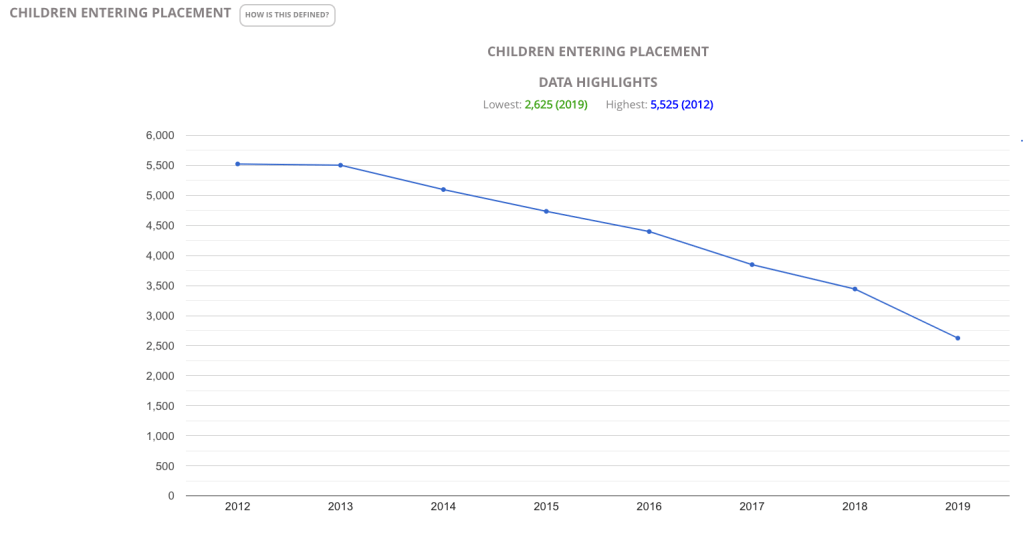
So what is going on in New Jersey? Certainly, foster care numbers have been decreasing. According to the data portal maintained by Rutgers University, annual entries to foster care fell from 5,504 in 2013 to 2,525 in 2019, as shown in the chart below. The rate of decrease in foster care entries became even steeper between 2018 and 2019, with a decrease of 23.7 percent in the number of entries in that one year alone. The total number of children in foster care dropped from a high of 7,775 in May 2014 to 4,463 in February 2020–before the pandemic closures occurred. So what could be causing this drastic decline in foster care placements and caseloads?

Source: NJ Child Welfare Data Hub, available from https://njchilddata.rutgers.edu/portal/entering-placement-reports#

One possibility might be a decline in child abuse and neglect, which Butkowski is implicitly assuming by attributing part of the fall in foster care cases to DCF’s “statewide prevention network.” In that case, one might expect reports to child abuse hotlines to decline significantly. But according to monthly state reports, calls to child abuse hotlines hardly changed between 2014 and 2019, decreasing very slightly from 165,458 to 164,417. Of course we cannot be sure that reports are an accurate measure of child maltreatment; but one might expect a significant reduction in hotline calls if a large reduction in maltreatment were occurring.

DCF’s Butkowski also credited the agency’s work to “keep children and parents together in their homes while receiving services” as a reason for declining foster care entries. It is true that most substantiations of abuse or neglect do not result in foster care. Instead, DCF works with many families in their homes to help them avoid future maltreatment. But DCF has been emphasizing in-home services for years. Of all the children who were under DCF supervision in foster care or in-home services, the percentage receiving in-home services rather than foster care was 84.7 percent in May 2014 and 90 percent in February 2020. So children were somewhat more likely to receive in-home services in 2020 than in 2014, but the difference was small and not likely to explain the big fall in the foster care rolls.

So with hotline calls basically unchanged, and only a slight increase in the emphasis on in-home services, how did New Jersey manage to reduce its foster care entries by almost half in six years? One can think of the child welfare process as a funnel, starting with referrals, the child welfare term for hotline calls. As we discussed, those have fallen only slightly. Only some referrals are screened-in and accepted for investigation; many are rerouted or receive no action because hotline workers determine that they do not concern abuse or neglect. But a reduction in screened-in referrals is not part of the explanation for New Jersey’s drop in foster care placements. New Jersey reported that 60,934 referrals were screened in in FFY 2019, compared with 59,151 in FFY 2013–a slight increase.

The next step in the child welfare funnel is investigation, and here the count shifts from the number of referrals to the number of children. According to data submitted to New Jersey to the Administration for Children and Families (ACF) and published in Child Maltreatment 2019, the number of children receiving an investigation in New Jersey increased slightly from Federal Fiscal Year (FFY 2015) to FFY 2019–from 74,546 to 78,741. However there was a stunning drop in the proportion of these children who were found to be abused or neglected (known as “substantiation” in the child welfare world). In FFY 2015, 13.0 percent of the children who received investigations (or 9,689 children) were found to be abused or neglected. In FFY 2019, only 6.5 percent of the children receiving investigations (5,132 children) were found to be victims of maltreatment. In other words, among the children who were involved in investigations, the proportion who were found to be maltreated dropped by half. Similarly, the number of children found to be maltreatment victims dropped by 47 percent. (This is very similar to the 44.6 percent decrease in foster care entries between those years shown in the Rutgers data portal cited above).

Note: The substantiation rate is the number of children found to be maltreatment victims divided by the number of children who were the subject of CPS investigations. Data are from Child Maltreatment 2019, available at https://www.acf.hhs.gov/sites/default/files/documents/cb/cm2019.pdf

It turns out that aside from Pennsylvania, which is not comparable to other states because it does not report on most neglect allegations, New Jersey had the lowest rate of substantiation per 1,000 children of all the states in FFY 2019. Only 2.6 children per 1,000 were found to be maltreated, compared to a national rate of 8.8 children per 1,000. In FFY 2015, this rate was 4.9 per 1,000 children in New Jersey–almost twice as high.

How did the number and percent of children found to be victims of child maltreatment drop so much in New Jersey over a four-year period, despite little decline in hotline calls? We asked DCF this question but received no reply. In the notes it submitted to ACF with its 2019 data, DCF acknowledged a decrease in the number of substantiated victims of maltreatment and stated that this is consistent with a continued trend–but provides no explanation. Perhaps policy or practice has changed to make it more difficult to substantiate abuse or neglect, through a change in definitions or in the standard of proof, or perhaps in training or agency culture. But such a change was not mentioned either by Butkowski or in DCF’s submission to ACF.

Let us revisit DCF’s previous message to foster parents saying that “In New Jersey, the number of youth in foster care continues to be reduced each year because we are focusing first on kinship placements.” This is an interesting statement because it implies that these kinship placements are not through the foster care system. It is important to understand that children can be placed with relatives in two ways. A child can be found to be a victim of maltreatment and placed with a relative, who becomes licensed as a foster parent. In New Jersey, 1,619 foster children (or 41 percent of the 3,951 children in foster care) were living with licensed kinship foster parents in November 2020. But these children are included in the state’s count of children in foster care, so they cannot account for the caseload drop. DCF must have been referring to something else.

Perhaps DCF’s earlier message to foster parents referred to the agency’s increasing use of a practice called “kinship diversion.” As described in an issue brief from ChildTrends, kinship diversion is a practice that occurs during an investigation or an in-home case when social workers determine that a child cannot remain safely with the parents or guardians. Instead of taking custody of a child, the agency facilitates placing the child with a relative. If this occurs in the context of an investigation, kinship diversion may result in a finding of “unsubstantiated” even when abuse or neglect has occurred, on the grounds that the child is now safe with the relative. We have no idea how widespread this practice is in New Jersey or nationwide since neither New Jersey nor other states report the number of these cases. However, the system of informal kinship care created by diversion has been called America’s hidden foster care system and nationwide it appears to dwarf the provision of kinship care within the foster care system.

There are many concerns about kinship diversion, as described in an earlier post: caregivers may not be vetted or held to the same standards as foster parents; they and the children they are caring for do not receive case management and services; they do not receive a foster care stipend and may have to depend on much-lower public assistance payments; there is nothing preventing caregivers giving children back to the parents without any assurance of safety; and parents are not guaranteed the due process rights and help with reunification that come with having their children in foster care. Because of the various concerns around kinship diversion, litigation has been filed in several states challenging this practice.

There is one other possible explanation that comes to mind for DCF’s foster parent surplus–dropping foster care rolls due to the COVID-19 pandemic. We removed data from the time of the pandemic from the above discussion to avoid confounding its effects with those of policy and practice changes but we need to ascertain whether the pandemic’s impact on calls to the hotline has affected entries into foster care. As in most states, hotline calls in New Jersey fell sharply in the aftermath of school closures and other pandemic measures. The number of child maltreatment referrals between March (the onset of school closures and quarantines) and November 2020 (the last month for which data are available on the DCF website) was 98,306, compared to 131,344 in the same period of 2019–a drop of 25 percent, based on monthly reports from DCF. It is likely that fewer calls from teachers now teaching virtually were a major factor behind this drop in hotline calls.

Entries into foster care also fell sharply in the wake of the pandemic. Foster care entries dropped from 1,949 in March through November 2019 to only 1,211 in the same months of 2020–a drop of 37.9 percent–which may have reflected in part the reduction in hotline calls and in part the continuing decrease in foster care entries that we have described. But the number of children in care did not drop nearly as much as entries into care. Between February and November 2020, the total number of youth in care decreased only 11 percent from 4,463 to 3,951. This drop is surprisingly low–in fact it is less than the decrease in the foster care caseload during the same months of 2019 (16.1 percent). The small size of this caseload decline reflects the fact that foster care exits dropped even more than foster care entries. Exits from foster care dropped from 2,754 in March through November 2019 to 1,661 in the same months of 2020. That is a drop of over 1,093, when the drop in foster care entries was “only” 738.[1] As a result, it appears that the number of children in foster care was higher, rather than lower, due to the pandemic. Therefore, it does not appear that the pandemic contributed to the decline in demand for foster parents.

One might expect to hear expressions of concern, or at least interest, in the recent precipitous drop in the number and rate of substantiations and in the foster care caseload from the court-ordered monitor charged with ensuring that New Jersey’s child welfare system is fulfilling its mission of protecting children. Since 2006 New Jersey has been operating under a settlement agreement in a lawsuit filed in 1999. The Court Monitor is Judith Meltzer, Executive Director of the Center for the Study of Social Policy (CSSP). In its most recent report, CSSP praised DCF for maintaining its progress toward meeting all the benchmarks required to exit the lawsuit, despite the challenges posed by COVID-19. Ironically, the report mentions DCF’s progress in “Prioritizing Safety.” The report does not mention the precipitous drop in foster care entries or substantiations before the pandemic or the fact that the state is turning away prospective foster parents.

New Jersey may be the first state to have stopped accepting applications for foster parents, and the reasons cited by DCF do not seem to explain this unusual event. Careful study of DCF data shows that the rate at which allegations of abuse or neglect are substantiated has been cut in half, and that there has been a similar reduction in entries into foster care. This cut in the substantiation rate could be due to policy or practice changes making it harder to confirm child maltreatment or it could be due to an increased tendency to place children with relatives without establishing officially that maltreatment has occurred. Without an adequate explanation from the state, the extent to which either of these factors is driving these trends is unknown. It is imperative to know the explanation of this trend to ensure that DCF’s new policies and practices are not compromising its mission of keeping children safe.

[1]: Reasons for this drop in foster care exits may include court shutdowns and delays and suspension of services parents need to complete their reunification plans.

Illinois’ Intact Family Services: What happens when family preservation trumps child safety?

ChapinHallIllinois’ child welfare services to families that are allowed to keep their children have major systemic flaws that put children at risk. Most importantly, there is extreme reluctance to remove children from their homes and place them in foster care. Those are the findings of a review from Chapin Hall at the University of Chicago that was commissioned by the Governor in the wake of several deaths of children whose families were being supervised by the state.

This report follows an earlier one, discussed in a  previous post,  by the Inspector General (OIG) for the Illinois Department of Children and Family Services (DCFS) stating that child safety and well-being are no longer priorities for the agency.  One problem area identified in that report was Intact Family Services, which are the services provided to families in order to prevent further abuse or neglect without removing the child. OIG’s 2018 annual report included an eight-year retrospective on the deaths of children in Intact Family Services cases, which concluded that in many of these cases the children remained in danger during the life of the case due to violence in their homes, when DCFS should have either removed the children or at least sought court involvement to enforce participation in services,

Increasingly, child welfare systems around the country have been relying on services to intact families (often called in-home or intact family services) in order to avoid placing children into foster care. In 2017, according to federal data, only 15% of children who received services after an investigation or assessment were placed in foster care; the other 85% were provided with services in their homes. These services may become even more predominant with implementation of the Family First Prevention Services Act, which allows federal Title IV-E funds to reimburse jurisdictions for the cost of such services.

It is important for child welfare agencies to be able to work with families that remain intact. This allows the agency to monitor the children’s safety and avoid the trauma of placement in foster care while working to ameliorate the conditions that might lead to a foster care placement. But agencies must be cognizant that not every family can be helped this way, keep a close watch what is going on in the home, and be ready to remove children when necessary to ensure their safety. The deaths of children who have received Intact Family Services in Illinois have raised questions about whether the agency is accomplishing these tasks.

In Illinois, Intact Family Services (referred to below as “Intact”)  are provided mostly by private agencies under contract with DCFS. The Chapin Hall  report found systemic issues that create barriers to effectively serving intact families.

Avoiding foster care placement: Perhaps the most important issue observed by the researchers was the high priority that Illinois places on avoiding placement of children in foster care. As a result of many years of such efforts, Illinois now has the lowest rate of child removal in the country. Intact staff expressed the belief that “recommendations to remove children based on case complexity, severity, or chronicity will not be heard by the Division of Child Protection (DCP) or the Court.” As a result, Intact supervisors are reluctant to reject referrals of families even when they believe a family cannot be served safely in the home.  They are also reluctant to elevate cases for supervisory review when they have not been able to engage a high risk family.

Supervisory Misalignment: In the past, negotiations between DCP and Intact over the appropriateness of a referral occurred on a supervisor-to-supervisor level, allowing Intact to push back against unsuitable referrals. An administrative realignment that placed investigators and Intact under different administrations eliminated this ability of Intact to contest inappropriate referrals. According to the researchers, this resulted in the opening of Intact cases for families with “extensive histories of physical abuse” that Intact staff believed they could not serve effectively.

High Risk Case Closures:  Intact service agencies are expected to work with a family for six months and then close the case with no further involvement by DCFS. The researchers learned that there was no clear pathway for intact staff to express concerns when they been unable to engage a family. As a result, some providers told the researcher that they may simply close the case when a family will not engage.

Staffing Issues: Caseload, capacity and turnover.  The researchers found that DCP investigators are overwhelmed with their high caseloads and are desperate to make referrals to Intact to get families off their caseload as soon as possible. The prescribed caseload limit of 15 cases per worker is very hard to manage, and some workers carry even more cases. Moreover, DCP workers tend to stop managing safety plans and assessments as soon as a referral is made to Intact, which leaves children in limbo until services begin. For their part, Intact workers’ caseloads are often over the prescribed limits and are not adjusted for travel time or case complexity. Moreover, the difficulty of their clientele makes the current caseload of 10:1 difficult to manage. High turnover among Intact workers, investigators and other staff can also contribute to the information gaps and knowledge deficits mentioned below.

Role Confusion: DCP workers and Intact workers seem to have different views of the role of the DCP worker, according to the researchers. DCP workers view their role as making and justifying the decisions about whether to substantiate the referral and remove the child. However, the Intact Family Services policy calls upon them to engage the family and transmit all necessary information to the Intact staff. Cultural differences between the two sets of workers compound the problems.

Information Gaps: Because of the role ambiguity mentioned above, investigators often fail to pass on crucial information to Intact workers. Yet, these workers often cannot access investigators notes or key features of the case history. Moreover Chapin Hall’s reviews of the two recent deaths of toddlers in intact cases found that much of the family’s history was inaccessible because cases were expunged or purged. DCFS expunges most unsubstantiated reports and shreds investigators files and appears to be more aggressive about such expungements than most other states, according to a previous DCFS Director, George Sheldon.

Service Gaps: The researchers also mentioned gaps in service availability, especially long waiting lists for substance abuse prevention, which make it very difficult to engage families as well as providers.

The authors made a number of recommendations for addressing these problems they identified.  These include:

  • Work with courts and State’s attorneys to refine the criteria for child removal in complex and chronic family cases;
  • Develop and refine protocol for closing Intact cases;
  • Direct attention to cases at greatest risk for severe harm; revisit the use of predictive models which should be transparent, based on broad input and be supported by ethical safeguards’
  • Clarify goals and expectations across staff roles;
  • Utilize evidence-based approaches to preventive case work;
  • Improve the quality of supervision;
  • Adjust the preventive services offered through Intact to meet the needs of the population;
  • Restructure Intact Services to address the supervisory mismatch with DCP; and
  • Redesign the assessment and intake process to reduce redundant information, improve accuracy or assessments to support decision-making and improve communication across child serving systems.

We would have liked to see a recommendation to modify Illinois’ policy of expunging and purging all unsubstantiated investigations. At a hearing in May, 2017, the DCFS Director, George Sheldon, expressed his support for allowing DCFS to keep records of all investigations, even if they are unsubstantiated. Research suggests that it is very difficult to make accurate decisions about whether maltreatment has occurred; moreover, unsubstantiated reports are as good as substantiated ones in predicting future maltreatment. Examples of children killed after families have had multiple unsubstantiated reports have been observed all over the country.

This report should be a must-read for all child welfare agencies.  Children in many states have died of abuse or neglect after intact cases have been opened for their families. (Think about Zymere Perkins in New York or Anthony Avalos and Gabriel Fernandez in Los Angeles.) Many of the issues identified by the Chapin-Hall report may have contributed to these deaths as well, particularly the extreme avoidance of child removals that has condemned so many innocent children to death ever since the widespread push to reduce the foster care rolls, supported by a coalition of wealthy and powerful foundations and advocacy groups.