A Reality Check on Family First: It Has Nothing to Do with the 50% Decline in Indiana’s Foster Care Caseloads

by Emily Putnam-Hornstein (University of North Carolina at Chapel Hill), Sarah Font (Pennsylvania State University), and Brett Drake (Washington University in St. Louis).

I am honored to publish this post by three of the leading academic researchers in child welfare. As often is the case in this blog, they are writing about the flawed use of data to support the user’s claims about a policy or program. In this essay, the authors discuss last year’s testimony by Indiana’s deputy director of child welfare services claiming success for the state’s family preservation program in reducing foster care caseloads without compromising child safety while also reducing racial disparities.

On May 22, 2024, the U.S. Senate Committee on Finance held a hearing titled “The Family First Prevention Services Act (FFPSA): Successes, Roadblocks, and Opportunities for Improvement.” The testimony was striking for its still-aspirational tone 6 years after the law passed and its sanitized depiction of why children enter foster care. As researchers, however, the statistics offered by Indiana’s deputy director of child welfare services, David Reed, caught our attention. Reed’stestimony indicated that FFPSA and associated investments in intensive family preservation services and concrete supports had produced: (1) a 50% decline in the state’s foster care caseload, alongside improved child safety; and (2) a two-thirds decrease in racial disparities among children entering foster care.

These claims are striking and beg the question: How?

On their very face, such dramatic numbers should invite skepticism. Despite continued efforts to move “upstream,” empirical studies of maltreatment prevention programs generally generate null or small effects. But one way for an agency to achieve a rapid reduction in foster care caseloads is to increase the threshold for intervening, leaving children in environments from which they would have been previously removed.

Below, we review data for Indiana and conclude that available evidence does not support the testimony offered.1 This is problematic not only for Senate Committee Members, but also the field at large. Bold causal claims based on flawed interpretations of data too often lead policymakers, and the public, to conclude that there are easy fixes to complex problems. 

Reducing Entries to Foster Care and Improving Child Safety

The ideal way to reduce foster care entries is by reducing the community incidence of child abuse and neglect. Other than a brief drop during the COVID-19 pandemic, and despite investments in voluntary programs such as Healthy Families Indiana, referrals to Indiana’s child maltreatment hotline were largely stable pre- and post-FFPSA implementation (i.e., 168,919 in 2017 vs. 172,077 in 2023). There is no evidence of a decrease in suspected maltreatment identified by community members.

Of note, data indicate that Indiana is now screening in a smaller percentage of referrals (75.0% in 2017 to 57.9% in 2023). Certainly, it is possible that Indiana was responding to allegations of maltreatment that were unwarranted. Indiana issued guidance in 2021 designed to change the state’s response to allegations of “educational neglect.” But if such changes led to the reduction, one would expect that as more “low-risk” referrals were screened out, children who were screened in would have higher risk and a greater share would be identified as victims requiring services.

Yet that is not what the data show. Among children who were screened in, the number of substantiated victims declined by roughly 30% between 2017 and 2023. This decline is particularly notable, given that during this same period, overdose deaths in Indiana were increasing and parental substance abuse is one of the most well-established risk factors for child maltreatment. It would appear that in addition to reducing the number of children who received a response, Indiana also increased its threshold for substantiating maltreatment. Importantly, changes in substantiation thresholds affect not only overall child victim counts, but also the federal measure of repeat maltreatment, which is the indicator of safety cited in Reed’s testimony. The easiest way to document improvements in child safety is to raise the bar for substantiation, thereby reducing both the initial victim count and the likelihood of identifying repeat incidents. 

Short of successful efforts to reduce the incidence of maltreatment in the community at large, a second way an agency could theoretically—and safely—reduce the number of children in foster care is by expanding efforts to prevent placement by providing more families with effective services and resources. Yet once again, Indiana’s data show that fewer rather than more children reported for maltreatment have received in-home services. State data suggest a reduced number of children receiving in-home services in absolute numbers (Figures 1 and 2, Table 1) and no change in the proportion (Figure 3). Moreover, as depicted in all three figures and consistent with screening and substantiations, steep declines in in-home services and foster care caseloads began in 2017, before FFPSA was implemented.

A third possibility is that the services provided have become more effective, thus reducing the rate of children entering foster care. Yet the major program touted by Reed in his FFPSA testimony—an intensive family preservation program called Indiana Family Preservation Services—appears to have no effect on removal and a near-zero effect on repeat maltreatment.2 Indeed, the program is described as having “0 favorable effects” by the federal clearinghouse for evidence-based programs. There is simply no way to attribute a 50% foster care reduction to Indiana’s prevention services. 

Finally, because the number of children in foster care is a function of the number of children entering care relative to the number of children exiting care, an additional possibility is that Indiana found ways to transition children out of its foster care system faster or in greater numbers. However, foster care entries declined from 12,826 in 2017 to 6,212 in 2023. underscoring that the bulk of the 50% caseload reduction likely stemmed from fewer entries.

Decreasing Racial Disparities

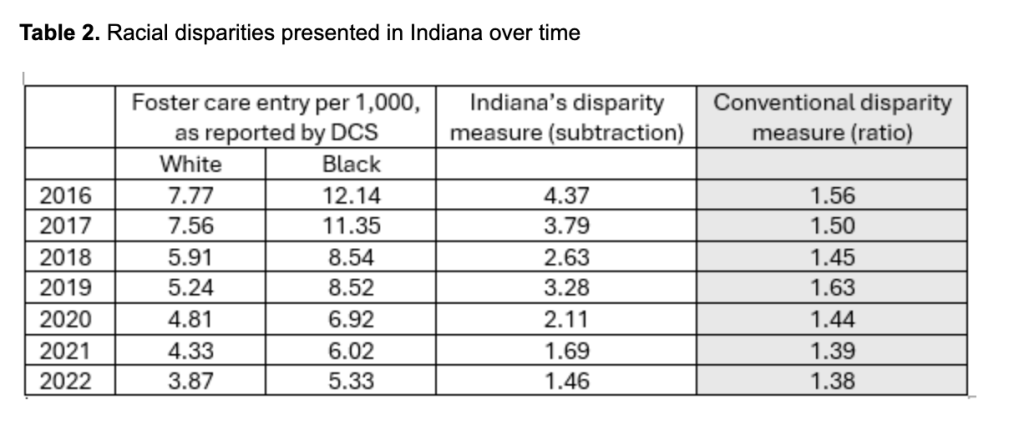
Senate committee members also heard about data suggesting that Indiana’s Black–White disparity in foster care entries declined by two thirds. The statistics presented, however, were quite unusual. The typical approach—both in the health literature and as a longstanding practice in child welfare—is to measure disparities as a ratio of rates (known as relative risk). In the context of the testimony presented, this would have been presented as the Black foster care entry rate divided by the White foster care entry rate.

But this is not what was used.

Rather, Indiana’s numbers were presented as the subtracted difference: the Black foster care entry rate minus the White foster care entry rate. The problem with this approach is that it is very sensitive to base rates. Imagine that rates of removal were 10 per 1,000 Black children and 1 per 1,000 White children, then those rates decreased to rates of 1 per 1,000 for Black children and 0.1 per 1,000 for White children. In both cases, the relative risk of removal is 10 times higher for Black children than White children (a 0% change in disparity). But using Indiana’s subtraction-based measure, it would appear that the disparity declined from 9 to 0.9: a 90% reduction. 

Using the conventional disparity ratio formula, the Black–White removal rate disparity declined only slightly in 2021–2022 compared with 2016–2017—a reduction of roughly 12%, not the “66.9% decrease” indicated in Reed’s testimony (see Table 2).

Summary

Available data do not support testimony that FFPSA implementation and Indiana’s Family Preservation Services program led to a 50% decline in foster care cases. Likewise, any reported improvements in child safety are likely an artifact of changed thresholds for classifying child maltreatment victims. We also believe that this testimony indicating dramatic reductions in racial disparities is quite overstated.

Of course, it is always possible that we have misunderstood the numbers Reed referenced—which is why we contacted him almost a year ago and shared our analysis. We received no response. If there is additional data that supports the testimony provided, we hope it will be made available. Until then, it is only reasonable to conclude that the striking claims made do not hold up to even modest scrutiny.

Note: On June 3, 2025, the IndyStar published an op-ed by Emily Putnam-Hornstein and Sarah Font summarizing the analysis in this post.

Notes

  1. Regarding data published by Indiana’s Department of Child Services, we relied on publicly available information published as of June 2024 to align with what would have been available at the time this testimony was prepared. We also used data submitted by Indiana and found in the annual Child Maltreatment Reports. We focused on trends from 2017 (before FFPSA) through 2023 (the most recent year available).
    ↩︎
  2. To elaborate, the intervention produced no “direct effect” on children entering foster care (i.e., no statistically significant reduction occurred in placements among families who were served). Published research has indicated that the intervention may have led to a small reduction in repeat maltreatment. To be generous, Indiana officials might argue that despite no direct effect on removals, the reduction in repeat maltreatment led to reduced removals over time. However, the estimated reduction in repeat maltreatment is only 4%, meaning that any indirect effects on removals cannot be more than this 4%. It is also worth noting that the declines in foster care caseloads began long before the program was implemented at any scale in Indiana. ↩︎

Figures and Tables

What can happen when “Family First” goes too far: a Wisconsin story

On October 1, 2021, the Family First Prevention Services Act (FFPSA) took effect for all states that had not yet implemented it. But many jurisdictions had already been realigning their systems in line with the family preservation emphasis of FFPSA before that time – many with great fervor. An article about one Wisconsin county piqued our curiosity, and further investigation suggests the state may be encouraging a disproportionate emphasis on keeping families together at the expense of child safety. Wisconsin is certainly not unique; the focus on keeping families together at almost all costs has been increasingly prevalent in state and county child welfare systems since long before the passage of FFPSA in 2018.

On August 13, the local Gazette published an article reporting that that foster parents and others in Rock County Wisconsin were asking for an investigation into worker turnover and leadership in the county’s child welfare system. Rock County is a county in southern Wisconsin with a population of 163,354 in 2018 and home of the city of Beloit. The article reported that at a recent meeting of the county board, local foster parents complained about employee turnover and a change in philosophy in the County’s child welfare system since the passage of the Family First Act by Congress in 2018. The foster parents alleged that changes in the child welfare system “have led to a mass exodus of longtime county CPS staff.” According to the speakers, the exodus in turn has resulted in a curtailing of investigations and delays in finding services and permanent homes for foster children.

County reports obtained by the Gazette showed that turnover among Child Protective Services (CPS) investigative and ongoing support workers increased from 57 percent in 2016 to 88 percent since that time. The Gazette found that 56 workers had left these jobs since 2016, leaving only three workers still in place who had been there in 2016. In open letters to the board, CPS workers expressed fear that they would “be fired, demoted or marginalized if they voice[d] ideas that run contrary to the county’s shifts in the foster system.” (The county’s Human Services chief later challenged the information about turnover, telling the Gazette that it had been 70 percent since 2016.)

The Gazette also reported dramatic growth in the backlog of completed investigations. According to data from the state Department of Children and Families (DCF) dashboard, the county had a 94% rate of timely completion of initial child screenings (child maltreatment investigations) in 2016, placing it close to the top of all counties in Wisconsin. But by this year as of September 28, 2021, Rock County had completed only 44.7 percent of initial screenings on time, placing it near the bottom of all counties.

Current trends in child welfare suggest that the change in philosophy to which parents and workers were referring was the increased focus on family preservation incorporated in the Family First Act, which had already been taking hold in many states before they actually implemented it. Information available on the website of Wisconsin’s Department of Children and Families supports that assumption. According to a page titled Child Welfare Strategic Transformation in Wisconsin, [s]ince 2018, Wisconsin has been progressively working toward transitioning the child welfare system to become more in-home, family-focused, and collaborative.” The website also indicates that DCF had “partnered with” a company called Root Inc. (a “change management consulting firm”) “to understand how Wisconsin counties were progressing toward achieving the 4 strategic priorities listed above.” A slide presentation from DCF and Root Inc. indicates that the purpose of the partnership is to “dramatically increase the number of children/families served in home.”

In the first phase of the partnership, according to the slides, Root’s ethnographic researchers studied 13 counties (including Rock County) through interviews, focus groups, and observations and came up with “a set of 17 behaviors that differentiated counties along a continuum of change and transformation.” In choosing the counties for the study, the researchers identified counties that they characterized as “on the way” or “advanced” based on the decline in the rate of their foster care populations, the ratio of entries to exits, and the percentage of calls that lead to removals of children from their families. (They left out counties on the bottom of the continuum of change). The authors of the slides did not provide the classification for each county, but Rock County’s inclusion means it was classified as advanced or at least “on the way.”

The first set of findings about “advanced” counties refers to “Mindsets and Decision-Making.” In these counties, one slide indicates that the “culture prioritizes and reinforces the importance of keeping families in home.” There are six bullets under that heading, which are displayed below. Two are of particular interest. “Decisions to remove are met with critical questioning and even pushback. And in “observation, individuals apologize to their peers when pushing for a [court] petition [for removal of a child].”

Source: Wisconsin Department of Children and Families. Child Welfare Transformation. Available from https://dcf.wisconsin.gov/files/press/2021/wi-dcf-root-insights-03-12-county-detailed.pdf

This language raises some serious concerns. Obviously it is best to keep children at home when it is possible to do it safely. But some children cannot be kept safe at home. And to say a worker should receive pushback, or even apologize, for trying to save a child’s life or prevent injury seems excessive, to say the least

In terms of worker-family relationship, the slides state that advanced counties are “[n]on-judgmental towards actions and optimistic in the belief that families can change.” Specific behaviors cited include that “[w]orkers discuss severe forms of maltreatment with a desire to understand the root causes without passing judgment.” Workers in advanced counties are also said to “easily identify strengths of a family.” In fact, teams in advanced counties “hold each other accountable for negative or pessimistic views of families and work hard to avoid anything that could be perceived as disparaging of a given family.” Moreover, “even with complex cases,” workers in advanced counties “approach a new case with optimism, staying open-minded about the severity of safety concerns and/or the possibility of being able to address challenges.”

It may be good practice for social workers to be optimistic and see family strengths, but unrealistic optimism coupled with blindness to danger signals can leave children vulnerable to severe harm. In Los Angeles County. a belief that social workers should focus exclusively on a family’s strengths led a CPS worker and upper management to disregard glaring evidence that four-year-old Noah Cuatro was being targeted for abuse by his parents. The fact that workers are expected to be “open-minded” even in the face of “severe” safety concerns raises some alarm in a system established to protect children. And asking teams to hold each other accountable to take a rosy view of all the families they serve may be problematic.

To be fair to the authors of the slides, they included in the traits of workers in “advanced” counties some attributes that are important for good child protective services workers, such as knowing “how to probe when kids are being coached,” so they clearly understand that families and children cannot always be believed when they deny that maltreatment has taken place. “Regularly assessing danger threats” is another trait the authors ascribe to workers in “advanced” counties. But the presentation makes a questionable distinction, stating that workers in advanced counties are “laser-focused on identifying and isolating safety threats (as opposed to risk) and desire to expand their skills with respect to isolating and controlling safety.” (The italics are ours). Child welfare systems around the country draw this distinction between safety and risk, defining “safety” as the absence of imminent danger while “risk is defined as danger to the child in some unspecified future. But this distinction is hard to draw and can have the paradoxical result of a child being found “safe” but “at high risk of future harm.”

The idea that child welfare systems may have begun overemphasizing family preservation in the years leading up to and following passage of the Family First Act is not a new one for this blog. We have reported that this reluctance to find fault with parents, remove their children, or terminate parental rights allowed the deaths of children known to child welfare systems around the country, including Zymere Perkins in New York, Adrian Jones and Evan Brewer in Kansas, Gabriel Fernandez in California, and Jordan Belliveau in Florida. Reports have found an extreme reluctance to remove children in Illinois, after the deaths of several children while their families were under supervision by the state. In a case mentioned earlier, the Los Angeles Times‘ found that a core practice model focusing exclusively on family strengths and disregarding obvious red flags resulted in the failure of the agency to implement a court order that would have saved the life of four-year-old Noah Cuatro. We have also discussed how this extreme reluctance to remove a child is related to the current “racial reckoning” and consequent desire to reduce racial disparity in foster care placement.

Returning to Rock County, it may not be surprising that workers who came to child welfare to protect children would leave when confronted with a demand to apologize for requesting to remove a child. On the other hand, all the other counties in Wisconsin are being subjected to the same pressures. Whether the family preservation emphasis is the only cause of Rock County’s loss of veteran staff, or whether there are other factors behind it, Child Welfare Monitor cannot say. However, we can suggest that wholesale departure of a child welfare workforce may be one additional consequence of a system realignment that went too far.

Homebuilders program, never proven effective for family preservation, approved regardless by Title IV-E Clearinghouse

Screen Shot 2020-04-06 at 5.48.54 PMThe federal Title IV-E Prevention Services Clearinghouse recently approved Homebuilders, a well-known family preservation program, for Title IV-E funding, giving it the highest rating of “well-supported.” This decision is sure to be lauded by many child welfare administrators looking for more program choices, including those in the fourteen states where it is currently being used as of 2018. Unfortunately, the Clearinghouse decision does not appear to be justified by the research it cites. Of the two studies cited as the basis of the rating, one worked to reunify rather than preserve families; the other study concluded that Homebuilders was not effective in preserving families.

As many readers know, the Family First Prevention Services Act expanded the use of Title IV-E funds, which were formerly used only for foster care, to pay for evidence-based practices to prevent the placement of children in foster care. “In-Home Parent Skill-based” services were one of the three groups of services authorized, and Homebuilders has been frequently cited as a likely member of this category. To be approved for funding, each practice must be approved by the Prevention Services Clearinghouse, which was also created by the Act, with a rating of “promising,” “supported” or “well-supported.” The Act establishes criteria for meeting each of these standards.

In order to be rated as “well-supported,” a practice must be shown to be superior to an “appropriate comparison practice using conventional standards of statistical significance” as demonstrated by improvements in “important child and parent outcomes, such as mental health, substance abuse and child safety and well-being.” This must be established by at least two studies that were determined by an independent review to be “well-designed and well-executed,” used random assignment or a quasi-experimental design, and “were carried out in a usual care or practice setting,” and at least one of which established a sustained effect lasting at least a year.

Homebuilders is the best-known family preservation program. Developed in 1974 by the Institute for Family Development, it provides “intensive, in-home crisis intervention, counseling, and life-skills education for families who have children at imminent risk of placement in state-funded care.” Its goal is to “prevent…unnecessary out-of-home placement … through intensive, on-site intervention, and to teach families new problem-solving skills to prevent future crises.”

In the 1980s and early 1990s, a movement in support of Homebuilders and other Intensive Family Preservation Services (IFPS) spread throughout the child welfare world, spearheaded by wealthy foundations and advocacy groups, as described by Richard Gelles in his influential text, The Book of David: How Preserving Families Can Cost Children’s Lives. This movement resulted in a rapid expansion of these programs around the country, culminating in federal legislation allocating $1 billion to these programs nationwide. However, a major study authorized by Congress and conducted between 1994 and 2002 cast doubt on the effectiveness of these programs at keeping children safe and reducing foster care placements. In recent years, that study seems to have been forgotten. Indeed it is common for supporters to express the belief that “research shows Homebuilders has been well-supported for decades,” as one advocate told the Chronicle of Social Change.

Therefore there were no expressions of surprise or consternation that the clearinghouse gave Homebuilders its highest rating as a “well-supported practice.” In its narrative, the Clearinghouse explains that Homebuilders meets the criteria laid out in the Family First Act for that rating. Specifically, “at least two studies with non-overlapping samples carried out in usual care or practice settings achieved a rating of moderate or high on design and execution and demonstrated favorable effects in a target outcome domain. At least one of the studies demonstrated a sustained favorable effect of at least 12 months beyond the end of treatment on at least one target outcome.”

The clearinghouse reviewed 17 studies for possible relevance to  the Homebuilders program. Of these studies, only three were determined eligible for inclusion as evidence of Homebuilders’ effectiveness. The others were ruled out because they were done before 1990, were not relevant, or did not meet basic quality standards. Of those three studies, two were determined to meet the clearinghouse design for “moderate” or “high” support of the causal evidence, and both met the “moderate” rather than the “high” standard. So  the Clearinghouse based its recommendation on two studies only–the minimum required for Clearinghouse approval–both of which the lowest acceptable standard for support of the evidence.

For each of these two studies, the Clearinghouse separated out each individual effect found at each site and date, resulting in separate listings for the same effect at different follow-up times and sites if the project had multiple sites. At the end of this process, the Clearinghouse cited 10 instances of “no effect” on child safety across the two programs, confirming what was already well-known. For child permanency, there were seven favorable outcomes, two unfavorable outcomes, and 13 findings of no effect. For adult well-being, they found one favorable effect, 14 instances of no effect, and no unfavorable effects. Despite the preponderance of findings that Homebuilders had no effect, the eight  favorable outcomes were enough to give Homebuilders the coveted rating of well-supported.”

The aggregate data is already underwhelming but it becomes worse when considering that seven of the eight favorable effects came from one study, which should not have been included at all in the review. That study, described by Elaine Walton and others in reports published between 1993 and 1998, assessed an intensive family reunification program provided in Utah. The study involved 110 families divided between the program and control groups. There were many things that made this program a strange prototype for Homebuilders. First, the program was aimed at reunification of children in foster care with their families, not the prevention of foster care placement. While Homebuilders can be used for reunification as well as for family preservation, it is known predominantly as a family preservation program.  Similarly, while Title IV-E funds can be used for family reunification programs as well as family preservation (if a state chooses to define children existing foster care as “foster care candidates”) Family First has been described by its supporters almost exclusively as an initiative to prevent the placement of children in foster care.

A program that is successful in family reunification may not be successful for family preservation. A family facing the possible removal of a child is in a very different situation from a family with a child already in foster care. Children in the Walton study had been in out-of-home placements from one to 88 months, with an average of one year. Most of the parents had presumably already participated in court-ordered services such as therapy, drug treatment and parenting classes.

Further undermining the relevance of the Walton study is that it was not a study of the Homebuilders program. The model described by Walton et al, called Family Reunification Services (FRS) by the authors,  departed from Homebuilders in many respects. Services were less intensive and longer in duration. Workers spent an average of about three hours per week in direct contact with the families, and this contact could last up to 90 days. This is a very different model from Homebuilders, which typically provides at least 40 hours of face-to-face services or about seven to ten hours a week, over a period of only four to six weeks.  It is hard to understand how the Clearinghouse could use this study of a non-Homebuilders reunification program to affirm the success of Homebuilders in general.  Yet, the Clearinghouse drew six or seven of its eight or nine favorable results from this study.[^1]

The second study cited by the Clearinghouse was conducted by three well-known research firms, Westat, Chapin Hall, and James Bell & Associates. This was a congressionally mandated evaluation that was intended to overcome shortcomings of previous studies. It included three family preservation program sites using the Homebuilders model, although the Clearinghouse cites only the studies from New Jersey (343 families) and Kentucky (442 families).  The researchers studied one family reunification program in New York, but the Clearinghouse did not review that portion of the study.

In reviewing the Homebuilders family preservation program sites in the three states,  the Westat researchers found no impact on child safety or foster care placement. The researchers concluded that their results were consistent with other studies that “have failed to produce evidence that family preservation programs with varying approaches to service have placement prevention effects or have more than minimal benefits in improved family or child functioning.”

Not surprisingly, the Clearinghouse found only one “favorable effect” from the Westat study. That effect was not on child safety or permanency but on adult well-being. They found a favorable impact on adult (not child) receipt of WIC program benefits at the Kentucky site immediately after program participation–not surprisingly as one would hope the Homebuilders caseworker helped families sign up for WIC. This is a very weak hook upon which to hang a “well-supported” rating.

The authors of the Westat study suggest that “The extent to which the intensive, short-term, crisis approach fits the needs of child welfare clients should be reexamined. The lives of these families are often full of difficulties—externally imposed and internally generated—such that their problems are better characterized as chronic, rather than 24 crisis. Short-term, intensive services may be useful for families with chronic difficulties, but those services are unlikely to solve, or make much of a dent in the underlying problems. Of course, the hope is family preservation programs will be able to connect families with on-going services to treat more chronic problems. But, that appears to happen far less than needed.”

In sum, the Clearinghouse based its rating on Homebuilders on two studies of two different programs. One of the programs did not follow the Homebuilders model and worked only to reunify families already separated by foster care. The second was a study of Homebuilders family preservation programs and according to its authors failed to demonstrate any favorable program impacts. The clearinghouse found only one favorable effect from this study, and it pertained to adult well-being. It is hard to believe that any reasonable person would conclude that these two studies together provide “strong support” that Homebuilders is effective in meeting the goals of Family First.

The flaws in the Clearinghouse approach to Homebuilders raise issues that are broader than the effectiveness of this one program. While the Act’s criteria for approval of a program are often described as “rigorous,” the Homebuilders result show that they are anything but that. Requiring only two studies to show favorable results regardless of the number of studies that show no impact; reporting that two studies have found favorable effects even though the one relevant study had only one minor favorable effect that its authors did not mention in their conclusion; allowing the use of data from an evaluation of one program to support the effectiveness of another program; rating a program as “well-supported” without specifying the specific outcomes that it has been shown to achieve — all of these connote a lack of rigor. Regarding the last point in particular, if a program is found to work for only one goal (such as family reunification and not family preservation) the Clearinghouse should approve it only for that goal.

The initial wave of Homebuilders expansion was spurred by an onslaught of non-scientific “evaluations” funded by foundations intent on demonstrating its effectiveness, as Richard Gelles describes in his book cited above. Sadly, the same type of advocacy-based analysis was used to support the passage of Family First.  Supporters of the Act repeatedly stated that we know what works to preserve families and we just need to fund it.  Yet Child Welfare Monitor has found few or no programs with strong evidence of large favorable effects. It is likely that other practices approved by the Clearinghouse have equally skimpy support.

This post was updated on April 16, 2020 after the Clearinghouse responded to Child Welfare Monitor’s question, submitted on April 2, requesting an explanation on apparent internal inconsistencies in its table about favorable program effects for Homebuilders.

Enter your email address to subscribe to this blog and receive notifications of new posts by email.