Child Welfare Update: February 2024

Greetings to my faithful readers! I’m trying out a different format for Child Welfare Monitor–a monthly newsletter format that highlights events and information that catch my eye. I’m not ruling out a single-issue piece now and then, particularly when there is a major new report or data source to discuss and analyze. Please let me know what you think of the new format. If you can think of a more exciting title than “Child Welfare Update,” let me know. And if you do find this to be a useful resource, please share it with your colleagues.

Adam Montgomery convicted of Harmony Montgomery’s death

In December 2021, Manchester, New Hampshire Police announced the disappearance of Harmony Montgomery, who would have been six years old if she were alive. We learned that Harmony’s noncustodial mother, Crystal Sorey, had called the police a month earlier to say that she had not seen or heard from her daughter since April 2019, two-and-a-half years earlier. The country was rapidly transfixed by the search for Harmony. We soon learned that the little girl, who was blind in one eye, had first been removed from Sorey at the age of two months by the Massachusetts Department of Children and Families (DCF) due to Sorey’s substance abuse. Harmony’s father, Adam Montgomery, was in jail at the time. Harmony was returned to her mother at seven months, and removed again at ten months. At almost three years old, and after two straight years in foster care with the same family that fostered her from the start and wanted to adopt her, Harmony was returned to her mother for the second time. At age three-and-a-half, Harmony was removed from her mother for the third time. Since Harmony was first removed, Adam Montgomery had been released from prison and begun visiting her. In February, 2018, a judge awarded Montgomery immediate custody of Harmony, without waiting for an assessment of his wife or a study of his living situation in New Hampshire.

A shattering report by the Massachusetts Child Advocate revealed the many missteps by all the professionals tasked with keeping Harmony safe. The OCA concluded that “Harmony’s individual needs, wellbeing, and safety were not prioritized or considered on an equal footing with the assertion of her parents’ rights to care for her in any aspect of the decision making by any state entity.” 

Two years after the search for Harmony began, Adam Montgomery has been convicted of her death, thanks to the testimony of his wife. She told prosecutors that after Harmony soiled her bed at night he beat her viciously on the head in the morning of December 9, 2019 and again that afternoon in the car when she soiled herself once more. He then injected opioids and ate fast food as Harmony died of her injuries in the back of the car. He concealed Harmony’s body for months until renting a U-Haul and dumping her remains somewhere outside Boston. Her body has never been found. Montgomery is already serving 32 1/2 years in prison for another case and I hope he will never see the light of day, but what about all the professionals who failed to prioritize Harmony’s needs? And what has Massachusetts done to ensure that there will be no more Harmonies? The adoptive parents of Harmony’s brother have been speaking out; I assume Harmony’s foster parents are too devastated to do so, but their hearts must be broken.

Race trumps child welfare I: Black children don’t get attached?

Harmony Montgomery’s case illustrates, among other things, what happens when the importance of attachment for young children is disregarded. Attachment theory, which is widely accepted and taught in classes on psychology, social work and human development, posits that a strong attachment is central to the development of infants and affects their brain development and their ability to form relationships throughout life. The critical role of attachment in human development, which has been confirmed in mammals as well as humans, is the reason that the Adoption and Safe Families Act (ASFA) set a timeline requiring states to file for termination of parental rights after a child had spent 15 of the last 22 months in foster care. That is the deadline that Harmony’s team disregarded when they returned her to her mother after two years in foster care and continued to work with both parents after her return to foster care at the age of three-and-a-half. The continued disruptions were so devastating for Harmony that her foster parents, according to the OCA, could no longer meet her needs when she was placed with them for the third time, and asked that she be transferred to a specialized therapeutic home.

But some lawyers that counsel parents in child protection cases are being told that attachment theory does not apply to Black children. In Race Trumps Child Welfare, Naomi Schaefer Riley calls attention to a paper called “The Weaponization of Whiteness in Child Welfare,” originally published by the National Association of Counsel for Children. The paper calls attachment theory a “tool to justify the separation of families” and a manifestation of “racism in psychology.” The authors take aim at professionals who utilize attachment theory to argue for the adoption of Black children by White foster families who have raised them from infancy rather than returning them to their parents or placing them with kin. They argue that a Black child who has lived with a White foster family for the entire two-and-a-half years of his life should be placed with a relative who has never even seen the child. Black families, they say, belong to a collective culture, which emphasizes the needs of the group as a whole over the needs of an individual. Thus, any suffering to an individual child, they imply, is justified by the gain to the group–though it is hard to understand how Black people as a whole gain from the traumatization of young Black children.

Race Trumps Child Welfare II: ABA “addressing bias in medical mandated reporting” in Michigan

The American Bar Association (ABA) has announced that its Center for Children and the Law is piloting a new initiative in Michigan “to address overreporting by medical professionals of Black, Indigenous and Latino/a children to the child welfare system.”  Without a footnote, the ABA reports that “injuries in Black children are 9 times more likely than those in White children to be reported as abuse despite evidence that child abuse and neglect occur at equal rates across races.” (Italics are mine.) Equal across races? I wonder what data they are using. While I am the first to acknowledge that maltreatment substantiation rates may not reflect actual incidence of abuse or neglect, evidence suggests that the two-to-one Blsck-White difference in child maltreatment substantiation rates is likely an understatement, not an overstatement. Moreover, Latino children nationwide are not reported to CPS disproportionately to their share of the population.

The pilots, funded by the Children’s Bureau, will use a “multisystem approach developed by the ABA’s Stop Overreporting Our People (STOP) project” to “address each decision made from the time a medical provider has a concern about maltreatment through child welfare hotline report and investigation to the decision of the judicial officer to remove the child from the home.” In Michigan, according to Child Maltreatment 2022, of the 174,000 referrals to the hotline in Federal Fiscal Year 2022, about 68,000 were screened in, about 139,000 children received an investigation or alternative response (down 12 percent from the previous year), and 23,500 were substantiated as victims of abuse or neglect–a whopping 37.7 percent drop over the previous year. Of those “victims,” a total of 2,760 or 11 percent were placed in foster care–along with an additional 956 children who were not substantiated as victims but may have been siblings who were deemed to be equally endangered. Despite the precipitous drops in investigations and substantiations and the very low proportion of children substantiated as victims that were placed in foster care, the ABA isn’t satisfied…or doesn’t bother to look at data. The Michigan pilots will also focus on how doctors are trained to report maltreatment, according to the ABA. Discouraging doctors from reporting the signs that they are uniquely trained to spot may not strike all readers as a good idea.

Where was CPS?

Utah: Abuse in plain sight: Ruby Franke, a parenting influencer who achieved fame by promoting her strict parenting style, was sentenced to up to thirty years after pleading guilty to aggravated child abuse of two of her children. Franke rose to prominence with a youtube channel called 8 Passengers (now taken down) that documented her life with her husband and six children and was criticized for promoting abusive discipline methods. She eventually formed a business partnership with another woman named Jodi Hildebrandt, who encouraged and participated in the abuse of Franke’s children. Both women were arrested in August 2023, after one of Franke’s children escaped the home and ran to a neighbor’s house asking for food and water. The neighbor noticed the child’s open wounds, duct tape around his ankles and wrists and emaciation and called the police. After the arrest, the oldest daughter posted on social media that: “We’ve been trying to tell the police and CPS for years about this, and so glad they finally decided to step up.” “Several of us tried to help,” one neighbor told the Salt Lake Tribune. “I know people left food on doorsteps knowing the kids might not be eating; I know people were making phone calls to DCFS, to the police — people really did try and care. No one was looking the other way.”

New Mexico: $5.5 million settlement reached in eight-year-old girl’s brutal death: The Santa Fe New Mexican reports that the New Mexico Children Youth and Families Department (CFYD) has agreed to pay $5.5 million to the brother and half-siblings of Samantha Rubino, acknowledging that it placed Samantha and her brother in the care of a man (Juan Lerma) with a history of child abuse and domestic violence, who had been investigated once before for abusing her and had not seen either Samantha or her brother for two years. Samantha died of blunt force trauma to the head, and Lerma placed her body in the trash. This is the latest in a series of big-money settlements by CYFD, funded by the taxpayers. New Mexico’s system is in crisis, with a backlog of 2,000 investigations of abuse and neglect. Is it too much to hope that the legislature will decide it is better to spend money up front to keep children safe than to pay massive settlements to their survivors?

The march continues to remove protections for homeschooled children

The powerful homeschool lobby continues its crusade to eliminate the few regulations that still exist to protect homeschooled children. In Nebraska, LB 1027 would eliminate two of the three minimal documents required for homeschool enrollments. It would bar school districts and Health and Human Services from investigating educational neglect in a homeschool setting. And it would give one parent the power to make homeschooling decisions without input from the other parent. The unicameral legislature’s Education Committee heard testimony from the Nebraska Christian Home Educators Association, the president of a Christian homeschoolers’ co-op, and another homeschooling parent. There was no testimony against the bill. The Education Committee has recommended the bill, and it is headed for a floor vote.

In West Virginia, legislators have tried to bar abusive parents from homeschooling ever since an eight-year-old girl named Raylee Browning died of sepsis, possibly caused by drinking toilet water, in 2018. Teachers had called CPS multiple times because Raylee was constantly hungry and covered in bruises. To avoid further problems, her guardians removed her from school for the ostensible purpose of homeschooling, thus enabling them to torture ber to death without interference. Every year since 2019, legislators have introduced Raylee’s Law, which would prohibit homeschooling if the parent or home educator had a pending investigation for child abuse or neglect or had been convicted of abuse, neglect or domestic violence. This very modest bill, which probably wouldn’t even have saved Raylee because her guardians did not have a pending investigation when they withdrew her from school, nor were they convicted of abuse, has never gotten through the legislature. This year it was voted down in the Education Committee by 15-5 after several legislators outlined their concerns–such as the fear that it would force children to enter public school before an investigation could be completed!

This year, the sponsors of Raylee’s Law managed to get a version of the legislation included in a bill that removes certain testing requirements for homeschooled children, and it passed by a voice vote. Unfortunately the amendment that passed was watered down further from the original bill, which itself was very weak The amendment that passed requires that a parent cannot withdraw a child for homeschooling if there is a pending child abuse or neglect investigation. But if the complaint is not substantiated within 14 days, the superintendent must authorize homeschooling. And the bill to which it was attached (HB 5180) reduces protection of homeschooled children by removing the requirement that parents submit academic assessments for homeschooled children in certain grades, as well as the requirement that the parent or home educator submit evidence that they have a high school or post-secondary degree.

Readers who care about the protection of homeschooled children and the drastic disproportion of power between homeschooling parents and advocates for their children should give to one of my favorite organizations, the Coalition for Responsible Home Education. They are doing their best on a shoestring budget, but they can’t afford to go to every state where protective legislation is threatened.

From the “Are you kidding me?” department

“Safe Haven laws” are a way for new parents who are not ready to raise a child to surrender their newborns safely without any questions or legal consequences. The laws exist in all 50 states. The Committee to Eliminate Child Abuse and Neglect Fatalities has endorsed these laws as a way to protect vulnerable infants and recommended that they be amended to extend the age of protected infants to age 1 and to expand the types of safe havens allowed. And it turns out that this option has existed in Europe since Pope Innocent III required churches to install “Foundling Wheels” in 1198!

In New Mexico, mothers are told they can anonymously surrender their infants through “safe haven baby boxes” located around the state. But recent media coverage from local stations KRQE and KOB4 has revealed the state’s Children Youth and Families Department (CYFD) has been investigating these surrenders–because they are required to do so by the state’s safe haven law. CYFD Secretary Teresa Casados told KRQE that “state law requires CYFD to investigate to ensure the mother was not forced to give up her baby, to make sure she is safe, and to inform the father of the child as well.” (She was apparently not asked what would happen if the father had raped or abused the mother.) She also explained that the Indian Child Welfare Act (ICWA) requires CYFD to look into each case and notify “all the tribes and pueblos” to ensure they are following the Act’s requirement that placement with a Native family be preferred. It is not clear that any other state has interpreted ICWA this way. New Mexico legislators rushed to draft legislation to retain the right of mothers to surrender their infants safely and anonymously, but the short session ended before a bill could be passed.

Never underestimate a persistent child advocate

John Hill, the Investigative Editor at Civil Beat, a nonprofit news outlet in Honolulu, Hawaii, has never given up on his quest to find out how a six-year-old girl named Ariel Sellers was placed with Lehua and Isaac Kalua, the adoptive parents who tortured her, culminating in her murder two-and-a-half years ago. The Kaluas have been charged with murder and abuse of both Ariel and her then 12-year-old sister, among other charges. The prosecution alleges that Ariel was kept in a dog cage and denied food, and that Lehua Kalua caused her death by duct-taping her mouth and nose. For more than two years, according to Hill, the Hawaii Department of Human Services has stonewalled in accounting for its actions in the adoption of Ariel, who was renamed “Isabella Kalua” by her adoptive parents. But Hawaii’s Public First Law Center, motivated by a series of columns written by Hill, has filed a motion to receive the foster and adoption records for Ariel and her siblings. Now Hill is asking uncomfortable questions about the January 2024 death of 10-year-old Geanna Bradley, who was also allegedly tortured and starved to death by her adoptive parents.

In a bizarre twist, the Honolulu Star Advertiser has reported that the Kaluas have retained custody over Isabella’s three sisters, who were removed from the home in September 2021. But apparently the state of Hawaii hasn’t moved to terminate the parental rights of the Kaluas. A special master appointed to oversee the interests of Ariel’s sisters is concerned that the failure to terminate the rights of the Kaluas will interfere with efforts to find permanent families and educational opportunities for the girls. (And already has, I would think!)

The guaranteed income craze continues

At its February oversight hearing, the Director of the District of Columbia Child and Family Services Agency announced a forthcoming grant from the Doris Duke Foundation to a guaranteed income for some low-income families. The announcement was greeted with congratulations from the Council Chair who referenced the great results from the recent Strong Families, Strong Futures pilot, which provided 132 new and expecting mothers with $10,800 in the course of a year. I don’t know where she got her information. An article in the Washington Post reported on interviews with three of the mothers participating in the pilot. One of the mothers took the money as a lump sum. Setting aside about $5,000 for essential expenses, she used the remaining money on a $6,000 trip to Miami preceded by the purchase of new clothes, shoes, gadgets and toys for all of her three children and a $180 hair and nails treatment for herself. Another mother decided to spend $525 on a birthday party for her one-year-old, who clearly couldn’t appreciate it. Program coordinators said that the mothers reported spending most of their funds on needs such as housing, food and transportation. But I’m not sure how I feel as a DC taxpayer to see my money spent in ways that I personally find wasteful, nor am I sure that allowing such spending provides appropriate training in how to budget scarce resources. Such no-strings-attached money giveaways might not be the best use of taxpayer money, even if foundations choose to support it.

And the prize for cynical use of data goes to….

Kentucky! The State’s Cabinet for Health and Family Services (CHFS) is crowing about Kentucky’s drop from the highest rate of child maltreatment “victimization” to number 13 among the 50 states and the District of Columbia. In a statement reported by Spectrum News1, CHFS said this improvement “demonstrates the efforts made by the Department for Community Based Services and its many partners to increase the provision of child welfare prevention services and reduce child abuse and neglect within the Commonwealth.” But child advocates and family court judges are not convinced, citing a longstanding problem with hotline workers screening out cases that should be investigated–exacerbated by the adoption of an actuarial screening tool at the hotline in April 2022. The report quotes two family court judges and a CASA program director who linked child deaths to the failure to investigate prior reports involving the same families. According to one judge, “The alarm has to be sounded because I’m not joking when I say children are perishing in the state of Kentucky because of this ‘Structured Decision Making’ tool….'” The judges are right. One has only to look at Kentucky’s commentary in the Children’s Bureau’s report, Child Maltreatment 2022.

An overall decrease for child victims was observed between FFY 2021 and FFY 2022.
Kentucky has worked diligently over the past several years to implement a safety model
which includes the implementation of SDM® Intake Assessment Tool and a thorough review and modification of the state’s acceptance criteria to ensure a focus upon children and families with true safety threats versus risk factors. This shift in the approach to the work may have contributed to the decrease in child victims this year.

Children’s Bureau, Child Maltreatment 2022, p. 13

In other words, they changed the screening criteria to screen out more cases and voilà! Fewer child victims! Amazing! The percentage of referrals that was screened in decreased from 45.5 percent in 2021 to 39.9 percent in 2022, and the maltreatment substantiation rate decreased from 14.9 to 12.3 per thousand children during the same period. But both of these rates have been decreasing since FFY 2018, so more factors than the new screening tool are likely responsible. It’s unlikely that a decrease in actual maltreatment is among them.

The placement and workforce crises continue

Every month brings another crop of articles on the intertwined placement and workforce shortages plaguing child welfare. February’s news on the placement crisis included a story from Texas Public Radio reporting on the release of hundreds of incident reports about “Children Without Placements” in the state from 2021 to 2023. They include stories of children squaring off to fight each other in the hallway of a Houston hotel that resulted in the hospitalization of one youth. These incidents, occurring at a rate of about two a day, often involved injured staff, injured youth, and calls to police.

In a state that requires some social workers to supervise youths in hotels and other unlicensed placements, its not surprising that about one in four caseworkers left the job in January, according to the head of the Department of Family and Protective Services (DFPS). And even workers who don’t have to supervise unruly youths are dealing with untenable caseloads and terrible working conditions. Some states are taking action to attract and retain workers. The Governor of Maine announced a series of three one-time lump-sum payments of $1,000 to recruit and retain child welfare workers. Let us hope it is enough to reduce the state’s high caseloads.

And now for some good news: efforts to keep siblings together

It’s always nice to read about people who see a need and create a program to meet it. February brought news of two new “foster care villages” to house larger sibling groups, an idea I have promoted in the past. In California, the actor Christian Bale achieved a dream he has nurtured for 16 years–breaking ground on Together California, a new foster home community in Palmdale, Los Angeles County. The project will include a dozen foster homes built to accommodate up to six siblings and staffed by full time, professional foster parents. A 7,000-square foot community center will offer academic, therapeutic, social, and recreational activities for young people in the foster homes and the surrounding community, which is very short on such resources.

In South Carolina, a new foster care “village” called Thornwell is transforming old houses built about 100 years ago to house foster families and large sibling groups. Two homes are in use, a third is under renovation and more homes await renovation provided the funds and parents can be found. Foster parents will pay one dollar of rent per month and receive free utilities. Children will be eligible for Thornwell’s early learning center, charter school, and recreational facilities. Here’s hoping for more programs like Together California and Thornwell!

No Way to Treat a Child: a needed corrective to the dominant narrative

No Way to Treat a Child: How the Foster Care System, Family Courts, and Racial Activists Are Wrecking Young Lives

These days, It is a bit difficult to be a left-leaning liberal while also being an advocate for abused and neglected children. I would never have expected that a Senior Fellow at the American Enterprise Institute (AEI), Naomi Schaefer Riley, would be one of my closest allies in child advocacy. Or that my proudest achievement since starting this blog would be my service on a child welfare innovation working group that she organized out of AEI, or that, with a few quibbles over details, I would agree with the main points of her new book. But that is the case in these strange times, in which many of my fellow liberals appear effectively indifferent to the fate of children whose parents they view as victims of a racist “family policing system.”

Naomi Schaefer Riley is a journalist, a former editor for the Wall Street Journal, and the author of five previous books. In her new book, No Way to Treat a Child: How the Foster Care System, Family Courts, and Racial Activists Are Wrecking Young Lives, uses examples, data and quotes from experts to show in heartbreaking detail how policymakers from the left and the right have converged in creating a child welfare system that puts adults first. Much of this occurs because in deciding how to treat abused or neglected children, the people who create and carry out child welfare law and policy “consider factors that are completely unrelated to and often at odds with a child’s best interests,” as Riley puts it.

Take family preservation and reunification, for example. Instead of placing the safety of the child as the highest priority, Riley illustrates that child welfare agencies leave many children in dangerous homes long past the time they should have been removed, with sometimes fatal results. They give parents more and more chances to get their children back, long after the law says that parental rights should be terminated. The book is full of stories of children ripped away from loving foster parents (often the only parents they have ever known) only to be returned to biological parents without evidence of meaningful changes in the behaviors that led to the children being removed.

Not only do today’s advocates of “family first” wrest children away from loving families to return home, but Riley describes how they send other hapless children to join distant relatives that they never knew, on the grounds that family is always best even if the relative does not appear until as much as two years after an infant has been placed in foster care. The fact that a relative may display the same dysfunction that the parent showed may be ignored. I would add, based on personal experience, that in my foster care work I often met grandmothers who seemed to have gained wisdom (and finally, for example, gave up drugs) with age, as well as aunts and uncles who avoided the family dysfunction and went on to lead productive lives, making their homes available to the children of their less well-adjusted siblings. But Riley is right to say we should consider not just blood, but also fitness and bonding before removing a child from a good pre-adoptive home to live with a relative.

As Riley describes, one of the primary factors that is now taking precedence over a child’s best interest is that of race or ethnicity. Riley explains how data on the overrepresentation of Black and Native American children in foster care in relation to their size is being attributed to racism in child protective services, as I have explained elsewhere, ignoring the evidence that the underlying disparities in abuse and neglect are largely responsible for these differences in foster care placement. And they don’t seem to have a problem with holding Black parents to a lower standard of parenting than White children to equalize the ratios. Moreover, many of these “racial activists” are recommending eliminating child welfare systems entirely along with abolishing the police. As Riley states, Native children are the canaries in the coal mine, “for what happens when you hold some parents to a lower standard, as we have done with the Indian Child Welfare Act with devastating effects for Native children.

Another way we subordinate the interests of children is by minimizing their parents’ responsibility for their treatment by saying it is simply due to poverty. Riley addresses the common trope that “neglect,” the reason that 63 percent of children children were removed from their families in 2019, is “just a code word for poverty,” a myth that I have addressed as well. I’d venture that anyone who has worked with families in child welfare knows there is often much more going on in these families than poverty alone, including substance abuse, mental illness, and domestic violence. Riley puts her finger on an important issue when she suggests that part of the problem may be that we use a general category called “neglect” as the reason behind many removals. However, I don’t agree with her recommendation to discard neglect as a reason for removal. As I explain in a recent post, we need to distinguish between the over-arching categories of “abuse” and “neglect” and the specific subcategories of neglect such as lack of supervision, educational neglect, and medical neglect. Contrary to Riley’s suggestion that they are types of neglect, substance abuse and mental illness are factors that contribute to it. This important information should be included in the record but should not be confounded with types of neglect.

Another way that policymakers disregard the best interests of the child is by deciding that foster homes are better than institutions for almost all children instead of recognizing that some children need a more intensive level of care for a limited time, or that others can thrive in group homes that simulate a family setting but provide more intensive attention than a typical foster home can provide. The Family First Prevention Services Act (FFPSA), which went into effect for all states on October 1, does allow for children to be placed temporarily in therapeutic institutions, although it sets some unreasonable limits on these institutions and on placement of children in them. But it does not provide any funding for placement in highly-regarded family-like group settings such as the Florida Sheriff’s Youth Ranches. (I’m not sure why Riley says in later in the book that FFPSA “is looking like another piece of federal legislation that will be largely ignored by states, many of which have already been granted waivers from it.” Those waivers were temporary and there is no way states can ignore the restrictions on congregate care).

In her chapter entitled “Searching for Justice in Family Court, Riley describes the catastrophic state of our family courts, which she attributes to a shortage of judges, their lack of training in child development and child welfare, and their leniency with attorneys and parents who do not show up in court. As a model for reform, Riley cites a family drug court in Ohio that meets weekly, hears from service providers working with parents, and imposes real consequences (like jail time) on parents who don’t follow orders. But this type of intensive court experience is much more expensive. These programs are small, and expanding this service to everyone would require a vast infusion of resources.

I appreciated Riley’s chapter on why CPS investigators are underqualified and undertrained.” Having graduated from a Master in Social Work (MSW) program as a midcareer student in 2009, I could not agree with her more when she states that the “capture of schools of social work and child welfare generally by a social-justice ideology has produced the kind of thinking that guides social welfare policy.” I’d add that some students are ill-prepared for their studies and may not get what they need while in school to exercise the best judgment, critical thinking, effective data analysis, and other important hard and soft skills. Riley suggests that the function of a CPS worker is really more akin to the police function than to the type of traditional social work function performed by other social workers in child welfare–those who manage in-home and foster care cases. As a matter of fact, Riley quotes my post suggesting that CPS Investigation should be either a separate specialty in MSW programs or could be folded into the growing field of Forensic Social Work.

Riley’s chapter on the promise of using predictive analytics in child welfare shows how concerns that using algorithms in child welfare would exacerbate current discrimination are not borne out by history or real-world results. Use of an algorithm to inform hotline screening decisions in Allegheny County Pennsylvania actually reduced the disparities in the opening of cases between Black and White children. As Riley states, this should not surprise anyone because data has often served to reduce the impact of bias by those who are making decisions. As she puts it, “if you are concerned about the presence of bias among child-welfare workers and the system at large, you should be more interested in using data, not less.”

Perhaps not surprisingly, it is Riley’s two chapters on the role of faith-based organizations in child welfare that made me uncomfortable. Riley describes the growing role of these groups, especially large evangelical organizations, in recruiting, training, and supporting foster and adoptive parents.” Like it or not,” she states, “most foster families in this country take in needy children at least in part because their religious beliefs demand such an action.” But the Christian Alliance for Orphans, an organization often quoted by Riley, was one of the groups behind the “orphan fever” that took hold among mainstream evangelical churches in the first decade of this century. Many families were not prepared for the behaviors of their new children and some turned to a book by a fundamentalist homeschooling guru named Michael Pearl that advocated physical discipline starting when children are less than a year old. Many of the adoptions were failures, some children were illegally sent back to their own countries, some children were abused, and at least two died of the abuse. But Riley’s narrative suggests that many evangelical churches working with foster youth are using a trauma-focused parenting model (Trust-Based Relational Intervention) that is diametrically opposed to the Pearl approach. Nevertheless, the association of evangelical Christianity with a “spare the rod” parenting philosophy as well as the possibility that saving souls is part of the motivation for fostering or adoption, make me a bit queasy about over-reliance on evangelical families as foster parents, and I would have liked to see Riley address this issue.

In her esteem for religious communities and their role in child welfare, Riley is worried that some jurisdictions will bar all organizations with whom they work from discriminating on the basis of sexual orientation or gender identity, driving religions institutions out of business. Since the book was written, however, the Supreme Court has ruled that the City of Philadelphia violated the First Amendment when it stopped referring children to Catholic Social Services for foster care and adoption because the agency would not certify same-sex foster parents. So this threat may be dwindling for the time being. In general, unlike many liberals, I agree with Riley that, as long as there is an agency to work with any potential foster parent, we should “let a thousand flowers bloom” rather than insisting that every agency accept every potential parent.

Riley ends the book with a list of recommendations for making the system more responsive to the needs of children rather than adults. She agrees with liberals that we need an influx of financial resources as well as “better stewardship of the money we already spend.” We need both a massive reform of our child welfare agencies and a family court overhaul, she argues. She wants recruitment of more qualified candidates for child welfare agencies and better training for them. She urges the child welfare system to move away from “bloodlines and skin color” and allow a child to form new family bonds when the family of origin cannot love and protect that child. I certainly hope that policymakers on both sides of the aisle read and learn from this important book.

The misuse of data to support preferred programs: the case of family resource centers

Family resource centers, also called family support centers or family success centers, are becoming the prevention program of choice for child welfare agencies around the country. These neighborhood-based centers are being touted as America’s best hope for preventing child maltreatment before it occurs. But the proponents of these centers have been a little too eager in their claims that these programs are supported by research. Two studies recently released to great fanfare do not stand up to close examination. The sites chosen appear to have been chosen for their potential to support the desired conclusion, the evaluations do not convincingly adjust for confounding factors (a major misstatement was made in one of the studies regarding the implementation date of a possibly confounding policy), and the studies are rife with methodological problems related to the measure of success and the attribution of outcomes to the programs.

According to the Child Welfare Information Gateway, family resource centers are “community-based or school-based, flexible, family-focused, and culturally sensitive hubs of support and resources that provide programs and targeted services based on the needs and interests of families.” These centers are known by different names around the country, including Family Centers, Family Success Centers, Family Support Centers, and Parent Child Centers. Services provided often include parenting support, access to resources, child development activities, and parent leadership development.

Family resource centers (FRC’s) are being heavily promoted by child welfare agency leaders, as well as influential private actors such as Casey Family Programs as “less punitive, more open-ended, flexible and voluntary venues where vulnerable families can connect to services, particularly in the communities sending the most children to foster care,” as a recent article in The Imprint put it. FRC’s are gaining increased support around the country. New York City recently announced that it would expand from three to thirty Family Enrichment Centers. In October 2021, the District of Columbia opened ten new Family Success Centers in 2021, under its “Families First DC” initiative. Texas has recently announced that it is investing $1 million to create an unspecified number of Family Resource Centers, and has announced the first five grantees. Many other jurisdictions, such as New Jersey, Vermont, and Allegheny County Pennsylvania, have been operating FRC’s for years. A national membership organization called the National Family Support Network (NFSN) represents and promotes these centers.

Two recent studies have drawn press attention with reports that two family resource centers have been very successful preventing child maltreatment and as a result are saving money for taxpayers. The studies were carried out by a Denver nonprofit called the OMNI Institute, “in partnership with” the NFSN and Casey Family Programs. The researchers report that they identified the two programs by contacting NFSN members and reviewing existing evaluations of FRCs “to identify potential opportunities that could serve as return on investment case studies.”

One of the two programs studied was the Community Partnership Family Resource Center (CPFRP) in Teller County, Colorado, a rural county in central Colorado with a population of approximately 25,000 that is almost all White. As described in their report, the researchers wanted to explore the impact of two new programs that the center implemented in 2014 and 2016, that they hypothesized might have the effect of preventing child abuse and neglect in the county. One of these programs was Colorado Community Response, a voluntary program for parents who were reported for abuse or neglect but were either screened out at the hotline level or investigated but received no child welfare services. A second program, Family Development Services, was a voluntary primary prevention program helping struggling families set goals and connect to resources. The researchers claim that the creation of Colorado Community Response and increased funding for Family Development Services offered “a potential opportunity to examine the Return on Investment for CPFRC to the child welfare system, by comparing child maltreatment outcomes prior to and after the establishment of these new practices.” They decided to use the number of maltreatment allegations that were “substantiated” (or found to be true upon investigation) as their outcome of interest.

In designing their study, the researchers sought to identify other changes that might also affect levels of child maltreatment in order to avoid confounding effects. They learned that Colorado had implemented a “differential response” model in 2013, which was a two-track model for addressing allegations of abuse or neglect. Allegations that are viewed as less serious are assigned to the alternative response track and usually do not receive a substantiation, or finding of abuse or neglect. Obviously, the change to differential response might dramatically affect the number of substantiations. The researchers identified several other policy changes and events that might have affected substantiations, such as the establishment of a statewide child abuse hotline and the inception of the COVID-19 pandemic. According to the report, they decided to use 2015 is the baseline year because “neither Colorado Community Response nor Family Development Services programming were available to the whole CPFRC population, but the statewide child abuse hotline and differential response models were in place.” They chose 2018 as the comparison year because it was the only year that both Colorado Community Response (CCR) and Family Development Services were fully implemented with no other major system-wide changes in place, and before a change in CCR eligibility requirements and the onset of the COVID-19 pandemic.

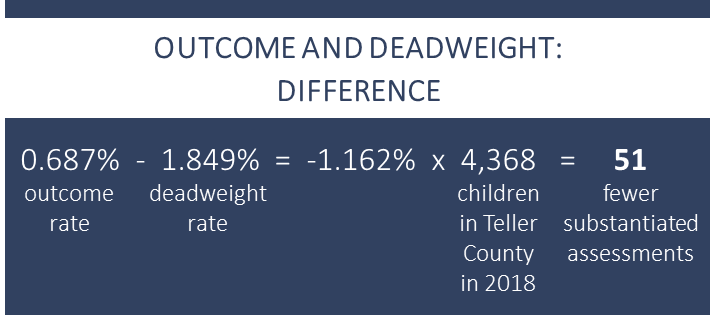
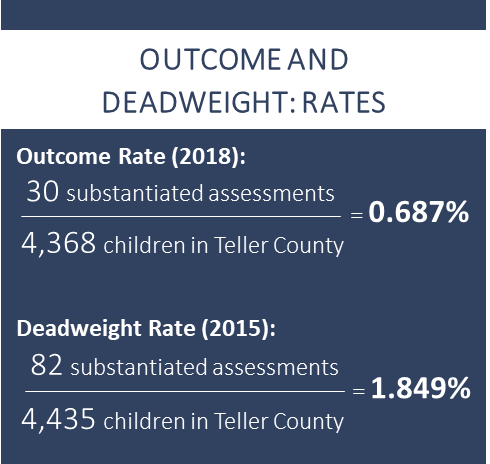
Using data provided by the state on its online dashboard, the OMNI researchers found that there were 82 substantiated assessments in 2015 and only 30 in 2018. To adjust for population changes they divided each number by the number of children in the County at the time, producing what they called an “outcome weight” for 2015 and a “deadweight rate” for 2018, as described in the first graphic below. Subtracting the deadweight rate from the outcome weight and multiplying by the child population in 2018, the researchers came up with a reduction of 51 fewer substantiated assessments in 2018, as illustrated in the second graphic. (The adjustment made little difference; simply subtracting the 30 from 82 resulted in a reduction of 52 substantiated assessments.) This impressive drop in substantiated cases translates to a “62.84 percent reduction in substantiated assessments from 2015 to 2018.”

Source:
Source: Sara Bayless, Melissa Richmond, Elaine Maskus, and Julia Ricotta, Return on Investment of a
Family Resource Center to the Child Welfare System
. Available from https://childwelfaremonitor.org/wp-content/uploads/2021/09/8b78c-communitypartnershipfamilyresourcecenterchildwelfarereturnoninvestmenttechnicalappendix.pdf.

The researchers used the estimated number of children served by CPFRC during 2018 (1,444) relative to the estimated number of children at risk for maltreatment based on income-to-needs (ITN) ratio (1,479)* and age (1,272), to decide how much of the change in substantiations to attribute to the program. The result was an “attribution estimate of 98 percent based on the ITN ratio and 114 percent based on age. Combining these estimates, the researchers decided to attribute the entire reduction in substantiated cases to CPFRC.

Finally, the researchers calculated a return on investment using total child welfare expenditures in 2018 divided by the number of substantiated assessments in that year, resulting in a total cost of $49,026 per substantiated investment. Multiplying that figure by 51, they concluded that the reduction of 51 substantiated assessments, (of which 100 percent were attributed to the program) saved the Teller County child welfare system $2,500,326 in 2018 compared to 2015. Dividing this total by $856,194, they came up with a “Return on Investment” of $2.92 for every dollar spent on the program.

There are many serious problems with this analysis. The choice of substantiations as an indicator of victimization is problematic because of the large body of literature illustrating the difficulty of determining if a child has been maltreated and the absence of differences in future outcomes between children with substantiated vs. unsubstantiated allegations. Allegations (or referrals) seem to be a more meaningful measure of abuse or neglect. Using data from two years without looking at the numbers for the years in-between is also problematic, as the researchers themselves admit. In their discussion of the weaknesses of the study, they acknowledge that using only two years, without the years in between, is not ideal because it provides a less robust understanding of changes in child maltreatment as well as making its estimates more susceptible to influence by other system-level factors.

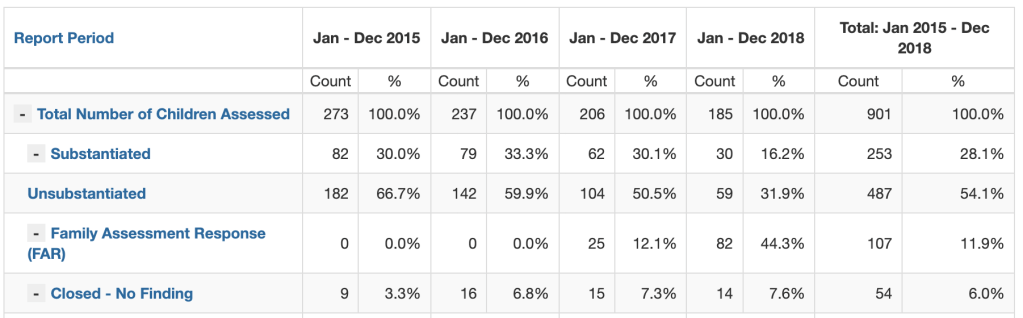
But there is a much worse –indeed fatal–problem with the two years chosen. The researchers claim that they chose 2015 because Differential Response was already in effect in in that year, having been implemented in 2013. But going to Colorado’s “Community Performance Center” (data dashboard) as helpfully directed by a footnote, one quickly learns that no children were assigned to Family Assessment Response (the option that does not result in substantiation) in Teller County in 2015, as shown in Table One below. In 2018, 82 children, or 44.3 percent of all children assessed, were assigned to Family Assessment Response. So an unknown part of the decrease in the number of children substantiated could have been due to the rollout of Differential Response.

Table One

Source: CDHS Community Performance Center, Number of Children Assessed in Child Welfare, available from https://rom.socwel.ku.edu/CO_Public/AllViews.aspx?RVID=647

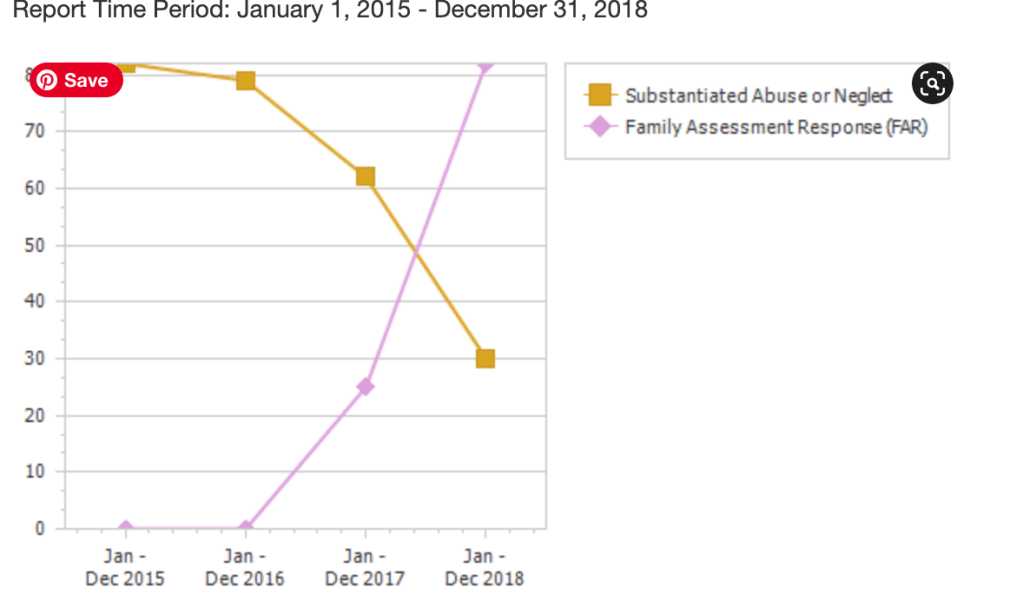
If there was any doubt that the advent of Differential Response may be related to the drop in substantiated assessments, one only has to look at Figure One below. It is hard to figure out how the researchers missed this graphic, which is prominently displayed on the relevant page of the data dashboard, and shows how substantiations fell between 2016 and 2018 as the number of children assessed through FAR increased. This is a bizarre error, considering that the researchers specifically cited the prior rollout of differential response as a reason for choosing 2015 as the baseline year for the study.

Source: CDHS Community Performance Center, Number of Children Assessed in Child Welfare, available from https://rom.socwel.ku.edu/CO_Public/AllViews.aspx?RVID=647

Another problem is the method the researchers used to attribute all of the “reduction” in cases to the program. First, the authors provide no explanation of the estimate that 1,444 children received services at CPFRC. We assume this includes every child who ever walked into the center, but we just do not know, since the researchers do not define it. We have no idea of the quantity of services received by each child. We don’t even know if this is an unduplicated count. Moreover, this conclusion simply violates common sense. On the face of it, how could one assume that one family support center caused the entire reduction in child maltreatment substantiations in a county? It just beggars belief.

The second study by OMNI focused on the Westminster Family Resource Center (WFRC), which serves a mostly-Latino population in Orange County, California. WFRC provides a variety of services, including information and referral, family support, case management, counseling, after school programs, domestic violence support, parenting classes, and “family reunification family fun activities.” WFRC belongs to a network of 15 Family Resource Centers known as Families and Communities Together (FaCT). The researchers report that In conducting the study OMNI took advantage of a pre-existing evaluation of all the centers in the FaCT network, which was conducted by Casey Family Programs, Orange County Social Services Agency, another nonprofit and a consulting firm. OMNI reports that “After consultation with the evaluation team and a review of the demographic profile of the areas served by FRCs within Orange County as a whole, OMNI identified Westminster Family Resource Center (WFRC) as a strong option for this project.” (The larger study is listed as “forthcoming” from Casey Family Programs in the references to the OMNI report.)

Unlike the Teller County report, the Orange County report compares outcomes across geographic areas rather than two time periods. The researchers defined WFRC’s service area as the census tracts where at least one percent of the population was served by WFRC. They matched 12 census tracts in Los Angeles County to the area served by WFRP based on ten “community level indicators related to child maltreatment,” such as the percentage of families in poverty and the unemployment rate; the other indicators were not listed.

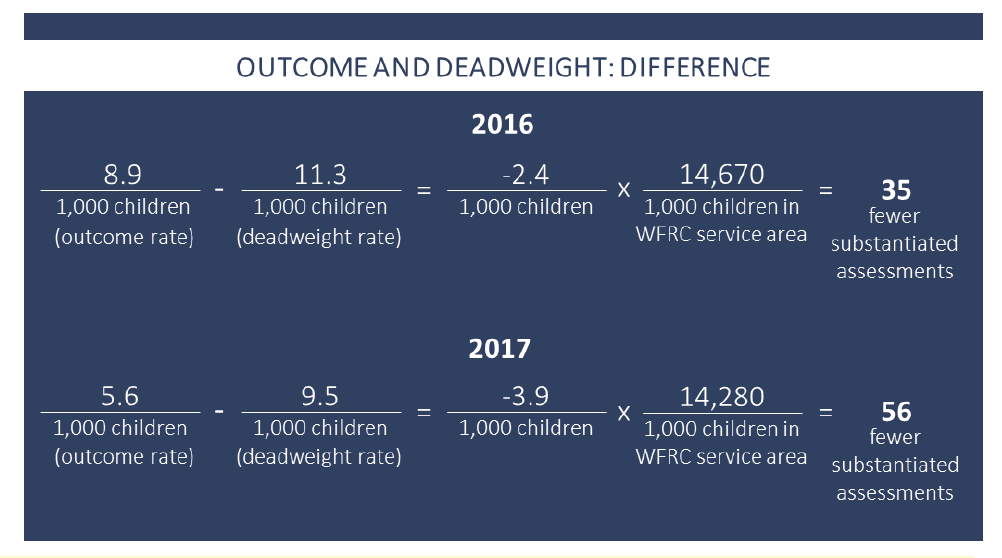
Using data from the pre-existing evaluation, the researchers subtracted the substantiation rate (number of substantiated children per 1000) in the WFRC areas from the substantiation rate in the matched areas for 2016 and 2017, the most recent years for which data were available, and then multiplied the difference by the number of children in the WFRC service area. The calculation is shown in the attached graphic, which incorrectly divides the number of children in the service area by 1,000. This calculation produced an estimate of 35 fewer substantiated assessments in 2016 and 56 fewer substantiated assessments in 2017. Unlike with the Teller County study, a reader cannot check the underlying data because it comes from an as yet unpublished study. Admitting that there are no guidelines for attributing results to a program in a “quasi-experimental evaluation” using community-level indicators, the researchers rather randomly decided to attribute 50 percent of the difference in substantiated assessments to the program.

Source: Sara Bayless, Melissa Richmond, Elaine Maskus, and Julia Ricotta, Return on Investment of a
Family Resource Center to theChild Welfare System, Westminster Family Resource Center, Orange
County, CA. Available from https://childwelfaremonitor.org/wp-content/uploads/2021/09/7845f-westminsterfamilyresourcecenterchildwelfarereturnoninvestmenttechnicalappendix.pdf
Note that the the equations are incorrect. The number of children in the service area was not divided by 1,000.

As in the Teller County study, the researchers went on to calculate a return on investment for WFRC. Although they did not explain their methodology for doing so, it appears they used the same approach of dividing child welfare costs for each year by the number of substantiated assessments for that year to come up with an estimated cost per substantiated assessment in California, adjusting for inflation, and finally subtracting the estimated costs of WFRC. By this method, they arrived at a return on investment of $2.80 in 2016 and $4.51 in 2017, which they averaged to get a total return on investment of $3.65 per dollar spent on the program.

The use of substantiation rates as an indicator of success is as problematic as in the Teller County study. As I have mentioned, substantiation does not equal victimization but instead reflects the agency’s performance in determining whether maltreatment really happened. Using substantiation as an indicator of maltreatment could introduce bias if one of these counties substantiated allegations at a higher proportion of cases than the other, as discussed below.

While there is no mistake as glaring as the Teller County team’s erroneous assumption that differential response had already been implemented in the study’s baseline year, the possibility of significant confounding effects does exist–in this case between places rather than times. California has a county-run child welfare system and the writers do not discuss any policy or practice differences that may exist between Los Angeles County and Orange County and how they might affect the differences in substantiation rate between the two counties. And indeed, data from the Child Welfare Indicators Project at Berkeley shows that Los Angeles County does substantiate a higher proportion of allegations than does Orange County. Of all the children with allegations in 2016 and 2017, 15.7 and 14.7 percent had substantiations in Orange County, versus about 18 percent in Los Angeles County both years. In addition, the fact that the reduction in substantiated assessments, and therefore the estimated cost savings due to the program, varied so much between 2016 and 2017 is already concerning and suggest that the impact found depends upon the year, and could be vastly different if another year were chosen.

The attribution of 50 percent of the difference in substantiations between the two counties to the WFRP has no basis in fact or social science. The researchers did not attempt the kind of calculation reported for Teller County (however problematic) in which they compared the number of children served to the number of children who might be at risk of maltreatment. They indicate that WFP served 1.77 percent of households in its service area as defined by the researchers, and we have no idea how that compares to the number of households where children are at risk of maltreatment.

Looking at the Teller County and Orange County studies together, the choice of these two specific programs out of all the over 3,000 FRC’s represented by NFSN (and the choice of only one out of 15 programs evaluated in Orange County) raises the possibility that the researchers cherry-picked programs to achieve the desired results. In fact, the researchers report that that is exactly what they did! One of the criteria they reported using to select their ultimate sites was that “there were available data demonstrating a plausible connection between FRC services and child welfare system outcomes;” another was that “[t]here were available quantitative data demonstrating that the child welfare system has benefited (e.g., through reductions in the incidence of child abuse/neglect).” The researchers also claim that they were looking for sites representing “demographically different communities,” and I suppose they achieved that with their two sites with mostly White and Latino clientele; but they seem to have been unable to find a suitably promising site with a predominantly Black clientele.

Clearly it is not easy to evaluate programs without random assignment to a treatment and control group, or at least a comparison group that is matched individually to a group of participants. It is also difficult to evaluate a program where each participant gets a different package of services, with some receiving as little as one visit to the center. There is ample reason to doubt that Family Resource Centers will have a large impact on the most serious cases of child abuse and neglect because the parents who use these centers tend to be those who are already open to seeking help, learning new parenting tools, and working toward change. It seems likely that the parents of the most vulnerable children are often the ones who are not willing to seek the kind of help that Family Resource Centers provide. Chronically neglectful parents may lack energy and motivation to go to a Family Resource Center; chronically abusive families are likely to want to avoid letting other adults set eyes on their children. That is why jurisdictions that are really serious about prevention have chosen to adopt more targeted strategies. For example, Allegheny County Pennsylvania, which has a network of 27 Family Resource Centers and was a pioneer in this effort, knew they had to do more for families with more intense needs. They created a three-tier model called Hello Baby, in which families are placed into tiers based on their needs. They are reaching out to all families, and they are referring those in the middle tier to county’s FRC’s. For the families with the greatest needs, a more intensive option is being offered.

A recurrent theme of this blog has been the use of flawed research to promote the programs that the promoters want to support, most recently in my post about race-blind removals. Using flawed research to support programs results in misperceptions by the public and its representatives and in turn to bad policy decisions. One does not have to look beyond Teller County for an example “Child abuse reports have declined dramatically locally due to a partnership between a key Teller government agency and a nonprofit organization,” trumpeted a local paper based on the press release from OMNI. In the article, the DHS Director Kim Mauthe was reported as saying that “the findings of the report are good news for the county. “It’s exciting because the calls we did receive through our child abuse hotline show that we had a decrease of child abuse by 57 percent, which is huge….” It is not clear what would be more disturbing: that Mauthe really believed this program had reduced child maltreatment (not “abuse” as she described it) by 57 percent, knowing that the study period included her county’s adoption of differential response, or that she was cynically misrepresenting the study results to the media. The report was presented at a meeting of county commissioners, who applauded Ms. Mauthe. They now presumably think that child maltreatment is on its way to disappearing, and if anything more is needed it would be to add more funding to the Family Resource Center–not necessarily the best approach if they want to reach the families with the most intense needs.

It is not surprising that this flawed research was funded and promoted by Casey Family Programs, a wealthy and powerful non-profit that has played an outsized role in child welfare in recent decades, funding advocacy-oriented research, providing free consultation to states, and even helping the government hire people who support its views. One of CFP’s goals is to “safely reduce the need for foster care in the United States by 50 percent,” a goal that is incidentally meaningless without a beginning and ending date. Most recently, CFP has publicized the faulty data on race-blind removals that I discussed in a recent post.

Family resource centers can be a great addition to a neighborhood, providing connections to needed programs and services for needy families. But two recent studies that claim to show that these centers reduce child maltreatment and thereby save money to taxpayers are too flawed to provide any meaningful evidence that they indeed have this effect. Any continuing publicity these studies receive may lead unsuspecting public officials to invest in family resource centers at the expense of other programs that may be more promising in preventing child maltreatment.

Child Neglect: a misused and misunderstood term

There is much confusion around child neglect. Opponents of the current child welfare system are fond of stating that most children reported to child protective services (CPS) are suffering from neglect, not abuse, that neglect is synonymous with poverty, and therefore that children are commonly being removed from home because of poverty. While neglect is clearly related to poverty, the facts suggest that the removal of children due to poverty alone is rare. To know more about this most common form of maltreatment, it is necessary to collect more specific data on the types of child neglect that are found when a neglect allegation is substantiated. Nevertheless, child welfare must recognize the important role of poverty in promoting child neglect and the role of poverty alleviation programs in child neglect prevention.

A useful way to distinguish between abuse and neglect of children is that abuse is generally an act of commission, while neglect is an act of omission. According to the Child Welfare Information Gateway, neglect is “commonly defined in state law as the failure of a parent or other person with responsibility for the child to provide needed food, clothing, shelter, medical care, or supervision to the degree that the child’s health, safety and well-being are threatened with harm.” The most commonly recognized categories of neglect include physical neglect (failure to provide for basic physical needs), medical neglect, inadequate supervision, emotional neglect, and educational neglect. Some states include exemptions for certain types of neglect, like religious exemptions for medical neglect. Twelve states and the District of Columbia exclude financial ability to provide for a child from the definition of neglect.

How true are common statements about neglect?

A number of statements about neglect are are frequently made in support of various views and proposals. These are discussed below.

The national child welfare system was established to address abuse, not neglect. This is absolutely true. The discovery of “battered child syndrome” by Henry Kempe at the University of Colorado led to the passage of child protection laws in every state within a few years. On the federal level, the Child Abuse Prevention and Treatment Act (CAPTA), which established the federal role in supporting and monitoring these systems, was also focused on abuse rather than neglect. According to an oft-quoted book about the history of CAPTA, Democrats feared that President Nixon might veto CAPTA if it was viewed as an anti-poverty program, so they took pains to reiterate that child maltreatment could happen to anybody, regardless of socioeconomic status. As a result, the responses to child maltreatment focused on mental health and parent education services rather than economic supports. In his essay, Poverty, Neglect and Cultural Denial, child welfare commentator Dee Wilson recalls that when he began working as a CPS social worker in the 1970’s, all his training focused on battered children. Yet, in his work he encountered battered babies and toddlers maybe “once or twice annually out of 100 to 150 assigned cases.” Instead, he received both in Colorado and later in Washington “a steady diet of reports of child neglect and, to a lesser extent, reports of excessive punishment of children with minor injuries that did not require medical attention.” Academic literature has contributed to the problem by failing to distinguish between abuse and neglect.

Neglect is the main reason for children’s involvement with child welfare. This is also a true statement. According to the latest data collected from the states and published in Child Maltreatment 2019, three-quarters (74.9 percent) of the 656,000 children found to be victims of maltreatment in 2019, were found to be neglected, 17.5 percent were physically abused, 9.3 percent were sexually abused, and 6.8 percent were “other.” Some children were found to be victims of both neglect and another maltreatment type. These percentages should not be viewed as an exact representation of the relative importance of different types of maltreatment. As Font and Maguire-Jack point out, investigators do not have to substantiate every allegation to justify intervention. So If there is more than one type of maltreatment in the home, investigators may not substantiate all of the different types. Thus a child found to be a victim of neglect only may actually have suffered abuse as well. Comparison of substantiation data with other sources, as shown in Font and Maguire-Jack’s table listed below. suggests that “substantiations are likely to grossly understate all forms of child maltreatment, but especially physical abuse.” So neglect does appear to be more common than abuse as a reason for child welfare involvement, but abuse may be be present in a higher fraction of cases than the percentages indicate.

Source: Sarah Font and Kathryn Maguire-Jack, The Nature and Causes of Child Abuse and Neglect.
ANNALS, AAPSS, 692, November 2020. https://journals.sagepub.com/doi/abs/10.1177/0002716220969642?journalCode=anna

Child neglect is strongly related to poverty. This is also true. Research demonstrates that poverty is a major risk factor for child neglect. According to the most recent National Incidence Study of Child Abuse and Neglect, children in low socioeconomic status households experienced maltreatment at five times the rate of other children. Studies have also demonstrated that providing economic supports for families (through programs like tax credits, passing on child support, food assistance, and child care subsidies) have direct effects on child maltreatment. We do not know exactly how poverty affects child neglect but in an excellent article in a journal issue devoted to child maltreatment Feely et al provide a useful way to think about it. They posit that the inverse of neglect is what they call “safe and consistent care or SCC,” which they define as “to provide safe, consistent supervision and constantly provide for children’s basic needs.” As they describe, time and money are two core resources a family needs to provide SCC. For a poor parent, it may be very difficult to provide acceptable levels of time and money simultaneously. So a poor parent might have to choose between going to work and letting the children be unsupervised or inappropriately supervised, or losing their job and letting their children go hungry.

Most parents found to be neglectful are actually just poor. The confusion of poverty with neglect is a trope that is cited again and again by those who advocate restricting government intervention in maltreating families. For example, Jerry Millner and David Keller, the former Associate Commissioner of the Children’s Bureau and his special assistant, have written that It’s time to stop confusing poverty with neglect. They claim that many children become involved with child welfare only because their parents are poor. For example, children might be taken into care because a parent gets evicted or cannot afford childcare and leaves them alone. Despite the popularity of this belief, the evidence does not support it. It is clear that most poor parents do not neglect their children. They find a way to provide safe and consistent care, whether it means extensive research on community resources, creative use of existing supports, or delaying the next birth until adequate resources are available to care for the children they already have. Dee Wilson argues based on his decades of experience in child welfare that “a large percentage of neglect cases which receive post-investigation services, or which result in foster placement, involve a combination of economic deprivation and psychological affliction, beginning with mood disorders such as depression and PTSD,” which often lead to substance abuse as a method of self-medication.

The most serious cases of neglect are often chronic. Chronic child neglect can be defined as “a parent or caregiver’s ongoing, serious pattern of deprivation of a child’s basic physical, developmental and/or emotional needs for healthy growth and development.” Chronic neglect by a single mother often opens the door for physical or sexual abuse by her boyfriend. Children who have experienced chronic neglect may suffer “serious cognitive and social deficits because of the….lack of responsive parent-to-child interaction that is essential for healthy child development.” Chronic neglect can have effects similar to trauma, such as difficulties with emotion regulation.

Many child neglect reports are frivolous and unnecessary, cluttering up the system and making it harder to identify serious maltreatment. Many critics of mandatory reporting and CPS cite a study estimating that 37.4 percent of all U.S. children (and 53 percent of Black children) experience a CPS investigation by the age of 18. Some argue that many of these reports are the consequence of a racist system that ensnares too many poor and Black families. Some are supporting bills to end anonymous mandatory reporting in New York and Texas. Another, smaller set of reports has drawn attention, as described by Naomi Schaefer Riley in her article, Reforming Child Neglect Laws. These reports target stable, functional middle class families that have chosen to give their children more independence than many other parents in their geographic and demographic stratum. The case of the Meitiv children, who were picked up by police while walking a mile to their home in Silver Spring, Maryland and became the subject of not one but two CPS cases, drew publicity around the country.

It is clear that some reports coming into hotlines do not warrant investigation, but we do not know what proportion. Annual data submitted by states and compiled in the Child Maltreatment 2019 report shows that that 45.5 percent of referrals (for all kinds of maltreatment) in 2019 were screened out. And of all children receiving an investigation or alternative response, only 18.9 percent were found to be victims of maltreatment. However, research suggests that the likelihood of another report, a substantiated report, or a foster care placement is the same for a child who is the subject of a substantiated versus an unsubstantiated report. Chances are that many of the children with unsubstantiated reports were previously the subject of substantiated reports, or will be the subject of such reports later. Moreover, as Font and Maguire-Jack point out, “it seems unavoidable that some number of non-maltreated children will be reported to CPS if mandatory reporters are acting appropriately.” After all, they are told that they do not need to be sure the maltreatment is occurring, but to leave that decision to CPS. Changing that guidance, in my opinion, would be dangerous to children.

Should neglect be treated differently from abuse?

Even if neglect is not “just poverty,” some commentators argue that it should be treated differently from abuse. Two former directors of large child welfare systems, Tom Morton and Jess McDonald, argue that because child protective services were designed around abuse rather than neglect, they were patterned after the criminal justice system and treat all maltreatment as antisocial behavior. Morton and McDonald argue that because neglect is an act of omission rather than commission, it should be treated differently, The response to neglect should occur in a “public health framework” outside the current child protection system.

I do not agree that we need a separate system to deal with neglect. As I have discussed, many neglected children are also victims of abuse, whether or not it is substantiated by authorities, and neglect by one caregiver can pave the way for abuse by another. We already have a criminal justice system that addresses criminal abuse and neglect separately from the child welfare system. While the effect may seem punitive, the goal of CPS is to make children safe, not punish parents. Both abuse and neglect make a child unsafe, and the first mission of child welfare is to ensure child safety. Splitting this mission into two is probably not be the best way to promote children’s safety.

Even if we do not need a separate system to deal with neglect, we need to recognize the importance of anti-poverty strategies to help families provide safe and consistent care and prevent child neglect. Prevention has become a major priority of child welfare leaders and thinkers, so this is a good time to talk about incorporating poverty alleviation into child maltreatment prevention. In this new vision, as Feely et al propose and as I have discussed in an earlier post, child maltreatment (especially neglect) prevention should not be the responsibility of child welfare agencies alone. This responsibility should be shared by all the agencies responsible for alleviating poverty. The new initiatives proposed by the Biden Administration for child tax credits, universal pre-kindergarten and expanded child care assistance should be a good beginning.

Is it time to drop the term “neglect”?

In an article in The Imprint, Rebecca Masterson of Gen Justice argues correctly that the term “child neglect” has become almost meaningless because it is used so broadly and so deceptively as a symptom of poverty. Masterson argues that “neglect” needs to be replaced by more specific terms, such as abandonment or refusal of medical care. I do not agree that the term neglect should be dropped. Just as “child abuse” is an umbrella term that includes physical abuse, sexual abuse, and emotional abuse, “neglect” has value as an umbrella term that refers to acts of omission that harm children, in contrast to abuse, which is an act of commission. It makes sense to have these umbrella categories.

But the umbrella categories of “abuse” and “neglect” should not be put in the same list of categories as the specific acts (or lack thereof) underneath the umbrellas. Unfortunately, state and local data systems often list “neglect” as a category along with other more specific terms for types of neglect. This results in bizarre analyses where “neglect” is often described as the most common category of child maltreatment–more common than its subcategories–as if anything else is possible! Just as social workers do not have to check off “abuse” as well as “physical abuse,” in their agency database, they should not be asked to check off “neglect,” as well as specific types of neglect. In order to fix this problem everywhere, and to make sure we have comparable data from all states, the federal government should mandate that all states use the same subcategories of abuse and neglect, and that “abuse” and “neglect” not be among the specific categories.

In devising these alternative categories, we also must be careful to avoid confounding neglect with conditions that may cause it, such as substance abuse and mental illness. These are contributing factors that should be noted in databases and shared with the federal government but are not in themselves forms of neglect. And indeed, in some jurisdictions, like the District of Columbia, substance abuse is not considered neglect unless it is considered to impair parenting.

Child neglect is the most common form of child maltreatment, yet it received little attention in the first decades of the modern child welfare system. It took a long time for child welfare scholars and leaders to recognize the importance of neglect. Unfortunately now that they have recognized its importance, many leaders are using this new knowledge in order to support their proposals to upend child welfare in ways that may be harmful to neglected children. This misuse of the concept of neglect can be addressed by requiring that child welfare agencies collect uniform data on the types of neglect that are being found. That being said, it is important for child welfare leaders to understand the importance of poverty alleviation strategies in preventing maltreatment in general and to recognize that this job does not belong to the child welfare system.

“Upending child welfare” means devaluing Black children’s lives

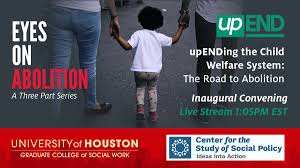
Image; University of Houston/Center for study of Social Policy

In the wake of the killing of George Floyd by police, expressions of outrage from around the country and calls for police reform were soon followed by calls for completely abolishing police forces. It did not take long before a chorus of cries were launched to eliminate child welfare as we know it as well. Child welfare was described as yet another system that controls and punishes people of color. Yet, these calls disregard the suffering of Black children who are abused and neglected; it also ignores the evidence on the reasons for Black families’ high level of involvement in child welfare.

The call for the abolition of child welfare did not come out of the blue after George Floyd’s death. It is the direct descendant of a movement that began around 2004, when a coalition of foundations, nonprofits, and academics formed around the idea that the “disproportionate” representation of Black children in child welfare stemmed from a racist system.[1] This coalition launched a well-funded campaign to reduce the representation of black children in child welfare and especially foster care. They issued reports, held conferences, and provided training and technical assistance to help states analyze their disproportionality problems. The movement seemed to run out of steam afternew research (described below) debunked their major thesis, but it regained strength in the wake of the Black Lives Matter movement, and came roaring to the forefront after George Floyd’s killing.

One of the leaders in the earlier coalition, the Center for the Study of Social Policy, has joined with the Graduate College of Social Work at the University of Houston to launch a movement entitled upEND, with the aim of ending child welfare as we know it. Several representatives of upEND have published an article in the Journal of Public Child Welfare which attempts to explain their thesis. The upEND argument relies on two assertions: that the high rate of Black child and family representation in the child welfare system is due to racism within the system, and that this high rate of representation harms Black children and families. Unfortunately, these assertions are largely wrong, as I explain below.

ASSERTION ONE: The difference in Black vs. white involvement in the child welfare system are due to a racist child welfare system.[2]

There is no disagreement about the truth of upEND’s statement that Black children and families are more likely to be involved in child welfare than White children and families. In its article, upEND cites studies concluding that Black children are more likely to be reported to child abuse hotlines, more likely to be investigated, more likely to be found to be maltreated, and more likely to be placed in foster care. The ultimate result is that of this chain of disparities at each phase of the child welfare pathway is that in 2018, black children represented 14% of the total child population but 23% of all kids in foster care.

However, the real controversy (although buried in the upEND article) is about the reasons for this disparity. Is it due to a racist child welfare system, as upEND and its allies posit, or due to a difference in the underlying rate of child abuse and neglect among Black versus White families? Data suggest it is the latter. Of course, it is difficult to measure child maltreatment, which makes this question hard to answer. Although the U.S. Children’s Bureau collects annual data on official reports of child maltreatment and agency dispositions of these reports, these numbers leave out unreported maltreatment and may reflect erroneous determinations by investigators. To provide a better estimate, the Bureau periodically conducts National Incidence Studies (NIS) of child abuse and neglect. These studies are designed to estimate more accurately the incidence of child maltreatment in the United States by using community professionals to report on the actual cases of maltreatment that they have seen during the reporting period.

According to the most recent national incidence study, NIS-4, conducted in 2010 on data collected in a year spanning 2005 and 2006, Black children were almost twice as likely to be abused or neglected as white children. It estimated that 24.0 of every 1,000 black children experienced maltreatment severe enough to cause harm in the study year as compared to 12.6 per 1,000 white children.[3] There is other research evidence that Black and White maltreatment rates differ, including studies finding that black children have higher rates of preventable injury deaths; and “evidence that other predictors or markers of maltreatment are higher for black children, including maternal arrest rates, traumatic brain injury rates, parent self-reported maltreatment rates, intentional injury rates, and homicide rates.” A study published in the journal Pediatrics in 2017 concluded that the child abuse fatality rate for children aged four and under was 8.0 per 100,000 African-American children, compared with 2.7 per 100,000 white children.

A conference convened in 2011 by Harvard, Chapin Hall at the University of Chicago, the National Council of Juvenile and Family Court Judges and the National Court Appointed Special Advocates, brought together leading scholars on child welfare and race from around the country. A research brief summarizing the conference concluded that “there is a significant black/white maltreatment gap, one that roughly parallels the gap in official maltreatment reports. This evidence contradicts the belief that black children are included at high rates in the child welfare system because of bias.” One speaker noted that “African American children are at least as likely to be underserved as overserved” by current child removal rates. The authors of the brief suggested that the higher rate of maltreatment of Black children stems from the history of slavery and racism, which led to higher poverty and concentration in impoverished neighborhoods characterized by crime, substance abuse, unemployment, and limited community services. As Randall Kennedy of Harvard Law School put it, “given the history of race and racism, given the deplorable conditions suffered disproportionately by black families—conditions that produce high rates of substance abuse and other self-destructive behavior—it would be surprising if black children did not have higher rates of contact with the child welfare system than white children.”

In her important book, Spare the Kids: Why Whupping Children Won’t Save Black America, Stacey Patton has added to this narrative by linking the legacy of slavery to current patterns of discipline by Black parents. Introduced to whipping by White slaveholders, Black parents adopted a similar practice to train their children to be docile workers and avoid worse punishments from their masters. Even today, Patton contends, some Black parents justify “whupping” their children as the only way to prevent them from being shot or locked up.

In other words, there is a strong argument that disproportionality is rooted in racism. But It’s not a racist child welfare system that results in disproportional representation of black children in the child welfare system. Rather, it is the our country’s history of slavery and continuing oppression of our Black citizens that has created the difference in child maltreatment which in turn resulted in disproportional representation of Black and White children in child welfare.

ASSERTION TWO: The disparity between Black and White representation in child welfare systems causes “pervasive and persistent harm” to Black children and families. 

The next pillar of upEND’s argument is that differences in child welfare involvement cause harm to Black children and families. The authors emphasize the placement of Black children in foster care, stating that “the act of forcible separation of children from their parents is the source of significant and lifelong trauma.” It is first worth noting that most children involved with child welfare are not separated from their families. Nationally, more children receive in-home services than are removed to foster care.[3] Moreover, it is not always clear that separation from parents is traumatic for a child. A child’s reaction to placement depends on the child’s age, the quality of the attachment with the parent, the type of environment from which the child is removed, and the way the placement is handled, according to Vera Fahlberg’s authoritative book, A Child’s Journey through Placement. A child who has been emotionally neglected and has no connection to the parent may have “almost no reaction” to the placement, Fahlberg points out. Moreover “if a child is actually fearful of his living environment, he may not react as adversely to the separation. Indeed, relief is occasionally observed.” And even if the child is traumatized by separation from abusive or neglectful parents, that child may still benefit from being removed from that environment.

There is an extensive literature on the harmful and often lifelong consequences of abuse and neglect. These can include impaired brain development, health problems; diminished executive functioning and cognitive skills; poor mental and emotional health; attachment disorders and social difficulties; post traumatic stress; unhealthy sexual practices; juvenile delinquency; alcohol and other drug use; and intergenerational transmission of maltreatment, as described in an issue brief from the Children’s Bureau. The specific outcomes for each child depend on “the child’s age and developmental status at the time of maltreatment, the type, frequency, duration, and severity of the maltreatment, and the relationship between the child and the perpetrator,” according to the Bureau.

Advocates of upending child welfare often point out that most children are removed for neglect rather than abuse, and they suggest that neglect is synonymous with poverty. But the actual prevalence of neglect versus abuse is unknown. One must remember that there may be several types of abuse and neglect in one family but the investigator may not be able to substantiate all of them. There may very well be abuse in a family where only neglect was substantiated. Moreover, the kind of neglect that leads to child welfare involvement is often serious or chronic and is not at all synonymous with poverty. Chronic neglect can lead to serious cognitive and social difficulties, chronic disease, and difficulties in emotion regulation similar to the effects of trauma, as discussed in another brief from the Children’s Bureau. Moreover, chronic neglect often “opens the door” for physical or sexual abuse by a mother’s male partner.

Even though child maltreatment can cause lifetime harm to its victims, one might still believe with upEND that the treatment (child welfare services) is worse than the disease, at least for Black children. To address this contention, Richard Barth and other well-known child welfare scholars recently published a review of the literature entitled Outcomes following child welfare services: what are they and do they differ for Black children? They reviewed more than 50 rigorous studies of outcomes following a child welfare intervention and found “very little reason to believe that children’s outcomes are worsened by participation in child welfare services.” They noted that the vast majority of children received short-term services, with only a fraction placed in foster care. Based on their analysis, they found that child welfare in general results in improved outcomes in the areas of safety and education for both White and Black children and generally neutral effects on health, mental health and behavioral outcomes. Moreover, they concluded that child welfare may protect Black children in particular against some future harms as early death, transitions to juvenile services (for girls), and early childbearing.  The authors found no evidence that Black children are doing worse than other children as a consequence of system involvement. Perhaps most important, the researchers found that Black parents and youth, like their White peers, are generally positive about their experience with child welfare. (Most interesting were the two surveys of 21-year-olds that found about two-thirds saying that they were lucky to have been placed in foster care.)

It is very sad that the measurable benefits of child welfare on children’s outcomes are so modest. This may be a consequence of the poor quality of services that are generally provided to many children and their parents. Far from the intensive parenting and enrichment that abuse and neglect victims need, many foster children and youth receive benign neglect at best and outright abuse at worst. As I have written based on my experience, many foster homes provide little nurturing and attention. The system is particularly unsuccessful for older youth with behavioral problems, who are often moved from home to home, placed in residential programs which vary from highly therapeutic to abusive, or spend nights in agencies and hotels, as described in an excellent blog post by Dee Wilson. Moreover, the services provided to children and families by other systems, like mental health and drug treatment, are often low-quality and plagued by waiting lists and provider turnover.

upEND’s policy prescription

In order to end racial disproportionality and its harmful effects, upEND proposes “the abolition of the child welfare system as we know it.” While the exact meaning of this phrase is not specified, the writers make it very clear that abolition means “that the forcible and involuntary separation of children from their parents is no longer viewed as an acceptable form of intervention.” To bolster their proposal, the authors contend that for Black families in America, forced family separation has its roots in the dehumanizing system of slavery.

The historical connection of child removal to racism and slavery is not clear. White children were removed from their families by child welfare agencies long before Black children. Dorothy Roberts, who herself has called for the abolition of child welfare, traces the intellectual roots of child removal to the early progressives around the turn of the twentieth century, who tried to address poverty by placing poor immigrant children in orphanages or sending them to work on rural farms. As Roberts describes in her famous book, Shattered Bonds: the Color of Child Welfare, “black families were virtually excluded from openly segregated child welfare services until the end of World War II.” When public agencies began to take over child welfare from private agencies, they started to turn their attention to Black children. But the disproportionality took some years to appear, according to statistics cited by Roberts. So it is hard to understand the logic of the claim that the practice of child removal by child welfare is rooted in racism.

While not clear on exactly what shape the new child welfare system (if any) would take, upEND states that it will replace the current child welfare system with “community-based supports for the care and well-being of children that are designed by and for families and communities…” The authors call for a broad range of policies including: creating and expanding critical safety net programs and affordable housing; expanding the use of informal care and supports for kin care providers; ending the use of congregate care placements; strengthening the efforts states must make to prevent foster care placement; and eliminating “arbitrary timelines” to terminate parental rights.

The authors do not explain how they would respond to maltreatment of children whose parents are not capable of protecting them, or who have seriously harmed them. As a member of the District of Columbia’s Child Fatality Review Panel, I have learned about many deaths of children whose families had long histories of contact with the city’s child welfare system. These families were the subject of numerous calls to the child abuse hotline for physical abuse, school absenteeism, children left alone, parents under the influence of drugs or alcohol or both–often multiple types of abuse and neglect for the same family. Some of these calls were set aside as not worth investigating, in some cases child protective services found no cause for intervention, and in some cases the intervention was not enough. Whether the child was accidentally crushed as an infant while sleeping with a parent on drugs or alcohol, beaten to death by a parent or the mother’s boyfriend, or shot as a teenager by a member of a rival crew after years of unresolved problems in the home, these children were abandoned by the system that was set up to protect them. upEND’s prescriptions would likely result in more such deaths, even more serious injuries and damage to children, and much more suffering.

As upEND proposes, we need to address the the unconscionable inequality and poverty that affects a disproportionate number of Black families by creating a true safety net and making affordable safe housing available to everyone. To add to their list, we also need to reform policing and criminal justice to eliminate a huge source of stress on Black families. But we cannot wait to protect children until present inequities and the impacts of past ones are eliminated. We should develop programs specifically aimed at preventing abuse and neglect among high-risk families of any race as soon as a child is born, such as Pennsylvania’s new Hello Baby program. Another promising approach is to provide high quality early childhood education accompanied by family support to all infants who are at risk of maltreatment. And as we work toward eliminating child abuse and neglect before they occur, we must continue to respond to children who are currently being maltreated. We must improve the accuracy of this response by eliminating any racial or other biases that result in false positive or negative findings of maltreatment. For example, the use of predictive risk modeling to screen hotline calls has been shown to reduce the disparity between the case opening rates between Black and White children.

As Barth and his colleagues put it, not responding to maltreatment of Black children is a “violation of children’s essential rights.” If we accept upEND’s prescription for eliminating differences in child welfare representation between Black and White children, we will subordinate the rights of children for safety, security and love to the rights of parents to complete autonomy in childrearing. For those who say Black Lives Matter, the this is a sad lack of concern for Black children’s lives.

[1]: The term “disproportionate” or “disproportionality” refer to the fact that a higher proportion of Black children are involved in child welfare relative to White children. In general I prefer to use a more neutral term, such as black children’s “higher level of involvement” or “representation” in child welfare.

[2]: I have taken the. liberty of formulating these assertions to reflect the actual pillars of upEND’s argument. As stated in the article, it appears that their first pillar is that there are racial disparities. But there is no disagreement about that. The authors gloss over the reasons for these disparities, which is the actual point of disagreement between the child welfare abolitionists and others.

[3]:Black children were also nearly twice as likely to experience maltreatment as defined by the more inclusive “endangerment standard.” This broader concept of maltreatment affected 49.6 per 1,000 Black children as compared to 28.6 per 1,000 White children.

[4] According to the Children’s Bureau’s most recent Child Maltreatment report, less than half of the maltreatment victims who received services in Fiscal Year 2018 (146,706 out of 391,661) were placed in foster care. Unfortunately, we do not have these data by race.

Child protection in the time of Covid-19: what we know and what we can do

Every year when school resumes after summer vacation, child welfare agencies brace themselves for an onslaught of reports as teachers see children after the entire summer and flood hotlines with reports of suspected abuse or neglect.  Earlier in the year, many officials and advocates expressed concern that this fall would see any even greater surge of calls than usual and that child welfare agencies would be overwhelmed. But as more and more schools and systems opted for a virtual opening this year, policymakers and advocates began to worry about the opposite problem–a continued dearth of reports to child abuse hotlines and a continued fear that children are suffering unseen.

A chorus of media reports from all over the country last spring documented drastic drops in calls to child abuse hotlines following school closures due to the coronavirus pandemic. As Child Welfare Monitor reported, almost every state reported declines in hotline calls last spring, with calls dropping often by half and sometimes by as much as 70 percent since schools shut their doors. A survey of children’s advocacy centers, which work with victims of physical and sexual abuse nationwide, found a 21 percent drop in the number of children served in January through June of 2020 compared to the same period in 2019; the drop would probably be much greater if only March through June were considered.

The loss of reports from schools was the primary explanation for the drops in reports of child maltreatment. And indeed the shift to online education delivered a double-whammy to any attempts at child protection. For children who did attend virtually, it was harder for teacher to see signs of trouble, like bruises or hunger. And many students who did did not show up for virtual education regularly or at all. The New York Times heard from many teachers around the country that fewer than half of their students were participating in online education. The School Superintendent in Los Angeles has reported that only 60 percent of students participated daily in online learning last spring. A child’s failure to participate may reflect the lack of a dedicated computer or internet access, difficulties in accessing platforms, a child too busy watching siblings or even working, or lack of engagement in virtual education.  Whatever the explanation for their absence, these children were not being seen by teachers, counselors or other school staff, often the ones who notice red flags. Other reporters, like doctors and extended family members, were also less likely to see children under the Covid-19 quarantine. 

More detailed data from Allegheny County Pennsylvania and two Colorado counties (shared in a webinar from Mathematica Policy Research) and from Maine (shared in a Child Welfare League of America webinar) shed some light on changes in reporting trends in the last school year and what they might mean.  The number of calls to child abuse hotlines (also called reports or referrals), as compared to the previous year, fell dramatically in all three states. The decline in reports was especially marked among teachers and other school staff such as counselors. In all the jurisdictions  the lower-risk referrals tended to drop off the most. In the data for Colorado and Allegheny County, where predictive risk modeling is used to screen hotline calls,  the average risk scores of the children being referred rose, suggesting that the lower-risk referrals tended to drop off more than the higher risk referrals. Maine officials found that reports were generally more severe and that they were getting fewer reports that were screened out as inappropriate or because there were multiple reports from the same family. Participants in both webinars suggested that in normal times schools make too many unnecessary reports for minor issues, and that many of these reports were being suppressed by the school closures.

It is encouraging that less serious referrals are more likely to be dropped than more serious ones, but it is equally clear that higher-risk referrals are being lost as well. Another important indicator is the percentage of referrals that result in a substantiation–or a finding that abuse or neglect has occurred. If the missing referrals were mainly frivolous,  we would expect a big increase in the percentage of reports that was substantiated. That did not occur in at least one state–Michigan–spurring its child welfare director to design an initiative discussed below. Unfortunately, substantiation data on a national level for last spring will not be available for another year from the federal government. 

At the same time that reports dropped, many child advocates have expressed fear that child maltreatment has actually increased. Based on past research, family violence increases in times of natural or economic disasters, probably in large part due to parental stress. In addition to the stress imposed by job loss and health concerns, parents who are cooped up in close quarters for months with their children may be more prone to respond with violence. And parents who need to work despite school closures may leave their children uncared for or with caregivers who are unprepared.

Despite these reasons to suspect that child maltreatment may be increasing, we do not have any national data to confirm or deny it. Data from individual hospitals in various locations around the country has been cited to demonstrate that cases of severe child abuse are increasing. Hospitals around the country have reported increases in serious injuries and even deaths compared to previous years. Reports of such excessive child abuse injuries and deaths have come from hospitals in Fort Worth, Texas, Orlando, Florida, Colorado Springs, Colorado, Washington, DC, and Pennsylvania. But without systematic data from hospitals, we really cannot know if this represents a national trend.

Last Spring, child advocates worried about the unseen children who would have to wait until schools reopened after the summer to have their situation discovered. But as more and more districts abandoned plans to open school buildings, it became clear that the anticipated onslaught of hotline calls would not occur in these jurisdictions. What can be done to ensure that children are safe? Several different approaches have been tried or suggested.

Public awareness campaigns: Some jurisdictions have instituted publicity campaigns encouraging members of the community to  report child abuse and neglect. For example,  the New Jersey Department of Children and Families launched a ‘Social Distancing Shouldn’t Mean Social Isolation’ campaign to raise awareness about child abuse, domestic violence and other dangers facing residents while homebound. It include a flyer about warning signs of child abuse as well as a more general resource that includes telephone numbers for the child abuse, domestic violence, mental health, and other hotlines. In a Call to Action for State Governors, CHILD USA, a national think tank focused on child protection, suggests that Governors should add to all their COVID updates a reference to the need for all adults to be alert for signs of abuse and neglect, along with how to reach the child abuse hotline.

Providing new guidance to traditional reporters: Some agencies have created new resources to share with educators and other traditional reporters of child abuse and neglect.  Maine issued guidance for educators, medical personnel, and community members to help them identify warning signs of child abuse and neglect in a time of virtual education.  CHILD USA released a useful list of Tips for Teachers on Child Welfare and Online Safety during COVID-19 which suggests questions for teachers to ask that are targeted at elementary, middle and high school students. The questions focus on food, physical safety and online safety. The document also includes tips on what to look for in the home environment as perceived through a computer screen. The Zero Abuse Project has published Responding to Child Abuse During a Pandemic: 25 Tips for MDT’s, which provides tips that might be useful for child welfare agencies as well. The authors included some valuable advice, such as a reminder to teachers that abuse has been shown to increase after a child receives a bad report card. They suggest that teachers. contact parents in advance of giving out a bad grade, promise to follow up (with the hope of defusing any violence) and call authorities if parents indicate a plan to punish the child physically,.

Reaching Out to Nontraditional Reporters: Some child advocates like family violence researcher Andrew Campbell have urged states to reach out to nontraditional reporters, such as postal workers, garbage collectors, and home repair agencies, who are continuing to see children as they move through homes and neighborhoods. A simple postcard listing the warning signs of child maltreatment and the phone number of the child abuse hotline could be distributed to businesses and agencies employing such workers. Animal protection agencies are another potential community partner for child welfare agencies, as Campbell also suggests. Animal control officers could be trained and enlisted to check up on the wellbeing of humans as well as animals in homes where animal abuse has been reported.

School Based Approaches: Schools have a critical role to play in ensuring that children can be protected in a time of virtual schooling. Districts must make sure that all students have access to a computer and high-speed internet service. It is critical that they adopt a policy of checking in with all students they have not been able to reach for a specified period of time, whether a day or a week.  Clearly this is easier said than done in schools serving largely disadvantaged populations. Media outlets have reported on the herculean efforts of dedicated school staff who have spent months trying to locate students who were missing from virtual education. Schools can also provide training to their teachers in how to spot red flags in virtual meetings, as Pueblo County Colorado has done. Schools should also consider adding to their virtual platforms an option for children to indicate that they are in trouble at home and need help. 

Reaching out to at-risk families known to the system: Noticing the precipitous fall in calls to the hotline without a corresponding rise in substantiation rates, Michigan’s child welfare director JooYeun Chang feared  that some children in need were “simply invisible,” as she explained to the editor of The Imprint. Before the pandemic arrived, the agency had commissioned an assessment from Chapin-Hall, a child welfare think-tank, which had identified 14,000 families that had been involved with the agency and had a high risk of children entering foster care without receiving additional preventive services. About 1,000 child protection workers freed up by the decline in hotline calls were assigned to reach out to these families to find out if they needed any type of assistance. Data provided to Child Welfare Monitor indicate that workers spoke with 8,267 of the 14,162 families on the list, and 80 percent of the families received a text, email, or mailing. Workers provided general support, information and referrals. Many parents expressed great appreciation for the calls; some conversations lasted 45 to 90 minutes. One worker was able to contact a cash assistance worker and rectify the erroneous closing of a case, another provided referrals to a father struggling with physical and mental health problems who thanked the worker several times just for listening. The agency is now reaching out to another 10,000 families that were investigated since the Covid-19 shutdowns began.

Inspired by Michigan, Allegheny County, Pennsylvania DHS is using staff and community partners to connect with higher-risk families involved in child welfare cases that closed six months earlier, to check in and find out whether they need help with food, housing or other services. Checking in with families to offer assistance is not designed to identify ongoing abuse or neglect. However, it may reduce the probability of child maltreatment recurrence by helping families meet concrete needs for food, clothing and shelter and even by offering them a friendly ear and reducing their social isolation.

Investing in Prevention: Interest in preventing child maltreatment before it occurs as was already growing before the Covid-19 pandemic. The drop in CPS reports under virtual schooling has led to even more interest in prevention.  Particularly relevant are secondary prevention approaches, which target families that are at risk of child maltreatment. Michigan DHHS under Jooyeun Chang is working on a new pilot that will be run by a nonprofit in two of the five Detroit zip codes from which the bulk of Detroit’s foster youth were removed. The program will target 400 families (chosen based on the previous calls), who will each receive a peer counselor with similar “lived experience” and a benefits navigator, who will connect the family to needed resources in the community. Combining peer counseling and benefits navigation is an innovative approach that may enhance the value of each of these components when provided together. In addition to the peer navigators, group activities will provide needed information and help participants build their social networks.

The Allegheny County (Pennsylvania) Department of Human Services (DHS) is launching the Hello Baby prevention program in partnership with local Healthy Start and Family Centers. The program, which is voluntary and not affiliated with child protective services, is an interesting hybrid of universal and targeted prevention. It will be offered to all families with a new baby but will offer three levels of services to families depending on how they score based on a predictive risk model using integrated data from multiple sources. The families with the most profound needs will be offered intensive services through Healthy Start Pittsburgh while others will be welcomed to their neighborhood Family Center and/or offered a variety of web-based and “warmline” supports and resources. While the program has not yet launched officially, DHS has soft-launched in some communities with a high density of vulnerable families.

The approaches outlined above fall into two broad categories: initiatives to enhance detection and reporting of child abuse and neglect and those designed to prevent it. These approaches are often supported by different groups in the child welfare space. However, both approaches are valid and important. We cannot go back in time and prevent the abuse and neglect that are already occurring, so we must have a robust system of reporting and investigation to find the children who need protection. On the other hand, to the extent that we can prevent future abuse and neglect before it starts, the benefits would be enormous.


America loses champion for a child-centered child welfare system

GellesRichard Gelles, one of the nation’s leading child welfare experts, died late in June of brain cancer, as reported by the Chronicle of Social ChangeGelles’ death deprives the nation of one of its leading child welfare scholars, and one of the few remaining spokespersons for a child centered approach to child welfare.

Richard Gelles played an important role in the passage of the Adoption and Safe Families Act (ASFA) of 1996 through the publication of  The Book of David: How Preserving Families Can Cost Children’s Lives. This book told the  story of a 15-month old boy who was murdered by his abusive mother. David’s parents had an open child welfare case when he was born, due to their severe abuse of his sister Marie when she was six weeks old that left her with lifelong disabilities.  While Marie was still in foster care, the parents were reported to the child abuse hotline twice for abusing David. In closing their investigation without removing David or opening a case, agency workers ignored two huge red flags–the grievous injury to six-week-old Marie and the failure by her parents to comply with the agency’s reunification plan, resulting in the termination of their parental rights to their daughter. Three and a half months after the case was closed, David was dead.

According to Gelles, David’s death could be traced to the doctrine requiring that agencies make “reasonable efforts” to keep or reunite abused and neglected children with their parents. Without any definition or timeframe, efforts to keep children like David with their birth parents often cross the line separating reasonable from unreasonable. Gelles argued that David’s death could also be traced to “the larger ideology behind ‘reasonable efforts,’ ‘the sacrosanct belief that children always (or nearly always) are better off with their biological parents.”

In his testimony at a 1995 Congressional hearing, Gelles argued that the current obsession with family preservation should be replaced for a “child centered child welfare system” where abused and neglected children would longer remain for years in abusive homes, nor would they languish for years in foster care. Instead, the goal of a child-centered child welfare system would be “to terminate parental rights, when appropriate, quickly enough so that (1) children are not permanently harmed, physically or psychologically, and {2) make children available for adoption earlier enough in their lives so that they are ‘adoptable.'”

Gelles’ perspective was incorporated into several changes made by ASFA, as described by  former Hill staffer Cassie Statuto Bevan in an Urban Institute compilation on ASFA ten years after its passage. The requirement for “reasonable efforts” was moderated by requiring that such efforts must maintain the child’s health and safety as the “paramount concern.” Moreover, a  deadline was placed on reunification efforts, requiring a state to file for termination of parental rights after a child had been in foster care for 15 of the previous 22 months. ASFA also allowed states to bypass reasonable efforts altogether in extraordinary cases, such as when parents have committed a felony assault resulting in serious injury to the child or another child–clearly an exception that could have been applied in David’s case.

While it appears that ASFA has resulted in shorter stays in foster care as Gelles hoped, the impact of the provisions designed to protect children from dangerous parents appears to have been less than their authors hoped. Agencies make frequent use allowable exceptions to the 15-month time limit for termination of parental rights and rarely use the provisions that allow them to forego reunification plans. In order to make the system more child-centered, these provisions should be strengthened. Unfortunately, we seem to be going in the opposite direction.

There is a groundswell of attacks against ASFA,  with critics claiming that 15 months is not enough time for with problems like drug addiction to address them, especially if services are not immediately available. Some critics even denounce the law as racist because they say it penalizes black parents, ignoring the needs of black children for safety and permanency. Contrary to the child-centered perspective Gelles promoted, these advocates prioritize parents’ rights over children’s needs to be placed in a loving home quickly enough to avoid permanent damage and early enough in their lives to be likely to be adopted.

In The Book of David and in his testimony, Gelles also criticized the investment of a billion dollars in unproven “intensive family preservation programs” to keep families together. These new programs, such as the well-publicized Homebuilders, were intensive, short term, crisis intervention services designed to address parental behaviors that are putting their children at risk. Gelles pointed out that there was no research evidence to support the success of intensive family preservation programs at preventing foster care placements, let alone keeping children safe–which was not even evaluated. And from a theoretical perspective, Gelles pointed out that intensive family preservation programs would be effective for only those families with a low level of risk and a high level of readiness to change. To assume that these services could work for all maltreating families was unrealistic. 

Sadly, the same programs that were supported without evidence in the 1980’s are being supported again with more baseless claims of research support. As reported in a recent post, Homebuilders is once again being promoted as effective in keeping families together, although the research is no more convincing than that of the 1980s. Recently Homebuilders was approved as a best practice that can be funded by the Family First Act, based on only two studies. One of the studies focused on a program that did not follow the Homebuilders model and worked only to reunify families already separated by foster care—not prevent foster care placement which is the main purpose of Family first. The second was a study of Homebuilders family preservation programs and according to its authors failed to demonstrate any favorable program impacts. 

Why invest in a program that has failed to document success over several decades of research? The renewed push for family preservation has once again taken over the child welfare world. With the passage of the Family First Act, allowing billions in funding for programs that keep families together, there is a desperate need for programs to spend that money on. The federal clearinghouse established to approve programs for this purpose has demonstrated that its standards for calling a program “well-supported by the evidence” are low indeed. And that is not surprising, since there are few such programs that have been shown to be effective in helping abusive and neglectful parents change longstanding and often intergenerational patterns. And so the story starts again.

As we face increased backlash against ASFA and increased incentives to spend billions of dollars on unproven family preservation programs, Richard Gelles’ keen analysis and advocacy for children will be greatly missed.


Schools and agencies should reach out to at-risk children before schools close

COVID reportingThe COVID-19 pandemic is having a disastrous effect on the systems designed to protect children from abuse and neglect, as discussed in an earlier post. With children being isolated from teachers and others who might report suspicions of maltreatment, a  drastic decline in calls to child protection hotlines has been reported nationwide. This decline calls for equally drastic measures to identify at-risk children before schools close for the academic year.
The Covid-19 pandemic and resulting economic crisis has given rise to widespread fears of increasing child abuse and neglect, as well as domestic violence. The stress imposed by job and income loss, unmet basic needs, school closures, and fear of sickness all are likely to lead to increases in child abuse and neglect. Older children who are too young to care for siblings safely may be nevertheless left in charge. Research suggests that child abuse increases during natural and economic disasters and the current crisis combines both.

Reports from emergency rooms suggest that the fears about increased child abuse are warranted. Hospitals in Texas, Florida, Philadelphia, Maryland and Washington DC have reported more children coming to emergency rooms with serious child abuse injuries, such as head trauma and fractures, that require hospitalization. A spokeswoman for the American College of Emergency Physicians told the Washington Post that members “nationwide have reported treating more serious injuries in a week than they are used to seeing in a month.”

At the same time as abuse and neglect appear to be increasing, social distancing is separating children from the professionals and others who might notice abuse or neglect and report it to authorities. As a result, calls to child abuse hotlines around the country have dropped drastically since the national lockdowns began. Child Welfare Monitor has collected reports of drops in the number of hotline calls from 37 states and the District of Columbia, most of which are reporting decreases of 50 percent or more.

The drop in child abuse and neglect reports is not a surprise. The largest source of such reports is education staff, who made 21 percent of such reports around the nation in 2018 according to federal data. With schools closed, some children are in contact with their teachers  through video apps, where signs of abuse or neglect are harder to spot than in person. But that is the best case. Not all schools are using video applications to run virtual classrooms (known as “synchronous” education) and relying instead on “asynchronous” teaching methods where teachers record lessons and post assignments, which students in turn email or upload.

Whatever the nature of online education, many children are participating sporadically or not at all. The New York Times heard from many teachers around the country that fewer than half of their students were participating. Not surprisingly, participation has been lowest in schools with many low-income students, who often lack access to computers and the internet. These are the same students who are most likely to be victims of abuse or neglect. Many systems, in conjunction with internet providers, have distributed computers and made free internet available to families that lacked these resources but it is not clear how successful these efforts have been in bridging the digital divide.

Despite the reduced access to students, many teachers are making special efforts to monitor their most vulnerable students.  The Washington Post reported on a teacher in Virginia who added a pop-up prompt to her power-points asking children how they are feeling on a scale from red (awful) to orange to yellow to blue (perfect). Staffers for Danville County Virginia public schools who are delivering meals to students try to take the opportunity to engage with families and lay eyes on the children.  Teachers are still making reports to hotlines, although certainly these reports are fewer in number. For example, as reported in Child Welfare Monitor DC, teachers made 30 percent of the 897 hotline calls received by the Child and Family Services Agency between March 16 and April 18 of this year, as compared to 52 percent of 2,356 hotline calls during the same period of 2019.

Aside from teachers and education personnel, other important reporting sources also have less access to children during this crisis situation. This includes medical personnel, who are seeing few children for routine appointments, as well as friends, family members, and neighbors.

Once schools close for the summer, the best opportunity to identify children at risk of maltreatment will be gone. Therefore, we urge schools and child welfare agencies to work together to identify these children before schools close for the summer.  School personnel could  make efforts to reach all students who has not been in regular contact with their teachers via telephone, text, email, or other means available.  Any student that they cannot reach even after several tries using more than one method could be referred to child protective services to be contacted through a home visit if necessary.

One official who has seen the need for action has been Sheriff Alex Villanueva of Los Angeles County, which has seen a 50% decline in calls to its child maltreatment hotline since the lockdown began. The county has been the site of numerous deaths of children known to the Department of Child and Family Services (DCFS), including the death of Gabriel Fernandez, which was the subject of a widely viewed documentary. Stating that “We do not want another Gabriel Fernandez,” Villanueva announced a plan to have patrol officers check up on high-risk children who  have not been in contact with their schools. Apparently the Sheriff was planning to reach out to schools reminding them of their mandatory reporting duties and announcing that deputies would be available to do welfare checks on children for whom schools express concern.

The Sheriff’s plan was rejected by DCFS on the grounds that sending uniformed officers to check on families without a specific allegation of abuse or neglect would only exacerbate their stress and not necessarily improve safety for children, as DCFS Director Bobby Cagle told the Los Angeles TimesChild Welfare Monitor agrees that police officers might not be the most appropriate professionals to do these welfare checks.  But instead of rejecting the idea of reaching out to these children and their families, DCFS could have worked with the schools to identify and reach out to these students, as suggested above.

Extraordinary times call for extraordinary measures. While child welfare agencies would not normally consider sending out workers to check on children with no specific allegation of abuse or neglect, it is crucial that we take advantage of the quickly disappearing window of opportunity to reach children that have not been in regular touch with their teachers during the societal lockdown. Child welfare agencies should work with schools to identify these children before schools close, leaving abused and neglected children completely at the mercy of their caregivers.


Impact of coronavirus on child welfare: a one-sided federal view

afScreen Shot 2020-04-18 at 12.58.40 PM.pngThe coronavirus is affecting every aspects of the child welfare system and its ability to achieve its three major goals–safety, permanency and well-being. In our last post, Child Welfare Monitor discussed the threat posed by social distancing to the safety of abused and neglected children who are not involved with the child welfare system. For children in the system, especially those who are in foster care, the disruptions posed by the response to the coronavirus pandemic pose a great threat to their hopes for permanency. Two top officials of the federal Children’s Bureau have expressed great concern about the effects of the crisis on permanency and their hopes that the states will prioritize family reunification both during and after the period of social distancing. Unfortunately, their formulation of the issue reveals a one-sided analysis of the problem. Moreover, they seem to have no interest in the safety of children trapped in their homes with abusive or neglectful parents.
Federal officials have rightly expressed their concern that the coronavirus pandemic will extend some children’s stays in foster care. There are three major reasons this might happen, as described in an excellent article in the Chronicle of Social Change. Services to parents, such as mental health, drug treatment, and parenting skills programs, are threatened by the pandemic. Some may have shifted to virtual services, but not all parents have the technological wherewithal to participate. Other services might not be provided at all. Secondly, reunifications must be ordered by a court, and courts have been drastically affected by the crisis. Most court buildings are closed; many are conducting virtual hearings but only for hearings deemed essential and able to be conducted virtually.

Third and perhaps most important, most visits between children in foster care and their parents have become virtual, conducted through apps like Facetime or Skype. But virtual visits are difficult with infants and young children, and for older children they cannot substitute for extended visits. Moreover, virtual visitation does not allow the normal progression from shorter and supervised visits to longer unsupervised ones, culminating in reunification as parents are able to prove that they can manage the children for extended periods of time.

The timelines written into law by the Adoption and Safe Families Act (AFSA) could result in termination of the rights of parents who through no fault of their own were unable to comply with their court-ordered case plans. These timelines require that a state must file a petition for Termination of Parental Rights (TPR) if a child has been in foster care for 15 of the last 22 months, with certain exceptions. If these timelines were strictly interpreted, the COVID-19 crisis could result in the termination of many parents’ rights because they would have been unable to complete services or demonstrate appropriate parenting skills by the end of the 15 months.

It must be noted, however, that the ASFA timelines are often honored more in the breach than in the observance even in normal times. The law allows them to be exceeded if there are “compelling reasons” to determine that TPR is not in the best interests of the child. Under these auspices, many parents have been given much more time to work toward reunification. As a social worker in the District of Columbia, this writer saw numerous cases in which children were reunified with their families after much more than 15 months in foster care.

Last week, the Chronicle of Social Change published an impassioned column by Jerry Milner, associate commissioner of the U.S. Children’s Bureau and his special assistant, David Kelly. Milner and Kelly argue that the virus itself should not be a reason to keep parents and children apart.

Despite our strong preference that all measures be taken to continue in-person family time for children in foster care and their parents and siblings, there will undoubtedly be instances where such family time is not provided. In some instances that may be appropriate due to the presence of the virus in the resource family home or home of the parent. In many more instances, there will be no known safety threat.

It appears that Milner and Kelly are advocating for in-person visits whenever there is no virus in the home of the foster family or birth parent. Governor Brian Kemp of Georgia became the focus of ridicule when he claimed on April 1 to have just discovered that as much as 25 percent of those with coronavirus might have no symptoms but still transmit the virus to others. Perhaps Milner and Kelly not yet learned about that finding. Moreover, one wonders what they would suggest if their recommendation resulted in the wholesale desertion of foster parents afraid of the risks of exposing the children in their custody to one or more family members each week.

Down the road, when families begin to bump up against their ASFA time limits, Milner and Kelly urge states to make use of the statutory exception allowing them not to file for TPR if there is a compelling reason to believe such filing would not be in the best interests of the child. That may be a reasonable prescription in many cases, considering how often this justification is used even in normal times. However, Milner and Kelly go on to anticipate attempts by unnamed nefarious forces to “use the crisis to serve their own interests or those of their constituencies. There will be those whose implicit or even explicit biases are drawn out into the light.” Thus, Milner and Kelly continue the practice of calling anyone who prioritizes the rights of children over those of their parents as racist, as Child Welfare Monitor pointed out in an earlier post.

Milner and Kelly take the opportunity to argue against the ASFA permanency timeline, arguing that it was “more the result of negotiation than what we know about the importance of parent-child relationships, recovery and trauma.” Yes, the ASFA timeline was the result of political forces, but in the opposite way from that claimed by Milner and Kelly. The earlier drafts of AFSA contained shorter timelines for younger children based on what we know about child development. These shorter timelines were eliminated because they would have made the bill impossible to pass.  Milner and Kelly warn that “child development and bonding will be used in arguments not to return children to their parents and to expedite adoptions in instances where families did not have a fair chance.” By denying the importance of bonding instead of acknowledging there is a conflict between two important values, Milner and Kelly betray that their position is based on ideology, not analysis.

Despite their misguided recommendations and hyperbolic statements, Milner and Kelly are right about the threat to timely permanency posed by social distancing and its effects. But they ignore that the social distancing imposed by the coronavirus is having a very different effect on children who have been abused and neglected but are not involved with the foster care system. Although there are strong reasons to believe that abuse and neglect are increasing, reports to child abuse hotlines are down as much as 50 percent around the country because children are not seeing the adults who usually report concerns about child maltreatment, especially school and medical personnel.  This crisis has drawn considerable media attention, as Child Welfare Monitor has described, and states and nonprofits have taken action to publicize the signs of child abuse and urge teachers who see children online and other workers who see children in person to be alert for the signs and ready to report to child protective services hotlines. But even during Child Abuse Prevention Month, Milner and Kelly have nothing to say about this issue and have issued no guidance for states and counties.  It is obvious that their minds are elsewhere.

Two of the major goals of child welfare–safety and permanency–are often in conflict. It takes wise leadership to navigate the narrow channel between endangering and separating them from the parents they love. Sadly, we are not blessed with such leadership on the federal level in these troubled times.

Enter your email address to subscribe to this blog and receive notifications of new posts by email.

When social distancing can kill: child protection during a pandemic


NJbridgethegapSocial distancing is essential to break the back of  the coronavirus pandemic. But for children who are at risk of abuse and neglect, social distancing means social isolation and the loss of any hope of rescue from their desperate circumstances. It is important for child welfare agencies to reach out to the general public and those workers still seeing children with special messages about warning signs of maltreatment and how to get help.

For children living in abusive or neglectful homes, the pandemic is a perfect storm. On one hand, abuse and neglect are likely to increase due to parental stress and more time spent together in close quarters due to social distancing. Research suggests that child abuse increases in times of economic or natural disasters.

At the same time as families are under increased stress and spending more time together, children are not being seen by mandated reporters, especially teachers and school staff.  One in five reports comes from education personnel, according to the most recent federal data; hence the annual summer falloff in reports and the uptick every October. Today, almost every school building in the country is closed. While many schools are conducting online classes, the New York Times has reported that fewer than half of students are participating in some schools. Absence from virtual classrooms seems to be especially high in schools with many low-income students, who often lack access to computers and the internet. Some students and parents have completely fallen out of touch with their schools. And these are precisely the students who are more likely to be abused or neglected.

Reports about declines in hotline calls have appeared from almost every state, with calls in dropping often by half and in some jurisdictions by as much as 70 percent since schools shut their doors.1 School closures cannot explain this entire decline. Clearly other possible abuse reporters, such as law enforcement, health personnel, neighbors, and family members are seeing less of children as well.

At the same time, there is reason to think that child abuse is increasing during the pandemic.  A three-year-old Fort Worth boy who died from “severe child abuse” on Easter morning was the third child in less than a month to die at Cook Children’s Hospital, according to the hospital. Since March 13, eight children have been admitted to the hospital for severe child abuse and three have died. The hospital normally sees six child abuse deaths in an entire year. The Arnold Palmer Children’s Hospital in Orlando, has seen a spike in child abuse cases. According to the medical director, the hospital normally sees one or two trauma cases a month. But in the last few weeks, eight children were brought to the hospital with severe injuries due to abuse. At Children’s National Medical Center in Washington DC, 86 percent of children coming to the Emergency Room with injuries suggesting child abuse between March 15 and April 20 had to be hospitalized compared to 50 percent in the same period of last year.

Ironically, April is Child Abuse Prevention month, when government and nonprofit agencies work to increase public awareness about child abuse and neglect and the need to report it. Unfortunately, a recent study casts doubt on the effectiveness of public education efforts to date. A nationwide survey conducted during the pandemic found that a large majority of Americans are not willing to report excessive physical punishment to the police or CPS. The New York Society for the Prevention of Cruelty to Children (NYSPCC)  surveyed 1,004 adults nationwide on March 27 to 29, in the midst of the crisis. They found that only 19% of adults say they are “very likely” to report a parent who is “excessively spanking or physically punishing their child” to child protective services. Only 36 percent of adults say they are very likely to contact the police if they see a stranger doing the same thing. Among the reasons given for their unwillingness to report, 68 percent of respondents cite that it might make things worse for the child, 35 percent cite the risk to their own family, and 30 percent say it is “none of my business.”

These survey results, with or without a pandemic, are frightening.  As Mary Pulido of NYSPCC puts it, “If what you see in public is enough to even make you think about calling the authorities, think of what that child could be enduring at home, behind closed doors.” But these results should not be surprising to those who are aware of past cases of egregious child abuse which were not reported despite obvious red flags.  For example, the media has reported on the failure of family and neighbors to report major concerns about treatment of the 13 Turpin children, who were imprisoned, starved, and physically abused by their parents over many years. 

What we know about the reluctance of people to report their concerns about children’s treatment suggests the need for a much more concerted effort for the long-term. Such an effort should be led by the federal government and implemented at the state and local levels. It should aim to increase knowledge of the signs of child abuse and neglect and convince citizens that it is their obligation to report, as described in an earlier post. Such a campaign would be more powerful if all citizens were required to report when they fear that a child is being harmed.

For this time of pandemic, we cannot hope for an immediate sea-change in attitudes, but governments can integrate messaging about child abuse and neglect into their communications with the public about the pandemic. Special efforts should be made to encourage teachers who are interacting with students online and other essential workers who have contact with children and families. Sadly, the federal Children’s Bureau has not issued any guidance to states and and counties resources and suggestions for how to do this. Such leadership has been left to state and local governments and nonprofits.

In a Call to Action for State Governors, CHILD USA, a national think tank focused on child protection, suggests that Governors should add to all their COVID updates a reference to the need for all adults to be alert for signs of abuse and neglect, along with how to reach the child abuse hotline. Special campaigns such as  #bridgethegap in New Jersey, may be helpful as well. As shown in the poster above, the public is reminded that “It IS your business. Everyone in New Jersey is a mandated reporter.” Readers should reach out to their government executives to urge them to incorporate such messages into their communications with the public. 

Special materials targeted to teachers and other staff may be helpful as well. New Jersey has produced a special message for education personnel asking them to “try to get ‘eyes on’ every child at least once a week.” Maine’s Office of Child and Family Services, in partnership with the Department of Education, has also issued guidance for educators, health care providers and community members for spotting and responding to signs of child maltreatment.

Screen Shot 2020-04-13 at 1.41.21 PM

CHILD USA has issued a list of Tips for Teachers on Child Welfare and Online Safety during COVID-19. This helpful document lists questions to ask students at the elementary, middle, and high school levels to assess their physical safety, online safety, and whether they are getting enough to eat. It also lists key items for teachers to look for when seeing their students online, such as the appearance of the student and the home, and things that the student might say.  And it suggests special efforts to monitor students with issues with drug abuse, mental illness or domestic abuse in their families. All child welfare agencies should ensure that their local school systems distribute this checklist to their teachers.

The document from CHILD USA does not say what teachers should do when they are unable to reach a child and their family, which is probably the case for many of the children most at-risk of maltreatment. Jurisdictions should consider the possibility of treating the inability to reach a child and family after several tries over several days as grounds for a teacher to call the child abuse hotline.

teachersCOVID

States and counties might also try to enlist the only people who are seeing children regularly other than their immediate families–grocery and pharmacy workers and mail carriers. A representative of the Allegheny County Department of Children Youth and Families told a reporter that the agency “plans to pivot its awareness campaign” to focus on these workers. They plan to make sure the workers get the message that “if you see something, say something.” A grassroots campaign run by former child welfare workers in Arizona is also trying to contact the people who are still seeing children, including grocery workers, delivery services, and food banks.

As Angelina Jolie wrote in Time Magazine, “We were underprepared for this moment because we have yet to take the protection of children seriously enough as a society.” This is a major problem which needs to be addressed for the long term, so that next time there is a crisis, we will have a society that is ready to keep its children safe in spite of physical isolation.

This post is being updated daily during the coronavirus crisis include new information.

Enter your email address to subscribe to this blog and receive notifications of new posts by email.