by Marie Cohen
I could not help being skeptical when I read the headline, “Colorado’s child abuse and neglect cases drop 40% in 4 years.” Major changes in social phenomena just don’t happen that fast. And indeed, Colorado’s own data suggests that this “drop” in abuse and neglect reflects little more than an agency’s desire to identify fewer victims.
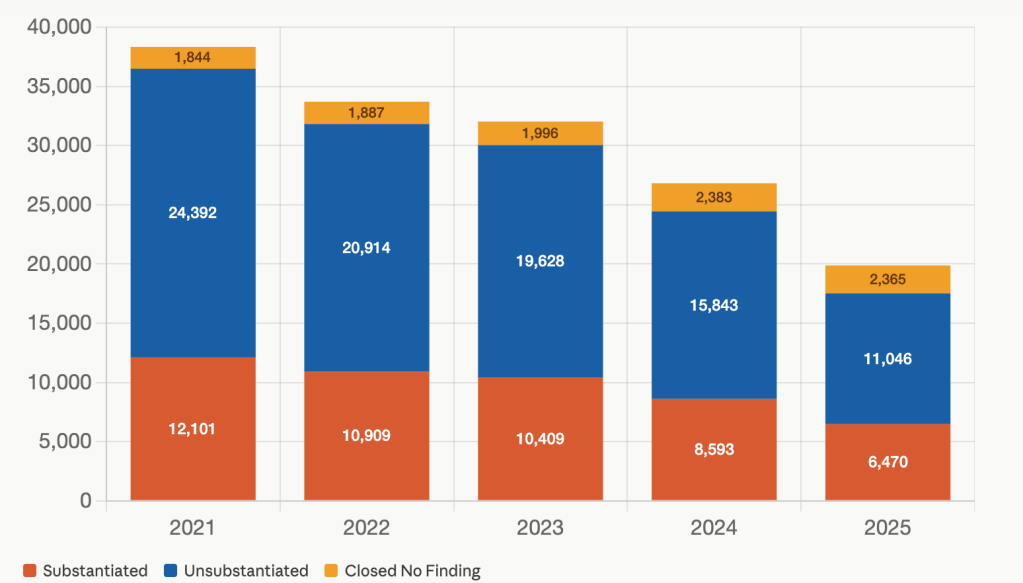
In 2021, according to the public dashboard of the Colorado Department of Human Services (CDHS) as of May 9, 2026, 12,101 children had “experienced substantiated abuse or neglect,” meaning that an investigation confirmed that abuse or neglect had occurred. In 2025, only 6,470 children had experienced substantiated abuse or neglect.
The decrease in confirmed cases of maltreatment was not due to a decrease in calls to the CDHS hotline about suspected abuse or neglect. These reports actually increased in number from 109,947 in 2021 to 117,467 in 2025, according to the Dashboard as of May 10, 2026, as shown in Chart I below. This is likely due in part to schools reopening after the pandemic and teachers being able to see signs of maltreatment.
Chart 1 Total Referrals by Screening Decision, 2021-2025
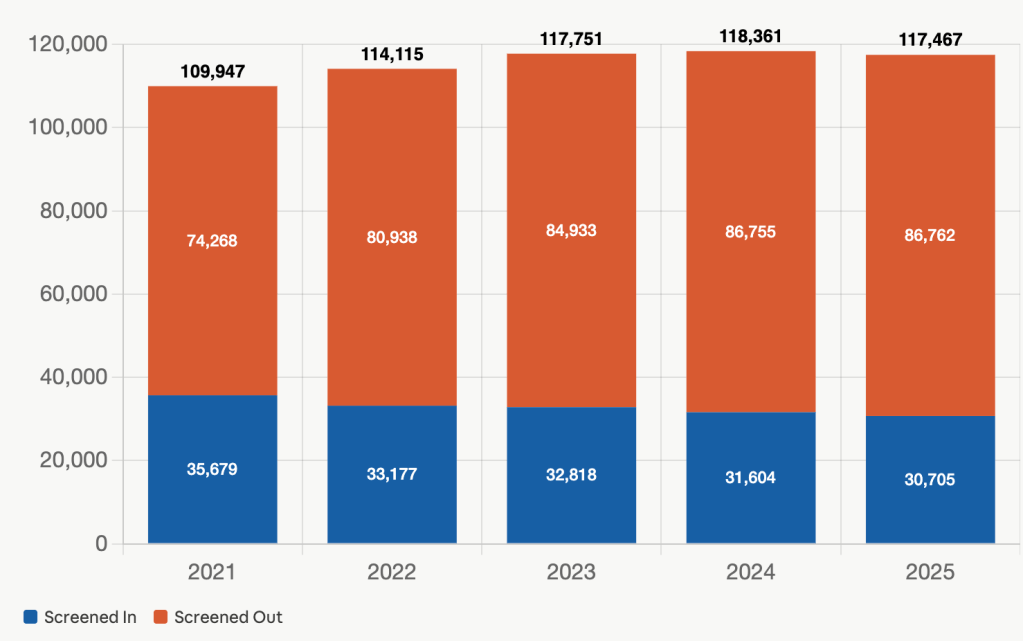
While the number of hotline calls increased, the percent of calls that were “screened in” (accepted) for an in-person response decreased from about a third to a quarter over the same period. As a result, the number of children accepted (as shown in Chart 3) dropped by more than 5,000, reducing the pool of children that could have received a “substantiated” finding.
After a report is accepted, it is assigned to a traditional investigation or a newer, different pathway called Family Assessment Response (FAR). FAR is designed for low to moderate risk cases and does not result in a finding because FAR is designed to be a non-adversarial process. Thus, children who receive a FAR cannot be found to be substantiated victims of abuse or neglect.
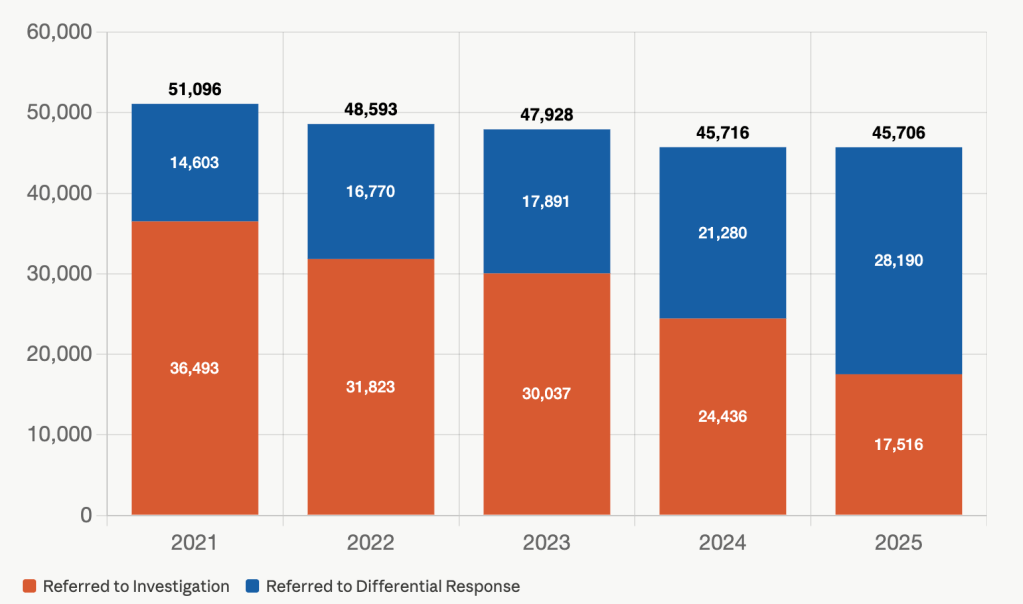
In 2025, 59 percent of the children with screened-in reports were referred to FAR, compared to only 33 percent in 2021. In other words, only 17,516 children were the subject of an investigation in 2025 compared to 36,493 children in 2021—less than half as many children–as shown in Chart 2.
Chart 2: Children Referred to Investigation and Differential Response, 2021-2025
Given the more than 50 percent drop in the number of children who received an investigation, it is not surprising that the number of children with substantiated findings of abuse or neglect dropped by almost 50 percent. Chart 3 shows how the number of children receiving a substantiated finding declined with the drop in the total number of children receiving an investigation.
Chart 3: Children Receiving an Investigation by Disposition, 2021-2025
But why did the number of children assigned to FAR more than double from 2021 to 2025? A CDHS spokesperson told me that the increase in the percentage of assessments assigned as a FAR between 2021 and 2025 is due to 21 additional counties, including two high-volume metro counties, adding the FAR option during the period.
Advocates and researchers have expressed concern that the overuse of an option like FAR can leave children in harm’s way when they are inappropriately assigned to it.
The reductions in the number of children screened in and the increased use of FAR reflect a loss of interest by CDHS in traditional child welfare services to protect children who are already being maltreated–investigation, in-home services and foster care.
Instead of intervening to protect children who are being abused or neglected, “the state has tried to get upstream from abuse and neglect, raising awareness of resources and encouraging the general community to support families,” Thomas Miller, director of children, aging and community services at CDHS told the Post. But Colorado’s new emphasis on prevention has not been accompanied by new resources or programs, according to the CDHS spokesperson.
Miller told the Post that “the majority of abuse cases are avoidable if parents have the right coping skills, the material resources their families need and social support for the inevitable difficult times.” He has a list of 50 ways for neighbors and community organizations to support families that may be at risk of maltreating their children.
It all sounds so simple. Apparently Miller has no concern about the confluence of substance abuse, mental illness, and domestic violence that characterize the families that are frequently encountered by child welfare, problems that are rarely solved by some coping tips or more money.
The Post suggests that Colorado’s new approach has helped reduce child abuse and neglect. But without evidence of such a decline, there is no reason to celebrate.


Good work as always. I wrote essentially this same story about Minnesota 15 years ago. I’m so sorry to see another state going down this path. We succeeded in getting counties to screen in a higher percentage of children but the proportion diverted to alternative response is still 60%, only down a small amount from a peak of 70%.
LikeLike
Thank you for this report. Knowing what I know about the majority of Child Protection Services, I wouldn’t have believed that headline either.
LikeLike