
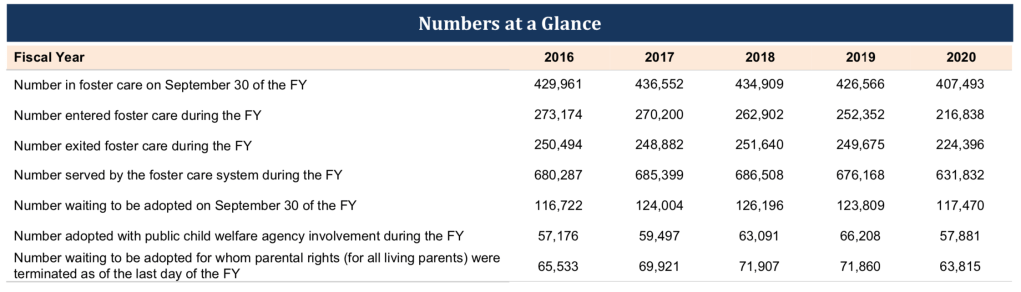
New data show drop in foster care numbers during pandemic

Source: US Children’s Bureau, AFCARS Report $28, https://www.acf.hhs.gov/sites/default/files/documents/cb/afcarsreport28.pdf

A long-awaited report from the federal government shows that most states saw a decrease in their foster care population during the fiscal year ending September 30, 2020, which included the onset of the COVID-19 pandemic. Both entries to foster care and exits from it declined in Fiscal Year (FY) 2020 compared to the previous fiscal year. These results are not surprising. Stay-at-home orders and school closures beginning in March 2021 resulted in a sharp drop in reports to child abuse hotlines, which in turn presumably brought about the reduction in children entering foster care. At the other end of the foster care pipeline, court shutdowns and a slow transition to virtual operations prolonged foster care stays for many youths. One result that is surprising, however, is the lack of a major decrease in children aging out of foster care, despite the widespread concern about young people being forced out of foster care during a pandemic.

Ever since the COVID-19 pandemic resulted in lockdowns and shut down schools around the country, child welfare researchers have been speculating about the pandemic’s impact on the number of children in foster care. While many states have released data on foster care caseloads following the onset of the pandemic, it was not until November 19, 2021 that the federal Children’s Bureau of the Administration of Children and Families (ACF) released the data it received from the 50 states, the District of Columbia and Puerto Rico for Fiscal Year 2020, which ended more than a year ago on September 30, 2020. The pandemic’s lockdowns and school closures began in the sixth month of the fiscal year, March 2020, so its effects should have been felt during approximately seven months, or slightly over half of the year. The data summarized here are drawn from the Adoption and Foster Care Analysis System (AFCARS) report for Fiscal Year 2020 compared to the 2019 report as well as an analysis of trends in foster care and adoption between FY 2011 and FY 2020. State by state data are taken from an Excel spreadsheet available on the ACF website.

The nation’s foster care population declined from 426,566 on September 30, 2020 to 407,493 children on September 30, 2021. That is a decline of 19,073 or 4.47 percent. According to the Children’s Bureau, this is the largest decrease in the past decade, and the lowest number of children in foster care since FY 2014.* Forty-one states plus Washington DC and Puerto Rico had an overall decrease in their foster care population, with only seven states seeing an increase. The seven states with increases were Arizona, Arkansas, Illinois, Maine, Nebraska, North Dakota and West Virginia. The change in a state’s foster care population depends on the number of entries and the number of exits from foster care. And indeed both entries and exits fell to historic lows in FY 2020. The reduction in entries was even greater than the fall in exits, which was why the number of children in foster care declined rather than increasing.

Entries into foster care fell drastically around the country, from 252,352 in FY 2019 to 216,838 in FY 2020 – a decrease of 14 percent. This was the lowest number of foster care entries since AFCARS data collection began 20 years ago. Foster care entries dropped in all but three states – Arkansas, Illinois, and North Dakota. These three states were also among the seven states with increased total foster care caseloads. It is not surprising that entries into foster care dropped in the wake of pandemic stay-at-home orders and school closings. While we are still waiting for the release of national data on child maltreatment reports in the wake of the pandemic, which are included in a different Children’s Bureau publication, media stories from almost every state indicate that calls to child abuse hotlines fell dramatically. This drop in calls would have led to a fall in investigations and likely a decline in the number of children removed from their homes. Monthly data analyzed by the Children’s Bureau drives home the impact of the Covid-19 pandemic on foster care entries. More than half of the decrease in entries was accounted for by the drops in March, April, and May, immediately following the onset of stay-at-home orders, which were later relaxed or removed, as well as school closures.

Source: Trends in Foster Care and Adoption, FY 2011-FY 2020, https://www.acf.hhs.gov/sites/default/files/documents/cb/trends_fostercare_adoption_11thru20.pdf

Reasons for entry into foster care in FY 2020 remained about the same proportionally as in the previous year, with 64 percent entering for a reason categorized as “neglect,” 35 percent for parental drug abuse, 13 percent for physical abuse, nine percent for housing related reasons and smaller percentages for parental incarceration, parental alcohol abuse, and sexual abuse. (A child may enter foster care for more than one reason, so the percentages add up to more than 100.)

Exits from foster care also decreased nationwide from 249,675 in FY 2019 to 224,396 in FY 2020 – a decrease of 10 percent – a large decrease but not as big as the decrease in entries, which explains why foster care numbers decreased nationwide. Only six states had an increase in foster care exits: Alaska, Illinois, North Carolina, Rhode island, South Dakota and Tennessee. Along with the decrease in exits, the mean time in care rose only slightly from 20.0 to 20.5 months in care, while the median rose from 15.5 to 15.9 months in care. Again, it is not surprising that the pandemic would lead to reduced exits from foster care. In order to reunify with their children, most parents are required to participate in services such as therapy and drug treatment, to obtain new housing, or to do other things that are contingent on assistance from government or private agencies. Child welfare agency staff and courts are also involved the process of exiting from foster care due to reunification, adoption, or guardianship. All of these systems were disrupted by the pandemic and took time to adjust to virtual operations. Monthly data shows that about 68 percent of the decrease in exits was accounted for by the first three months of the pandemic, when agencies and courts were struggling to transition to virtual operations. It is encouraging that the number of exits was approaching normal by September 2020; it will be interesting to see if the number of exits was higher than normal in the early months of FY 2021.

Source: Trends in Foster Care and Adoption, FY 2011-FY 2020, https://www.acf.hhs.gov/sites/default/files/documents/cb/trends_fostercare_adoption_11thru20.pdf

Most exits from foster care occur through family reunification, adoption, guardianship, and emancipation. The proportions exiting for each reason in FY 2020 remained similar to the previous year, while the total number of exits dropped, as shown in Table 3 below. Children exiting through reunification were 48 percent of the young people exiting foster care in FY 2020, and the number of children exiting through reunification dropped by 8.3 percent from FY 2019. Children exiting through adoption were 26 percent of those leaving foster care, and the number of children exiting through adoption fell by 12.6 percent. Exits to guardianships fell by 11 percent and other less frequent reasons for exit fell as well. The drop in reunifications, adoptions and guardianships is not surprising given court delays and also the likely pause in other agency activities during the pandemic. However, nine states did see an increase in children exiting through adoption.

Table 3

Reasons for Exit from Foster Care, FY 2019 and FY 2020

Exit ReasonFY 2019
Number
FY 2019
Percent
FY 2020
(Number)
FY 2020
(Percent)
Decrease
(Number)
Decrease
(Percent)
Reunification117,01047%107,33348%9,6778%
Living with another relative15,4226%12,4636%2,95919%
Adoption54,41526%56,56825%7,84712%
Emancipation20,4458%20,0109%4352%
Guardianship26,10311%23,16010%2,94311%
Transfer to another agency2,7261%2,2631%46317%
Runaway6080%5280%8013%
Death of Child3850%3600%256%
Source: US Children’s Bureau, AFCARS Report $28, https://www.acf.hhs.gov/sites/default/files/documents/cb/afcarsreport28.pdf

It is surprising that the number of foster care exits due to emancipation or “aging out” of foster care fell only slightly, to 20,010 in FY 2020 from 20,445 in FY 2019, making emancipations a slightly higher percentage of exits in FY 2020–8.9 percent, vs. 8.2 percent in FY 2019. There has been widespread concern about youth aging out of foster care during the pandemic, and a federal moratorium on emancipations was passed after the fiscal year ended. At least two jurisdictions, California and the District of Columbia, allowed youth to remain in care past their twenty-first birthdays due to the pandemic. It is surprising that this policy in California, with 50,737 youth in care or 12.45 percent of the nation’s foster youth on September 30, 2020, did not result in a bigger drop in emancipation exits nationwide. California’s foster care extension took effect on April 17, 2020 through an executive order by the Governor and was later expanded through the state budget to June 30, 2021. And indeed, data from California via the Child Welfare Indicators Project show that the number of youth exiting through emancipation dropped by over 1,000 from 3,618 in FY 2019 to 2,615 in FY 2020. Since total emancipation exits dropped by only 435 nationwide, it appears that the number of youth exiting care through emancipation outside of California actually increased. This raises concern about the fate of those young people who aged out of care during the first seven months of the pandemic.

In December 2020 (after the Fiscal Year was already over), Congress passed the Supporting Foster Youth and Families Through the Pandemic Act (P.L. 116-260), which banned states from allowing a child to age out of foster care before October 1, 2021, allowed youth who have exited foster care during the pandemic to return to care and added federal funding for this purpose. But this occurred after the end of FY 2020 so it did not affect the numbers for that year. Moreover, The Imprint reported in March 2021 that many states were not offering youth the option to stay in care despite the legislation, raising fears that the number of emancipations in FY 2021 may not have been much lower than the number for FY 2020.

Among the other data included in the AFCARS report, terminations of parental rights decreased by 11.2 percent in FY 2020. This is not surprising given the court shutdowns and delays. Perhaps this decline in TPR’s explains why the number of children waiting to be adopted actually decreased from 123,809 to 117,470, contrary to what might be expected from the decrease in adoptions.

It is disconcerting that some child welfare leaders and media outlets are portraying the reductions in foster care caseloads during FY 2020 as a beneficial byproduct of the pandemic. Despite the fact that maltreatment reports dropped by about half after the pandemic struck, Commissioner David Hansell of New York City’s Administration for Children’s Services told the Imprint that “It was just as likely that the pandemic was ‘a very positive thing’ for children, who were able to spend more time with their parents.” Based on an interview with Connecticut’s Commissioner of Children and Families, an NBC reporter stated that ‘With the pandemic, the last two years have been difficult, but something positive has also happened during that time span. Today, there are fewer kids in foster care in Connecticut.”

Even In normal times, I take issue with using reductions in foster care numbers as an indicator of success. Certainly if foster care placements can be reduced without increasing harm to children, that is a good thing. But in the wake of the pandemic, we know that many children were isolated from adults other than their parents due to stay-at-home orders and school closures, and we have seen a drastic decline in calls to child abuse hotlines. Thus, it is likely that some children were left in unsafe situations. Moreover, the pandemic caused increased stress to many parents, which may have led to increased maltreatment, as some evidence is beginning to show. So when Oregon’s Deputy Director of Child Welfare Practice and Programming told a reporter that “Even though we had fewer calls, the right calls were coming in and we got to the children who needed us,” one wonders how she knows that was the case, and whether her statement reflects wishful thinking rather than actual information.**

There have been many predictions of an onslaught of calls to child protective services hotlines once children returned to school. And indeed, there have been reports of a surge of calls after schools re-opened in Arizona, Kentucky, upstate New York, and other places, but we will have to wait another year for the national data on CPS reports and foster care entries after pandemic closures lifted.

The FY 2020 data on foster care around the country provided in the long-awaited AFCARS report contains few surprises. As expected by many, foster care entries and exits both fell in the first year of the pandemic. Since entries fell more than exits, the total number of children in foster care fell by over four percent. These numbers raise concerns regarding children who remained in unsafe homes and those who stayed in foster care too long due to agency and court delays. The one surprise was a concerning one: the lack of a major pandemic impact on the number of youth aging out of care. The second pandemic fiscal year has already come and gone, but it will be another year before we can get a national picture of how child welfare systems adjusted to operating during a pandemic.

*Our percentages are slightly different from those in the federal Trends report because the Children’s Bureau calculated their percentages based on numbers rounded to the nearest thousand.

*There is evidence that maltreatment referrals from school personnel are less likely to be substantiated than reports from other groups, and this may reflect their tendency to make referrals that do not rise to the level of maltreatment, perhaps out of concern to comply with mandatory reporting requirements. Data from the first three months of the pandemic shared in a webinar showed that referrals which had a lower risk score (measured by predictive analytics) tended to drop off more than referrals with a higher risk score. However as I pointed out in an earlier post, that low-risk referrals dropped off more does not mean that high-risk referrals were not lost as well.

Lethal reunifications: two children dead in New York and Florida

Their names were Rashid Bryant and Julissia Battles). She was seven years old and he had lived for only 22 months. He lived in Opa-Locka, Florida, and she lived in the Bronx. They were both taken into state care at birth. Julissia had a life of safety and love with her grandmother, occasionally punctuated by disturbing visits with her mother, until the age of six, when she was dropped off for a visit that ended in her death. Rashid knew 14 months of safety and care starting at birth, before the months of torture began. An inexplicable drive to reunify families, regardless of the lack of change in the parent’ ability to care for their children, is behind both of these tragic stories.

The 694 days of Rashid Bryant

By the time Rashid Bryant was born, on December 13, 2018, his parents were already known to the Florida Department of Children and Families, according to Carol Miller of the Miami Herald, whose articles from May 10 and July 8 are the basis of this account. Rashid’s parents, Jabora Deris and Christopher Bryant of Opa-Locka, had first come to the attention of the Florida Department of Children and Families (DCF) in 2013 and were reported at least 16 times to DCF. The allegations included parental drug abuse, physical injury, domestic violence, and inadequate supervision of their many children. The reports alleged that Deris smoked marijuana with her older children, that most of her children did not to school, that her home had no running water and that the children were hungry and losing weight. An allegation that Bryant had thrown one of his children into a car when escaping from police finally resulted in court-ordered in-home supervision of this family by DCF. When Deris and her newest child tested positive for marijuana, all of the children were removed but were soon returned to the family in August 2018.

By that time, Deris and Bryant had eight children including two younger than two and a hotline report said that the couple were leaving a 15-year-old in charge of several younger siblings, including a two-year-old who was seen outside naked. In October and November 2018, DCF received seven new reports, including drug abuse, inadequate supervision and “environmental hazards.” The couple’s children were taken into custody around Nov. 22, 2018 and were placed with relatives and foster parents. Less than a month later, their ninth child, Rashid, was born and was immediately taken into state care.

The 14 months from his birth in December 13, 2018 until his return “home” on February 2 may have been the only time that Rashid received the love and care he deserved. But the system had reunification on its mind. By August 2019 the parents were given unsupervised visitation, which was revoked after they suddenly moved without notifying the court, but was restarted again in January 2020. That same month, a supervisor with a private case management agency handling the case for the state of Florida stated that conditions for the children’s return had been met. But records reviewed by the Herald show that DCF did not agree, stating that “This determination was not supported, given that the reason for removal had not been remedied.”

On February 28, 2020 14-month-old Rashid and three brothers were returned to their mother by the court, despite the fact that DCF had asked the judge to return the children gradually, starting with one older child. According to agency records reviewed by the Herald, the children were sent home without supportive services to assist the mother with her four young children. As if that were not enough, the judge also saw fit to give “liberal, unsupervised visitation” to Deris with her other five children.

About a month later, Deris’ tenth child was born, to the “complete surprise” of caseworkers, who reported that she had denied in court that she was pregnant. Three weeks after the birth of her tenth child, the judge saw fit to return her remaining four children, leaving the new mother with the custody of ten children including five that were younger than five years old. Oversight of Rashid and the three brothers sent home with him ended in August of 2020, and all monitoring of the family end by October of that year at the judge’s order.

We don’t know when Rashid’s suffering began. We do know that he injured his leg around June 2020, but his mother waited two days to seek medical help, leaving the hospital with Rashid after refusing to allow an X-Rray. It appears Rashid spent the last five months of his life mostly in bed. At a June 22 pool party at the house of an aunt, Rashid and his father never left the car, according to the aunt. When she tried to pick him up from his car seat, she reported that Rashid began to cry. She never saw him again. Rashid’s maternal grandfather, who frequently visited the home, reported not seeing Rashid for about two months. (Why these family members did nothing in view of these red flags is another question.) Rashid’s brother, then 16, told police that he noticed something wrong with Rashid’s leg two months before he died because the little boy cringed and cried when it was touched. The teen described another incident where Rashid vomited all over his bed and then lay still and shaking with his legs up in the air. The teen could not remember if his mother sought medical attention after either of these incidents. After that incident, reported the teen, Rashid could not move his right arm. Four days before he died, a sister saw Rashid vomit after eating. She reported that the right side of his body appeared limp and his eyes were moving in different directions.

On November 6, 2020, two weeks after DCF closed the case on the family by court order, Rashid was dead. He had lived 694 days. The arrest warrant said that Rashid had suffered two seizures in the month before his death but his mother had never bothered to take him to a pediatrician. On the morning of Rashid fatal seizure, Deris called her sister saying he was unresponsive and “foaming from his nose and mouth.” Her sister told her to take him to the hospital. Deris did call for an ambulance–83 minutes later.

The Medical Examiner reported that in the months before his death Rashid had suffered two cracks to his skull — one healing, the other fresh. He also had a healing rib fracture and a recently broken leg. The cause of Rashid’s death was “complications of acute and chronic blunt force injuries.” The contributory cause was “parental neglect.” Deris and Bryant were arrested within a week of Rashid’s death and are awaiting trial on manslaughter and aggravated child abuse.

But somehow, DCF has not decided whether Rashid died of abuse or neglect–so they refuse to release the case files that they are required to release by law when a child dies of abuse or neglect by a caregiver . That requirement is in a state law that was passed requiring such revelations in the wake of the Miami Herald’s publication in 2014 of, Innocents Lost, detailing the deaths of about 500 children after DCF involvement. The Herald has filed suit against DCF and has been joined in the suit by a dozen media companies and advocacy groups.

Julissia Batties: from home to hell

On August 10, police and medics were summoned to the 10th-floor Bronx apartment where Julissia Batties lived with her mother, Navasia Jones, her 17-year-old half-brother, and one-year-old brother, as reported by the New York Times and many other media. Her mother gave inconsistent accounts to the police but it appears that after finding Julissia “vomiting and urinating on herself” at 5am, she waited three hours, and went to the store and the bank, before she called for emergency services shortly after 8:00 AM. Julissia was pronounced dead shortly after 9am. Julissia’s 17-year-old half-brother later told police that he had punched Julissia in the face eight times that morning because he thought she had taken some snacks. But those were not the injuries that killed Julissia. The medical examiner found injuries all over her body. On Friday her death was ruled a homicide caused by blunt force trauma to the abdomen. There have been no arrests so far.

Records show that Julissia’s mother had a long history of involvement with ACS and police. In 2013, the year before Julissia was born, Jones lost custody of her four older children. When Julissia was born in April 2014, she was immediately removed from her mother’s custody and placed with her paternal grandmother, Yolanda Davis. A family court judge initially granted Jones’ motion for custody of the new baby, but ACS appealed, and the appeals court stayed enforcement of the custody transfer pending their decision on the appeal. In 2015, the appellate court agreed with ACS, stating that “the mother had failed to address or acknowledge the circumstances that led to the removal of the child.” The court stated that although the mother complied with the services required by her case plan, “she was still prone to unpredictable emotional outbursts, even during visits with the children, and she was easily provoked and agitated. Indeed, the case planner testified that she had not seen any improvement in the mother’s conduct even after the mother participated in the mandated services.” The court concluded that “until the mother is able to successfully address and acknowledge the circumstances that led to the removal of the other children, we cannot agree that the return of the subject child to the mother’s custody, even with the safeguards imposed by the Family Court, would not present an imminent risk to the subject child’s life or health.” Wise words indeed. Julissia remained with her grandmother, Yolanda Davis, until being returned to her mother on March 2020, when she was almost six years old.

It appears that the COVID-19 pandemic had some role in the transformation of a weekend visit into a custody change that resulted in a child’s death. Davis told a local TV station, PIX-11, that a caseworker told her the visit had been extended due to the pandemic, and the extension never ended. Sources told the New York Post that the mother was officially granted custody in June 2021, though the circumstances are unclear. The decision to return Julissia to her mother appears to have been made at the recommendation of SCO Family of Services, a foster care nonprofit that was managing the case for ACS. After the first month or so, Julissia was not even granted visits with her grandmother, which would have been a much-needed respite and could have saved her, had the grandmother seen or reported injuries or other concerns. The New York Daily News reported that in May 2020, Davis was denied visits with Julissia because she had allowed the child to see her own father, Davis’ son. The motivation behind denying a child visits with the only parent she had known for six years are truly hard to understand.

There were many indications that all was not well in Navasia Jones’ household in the months before Julissia’s death. A neighbor told the Times that “there was always a lot of commotion, always yelling, always screaming” in the apartment. As recently as August 6, his girlfriend had called authorities to report that Julissia had a black eye. The neighbor told the Times that he had spoken to police and ACS staff about the family several times. Police reported to the Times that officers had filed at least nine domestic abuse reports on the family and responded to five reports of a person needing medical attention.

The decision to send Julissia home with her mother after six years apart is particularly strange because the Adoption and Safe Families Act of 1997 (ASFA) requires that a state must file for termination of parental rights after a child has spent 15 of the last 22 months in foster care. The requirement was written into law because children were languishing for years in foster care without a plan for permanency. It was recognized that children need permanency and stability and it is hard to understand why ACS and its contractor would want to move a thriving child from the grandmother who had parented her from birth to age six.

Much needs to be clarified to understand how this child was returned to the family that would kill her. ACS and SCO have declined to comment on the case, citing confidentiality. ACS did issue a statement that “its top priority is protecting the safety and wellbeing of all children in New York City.” But it is clear that other priorities took a front seat in Julissia’s case.

Factors Contributing to lethal reunifications

What explains the adamant determination on the part of some agency personnel and judges to return children to biological parents who have shown no sign of changing the behaviors that caused the system to remove them in the first place? To some extent, it reflects an ideology–one that is becoming increasingly dominant in the nation– that is committed to family preservation and family reunification at almost any cost. Child welfare is known for pendulum shifts in the emphasis on child safety as opposed to family preservation and reunification, but the latter is clearly in the ascendant right now. Extreme deference to this ideology can blind agency employees and judges to what is right in front of their faces: the failure of a parent to change the behaviors and attitudes that resulted in the initial removal of a child.

The obsession with family reunification at all costs can be encoded into social worker evaluations. In Tennessee, a recent survey of social workers suggests that they are being judged by whether they close cases in a timely manner, regardless of child safety. As one worker put it, “Children are returned home or exiting custody to relatives quickly to lower the number of cases without regard to whether the children will be truly safe and the parents ready to parent again.”

The current emphasis on family preservation and reunification is often justified as a way to ratify racial imbalances in child welfare involvement. A growing movement urges drastically scaling down or eliminating current child welfare services on the grounds that the overrepresentation of Black children in care compared to White children is a consequence of racism. Supporters call for elimination of the “disproportionality” between removals of Black and White children from their parents, while disregarding higher rates of poverty and historical trauma that result in more child maltreatment among Black families. To say that Black children need to stay with, or return to, abusive parents in order to equalize the percentages of White and Black children in care is to devalue children and reduce them to nothing more than their race, a strange position for an anti-racist movement to take. As described in a document entitled How we endUP: A Future without Family Policing, parts of this movement are fighting for repeal of ASFA, which would eliminate timelines and encourage jurisdictions to reunify children with their birth parents years after they had established parental bonds with other caregivers, such as grandmothers or former foster parents.

Racial considerations are not the only factor driving systems to support reunification at all calls. Lethal reunifications occur in states like Maine, where 88 percent of the children in foster care are White. Maine’s Office of the Child Advocate recently reported that the state’s child welfare system continues to struggle to make good decisions around two critical points–the initial safety assessment of a child and the finding that it is safe to reunify the child with her parents. In its review of seven cases closed through reunification, the OCA found multiple incidents where children were sent home with insufficient evidence that they would be safe. In one case, the parents had not been visited for a year-and-a-half despite the fact that home conditions were a reason for the original removal. In another case, providers were not contacted or given the information they needed to treat the issues that had resulted in the removal. In another case, the parent “failed to understand or agree to the reasons the children entered custody, but this was not considered significant.” In yet another case, the trial home placement started too soon and the parent never completed required substance abuse treatment. The child was sent home two months after the parent had a positive toxicology screen.

In responding to the criticisms of Maine’s OCA, OCFS admitted that “staff have been challenged with the current workload based on the increase in the number of calls, assessments, and children in care.” It is clear that insufficient of resources lead to excessive caseloads around the country, endangering children. In Tennesseee, for example, while caseloads are not allowed to exceed an average of 20 (a very high number in the experience of this former social worker) data obtained by the Tennessee Lookout, indicated that 30% of caseworkers had caseloads of more than 20, and that many had 30, 40 or even 50 cases. Insufficient funding often means low pay and a difficulty in attracting people with the education and critical thinking skills required for the job. High caseloads and poor pay lead to high turnover, resulting in a loss of institutional memory about specific cases that may drag on for years, such as those discussed here. In turn, high turnover leads to high caseloads as social workers have to pick up cases from those who leave. Such factors may or may not have contributed to the deaths of Rashid and Julissia; they have certainly contributed to other child deaths around the country. Most taxpayers don’t want to think about these systems or fund them; it is easy to avoid reading about the consequences when they occur.

And cost considerations drive reunifications in another way as well. Reunifications save money for cash-strapped child welfare systems. Once a child is sent home and the case is closed, the jurisdiction incurs no more expenditures for foster care. If the child is instead placed in guardianship or adoption with a relative or foster parent, the jurisdiction may end up paying a monthly stipend to the caregiver until the child turns 21. Of course, many relatives who step up to the plate like Julissia’s grandmother are not paid, due to the same budget concerns. giving rise to the current outcry and debate around hidden foster care.

Family court problems contribute to lethal reunifications as well. Rashid’s death appears to be primarily due to a judge who insisted against agency protests on the return of nine children in the space of two months, during which the mother also gave birth to a tenth child. The information available suggests that Florida DCF staff proposed a much slower reunification process. We don’t know what influenced the judge’s decision, but we do know that family courts are overwhelmed and in crisis, resulting too often in the deaths of children in both custody and child protection cases. These courts are inundated with cases, judges often lack the training they need, delays are all too frequent and were worsened by the pandemic. Judges rarely see consequences for decisions that lead to an innocent child’s death, and I have never heard of a judge being removed for the death of a child that was placed in a lethal home against all the evidence. The judge who sent Rashid to his death probably continues to endanger other children daily. This judge must be named, punished, removed and never again allowed to send children to their deaths.

The degree to which the pandemic contributed to Julissia’s and Rashid’s deaths is impossible to estimate. Julissia’s irregular reunification was justified to her grandmother on the grounds of the pandemic. Both Rashid and Julissia should have been visited regularly at least monthly once they were placed with their original families, depending on state regulations. Visits to Rashid should have occurred until the judge terminated them in August, well after the leg injury that left him bedridden, and he should have also been seen in the visits to his siblings that terminated in October. Even if the case managers were visiting (virtually or in real life) only the four children whose cases had not been closed, they should have had the curiosity to ask about little Rashid. For Julissia, there should have been visits throughout her 16 months in hell. Were these visits conducted at all, virtually, or in person? What information was gathered at these visits? This information that must be revealed.

This is not my first post about a lethal reunification in Florida. In January 2019, I wrote about Jordan Belliveau, who was murdered by his mother eight months after being reunified with her, even while a agency in Pinellas County was still monitoring the family. A caseworker for the agency and later resigned told News Channel Eight that the system “puts far too much weight on reuniting kids with unfit parents and makes it nearly impossible for caseworkers to terminate parental rights.” It does not appear that the state learned from Jordan’s death.

I could have written about other lethal reunifications in New Mexico, Ohio, and elsewhere. But I often resist writing about the deaths of a specific child or children known to the system that was supposed to protect them. There are so many reports of such cases, and they are only the tip of the iceberg. Why choose one and not another? I cried for Rashid but I did not write about him until I read about Julissia. Then I knew that I had to write about both, because they represent so many others whose names we will never know. Some of these children’s names may never be known to the general public because there was no outraged grandmother to speak out, no determination of the cause of death, no charges by police, or no alert reporter to reads a crime report and ask questions. But others are unknown because they are suffering in silence and darkness. Because death is not the worst thing that can happen to a child whose life is one of unremitting pain.