
New Jersey’s claim of declining child maltreatment: ingenuous or disingenuous?

Officials of New Jersey’s Department of Children and Families (DCF) are congratulating themselves on what they call the decline of child abuse and neglect in their state and attributing this ostensible decline to their department’s preventive services. The number of reports of child child maltreatment has actually increased over this period. DCF’s claims are based on a decline in the number of children with substantiated reports–a number which reflects DCF policy and practice much more than it reflects actual abuse and neglect. Whether agency officials are ignorant or attempting to manipulate the data for naive readers, this is no way to keep the public informed about how well New Jersey is protecting its children.

Two DCF officials, Laura Jamey, Director of the Division of Child Protection and Permanency and Sanford Starr, Director of the Division of Family and Community Partnerships, say they have some good news for New Jerseyans. They announce it in an op-ed titled “Maltreatment of NJ kids is decreasing. Here’s wow [sic] we’re preventing it,” which was published in the Asbury Park Press. “By using evidenced-based [sic] prevention strategies and practically addressing families’ needs, we’re happy to report that over the past decade, there has been a steady decline in the number of confirmed cases of child abuse and neglect in our state. In 2016, there were more than 8,000 substantiated and established cases of Child Abuse and Neglect in New Jersey. Last year, that number was only 2,641.”

Wow! sounds impressive, right? But it turns out the authors took as much care with the substance of their commentary as with their capitalization and spelling. That much is clear to anyone who bothers to look at the data that New Jersey shares with the federal government through the National Child Abuse and Neglect Data System (NCANDS) and which the federal Children’s Bureau shares through its annual Child Maltreatment reports. The data for 2023 have not yet been published by the Bureau, but the figures below represent what New Jersey reported for Federal Fiscal Years (FFY) 2016 to 2022, which ended on September 30, 2022.

Federal Fiscal YearReferralsChildren Receiving an Investigation or Alternative responseChildren receiving a “substantiated” disposition/percent of referrals
201656,01473,8898,264 (11.2%)
201757,02674,3936,614 (11.6%)
201859, 42877,6616,008 (10.1%)
201960,93478,7415,132 (8.4%)
202052,85370,1793,655 (6.9%)
202148,78166,3213,188 (6.5%)
202257,06874,7663,146 (5.5%)
Sources: Child Maltreatment 2016-2022, Children’s Bureau, Administration on Children and Families

Jamey and Starr cited only the number of substantiated cases of maltreatment. But that figure has meaning only in the context of two figures that represent earlier steps in the process, which are always discussed first in the Child Maltreatment reports. “Referrals” is the child welfare system’s term for reports to the state child protective services hotline. As you can see, those reports increased slightly in New Jersey from 56,014 in FFY2016 to 60,934 in FFY2019. There was a significant drop in referrals during the COVID pandemic in FFY2020 and FFY2021, and then a rebound to 57,068 in FFY 2022, just slightly higher than the number in 2016.

The number of children who were the subject of an investigation also dipped during COVID (in response to the drop in referrals) and bounced back up to a level that was slightly higher than that of 2016. But the number of cases that received a disposition of “substantiated” (which means an investigation concluded that a preponderance of the evidence indicated that abuse and neglect occurred) fell every year, with especially large drops in 2017 and during the COVID pandemic. And according to Jamey and Staff, that number fell even further to 2,641 in 2023, which means the number of children with substantiated referrals had dropped by 68 percent since FFY2016. And the number of children receiving a substantiated disposition as a percent of all referrals fell by half–from 11.2 percent to 5.5 percent, in that period.

So what explains this large drop in children with substantiated dispositions during a period of nine years? In its commentary in Child Maltreatment 2017 (CM2017), New Jersey attributed the one-year drop in children with substantiated dispositions from FFY 2016 to FFY2017 to a revised disposition model it adopted in April 2013.1 But after FFY2017, DCF provided no explanations other than regularly repeating its statement in 2018 that “the decrease in the number of substantiated victims “remains consistent with prior years and shows a continued trend in the decrease of victimization rates.” In CM2022, DCF simply acknowledged without explaining that “[d]espite the number of CPS referrals increasing from FFY 2021 to FFY 2022, the number of child victims continues to decrease. The rate in which New Jersey substantiated reports also decreased from FFY 2021 to FFY 2022.”

Research suggests that substantiation decisions are not very accurate and that a report to the hotline predicts future maltreatment reports and developmental outcomes almost as well as a substantiated report.2 So it just does not seem plausible that child maltreatment could have dropped by over half while the number of reports increased. There is one possible explanation for this decline, which I raised in a 2021 blog. New Jersey is one of many states that is increasingly using a practice called “kinship diversion.” Kinship diversion occurs when social workers determine that a child cannot remain safely with the parents or guardians. Instead of taking custody of a child, the agency facilitates placing the child with a relative or family friend. If this occurs in the context of an investigation, kinship diversion may result in a finding of “unsubstantiated” (or in New Jersey, “unfounded” or “not established”) even when abuse or neglect has occurred, on the grounds that the child is now safe with the relative. We have no idea how widespread kinship diversion is in New Jersey or how often it results in an “unfounded” or “not established” finding. However, the system of informal kinship care created by kinship diversion has been called America’s hidden foster care system and nationwide it appears to dwarf the provision of kinship care within the foster care system.

There is no way of knowing how much, if any, of the drop in child maltreatment substantiations is accounted for by kinship diversion. If diversion accounts for a substantial portion of the drop, that points to serious problems with the practice. It means not only that DCF is undercounting incidents of child abuse or neglect but also that a parent who committed serious maltreatment would not show up as having a substantiated report, possibly affecting decisions on future allegations against that parent. I described some of the other problems with kinship diversion, such as the lack of support for the child and relatives, the possibility that the caregiver will return the child to the an unsafe home, the possible placement of children with inadequately-vetted relatives, and the lack of due process and services for the parents, in another post.

Despite their lack of explanation in their annual commentaries designed for federal employees and child welfare specialists to read, DCF officials have offered the public an optimistic explanation for the drop in maltreatment substantiations. “We’ve worked to transform New Jersey’s child welfare system to support and strengthen families who are struggling to meet their basic needs rather than separating them. A family unable to provide clean clothes may need a supportive neighbor who can offer a ride to the local laundromat. A family struggling to put food on the table may need to be connected with a local food bank.” We have already shown that this decline does not indicate a decline in actual maltreatment, but this attempt to tie it to simple casework like finding a family a ride to a laundromat is simply not believable.

The problem is not just an op-ed that few will read. As quoted in NJ Spotlight News, the Commissioner of DCF told a legislative committee that “Working together, we have achieved so much for New Jersey’s families, including the lowest rate of family separations in the country, one of the lowest rates of child maltreatment and repeat maltreatment in the country.” This was quoted as part of a congratulatory article about how New Jersey has become a “national leader in child welfare.” it is unfortunate that this public media outlet simply echoed the Department’s rosy view, making no attempt to verify their claims by consulting the data.

The misuse of data by high officials of New Jersey’s child welfare agency raises an uncomfortable question. Is it really possible that these leaders believe that child maltreatment has declined by 68 percent since 2016? All I can say is that their statement reflects either ignorance or a cynical disregard for the truth. Neither of these options reflects well on the leadership’s moral or intellectual capacity to serve their state’s most vulnerable children and families.

Notes

  1. Before the new framework, New Jersey had only two investigation dispositions: unfounded and substantiated. The new model added two new dispositions: established and not established, which fall on a continuum between “substantiated” and “unfounded.” DCF explains that the cases that receive the “established” disposition are coded as “substantiated” in NCANDS, so it is possible that finding some children who would have been substantiated as “not established” instead contributed to the drop in substantiations. ↩︎
  2. Theodore Cross and Cecilia Casanueva, “Caseworker Judgments and Substantiation,” Child Maltreatment, 14, 1 (2009): 38-52; Desmond K. Runyan et al, “Describing Maltreatment: Do child protective services reports and research definitions agree?” Child Abuse and Neglect 29 (2005): 461-477; Brett Drake, “Unraveling ‘Unsubstantiated,’” Child Maltreatment, August 1996; and Amy M. Smith Slep and Richard E. Heyman, “Creating and Field-Testing Child Maltreatment Definitions: Improving the Reliability of Substantiation Determinations,” Child Maltreatment, 11, 3 (August 2006): 217-236. Brett Drake, Melissa Jonson-Reid, Ineke Wy and Silke Chung, “Substantiation and Recidivism,” Child Maltreatment 8,4 (2003): 248-260; Jon M. Hussey et al., “Defining maltreatment according to substantiation: Distinction without a difference?” Child Abuse and Neglect 29 (2005): 479-492; Patricia L. Kohl, Melissa Jonson-Reid, and Brett Drake, “Time to Leave Substantiation Behind: Findings from a National Probability Study,” Child Maltreatment, 14 (2009), 17-26; Jeffrey Leiter, Kristen A. Myers, and Matthew T. Zingraff, “Substantiated and unsubstantiated cases of child maltreatment: do their consequences differ?” Social Work Research 18 (1994): 67-82; and Diana J. English et al, “Causes and Consequences of the Substantiation Decision in Washington State Child Protective Services,” Children and Youth Services Review, 24, 11 (2002): 817-851. ↩︎
New Jersey to foster parents: thanks but no thanks!

Foster Parents Needed As COVID-19 Pandemic Strains Families is a typical headline these days, as illustrated in an article from Illinois. The pandemic has imposed new impediments to recruiting and retaining foster parents, including fears of exposure to COVID-19, loss of employment and income, and concerns about supervising virtual schooling. But these issues do not seem to be affecting New Jersey, where prospective foster parents are told that they are not needed, thank you very much! While the state credits its efforts at child abuse prevention and family preservation for its lack of need for foster parents, the explanation seems to lie elsewhere. Over the course of five years, the state has cut in half its rate of confirming allegations of abuse and neglect–resulting in a similar fall in the number of children entering foster care. This is a big change, and one that demands explanation in order to ensure that the agency is continuing to fulfill its mission of ensuring children’s safety in New Jersey.

Would-be New Jersey foster parents who click on “Be A Foster Parent” on the website of the Department of Children and Families (DCF) are greeted with the following message: “Thank you for your interest in becoming a resource parent to children and youth in state care.  Due to the COVID19 Pandemic and its impact on operations, DCF has suspended all new inquiry submissions at this time. Please continue to check our website for any updates.” This is an odd message indeed, as it seems to imply that the pandemic has made recruitment and licensing impossible. But agencies around the country have adapted quickly to move vetting and training online in order to enable new foster parents to enter the pipeline. Not so New Jersey.

When we asked DCF why foster parents are being turned away, we received the following reply from DCF Communications Director Jason Butkowski. “[W]e did experience a 19.17% reduction in out-of-home placements from 2019 to 2020.  This is attributable both to New Jersey’s statewide prevention network and our ongoing work to preserve families and keep children and parents together in their homes while receiving services.”

Interestingly, a message sent earlier to prospective foster parents gave a different answer. In May, 2020, would-be foster parents received a message saying, “In New Jersey, the number of youth in foster care continues to be reduced each year because we are focusing first on kinship placements,” as quoted in an article by Naomi Schaefer Riley. We asked Mr. Butkowski which explanation was more accurate–prevention and family preservation or kinship placements–but received no answer.

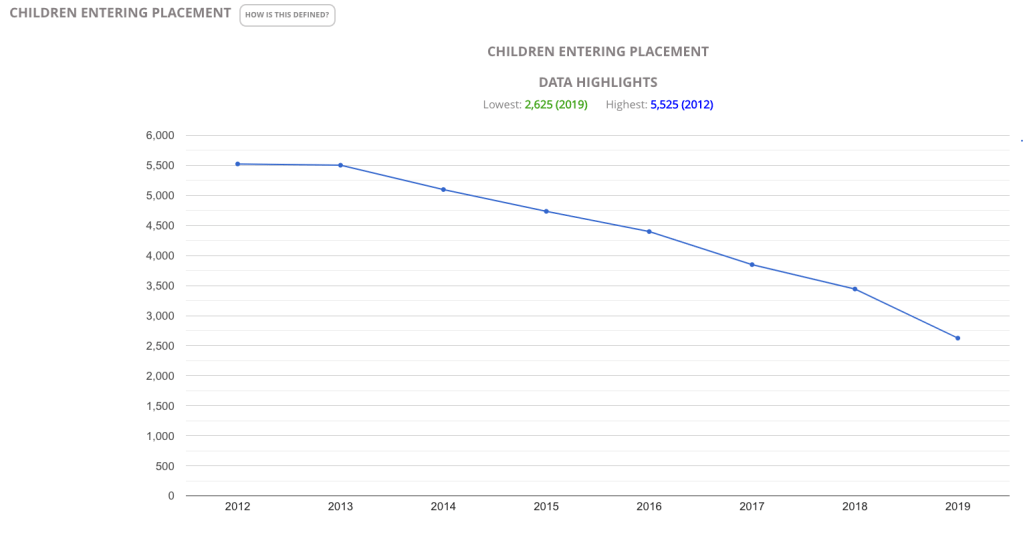
So what is going on in New Jersey? Certainly, foster care numbers have been decreasing. According to the data portal maintained by Rutgers University, annual entries to foster care fell from 5,504 in 2013 to 2,525 in 2019, as shown in the chart below. The rate of decrease in foster care entries became even steeper between 2018 and 2019, with a decrease of 23.7 percent in the number of entries in that one year alone. The total number of children in foster care dropped from a high of 7,775 in May 2014 to 4,463 in February 2020–before the pandemic closures occurred. So what could be causing this drastic decline in foster care placements and caseloads?

Source: NJ Child Welfare Data Hub, available from https://njchilddata.rutgers.edu/portal/entering-placement-reports#

One possibility might be a decline in child abuse and neglect, which Butkowski is implicitly assuming by attributing part of the fall in foster care cases to DCF’s “statewide prevention network.” In that case, one might expect reports to child abuse hotlines to decline significantly. But according to monthly state reports, calls to child abuse hotlines hardly changed between 2014 and 2019, decreasing very slightly from 165,458 to 164,417. Of course we cannot be sure that reports are an accurate measure of child maltreatment; but one might expect a significant reduction in hotline calls if a large reduction in maltreatment were occurring.

DCF’s Butkowski also credited the agency’s work to “keep children and parents together in their homes while receiving services” as a reason for declining foster care entries. It is true that most substantiations of abuse or neglect do not result in foster care. Instead, DCF works with many families in their homes to help them avoid future maltreatment. But DCF has been emphasizing in-home services for years. Of all the children who were under DCF supervision in foster care or in-home services, the percentage receiving in-home services rather than foster care was 84.7 percent in May 2014 and 90 percent in February 2020. So children were somewhat more likely to receive in-home services in 2020 than in 2014, but the difference was small and not likely to explain the big fall in the foster care rolls.

So with hotline calls basically unchanged, and only a slight increase in the emphasis on in-home services, how did New Jersey manage to reduce its foster care entries by almost half in six years? One can think of the child welfare process as a funnel, starting with referrals, the child welfare term for hotline calls. As we discussed, those have fallen only slightly. Only some referrals are screened-in and accepted for investigation; many are rerouted or receive no action because hotline workers determine that they do not concern abuse or neglect. But a reduction in screened-in referrals is not part of the explanation for New Jersey’s drop in foster care placements. New Jersey reported that 60,934 referrals were screened in in FFY 2019, compared with 59,151 in FFY 2013–a slight increase.

The next step in the child welfare funnel is investigation, and here the count shifts from the number of referrals to the number of children. According to data submitted to New Jersey to the Administration for Children and Families (ACF) and published in Child Maltreatment 2019, the number of children receiving an investigation in New Jersey increased slightly from Federal Fiscal Year (FFY 2015) to FFY 2019–from 74,546 to 78,741. However there was a stunning drop in the proportion of these children who were found to be abused or neglected (known as “substantiation” in the child welfare world). In FFY 2015, 13.0 percent of the children who received investigations (or 9,689 children) were found to be abused or neglected. In FFY 2019, only 6.5 percent of the children receiving investigations (5,132 children) were found to be victims of maltreatment. In other words, among the children who were involved in investigations, the proportion who were found to be maltreated dropped by half. Similarly, the number of children found to be maltreatment victims dropped by 47 percent. (This is very similar to the 44.6 percent decrease in foster care entries between those years shown in the Rutgers data portal cited above).

Note: The substantiation rate is the number of children found to be maltreatment victims divided by the number of children who were the subject of CPS investigations. Data are from Child Maltreatment 2019, available at https://www.acf.hhs.gov/sites/default/files/documents/cb/cm2019.pdf

It turns out that aside from Pennsylvania, which is not comparable to other states because it does not report on most neglect allegations, New Jersey had the lowest rate of substantiation per 1,000 children of all the states in FFY 2019. Only 2.6 children per 1,000 were found to be maltreated, compared to a national rate of 8.8 children per 1,000. In FFY 2015, this rate was 4.9 per 1,000 children in New Jersey–almost twice as high.

How did the number and percent of children found to be victims of child maltreatment drop so much in New Jersey over a four-year period, despite little decline in hotline calls? We asked DCF this question but received no reply. In the notes it submitted to ACF with its 2019 data, DCF acknowledged a decrease in the number of substantiated victims of maltreatment and stated that this is consistent with a continued trend–but provides no explanation. Perhaps policy or practice has changed to make it more difficult to substantiate abuse or neglect, through a change in definitions or in the standard of proof, or perhaps in training or agency culture. But such a change was not mentioned either by Butkowski or in DCF’s submission to ACF.

Let us revisit DCF’s previous message to foster parents saying that “In New Jersey, the number of youth in foster care continues to be reduced each year because we are focusing first on kinship placements.” This is an interesting statement because it implies that these kinship placements are not through the foster care system. It is important to understand that children can be placed with relatives in two ways. A child can be found to be a victim of maltreatment and placed with a relative, who becomes licensed as a foster parent. In New Jersey, 1,619 foster children (or 41 percent of the 3,951 children in foster care) were living with licensed kinship foster parents in November 2020. But these children are included in the state’s count of children in foster care, so they cannot account for the caseload drop. DCF must have been referring to something else.

Perhaps DCF’s earlier message to foster parents referred to the agency’s increasing use of a practice called “kinship diversion.” As described in an issue brief from ChildTrends, kinship diversion is a practice that occurs during an investigation or an in-home case when social workers determine that a child cannot remain safely with the parents or guardians. Instead of taking custody of a child, the agency facilitates placing the child with a relative. If this occurs in the context of an investigation, kinship diversion may result in a finding of “unsubstantiated” even when abuse or neglect has occurred, on the grounds that the child is now safe with the relative. We have no idea how widespread this practice is in New Jersey or nationwide since neither New Jersey nor other states report the number of these cases. However, the system of informal kinship care created by diversion has been called America’s hidden foster care system and nationwide it appears to dwarf the provision of kinship care within the foster care system.

There are many concerns about kinship diversion, as described in an earlier post: caregivers may not be vetted or held to the same standards as foster parents; they and the children they are caring for do not receive case management and services; they do not receive a foster care stipend and may have to depend on much-lower public assistance payments; there is nothing preventing caregivers giving children back to the parents without any assurance of safety; and parents are not guaranteed the due process rights and help with reunification that come with having their children in foster care. Because of the various concerns around kinship diversion, litigation has been filed in several states challenging this practice.

There is one other possible explanation that comes to mind for DCF’s foster parent surplus–dropping foster care rolls due to the COVID-19 pandemic. We removed data from the time of the pandemic from the above discussion to avoid confounding its effects with those of policy and practice changes but we need to ascertain whether the pandemic’s impact on calls to the hotline has affected entries into foster care. As in most states, hotline calls in New Jersey fell sharply in the aftermath of school closures and other pandemic measures. The number of child maltreatment referrals between March (the onset of school closures and quarantines) and November 2020 (the last month for which data are available on the DCF website) was 98,306, compared to 131,344 in the same period of 2019–a drop of 25 percent, based on monthly reports from DCF. It is likely that fewer calls from teachers now teaching virtually were a major factor behind this drop in hotline calls.

Entries into foster care also fell sharply in the wake of the pandemic. Foster care entries dropped from 1,949 in March through November 2019 to only 1,211 in the same months of 2020–a drop of 37.9 percent–which may have reflected in part the reduction in hotline calls and in part the continuing decrease in foster care entries that we have described. But the number of children in care did not drop nearly as much as entries into care. Between February and November 2020, the total number of youth in care decreased only 11 percent from 4,463 to 3,951. This drop is surprisingly low–in fact it is less than the decrease in the foster care caseload during the same months of 2019 (16.1 percent). The small size of this caseload decline reflects the fact that foster care exits dropped even more than foster care entries. Exits from foster care dropped from 2,754 in March through November 2019 to 1,661 in the same months of 2020. That is a drop of over 1,093, when the drop in foster care entries was “only” 738.[1] As a result, it appears that the number of children in foster care was higher, rather than lower, due to the pandemic. Therefore, it does not appear that the pandemic contributed to the decline in demand for foster parents.

One might expect to hear expressions of concern, or at least interest, in the recent precipitous drop in the number and rate of substantiations and in the foster care caseload from the court-ordered monitor charged with ensuring that New Jersey’s child welfare system is fulfilling its mission of protecting children. Since 2006 New Jersey has been operating under a settlement agreement in a lawsuit filed in 1999. The Court Monitor is Judith Meltzer, Executive Director of the Center for the Study of Social Policy (CSSP). In its most recent report, CSSP praised DCF for maintaining its progress toward meeting all the benchmarks required to exit the lawsuit, despite the challenges posed by COVID-19. Ironically, the report mentions DCF’s progress in “Prioritizing Safety.” The report does not mention the precipitous drop in foster care entries or substantiations before the pandemic or the fact that the state is turning away prospective foster parents.

New Jersey may be the first state to have stopped accepting applications for foster parents, and the reasons cited by DCF do not seem to explain this unusual event. Careful study of DCF data shows that the rate at which allegations of abuse or neglect are substantiated has been cut in half, and that there has been a similar reduction in entries into foster care. This cut in the substantiation rate could be due to policy or practice changes making it harder to confirm child maltreatment or it could be due to an increased tendency to place children with relatives without establishing officially that maltreatment has occurred. Without an adequate explanation from the state, the extent to which either of these factors is driving these trends is unknown. It is imperative to know the explanation of this trend to ensure that DCF’s new policies and practices are not compromising its mission of keeping children safe.

[1]: Reasons for this drop in foster care exits may include court shutdowns and delays and suspension of services parents need to complete their reunification plans.