
by Marie Cohen

A new report from the Government Accountability Office (GAO) has revealed what many of us have expected: implementation of the Family First Prevention Services Act (often called “Family First”) has not reduced the use of congregate care in most states. There is no reason to be surprised. The failure of Family First to achieve this goal was predicted from the start. Requiring states to stop using existing congregate care facilities while making it difficult to provide alternative placements was not only bound but actually designed to fail as a consequence of the revenue neutrality that was built into the law. GAO’s lack of substantial recommendations to solve the problem is disappointing, as is the failure of Senator Wyden to recognize the fundamental flaws in the law he created and pushed through Congress in 2018.
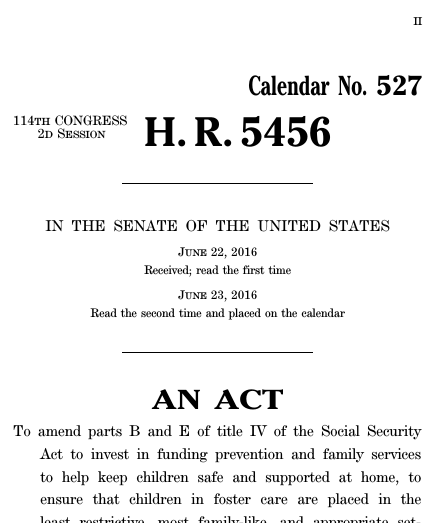
Family First, passed as part of the Bipartisan Budget Act and signed by President Trump in 2018,1 made two major changes in existing law. Part One extended funding under Title IV-E of the Social Security Act to programs designed to keep children safely at home or with relatives instead of being placed in foster care. Part IV, which is the subject of this post, was to limit funding for all placements that are not foster homes. Such placements are often labeled as “congregate care,” and include group homes, residential treatment centers, and any setting other than a family foster home. While federal funds could be claimed for the placement of any youth in such a setting before Family First, the law limited both the types of congregate care settings that can be funded and the characteristics of the youths who could be placed in these facilities with federal funds. The rationale for these limits was that most children do better in families than in group or institutional settings and that many children were placed in congregate care for lack of an alternative. For those youths who truly need congregate care, the goal was to ensure that these settings are high-quality and truly therapeutic
To reduce the placement of children in congregate care and ensure that such settings are appropriate when used, Family First limited reimbursement for children placed in congregate care facilities after 14 days to four categories (1) a new placement type called a Quality Residential Treatment Program (QRTP) designed for children with “serious emotional or behavioral disorders or disturbances;” (2) a setting designed for pregnant or parenting youth; (3) an independent living setting for youth over age 18; and (4) a setting for children who “have been found to be, or are at risk of becoming, sex trafficking victims.”
As defined in Family First,a QRTP must have a trauma-informed treatment model, have registered or licensed nursing staff available 24/7, have provisions for family involvement in a child’s treatment, be licensed and accredited, and provide “discharge planning and family-based aftercare support for at least six months post-discharge.” To be placed in a QRTP, a youth must be assessed by a “qualified individual” to determine whether his or her needs can be met in a foster family home or with family. If the assessment recommends the placement, it must be approved by a court and reconsidered at every permanency hearing, and the agency head must approve placement in a QRTP for more than 12 months.
Despite Family First’s goal of reducing the use of congregate care, the new GAO Report found that there has been no reduction in the use of such care in the majority of states.2 Based on survey responses from 49 states in in the first half of 2025, GAO found that 26 of these states reported that the percentage of their foster youth who were placed in congregate care settings had either increased or remained the same compared to October 2021. Moreover, 26 states reported that the average number of days that youths spent in congregate care either increased or stayed the same in the same period. Forty-two states reported that they continued to use “stopgap placements” like hotel rooms, office buildings, and hotel emergency rooms because other placements were unavailable. More states reported an increase than a decrease in how much time youths spent at stopgap placements and emergency shelters over the period. And 43 states reported using out-of-state placements, with 29 of them reporting that the use of these placements had increased since October 2021.
GAO found that 34 states (more than two-thirds of the states responding) had at least some QRTP’s. But unfortunately, states were not able to open enough QRTP’s (through conversion of existing facilities to QRTP’s or establishment of new ones) to eliminate congregate care placements that did not meet Family First standards. Of those 34 states, half reported that 50 percent or less of their child welfare congregate care facilities were QRTP’s. Thirty states reported that meeting QRTP requirements was challenging. The requirement that states reported was most difficult to meet was providing family-based aftercare support for at least six months after discharge. Of the 15 states that had no QRTP’s, several reported that the time or cost of meeting QRTP requirements was too burdensome; some said that providers could not meet the requirements. Two states reported that they had implemented QRTP’s but that the facilities had closed or implementation had been paused because of difficulties in meeting the requirements.
With the new limitations on congregate care reimbursement and the difficulty of establishing QRTP’s, GAO found that “the majority of states increased their own spending on congregate care as federal funding diminished.” Twenty-nine of the 49 responding states reported increasing the amount of state, county or local funds used to support youths in congregate care. Drawing from its visits to four states, GAO reported that:
An official in one of these states told us that the goal of reducing the use of congregate care was well intended, but noted that in practice, some youth still required congregate care. Officials in another of these states said that in many cases the state must now pay for the same services that it previously paid for with Title IV-E funds to prevent youth from sleeping in offices or other inappropriate settings. Officials also said that a lack of foster homes and youths’ challenging behaviors made placing youth with families difficult. This leaves the state few options but to continue to place youth in congregate care and pay for those placements with state funds…..Officials in three of four states we visited said that Family First shifted congregate care costs to states. State officials noted that the decline in the percent of federal funds for congregate care since the passage of Family First has been quite large.
In open-ended survey responses, several states reported that the need to shift state and local funds to congregate care has reduced funding for other important priorities, including community based and prevention services and workforce support and training.
All 49 responding states reported challenges in securing enough foster care placements in general, including ten states reporting a challenge in finding family foster homes, both relative and nonrelative, and four reporting a challenge in finding therapeutic foster homes. But securing enough congregate care placements was a challenge for almost all the states. Forty-seven states reported that finding “step-down beds”3 for young people in congregate care was at least a moderate challenge and thirty-nine states reported a lack of behavioral health congregate care placements was at least a moderate challenge.
With only ten states reporting a lack of foster homes as a challenge and compared to 39 reporting the lack of behavioral health congregate care placements as a challenge, it is clear that the placement crisis is worst for children who need the intensive services and supervision only congregate placements can provide. Forty-one state child welfare agencies reported that finding placements for youth with significant behavioral challenges, autism, or intellectual disabilities was very or extremely challenging. And these children, often called “high acuity youth,” are becoming more prevalent in foster care caseloads. Officials in all four states that GAO visited reported that the severity of foster youths’ needs had increased.
Recent news from Tennessee shows how desperate the situation can get. The Department of Children’s Services is supporting a bill that would allow foster children to be locked up in detention centers without being charged with a crime. The bill would create a new class of foster children called “Children in Need of Heightened Supervision,” who could be placed in juvenile jails without any charges. The department claims that these children are violent and there is no other facility that can supervise them adequately.
GAO’s findings should not have been a surprise to anyone. The Family First Act was designed to be revenue-neutral, so that any increased costs would have to be balanced out by savings. Since Part I was expected to result in new expenditures for prevention services, there had to be an equivalent amount of savings, and much of that savings would have to come from reduced spending for congregate care. The Congressional Budget Office in its 2016 cost estimate projected that that ” because states would take several years to recruit and retain additional foster parents, many states would not have enough placements for all children eligible under Title IV-E. CBO estimated that about 70 percent of the children residing in group settings other than [QRTP’s] in 2020 would simply become ineligible for any reimbursement under title IV-E.” Thus, states would be paying the entire cost of these congregate care placements rather than close to half the cost as they were before. Over the ten-year period from 2017 to 2026, CBO estimated that the restriction on non-family placements would on net reduce direct federal spending by $910 million, which would offset almost 70% of the costs of extending IV-E reimbursement to family preservation services.4
CBO expected that the fraction of children whose placements would not be eligible for funding would decrease in future years as the states recruited and retained more foster parents. The cost estimators apparently assumed the entire “placement gap” created by Family First could eventually be filled by recruiting and retaining more foster parents. Their lack of understanding that many of the youths in need of placements have needs and behaviors that are too severe to be met in a normal foster home is quite surprising.
Anyone who claims to be surprised at the GAO results is either disingenuous or has a memory problem. Family First could have achieved its Part IV goal only with less restrictive standards for QRTP’s or increased financial assistance to help states establish or convert existing facilities into QRTP’s. I called attention to the problem before the law was passed in a post called The Family First Act: A Bad Bill that Won’t Go Away.
Surprisingly, GAO has only one recommendation to improve the situation. That recommendation is based on its finding that some states are taking advantage of the lack of guidance about how to define a setting for children who “have been found to be, or are at risk of becoming, sex trafficking victims,” which is one of four settings for which states are allowed to receive IV-E funds after a child has been there for fourteen days. Because this term is not defined and federal guidance provides no further information on how to interpret it, states have been interpreting this language in different ways. For example, at least one state has designated all of its congregate care facilities as this type of setting and claims IV-E funding for all children in congregate care in the state. Other states believe they can claim IV-E funding for any youth placed in a facility designated for actual or potential victims of sex trafficking. Still other states require that a youth placed in such a facility must be individually assessed as a victim or at risk of sex trafficking to be eligible for Title IV-E funds.
Because these different interpretations can result in disparities in Title IV-E funding between states, GAO recommended that The Secretary of Health and Human Services should direct the Administration for Children and Families to clarify its guidance on the appropriate use of Title IV-E funds for youth in facilities designated as settings “providing high-quality residential care and supportive services to children and youth who have been found to be, or are at risk of becoming, sex trafficking victims.”
GAO’s recommendation is shockingly narrow. Having found that the most challenging requirement for a QRTP was providing family-based aftercare support for at least six months after discharge, it is surprising that GAO did not suggest that Congress modify that requirement. It might be more appropriate and realistic to require that each child receive six months of aftercare after attending a QRTP rather than requiring that the QRTP provide that care.
Another recommendation is strikingly missing in the GAO report: exempting QRTP’s from the “IMD exclusion.” An “Institution for Mental Disease” (IMD) is an facility with more than 16 beds that cares for people with “mental diseases.” The “IMD Exclusion” prohibits states from using Medicaid to pay for care provided in IMD’s. This exclusion dates back to the creation of Medicaid in 1965 and was put in place to prohibit the use of Medicaid funds to pay for large mental institutions. The problem is that QRTP’s of more than 16 beds will probably fall victim to the IMD exclusion. According to a letter to Congress signed by more than 500 organizations, “Many high-quality, licensed, and accredited residential providers are considered to have over 16 beds because the bed count includes all beds on a campus or under common ownership, rather than the number of beds in each separate unit, cottage, or family-style home. Further, FFPSA did not include a size restriction in the QRTP requirements, and there is no evidence that programs with 16 beds produce better outcomes than programs with greater capacity.” The letter calls for Congress to fix this problem by exempting QRTP’s from being classified by Center for Medicare and Medicaid Services (part of HHS) as IMD’s. Bills were introduced in 2021 and 2023 to accomplish this, but they did not advance to the floor.5 Senator Ron Wyden, prime architect of the Family First Act, who chaired the Senate Finance Committee from 2021 to 2025, has ignored numerous pleas to fix the IMD exclusion.
It is strange that the term “IMD” does not even appear in the GAO report. The intersection between QRTP’s and the IMD exclusion has been a source of consternation among states and residential providers since the passage of Family First. Over 600 organizations signed the letter to Congress asking it to exempt QRTP’s from this provision. It is quite strange that GAO did not ask about the impact of the IMD exclusion, and it is hard to believe that the states did not mention it in their survey responses or conversations with GAO.
By cynically or naively shifting cost of needed congregate care from the federal government to the states, Congress failed the children most damaged by abuse and neglect. And GAO missed its opportunity to tell Congress that it was responsible for fixing the problems that it created. So it is not surprising that instead of trying to fix the flaws in Family First, like the IMD Exclusion and the overly restrictive QRTP requirements. Senator Wyden chose to criticize ACF for not enforcing its standards, saying “I will continue to hold Alex Adams and the Administration for Children and Families accountable for any action or inaction that allows the intent of the bipartisan Family First Act to be tarnished.” To write a bad bill for which anyone with clear eyes could see the consequences, to refuse to fix it once the effects became clear, and then to demand that it be enforced is betrayal of the most traumatized and needy children in foster care around the nation.
Author’s Note: The same day as I posted this blog, the nonprofit newsroom Searchlight New Mexico published an article reporting that agencies providing treatment foster care (TFC) for New Mexico’s Children Youth and Families Department (CFYD) were turning down referrals of hard-to-place youth. Among those rejected were a teenage girl who had shot and killed her father and another teenager who was currently placed in a psychiatric ward for extreme and aggressive sexual behaviors. As the director of the treatment foster care agency wrote to legislators “These are just two examples of the types of referrals we receive on a constant basis that are not clinically appropriate” for treatment foster care….These are the children that are routinely staying in CYFD offices because TFC agencies say no.” In recent years, CYFD has referred hundreds of children to TFC agencies, and most of them have been rejected. CFYD told Searchlight that all of these children were assessed and approved for TFC by the agency and “managed care providers.” According to the CYFD spokesperson, “The issue isn’t that a child doesn’t meet the clinical need of the TFC, it is that the TFC agency doesn’t have a TFC family that matches to the clinical needs.”
Really? As the Searchlight article explains, these children being turned down have bounced from home to home for years, interspersed with stays in offices and hotels. By the time they are referred to TFC, they need round-the-clock supervision and care, which TFC families are not equipped not provide. These are family homes, after all. Not to mention the fact that no foster home is prepared for children who have killed or displayed extreme and aggressive sexual behaviors. But the needed 24-hour care does not exist in New Mexico. Many residential treatment facilities have shut down, and the state does not have a single QRTP. As the TFC director told Searchlight, “I’m not saying all these kids need to be in residential treatment centers. But what we’ve done is we’ve gone from a system that actually had providers at each level of care to a system that has hardly anything. So there’s nowhere to send these kids.”
And yet CYFD is still trying to force these children into TFC homes. Searchlight reported on a new sense of optimism now that the parties in the Kevin S settlement are setting a new annual target for TFC placements. The power of wishful thinking is great indeed.
Notes
- See Title VII of Public Law 115–123. ↩︎
- It is truly unfortunate that GAO does not list the answers by state. It is the total number of children experiencing these conditions that matters more than the number of states that experienced a decline. ↩︎
- This term generally refers to a placement that is less intensive and restrictive than the previous level, but more intensive than traditional foster care. It could be a less restrictive congregate care placement or a therapeutic foster home. ↩︎
- This cost estimate was for the Family First Prevention Services Act of 2016. This bill was incorporated and passed, with some changes, in the Bipartisan Budget Act of 2018. The CBO cost estimate for this bill does not contain a detailed narrative about Family First but reduces the estimated savings from the congregate care restrictions to $641. It is not clear why the savings estimate was reduced but it is clear that these provisions were still expected to produce savings. ↩︎
- The 2023 bill was included by the House Energy and Commerce Committee’s Subcommittee on Health as part of the SUPPORT Act but was not included in the act that was passed. In its FY 2021 budget, the Trump Administration also asked Congress to exempt QRTP’s from the IMD exclusion ↩︎
 Child Welfare Monitor