
Child welfare and community norms: a troubling divergence

Arabella McCormack, NBC7 San Diego

This summer, I was asked by a reporter to comment on a terrible case in the District of Columbia. Twenty-month old Kemy Washington died of starvation and dehydration, after her mother had had overdosed on a mix of MDMA, cocaine, ethanol and the animal sedative xylazine. An older sibling had been removed from Kemy’s mother due to her neglect and that child’s guardianship with a relative had been ratified only days before Kemy was born. Yet, Kemy was never on the radar screen of the Child and Family Services Agency until her grandmother made two calls, which were apparently screened out as not involving child abuse or neglect. When I read the more than 600 comments on the article, I was struck that over and over again, commenters asked the same question. How is it that a mother who had a previous child removed from her due to neglect could give birth to another child without triggering an investigation, close monitoring, or even removal of the child? The reporter asked me the same question and I explained that such a policy, though clearly logical to members of the community, would never be accepted by the current child welfare establishment, where it would be viewed as an unacceptable infringement on parents’ rights.

I have often remarked on situations where child welfare policy or practice departs from general community norms. Whether it is the continued screening out of calls on the same family, even if a child was previously removed; the refusal to consider policies that would trigger investigations when a new child is born to a parent who committed severe abuse or neglect; the push to “reunify” children with parents who have proved over and over again that they cannot keep them safe or even stop harming them, it seems that policymakers and practitioners of child welfare are operating from a different set of norms than the public. What would be clear to a grandparent, a neighbor, or a random layperson do not seem so evident for those who are charged with protecting our children. This was made very clear in a devastating report on child fatalities in Minnesota. As the authors put it,

Members of the public often express dismay and outrage to us over stories such as those recounted in this report. We infer from this that the professional norms currently guiding child protection and foster care are out of alignment with those of the broader community. 

Examples of this divergence abound, and I am sharing just a few here.

“B.B.” was born in the State of Washington in 2022 and died of fentanyl poisoning in March, 2023. Starting in 2014, the Department of Children, Youth and Families (DCYF) had received 30 reports about B.B.’s family for the use of heroin, marijuana and alcohol in the home; lack of supervision of the children; domestic violence; an unsafe adult living with the family; an unsafe and unclean physical environment; unsecured guns in the home, “out-of-control” behaviors by B.B.’s older siblings at school to which the mother was unresponsive, seeming “out of it;” concerns about the children’s hygiene; and the mother driving under the influence of marijuana. A few days before B.B.’s death, a caseworker told B.B.’s mother that the agency was closing a voluntary services case that had been open for about half a year. But the family was already under investigation again at the time B.B. died.

There have been multiple cases around the country of child protection workers disregarding reports of hungry children eating food from the floor or the garbage, until a child finally died or escaped from the torturers. School staff in Utah reported making at least four calls in the 2022-2023 school year (confirmed by a timeline released by DCFS) to CPS alleging that Gavin Peterson was always hungry and eating food from the trash. School staff were buying his lunch but had to stop after his father and stepmother forbade it. One school staffer “said Gavinโ€™s father and stepmother justified Gavinโ€™s small frame and constant desire for food as side effects from his medication, but she didnโ€™t buy it.” Why did CPS? That summer, Gavin was withdrawn from school. A year later he was dead after years of starvation and beatings.

Seven-month-old Emmanuel Haro is missing and presumed dead. Investigators believe that he was abused for an extended period of time before he was killed. But his suffering and death could have been avoided. His father had been arrested for abusing a child from a previous marriage in 2018–abuse so serious that the child is now bedridden. A simple “birth match” policy could have prevented the death of Emmanuel Haro. If birth records were linked to criminal and CPS records, Emmanuel’s birth could have triggered a mandatory investigation and monitoring because the father had been convicted of child abuse–the kind of policy that commenters in the Kemy Washington case were asking for. It is hard to think of a more common-sense idea than birth match. Yet, only five states had such a policy in 2022, according to my report on birth match for the American Enterprise Institute. And most of these programs are very limited both in terms of which parents are covered and of the state response.

Even a birth match policy would not help in cases where a parent’s violent history is known but disregarded. Four-year-old Rykelan Brown died from a beating by his father, Joshua Emmons, in May 2024, two months after he was removed from a loving foster home to be placed with Emmons. The foster parents had repeatedly reported that Rykelan came home from visits with his father bruised and saying his father hit him and he never wanted to go there again. The local Department of Social Services knew that in 2019 Emmons had beat his then-girlfriend’s three-year-old son so severely that he damaged the child’s liver, which must now be checked regularly. But the social services commissioner told an interviewer that the event occurred too long ago to be considered. Really? Even when paired with Rykelan’s bruises and reports of beatings?

As the above examples show, some things that are intuitive to ordinary people – -like that a child going to school hungry (and not because of poverty) – is a sign that something is deeply wrong at home–seemed to be missed by people engaged in child welfare practice, administration and policymaking. Much of the problem stems from a dominant ideology that preaches that abused and neglected children are almost always better off with their own families. The same viewpoint holds that what child welfare calls neglect is just poverty, as if all poor parents neglect their children, and that child welfare is a a racist system that was created to destroy Black and Brown families.1 Social work schools have adopted and promulgated these positions and agencies have incorporated them in the training for new social workers. Deep-pocketed groups like Casey Family Programs have used their money to foster this ideology through training and technical assistance to state and local agencies. The entire child welfare community in many states has found itself endorsing policies and practices that defy common sense thinking.

We must bring child welfare policy and practice back into alignment with community norms. But that is easier said than done. The public pays little attention to child welfare until there is a tragic fatality or egregious incident that is covered in the media. But many of these cases are never known to the media and therefore to the public. And even when they are, child welfare agencies often refuse to release information about their past involvement with the family, in violation of federal law. So the press, the public and legislators cannot identify what went wrong and what would be needed to prevent future tragedies in the future.

A small but useful first step to align child welfare systems with community norms would be to make the public aware of decisions that clearly violated these norms and harmed children. The federal government should enforce the requirements of the Child Abuse Prevention and Treatment Act (CAPTA), which as interpreted in the federal Child Welfare Policy Manual, requires states to issue specific information and findings on all child maltreatment fatalities and near fatalities caused by maltreatment. That includes information about past dealings between the children’s families and the child welfare agency. Ultimately, the requirement must be expanded to cover all “egregious incidents” where maltreatment is suspected.2 Increased public awareness how child welfare agencies knowingly and routinely leave children in harm’s way may help elevate child welfare into a major issue, not a backwater that gets addressed only when there is a tragedy.

Three family members are awaiting trial for murdering 11-year-old Arabella McCormick in August 2022 and torturing her sisters. A kindergarten aide in Arabella’s class told a reporter that she got a disturbing note from Arabella’s foster mother, who went on to adopt her and then allegedly participate in her murder. โ€œIn the envelope, it said, โ€˜Arabella is,โ€™ and it was line items such as โ€˜a terrible child,โ€™โ€ she said. โ€œโ€˜She’s a liar. You can’t believe anything she says. She’s a thief. She steals everything. Don’t trust her.’ It was just one thing after another of horrible things that you would never say about a 6-year-old.” The teacher’s aide told the grand jury that she contacted child protective services (CPS) after Arabella arrived at school school in the same dirty clothes on several occasions. She also told CPS that Arabella wasnโ€™t allowed to eat fruit, accept rewards or participate in recess with other children. โ€œAnd the lady from CPS said to me on the phone โ€” after I told her everything, she said, โ€˜Well, it could be worse,โ€™โ€ the teacherโ€™s aide told the grand jury. Really? I don’t think most members of the public would agree.

Notes

  1. In fact, child welfare systems initially involved White children only. Black children were originally excluded from public child welfare systems. โ†ฉ๏ธŽ
  2. Both Colorado and Wisconsin release information on cases meeting this description. โ†ฉ๏ธŽ

Child Welfare Monitor DC: 65 percent of investigations closed as “incomplete” in the second quarter of FY 2025

by Marie Cohen

In a post dated January 10, 2025, I reported that 40 percent of investigations conducted by the District of Columbia’s Child and Family Services Agency (CFSA) in Fiscal Year(FY) 2024, which ended on September 30 2024, were “incomplete.” But by annual rather than quarterly data, that post actually understated the magnitude of the problem, which has worsened in the first half of FY 2025. The percentage of investigations that were terminated with a finding of “incomplete” increased to 65 percent in the second quarter of FY2025. The number of substantiated investigations has increased, while foster care placements and in-home case openings have not kept up with the apparent need for services.

The number of reports to child abuse hotlines varies by season, with reports tending to drop off during the summer when schools are closed and then increase again when schools re-open, along with fluctuations during the school year. Thus, data for part of a year should be compared to the same period of the preceding year. As shown in the table below, the number of reports to the CFSA hotline increased by from 11,945 in the first half of FY 2024 to 12,342 in the first half of FY 2025. The number of reports accepted for investigation actually decreased from 2,197 to 1,973, mostly because the hotline was screening out more of them. Nevertheless, the number of investigations conducted increased from 1,774 to 2,089. Thus, there were more reports, fewer reports accepted, and more reports investigated in the first half of FY 2025 than in the same period of the previous year. The reasons for these changes are unknown.

Table 1: Data for First Half of 2025 Compared to First Half of 2024

October-March 2024October-March 2025
Hotline Calls (referrals)11,94512,342
Referrals Accepted for Investigation2,1971,973
Investigations1,7742,089
–Incomplete456 (26%) 1,305 (62%)
–Unfounded949 (54%)327 (16%)
–Substantiated267 (15%)377 (18%)
–Inconclusive94 (5%)74 (4%)
In-Home Cases Opened 125169
Children Placed in Foster Care 110 96
Source: CFSA Data Dashboard

An investigation can have several findings. “Substantiated” means that the investigator (with approval from their supervisor) has concluded that the allegation of maltreatment (or risk of maltreatment) is supported by the evidence. “Unfounded” means there is insufficient evidence to support the allegations. “Inconclusive” means there is some evidence that maltreatment occurred but not enough evidence to support it definitively. “Incomplete” is defined as “an investigation finding for referrals in which there were barriers to being able to complete every aspect of the investigation. This could include obtaining confirmation during the investigation that the family was a resident of another state outside D.C., the parent refusing the social worker access to the home to complete a home assessment, or inability to locate the family.” (For the complete definitions, see the Investigations Page on the CFSA Dashboard). It is important to note that “Incomplete” refers to a finding upon closure of an investigation. It is not refer to an investigation that is ongoing.

The total number of investigations increased from 11,945 in the first half of FY 2024 to 12,342 in the first half of Fiscal Year 2025, as Table 1 shows. And there were some big changes in the numbers of investigations that were incomplete, substantiated and inconclusive. The number of incomplete investigations skyrocketed from 456 to 1,305. The number of unfounded investigations dropped from 949 to 327. And the number of substantiated investigations increased from 267 to 377, which is a large increase of 41 percent. This reflects both an increased number of investigations conducted and an increase in the percentage substantiated from 15 percent to 18 percent.

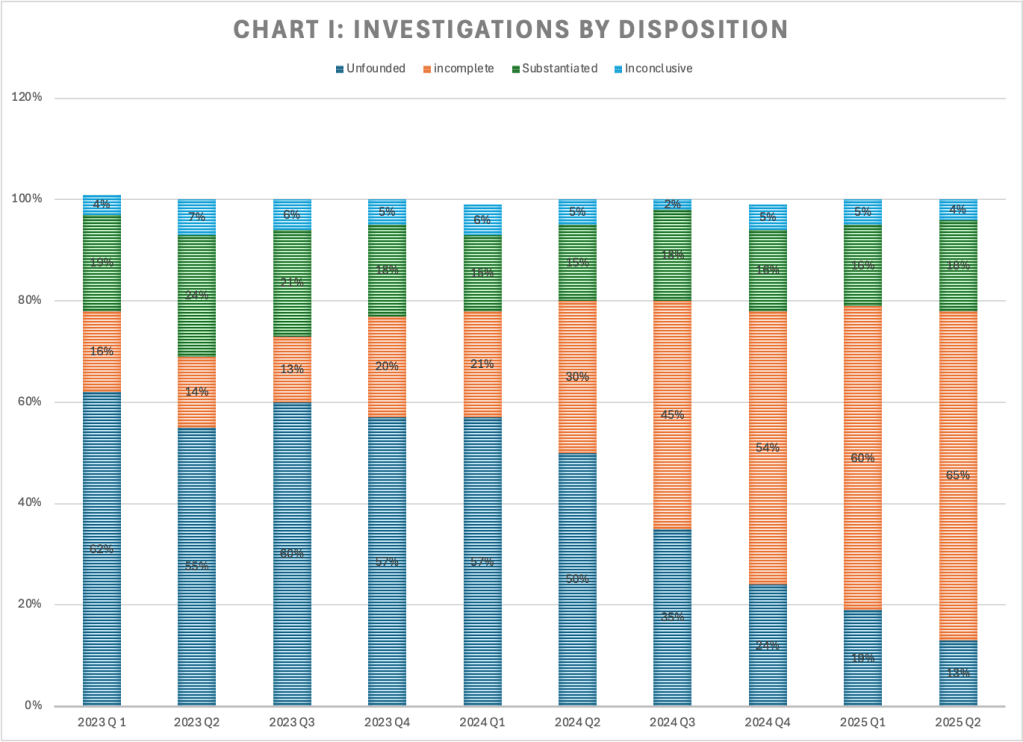
Chart I shows how the percentage of investigations by disposition has changed over the past nine quarters. The percentage of investigations that was incomplete (see the orange segments in the chart below) began to rise in the first quarter of 2024, when it jumped to 20 percent from 13 percent in the previous quarter. It rose to 30 percent in the third quarter of 2024, 45 percent in the third quarter, and 54 percent in the fourth quarter, 60 percent in the first quarter of 2025, and 65 percent in the second quarter of the current fiscal year.

Source: CFSA Dashboard, Investigations of Abuse and Neglect

As the percentage of investigations that are incomplete has increased, the percentage that are unfounded (dark blue in the above chart) has decreased–from 57 percent in the first quarter of 2024 to 13 percent in the first quarter of 2025. That drop of 44 percentage points happened at the same time as the percentage of investigations that were incomplete rose from 21 percent to 65 percent–an increase of 43 percentage points. It appears that investigations that would formerly have been closed as unfounded are now being closed as incomplete. CFSA did not respond to a request for the reasons for this change. The percentage of investigations that are substantiated has changed little since the first quarter of FY 2024.

Once an investigation is substantiated, CFSA may open a case for in-home services, or less often for foster care. As shown in Table I above, 169 in-home cases (each involving one or more children) were opened in the first half of FY 2025, compared to 125 in the first half of FY 2024. And 96 children were placed in foster care in the first half of FY 2025 compared with 110 in the first quarter of FY 2024. Unfortunately these two sets of numbers are not comparable as each in-home case can involve more than one child. But with substantiated reports increasing by over 100, in-home cases increasing by only 44, and foster care removals decreasing, it appears that some of the families with substantiated reports in 2025 are not receiving any CFSA services at all, and that is concerning. Perhaps some of these families are being referred to the collaboratives for services, which are less intensive and delivered by staff with lower credentials. And it is possible that some of these investigations may culminate in an informal kinship placement, but that means no services are provided to the parents or the children.

Clearly the staffing crisis with which CFSA (along with other agencies around the country) is struggling is responsible for the increase in incomplete investigations, and perhaps for the reduced percentage of substantiated cases receiving services as well. At the oversight hearing on February 13, 2025, Interim Director Trice pointed out that the number of investigative social workers has dropped from 100 to below 40. It is no surprise that CFSA’s oversight responses documented that most investigative workers had caseloads above 15. the maximum caseload allowed by CFSA’s Four Pillars Performance Framework. Average caseloads for the 38 investigative workers in the first quarter of FY 2025 were 30 or higher for 10 workers and 20 or higher for a total of 20 workers.

Director Trice reported that the agency is making do by diverting workers from the In-Home units to Investigations, but that is not a good solution. Families with in-home cases are often deeply troubled, with long histories of chronic neglect. According to CFSA’s 2023 Child Fatality Report, two children died while their families had open in-home cases. We cannot afford to divert these critically needed workers. Moreover, it is possible that the diversion of in-home workers to investigations may be part of the reason that in-home case openings did not increase more given the increase in substantiations. With workers not available to handle these cases, the agency may be more reluctant to open them.

What can be done? Creative solutions are needed. It may be necessary to temporarily reduce licensing or degree requirements through a special waiver due to the staffing crisis. Former Director Robert Matthews spoke of obtaining permission from the Board of Social Work Examiners to use workers with Bachelor of Social Work degrees to help investigators (not carry cases), but this plan was not mentioned in this year’s oversight responses. The agency might consider recruiting federal workers who have lost their jobs for these positions. Recruiting retired police officers and military veterans is another idea that has potential. A partnership with local schools of social work, as Maryland and other states maintain, is long past due. Those who agree to take jobs and remain for a given amount of time should receive loan forgiveness and perhaps housing as well. In a housing-hungry citizen, this could be a game changer. CFSA needs to think outside the box to resolve the staffing crisis.

CFSA’s Dashboard data for the first half of FY 2025 raises more questions than it provides answers. The most striking trend is the continuing explosion in the percentage of investigations that were incomplete–which was 65 percent in the second quarter. Also concerning is the failure of in-home case openings and foster care placements to keep up with increased substantiations. Like many other child welfare agencies, CFSA has been devoting much time and attention to programs outside of its core functions, like the warmline and family success centers. In this time of budget stringency and looming recession, it is time for CFSA to focus on its ability to perform its most basic and important function–child protection.

The rejection of child protection

by Marie Cohen

Source: https://www.youtube.com/watch?v=BjwC0xh0afk

Proposed federal budget cuts to child welfare services might hurt New Jersey’s recent progress in child welfare, the Commissioner of New Jersey’s Department of Children and Families told state legislators last month. The anticipated reduction of more than $100 million would force the department to โ€œrevert to its most basic role โ€” that of child protection โ€” not prevention, not support or empowerment, just surveillance and foster care,โ€ DCF Commissioner Christine Norbut-Beyer told members of the state Senate’s Budget Appropriations Committee. The relegation of child protection–or “surveillance and foster care”–to the “most basic” version of child welfare is telling. DCF’s Commissioner, like many other progressive child welfare administrators, no longer views child protection as the primary purpose of child welfare services.

For those who regularly read this blog, the devaluation of child protection and foster care by a high-level administrator over child welfare will not be a surprise. There has been a sea-change in child welfare over the past decade. The mainstream view of the purpose of child welfare has shifted from responding to child abuse and neglect to “upstream prevention.” And why not? Why wait until children are abused and neglected if we can prevent the maltreatment altogether?

There is no denying that ideally, it is better to prevent maltreatment than to respond to it. But the services that are discussed as prevention are mainly in the province of other agencies. In seeking to broaden child welfare services through the Family First Act, Congress added mental health, drug treatment, and parenting training. While the latter can be seen as a function of child welfare, drug treatment and mental health are separate systems. There has been increased emphasis on cash and housing and other antipoverty benefits as child maltreatment prevention; we have large programs to address these problems–much larger than the child welfare system. Even some of the “prevention services” that DCF and other state agencies have adopted, like “Family Success Centers,” provide a wide array of place-based services, most of which do not fall into the traditional orbit of child welfare and would be most appropriately funded jointly with other agencies.

If “prevention” could abolish the need for child protection, then there would be no need for child protection agencies. But we know that no amount of “prevention” (at least as envisioned by today’s child welfare establishment) will eliminate child abuse and neglect. We are often talking about patterns of mental illness, drug abuse, family violence, and poverty that have persisted over generations. And then there are families that are not poor or characterized by generations of dysfunction but where a parent’s mental illness or disordered personality makes them incapable of safely raising children. As Jedd Meddefield describes in his brilliant essay called A Watershed Perspective for Child Welfare, “As critical as it is to fully consider upstream factors, it would be wrong not to do all we can to help children who lack safe families today.

But the fact is that many of today’s child welfare leaders like Norbut-Beyer appear not to be interested in child protection and foster care. They often disparage the “reactive” role of child protective services in contrast to the “proactive” nature of prevention. Many agencies have reactive missionsโ€“police, firefighters, emergency roomsโ€“and one could argue these are the most important services of all because they save lives. The analogy with the police is revealing. Police react to allegations of crime just as child welfare agencies react to allegations of child abuse and neglect. Toย preventย crime, we must not rely on the police, who are overburdened already and not trained and equipped to provide the services needed. Instead we must turn to a whole host of agencies dealing with education, public health, mental health, housing, income security and moreโ€“the same agencies that we must mobilize if we want to prevent child abuse and neglect. Nobody is saying that the police need to address the underlying causes of crime.

Norbert-Beyer’s use of the word “surveillance” as a synonym for child protection is telling indeed. She clearly doesn’t see CPS investigators as heroes who go out in sometimes dangerous and certainly uncomfortable circumstances to protect children–and maybe even to save them. It’s not surprising because we have all been told that saving children is not what child welfare is about.1 And foster care? Norbert-Beyer boasts that New Jersey has the lowest rate of child removal in the country, and children who are removed more often than not go to relatives. She’s not very interested in the quality of care these vulnerable young people receive or in all the things her agency could do it improve it, like establishing foster care communities (like Together California) to house large sibling groups or investing in cutting-edge models of high-quality residential care.

When the person who is in charge of child protective services in a state that is acknowledged as a leader in the field calls it “surveillance,” and relegates it along with foster care to “basic” functions that hardly deserve mentioning, it’s hard to have faith that the crucial mission of child protection will be implemented with the passion it deserves. Norbert-Beyer’s comments illustrate the prevalent thinking that leads to the diversion of resources from crucially needed child protective services and foster care to “prevention services” that are and should be provided by other agencies.

  1. See for example this statement from Casey Family Programs, which includes the words “Weย must continue to evolve from an approach that seeks to โ€œrescueโ€ childrenย from their families to one that invests in supporting families before abuse and neglect occur.” One of the first messages I was given as a CPS trainee is that my job was not to save children.
    โ†ฉ๏ธŽ

A life discounted: The tragic story of Begidu Morris

by Marie Cohen

Ten-year-old Begidu Morris died more than three years ago of horrific child abuse by his parents, who adopted him from Ethiopia. But there was no avalanche of media coverage of his death, no interviews with shocked neighbors saying they had no idea the child even existed. No pyramid of teddy bears and flowers outside his home. No arrests of those who tortured and murdered Begidu, and no demonstrations demanding justice. No anguished commentaries from experts on how we failed and what could be done to prevent such tragedies in the future. There is not even a picture of Begidu by which we can remember him. If not for a child fatality summary released by the Florida Department of Children and Families (DCF) two years after Begidu’s death, nobody outside the family, a few neighbors, and a small group of medical, social service, and law enforcement professionals would have known that it happened.

According to the DCF child fatality summary, Begidu Morris collapsed at home in Lee County, Florida, on March 17, 2022 and was transported to Golisano Childrenโ€™s Hospital. He was diagnosed with subdural hematoma, hypothermia, cardiac arrest, acute respiratory failure, retinal hemorrhages, and metabolic acidosis.Begidu was placed on life support and died on March 22, 2022. Examination showed bruising to Begiduโ€™s head and significant scarring to his buttocks. Begidu weighed 44 pounds, which was in the 0.1 percentile for his age. An autopsy determined that the cause of death was โ€œcomplications of hypoxic ischemic encephalopathy due to craniocerebral traumaโ€ and the manner of death was homicide.

The CPS investigation

Begidu lived with his adoptive parents, Jack and Consuela Morris, and their biological son. Their two other biological children were in college and returned home for vacations. Begidu and his biological sister were adopted from Ethiopia by the Morrises, when he was about two years old. His sister’s adoption with the Morris family disrupted and she was re-adopted by another family in 2019. After Begidu’s death, the family quickly obtained a lawyer and was โ€œminimally cooperativeโ€ with the CPS and police investigations.

The familyโ€™s three-bedroom home was described by the investigator as โ€œpristine.โ€ In addition to the master bedroom and the teenage siblingโ€™s room, the third bedroom served as a guest room for the two adult siblings when they returned home from college. Begidu slept in a small closet, where investigators discovered a pile of urine-soaked clothing on a rollaway bed. The door to the closet was locked from the outside and was monitored by a camera. The closet had no ventilation and there were no toys or personal possessions indicating that a child lived there. Begidu’s adoptive parents claimed that he engaged in behaviors such as temper tantrums and fecal smearing.

The CPS investigation concluded that โ€œ[a]lthough it was not able to be determined with certainty who inflicted the injury/injuries that led to this childโ€™s death, it can be concluded that the parents either participated in the abuse that led to the childโ€™s injuries and subsequent death, or they participated in concealing the horrific abuse and neglect that he suffered.โ€ It found the parents Jack and Consuelo Morris responsible for Begiduโ€™s death and for “bizarre punishments,” internal injuries, physical injuries, medical neglect, “failure to thrive/malnutrition/dehydration,” failure to protect, and inadequate supervision. 

Deaths due to child abuse or neglect are the tip of the huge iceberg of child maltreatment, most of which remains unseen by the public. All of these deaths should be examined, not only to determine whether maltreatment occurred and who was responsible, but also to identify systemic issues that might suggest policy changes to protect other children. Yet, the investigation summary I received showed a complete lack of curiosity and interest by DCF in drawing lessons from this terrible case and making them available to the public.

Isolation is a common element of severe and chronic child abuse cases. Begidu was clearly isolated. He had not visited a medical provider in three years. Most neighbors were unaware that the child even existed. And perhaps most important, he was not attending school–at least not in person. The Investigation Summary contains three different statements about Begidu’s and his adoptive brother’s schooling, stating in one place that the brother was enrolled in Lee County Schools and Begidu was not, in another place that both were homeschooled, and in two different places that each was enrolled in “virtual school.” DCF did not respond to my request to know which statement was correct. Yet this is crucial information.

If Begidu was enrolled in school virtually, it would have been incumbent on the investigator to contact the school and ask about his attendance and any interactions with Begidu and his family. This would be important in establishing if there was any negligence on the part of school staff or any need for policy changes. If Begidu was not in school at all, the question would be whether the state was aware he was being homeschooled. Homeschooling parents in Florida must provide one-time notice to the local superintendent, maintain a portfolio of their children’s work, and turn in an annual assessment by standardized test or portfolio evaluation. We need to know if Begidu’s parents complied with these requirements, and how he fell through the cracks if they did not.

With the lack of protective educators to respond to Begidu’s plight, DCF should have wanted to know if there were any opportunities for his situation to be brought to the attention of other protective adults. While the Morris family had no history with CPS in Florida or in Michigan, where they adopted Begidu, there may have been an occasion when the abuse in this home could have come to light. Begiduโ€™s sister was re-adopted by another family in Florida in 2019. One cannot help wondering if the sister was the previous target of abuse in the home, thus leading to her adoption by another family. In his medical chart from a primary care visit in 2018 or 2019, there was a note that Begidu said he was “going to be just like his sister.โ€ (These may be the only words of Begidu’s to be recorded).

Fully 19 lines of text about Begiduโ€™s sister are redacted from the Investigation Summary, which says only that she lives in another state and had no contact with Begidu or the Morris family. It is likely that the redacted information concerned the circumstances behind the disruption of the sisterโ€™s adoption. Did the sister report any concerning treatment to her new adoptive parents? Did anyone involved in the second adoption have information that should have been reported and investigated? Was a coverup part of the new adoption arrangement? Unfortunately, DCF denied my request for this information. DCF appears to have no interest in learning from Begidu’s death and sharing the implications of what they have learned with the wider community in the interests of protecting children in the future.

Whatever the flaws of the investigation were in terms of uncovering systemic issues, DCF ultimately found Begidu’s parents to be responsible for Begidu’s death and the horrific abuse and neglect that preceded it. But shockingly, the agency decided not to remove Begiduโ€™s adoptive brother from the home. According to the case summary, the teenager reported feeling safe in the home, and โ€œsources familiar with the childโ€ reported no concerns for his safety. (One wonders who these sources were and what they knew about Begiduโ€™s abuse.) The investigator also noted that the teen โ€œappeared physically healthy, was enrolled in virtual school, and was visible in the community, including attending a Mixed Martial Arts program several times weekly. He had his own fully furnished bedroom, and he was allowed to have relationships with others outside the home, including his adult siblings who were away at college.โ€ It is clear that this decision did not come easily. According to the investigation summary, โ€œ[W]hile it is concerning that [Begiduโ€™s sibling] remains in the home, it should be noted that he does not share the same vulnerabilities that were present with his younger sibling.โ€ This is quite a statement. Apparently, this child was considered โ€œsafeโ€ in the home of where his brother suffered unspeakable abuse and died, because he himself was not ill-treated. There was not even a services case opened to make sure that he received therapy for the trauma he has endured.

The criminal investigation

Three years after Begidu’s death, the police have made no arrests in the case. The DCF Investigation Summary states that CPS was involved in multiple meetings, including with the State Attorney’s Office (SAO) and that

“[u]ltimately no action was taken by the SAO as the perpetrator of abuse could not be determined based on the information that was available at the time of their staffing. There were two individuals (the mother and [the brother]) in the home capable of causing the head trauma to the child; the individual responsible for the abuse could not be determined.

The lack of charges is almost incredible. If they could not have charged anyone with the actual homicide, it is hard not to understand how the parents could not have been charged with multiple counts of child abuse, charges that surely exist in Florida as they do in other states. It is hard not to ask the question, as one child advocate put it, could this happen if Begidu were White? The State’s Attorney denied my request for the investigation records on the grounds that “there is still an active investigation.” But it is hard to believe that the police are still seriously working on this case.

Adoptions and Severe Abuse

Begidu’s story has similarities with the stories of other children adopted from overseas or from foster care. Few readers could have forgotten the six Hart children, adopted from foster care in Texas, who were starved, beaten, and eventually killed in a 2018 murder-suicide by one of their adoptive mothers. In 2013, a Washington State couple were convicted and sentenced to decades in prison in the death of their Ethiopian adopted daughter, Hanna Williams, who died of hypothermia in 2011 after being forced to sleep outside in the rain. Her malnourished body was covered with bruises and scratches and her brother testified that their adoptive parents beat them and deprived them of food. A Pittsburgh couple was sentenced in 2014 for endangering the welfare of two children they adopted from Ethiopia through withholding food from their six-year-old son and causing abusive head trauma to their 18-month-old daughter. In a dispiriting echo of Begidu’s case, the adoptive mother was sentenced to six to 12 months in jail with daily work release to enable her to go home and care for her biological children. The mother who re-adopted these children saw this sentence as “an indication that the court viewed adopted children as different, since it decided that a woman who abused her adopted kids could be trusted with her biological children.” In 2021, a woman in Washington was charged with second-degree criminal maltreatment for beating and starving a 12-year-old boy that she and her husband adopted from Ethiopia. The prosecution decided to drop the case, as reported by KUOW, stating that the boy had โ€œsuffered mental health challenges which will prevent him from testifying.โ€ The child had been re-adopted by one of his schoolteachers, who saw his abuse and came to an agreement with his parents–a possible hint to what may have happened with Begidu’s sister.

The vast majority of adoptive families provide loving homes, and a study from the Netherlands suggests that adoptive families are less likely to maltreat their children than birth families. Nevertheless, observers have noted clusters of cases of severe abuse of adopted children. Such a cluster was noted in the State of Washington at the time of Hanna Williams’ death. A committee led by Washington’s child welfare agency and children’s ombudsman in 2012 published a Severe Abuse of Adopted Children Committee Report, which discussed 15 cases of adopted children who had suffered abuse at the hands of their adoptive families. There was a common pattern of concerning parenting practices in these cases, including physical confinement, withholding food, isolation (including withdrawal from school), forcing the child to remain outside the home; and disparaging remarks about the child. The committee observed that these cases tend to occur “when an adoptive family is ill-prepared or ill matched with a child that suffers from unidentified and/or untreated trauma, abuse, and/or neglect.” The analysis suggests that families may respond to their adopted children’s difficult behaviors caused by past trauma by using punishments like sending a child to bed without dinner, which in turn triggers further behaviors, leading to a vicious cycle of behaviors and punishments culminating in egregious abuse.

The Washington committee made multiple recommendations for avoiding such tragedies in the future, including better oversight of child-placing agencies, strengthening the assessment of prospective adoptive families, and improved training for parents and adoption professionals, and post-adoption support services for families. Some of these recommendations required legislation and other required agency action, and it is not clear whether any of them were implemented.

The trial of Larry and Carri Williams for the death of their adopted daughter, Hannah, was a major event in Washington, with Seattle-area Ethiopians attending proceedings every day, “almost as a vigil” as the Seattle Times described it. But with no arrests in Begidu’s case and no media coverage until two years later, Florida’s Ethiopian community may not even be aware of it. Holding Begidu’s adoptive parents accountable wonโ€™t bring him back, but the lack of any meaningful response to his death is an offense to all child victims of abuse and neglect and those who care about them. The only thing that can be done now is to hold his torturers and murderers responsible and learn from his suffering to prevent other children from sharing it.

This blog was updated on April 25, 26, 27 and 29.


No progress on child protection reforms in Utah halfway through the legislative session

The death of Gavin Peterson from starvation last year after years of abuse and multiple calls to child protective services regarding his treatment set off an outcry in Utah and around the country. Media reports appeared throughout the country, legislators expressed their outrage, hearings were held, and concerned citizens rallied. But halfway through the legislative session that followed Gavin’s death, it appears that there will be no policy changes that will prevent more children suffering Gavin’s fate. Instead, his name has been invoked to support bills that would not have saved him, and, ironically, legislation that could increase the risks for children like Gavin who are withdrawn from school seems poised for passage.

As described in an earlier post, Gavin Peterson died of starvation in July 2024 at the age of 12, almost a year after his father and stepmother withdrew him from school, ostensibly to homeschool him. Gavin had been the subject of multiple reports to the Utah Division of Child and Family Services (DCFS), including at least four reports from his school describing him as eating food from the trash and with other signs of neglect and abuse. An investigation found no maltreatment but did result in his father and stepmother withdrawing him from school, a common response of abusive parents to being investigated, and too often a precursor of a child’s death from abuse. Gavin’s withdrawal from school was his death warrant, because there were no more caring adults to report on his suffering.

There are several types of legislation that might have helped prevent future Utah children suffering Gavin’s fate. Perhaps most effective would be to increase the protections for homeschooled children. For example, the Make Homeschool Safe Act developed by the Coalition for Responsible Home Education proposes that no person who has been found to have engaged in child abuse or neglect can operate a home school. It is not clear from the limited information provided by DCFS whether Gavin’s stepmother had been found to have committed abuse or neglect, but given that a case was open on the family for a year, it seems likely that she was. In addition, the bill would allow no person to withdraw a child from school for homeschooling within three years of an investigation of potential abuse or neglect unless there is a risk assessment by a child protective services worker and monthly risk assessments for the first 12 months of the child’s withdrawal from school. Such a law, if implemented faithfully, might well have saved Gavin.

But far from placing controls on homeschooling, Utah legislators are bent on removing them in the wake of Gavin’s death. For the past close to two years, Utah has required parents who homeschool their children to sign an affidavit swearing that they have never been convicted of child abuse. Admittedly, this seems to be a pretty toothless requirement, as compared to requiring a check of police and CPS records. But the homeschooling community has decided that even this weak law is offensive, as the Salt Lake Tribune has reported. Homeschooling families thronged the Capitol on February 25 to demonstrate their support for a bill that would eliminate this requirement. Its sponsor, Representative Noeleen Peck, justified the bill by saying the requirement “didn’t work” and was “confusing.” Some districts misinterpreted it to require a background check, she said. Perhaps that misinterpretation–giving the requirement teeth after all–explains the overwhelming support for this bill among homeschooling parents. The Committee voted unanimously to recommend the bill eliminating the requirement.

One bill (HB83) that did get introduced in Gavin’s name would not have protected him, despite being a good bill. It would make it easier for police or social workers to obtain a warrant to view a child and a home for the purposes of investigating a report of child abuse or neglect. This bill addresses a real problem in Utah which gained attention through another horrific abuse case in the same year. Parenting influencer Ruby Franke was starving and torturing her two youngest children. Police tried to check on them, but Franke would not respond to the door and a judge would not issue a warrant to allow them to enter the home. HB83 presumably would have enabled police to obtain a warrant to enter the Franke home and perhaps discover the children’s plight.

The sponsor of HB83, state Rep. Christine Watkins, told the House Judiciary Committee that this bill was in direct response to the cases of Gavin Peterson and the children of Ruby Franke. But the case history that was released by DCFS describes no instance of police or DCFS being denied access to Gavin’s home. DCFS visited the home twice in March, 2023 and interviewed Gavin outside the presence of his parents. But he did not disclose the abuse, probably for fear of retaliation by the abusers. Certainly the difficulty of accessing children at home is a problem worth correcting, but it was not apparently related to Gavin’s death. In any case, the bill did not make it out of its first committee hearing and does not seem likely to advance.

Sadly, it appears that the most consequential bill that will be passed in response to Gavin’s death is a measure that would eliminate the cost of reduced-price school lunches. The bill’s sponsor, House Rep. Tyler Clancy, told KJZZ that Gavin Peterson’s death helped build support for the bill. “It shakes you to your core when you read a story about a young person like Gavin Peterson starving to death,โ€ Clancy said. Clancy’s compassion is commendable, but this bill would not have helped Gavin, who died almost a year after he was removed from school. There is something disturbing about using Gavin’s name to support a bill, however beneficial, that wouldn’t have helped him.

It is hard to understand how well-intentioned legislators, in the aftermath of a tragedy like Gavin Peterson’s death, can use his name to support legislation (no matter how worthwhile) that would not have prevented the tragedy in the first place. Whether it is the lack of bandwidth among legislators and staff or the dominance of preconceived notions about what constitutes the problem. It’s even harder to understand legislators voting to reduce protections for children who are withdrawn from school less than a year after Gavin’s death. The Utah Legislature is not unique in its failure to produce meaningful reforms after tragic failures in child protection. But it is the children trapped in their houses of horror that must pay the price.

Child Maltreatment 2023: A reduction in child maltreatment victims or a retrenchment of child protection?

“New Federal Report Demonstrates Reduction in Child Maltreatment Victims and Underscores Need for Continued Action,” the Administration on Children and Families (ACF) of the US Department of Health and Human Services proclaimed in releasing the latest annual report on the government response to child abuse and neglect. As in the past several years, ACF’s language suggested that child abuse and neglect are decreasing. But with states around the country changing law, policy and practice to reduce child welfare agencies’ footprint, the number of “child maltreatment victims” cited by ACF is likely more a reflection of policy and practice than an indicator of actual maltreatment.

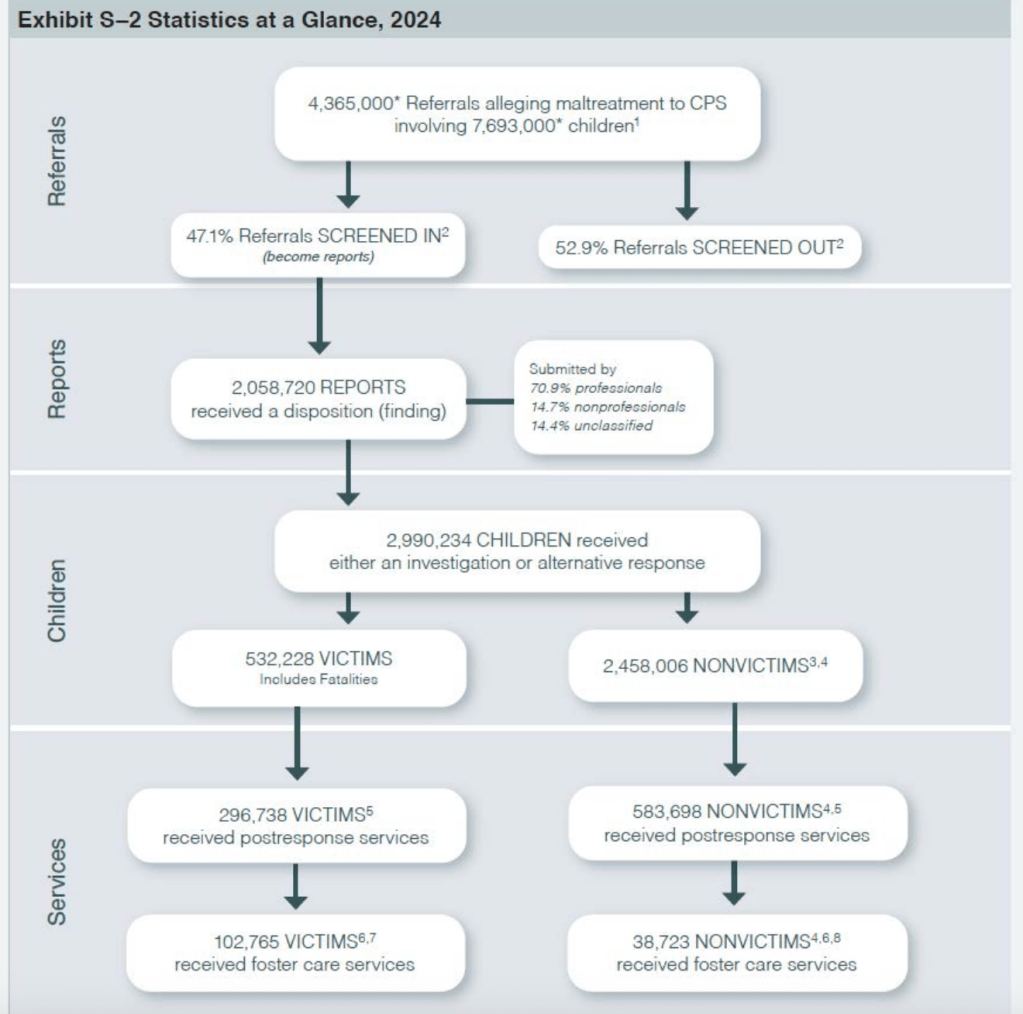
The annualย Child Maltreatmentย reports, produced by the Childrenโ€™s Bureau of ACF, are based on data that states submit to the National Child Abuse and Neglect (NCANDS) data system. The new report, Child Maltreatment 2023 (CM2023), provides data for Federal Fiscal Year (FFY) 2023, which ended on September 30, 2024. The report documents the funnel-like operations child welfare protective services (CPS), which at each stage select only a fraction of the cases or children to proceed to the next stage. Exhibit S-2 summarizes the findings of the newest report. Child welfare agencies received 4.399 million “referrals” alleging maltreatment in Federal Fiscal Year (FFY) 2023 and “screened in” 2.1 million of them as “reports” for “disposition” through an investigation or alternative response. The investigation or assessment of those reports resulted in a total of 546,159 children determined to be victims of child abuse and neglect. (The final stage of the funnel involves services and is not covered in this post.) State and local policies and practice affect every stage of this process, as explained in detail below.

Referrals

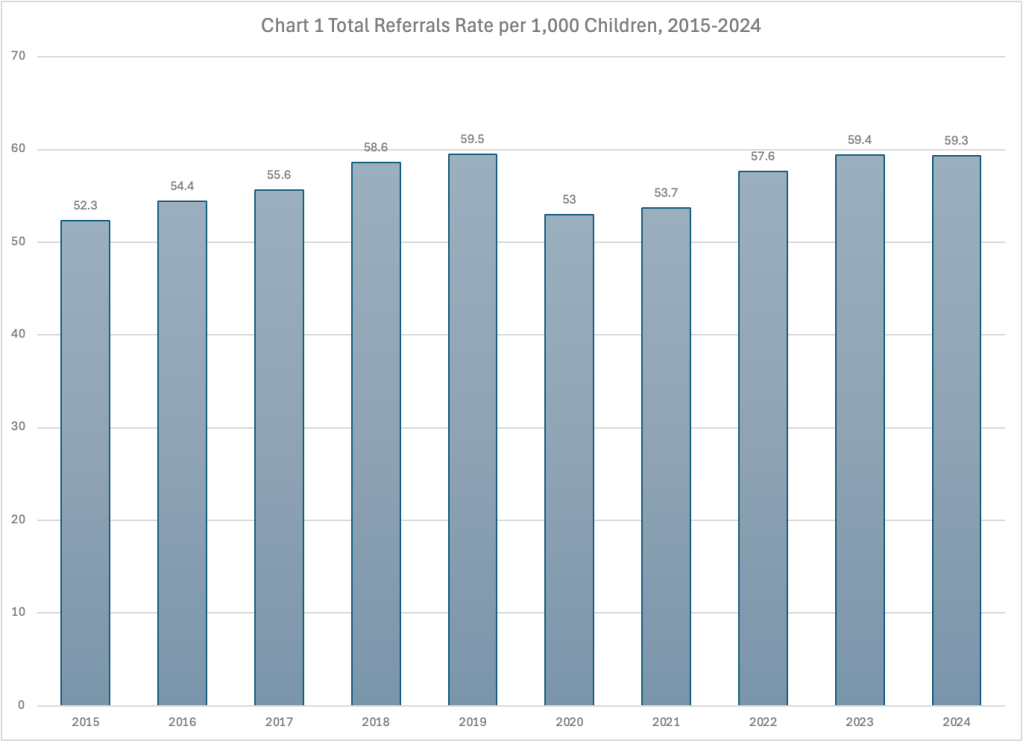
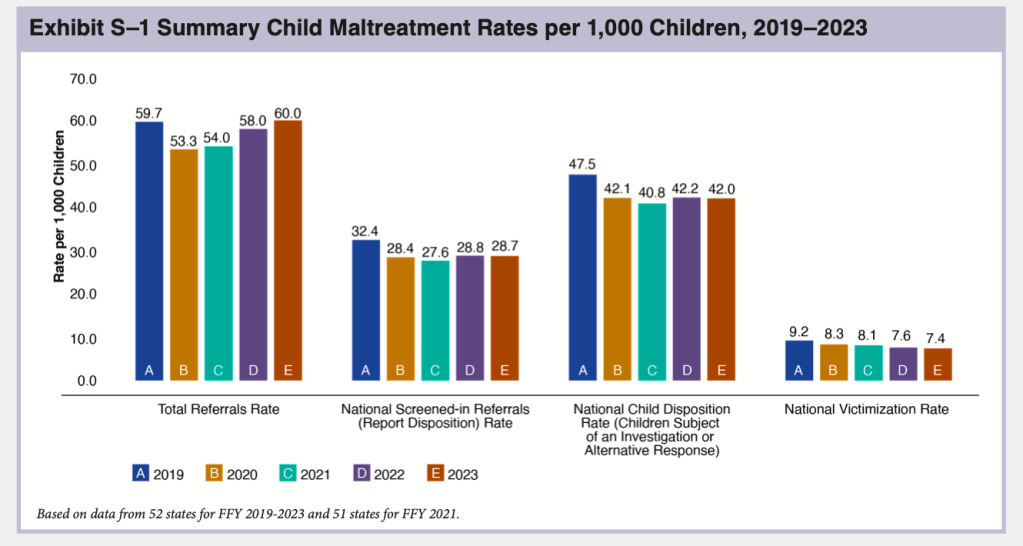
NCANDS uses the term โ€œreferralsโ€ to mean reports to child welfare agencies alleging maltreatment. Agencies received an estimated total of 4,399,000 referrals through their child abuse hotlines or central registries in FFY 2023, according to CM 2023. This is a very slight increase over the previous year and represents about 7.8 million children, or 60 per 1,000 children. As shown in Exhibit S-1, the total number of referrals has been increasing since 2020, when the COVID-19 pandemic resulted in a large drop in referrals. In FFY 2023, the number of referrals surpassed the pre-Covid 2019 total for the first time as the lingering effects of the pandemic, which acted to suppress reports, finally dissipated.

As in past years, the state-by-state tables document large differences in referral rates, from 19.9 per 1,000 children in Hawaii to 171.2 per 1,000 in Vermont–also the top and bottom states in 2022. These differences reflect not just different numbers of calls to child abuse hotlines but also state policy and practice. Vermont reports that it counts all calls to the hotline as referrals, while other states do not do so. For example, Connecticut reported in CM2022 that none of the calls that are assigned to alternative response are included in NCANDS, resulting in a far lower number of calls than the number they actually receive. Referral rates may also affected by a state’s policy on who is required to report and what must be reported. Such policies are disseminated to mandatory reporters through training and agency communications. New York reported implementing in FFY 2023 a new training for mandated reporters that helps them identify when concerns do not rise to a level legally requiring a report be made.” The training also focuses on implicit bias in order to “reduce the number of SCR reports influenced by bias about race or poverty.” The number of referrals in New York dropped by a very small fraction in FFY 2023. Missouri reported in CM2022 that it stopped accepting educational neglect referrals in 2021 as the COVID emergency ended, resulting in a decreased number of referrals received the following year.

Reports

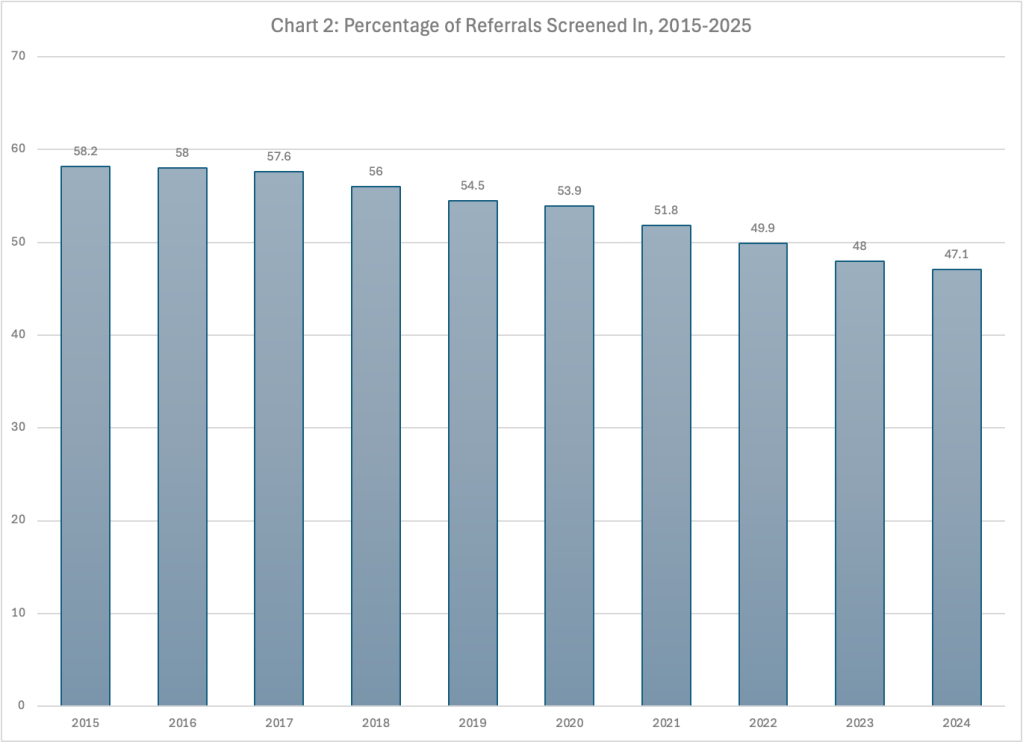
Once a state agency receives a referral, it will be screened in or out by agency staff. In general, referrals are screened out if they are deemed not to contain an allegation of child abuse or neglect, contain too little information to act on, are more appropriately assigned to another agency, or for some other reason do not fall under the mandate of the child welfare agency. In the language used by NCANDS, a referral becomes a โ€œreportโ€ once it is screened in. “Reports” are assigned for an investigation or “alternative response.” State data indicates that child welfare agencies screened in 2.1 million referrals, about 47.5 percent of referrals for an investigation or alternative response, and “screened out” the other 52.5 percent as not warranting a response. The number of screened-in referrals was 11.6 percent less than in FFY 2019 and slightly less than in FFY 2022.

A total of 42 states reported a decrease in the number of screened-in referrals in FFY 2023. In their commentaries, several of these states described policy and practice changes that led to their screening out more referrals. Ohio reported that two of its major metropolitan counties, which had significantly higher screen-in rates than the rest of the state, adjusted their screening procedures to be consistent with the rest of the state, resulting in a lower screen-in rate in those counties and statewide. Mississippi reported an increasing the amount of screening it conducted, especially when a report was received regarding a case that was already open; perhaps this is why its screen-in rate dropped from 41.3 to 36.5 per 1,000 children. Nebraska reported dropping a policy to require accepting all referrals from a medical professional involving children under six. Some states explicitly reported that their screening changes were adopted in order to decrease the number of screened in referrals. Kentucky reported adopting a new SDMยฎ screening tool designed to decrease the number of referrals that are “incorrectly accepted for investigation.” Nevada reported a decrease in screened-in referrals because it established new intake processes to ensure that referrals are screened out when they do not meet criteria for acceptance.

“Victims”

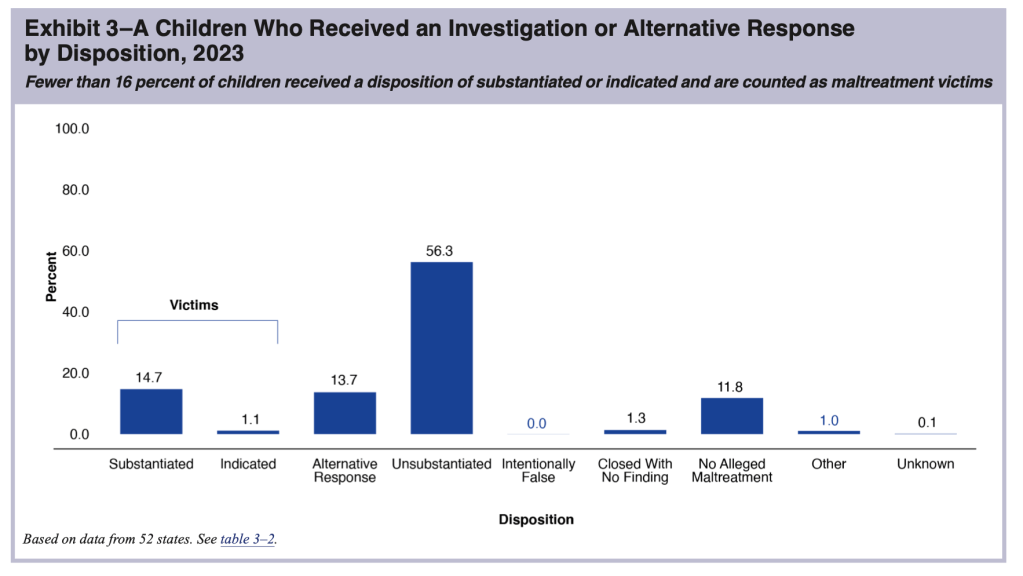
The next phase in the funnel of CPS is the determination of whether abuse or neglect has occurred. At this stage, the level of analysis shifts from the case to the child, and the number of “victims” is the result. In NCANDS, a โ€œvictimโ€ is defined as โ€œa child for whom the state determined at least one maltreatment was substantiated or indicated1; and a disposition of substantiated or indicated was assigned for a child in a report.โ€ “Victims” include children who died of abuse or neglect if the maltreatment was verified. Some children receive an “alternative response”2 instead of an investigation; these children are not counted as victims. According to CM2023, states reported a total of 546,159 victims of child abuse and neglect in FY 2023, producing a “victimization rate” of 7.4 per 1,000 children.

The number of “victims” reported by states according to the NCANDS definition does not represent the true number of children who experienced abuse or neglect, which is unknown. Many cases of child maltreatment go unreported. Children assigned to alternative response are not found to be victims unless their case is reassigned to the investigation track. And finally, substantiation may not be an accurate reflection of whether maltreatment occurred. Making a determination of whether maltreatment occurred is difficult. Adults and children do not always tell the truth, the youngest children are nonverbal or not sufficiently articulate to answer the relevant questions. So it is not surprising that research suggests that substantiation decisions are inaccurate3 and a report to the hotline predicts future maltreatment reports and developmental outcomes almost as well as a substantiated report.4 

State “victimization rates” range from a low of 1.5 per 1,000 children in New Jersey to a high of 16.2 in Massachusetts. It is unlikely that Massachusetts has more than ten times more child abuse and neglect victims than New Jersey–a not dissimilar Northeastern state. Policy and practice must be at play, including different definitions of abuse or neglect, levels of evidence required to confirm maltreatment, and policies regarding the use of alternative response or “Plans of Safe Care”5 to divert children from investigation, among other factors. Maine reported the second highest “victimization rate.” The Maine Monitor asked experts why this might be so. Among the reasons suggested were the definition of maltreatment; Maine allows abuse or neglect to be substantiated when there is a “threat” of maltreatment, even if there is no finding that it already occurred. In view of the deceptiveness of these terms, I have put the terms “victims” and “victimization rates,” when not preceded by the word “reported,” in quotation marks in this post.

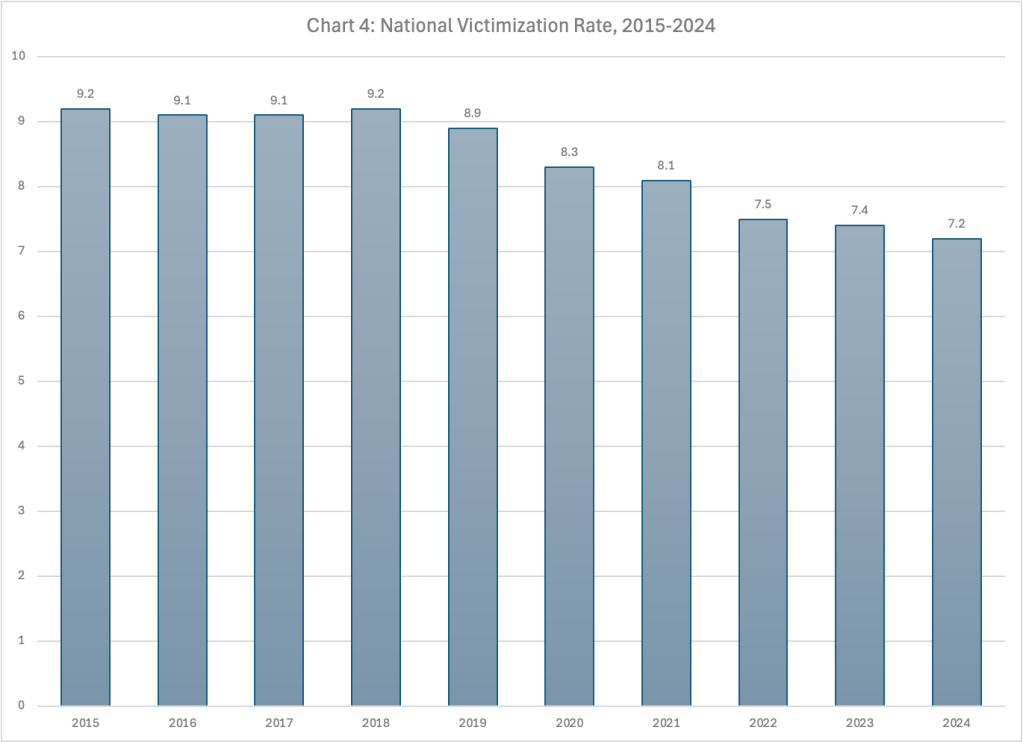
The national “victimization rate” of 7.4 per 1,000 children, is a small decrease from 7.7 in FFY 2022 and the total number of reported “victims” was 19.3 percent less than the total reported in FFY 2019. This “victimization rate” has declined every year since FFY 2018. Of course, this decline is in part a result of the decline in the number of screened-in referrals that was discussed above. Any referral that is screened out is one less reported “victim,” even though some percentage of the screened-out referrals almost certainly reflected actual incidents of maltreatment.6 It is also clear that changes in policy and practice have contributed to the decline in the number of “victims” reported by states, as described below.

Policy and practice changes affecting “victimization” numbers

The change in the number of “victims” between FFY 2019 and FFY 2023 ranged from a 52 percent decrease in North Dakota to a 32 percent increase in Nevada, suggesting that these changes may reflect policy and practice more than actual trends in abuse and neglect. And indeed, two of the largest states made it more difficult to substantiate maltreatment in FFY 2022, and both found a decline in the number of maltreatment victims. In Texas, the legislature narrowed the definition of neglect, requiring the existence of both โ€œblatant disregardโ€ for the consequences of a parentโ€™s action or inaction and either a โ€œresulting harm or immediate danger.โ€ Perhaps this helps account for the drop in the number of reported victims from 65,253 in FFY 2021 to 54,207 in FFY 2022. But the number of victims actually rose very slightly in FFY 2023. Perhaps the new definition had been assimilated into practice and was no longer resulting in a decrease in substantiations. In New York, the level of evidence required to substantiate an allegation of abuse or neglect was changed from โ€œsome credible evidenceโ€ to โ€œa fair preponderance of the evidenceโ€ in FFY 2022. The number of victims found in New York dropped from 56,760 in FFY 2021 in to 50,056 in FFY 2022, which the Office of Child and Family Services attributed in its CM 2022 commentary to that change in evidentiary standards. The number of reported victims fell further to 46,431 in FY2023; perhaps the changed evidentiary standards were continuing to take hold or other state policies affecting other parts of the funnel–such as the attempt to rein in mandatory reporting–were contributing factors. The agency did not address this issue in its 2023 commentary.

A few states did mention in their CM 2023 commentary changes in policy or practice that might have contributed to changes in the number of “victims” in FFY 2023. North Dakota attributes a decrease partly to a change in state statute and policy which allows protective services to be provided when impending danger is identified, even without a substantiation. The agency appears to believe that workers are not substantiating as many reports now that they do not need a substantiation to provide services. Arkansas attributed a decrease in victims to the adoption of a new assessment tool that may have contributed to the routing of more reports to the differential response pathway. Kentucky reported that the adoption of new “Standards of Practice” may have contributed to the increase in the number of “victims” reported in FFY 2023.

Fatalities

Based on reports from 49 states (all but Massachusetts), the District of Columbia, and Puerto Rico, CM2023 estimated a national maltreatment fatality rate of 2.73 per 100,000 children. That rate was then applied to the child population of all 52 jurisdictions and rounded to the nearest 10 to provide a national estimate of 2,000. But experts agree that the annual estimates of child fatalities from NCANDS significantly undercount the true number of deaths that are due to child maltreatment. I discussed this in detail in A Jumble of Standards: How State and Federal Authorities Have Underestimated Child Maltreatment Fatalities.

The annual fatality estimates presented in the report increased by 12.3 percent between FFY 2019 and FFY 2022 and then fell slightly from 2,050 to 2,000 in FFY 2023, a fact that ACF mentioned in its press release. Such a small reduction of less than three percent over the previous year cannot be statistically distinguished from random fluctuation, especially because it is based on much-smaller numbers from the individual states. State commentaries illustrate the randomness of these year-to-year changes. In CM 2022, two individual states explained year-to-year jumps in fatalities by explaining that many children in one family died and that a large group of fatalities that occurred the previous year were reported in the current year. But even aside from statistical fluctuations, there are many reasons one cannot rely on year-to-year changes. These include the timing of reports and changes in policy and practice.

Timing

According to CM 2023 (and previous reports), “The child fatality count in this report reflects the federal fiscal year (FFY) in which the deaths are determined as due to maltreatment. The year in which a determination is made may be different from the year in which the child died.” The authors go on to explain explain that It may take more than a year to find out about a fatality, gather the evidence (such as autopsy results and police investigations) to determine whether it was due to maltreatment, and then make the determination. Alabama, for example, explained in its commentary that the deaths reported in a given year may have occurred up to five years before.

To add to the uncertainty around timing, the writers of CM 2023 are not exactly correct when they state that all states report on the fatalities determined in the reporting year. In their annual submissions to NCANDS, several states add fatalities for the previous year, implying that their practice is to report on fatalities that occurred in a specific time period, not those determined in the applicable year. Four states revised their number of 2022 fatalities in their submissions to CM2023. This suggests that their 2023 reports are in turn incomplete and will be revised in succeeding years. California, for example, explained that:

Calendar Year (CY) 2022 is the most recent validated annual data and is therefore reported for FFY 2023. It is recognized that counties will continue to determine causes of fatalities to be the result of abuse and/or neglect that occurred in prior years. Therefore, the number reflected in this report is a point in time number for CY 2022 as of December 2023 and may change if additional fatalities that occurred in CY 2022 are later determined to be the result of abuse and/or neglect.

So California is reporting (for CM 2023) a truncated count of child maltreatment deaths for Calendar Year 2022. But it did add 12 fatalities to the count of fatalities that it reported for FFY 2022, raising its total from 164 to 176. California reported 150 fatalities for FY2023; one can assume that additional deaths will be reported in the next report. The four states together added 56 deaths for FFY 2023. Arizona’s total increased from 14 to 39, Maine from three to 10 and Virginia from 39 to 51. .

Policy and Practice: Fatality Definition and Measurement

In addition to timing issues, year-to-year changes in fatality counts can reflect changes in how states screen or define child maltreatment fatalities. In previous issues of CM, states have reported on improvements in their collection of fatality information. Over time, some states have eliminated obsolete practices in screening and information collection. West Virginia reported in its 2016 commentary that it had begun investigating child fatalities in cases where there were no other children in the home. North Carolina ended its restrictive policy of reporting only fatalities determined by a chief medical examiner to be homicide, and it also began efforts to incorporate vital statistics and criminal justice data. 

During FY 2023, some states reported changes that may have resulted in a reduced number of child fatalities reported. 

  • Texas did not submit commentary for FFY 2023. But as reported above, it changed its screening policy so that reports involving a child fatality but include no explicit concern for abuse and neglect are not investigated if the reporter and other pertinent sources had no concern for abuse or neglect. DFPS reports that the number of child fatalities it investigated decreased from 997 in FY2022 to 690 in FY2023 (a 31 percent decrease) due to this new screening policy. And the number of child maltreatment fatalities fell from 182 to 164. But with a drastic drop in foster care placements in Texas, there is reason to fear that maltreatment fatalities increased rather than decreased. If that is the case, this change screening policy may have resulted in the failure to investigate and confirm actual maltreatment deaths.. 
  • The Illinois Division of Child Protection reported that it added a new administrative review process for sleep-related deaths. A senior administrator reviews the investigation to ensure that death included evidence of โ€œblatant disregard.โ€ DCF links this new policy with a decrease of 24.6% in reported child fatalities in FFY 2023.

Other states reported changes that might result in an increased number of child fatalities reported. Maryland attributed an increase in reported fatalities to a policy change requiring local agencies to screen in sleep-related fatalities as part of its prevention effort. Alaska reported a change that may affect fatality counts in future years: in December 2023 the agency dropped its practice of screening out cases where no surviving children remained in the home; from now on the agency will be making maltreatment findings even when there are no surviving children.ย 

It is regrettable that most state commentaries do not include explanations for the changes in their reported number of referrals, reports, and victims. Worse, several states do not even submit commentaries in time to be included in each year’s report. In CM023, commentaries are missing for Arizona, Hawaii, Kansas, New Hampshire, North Carolina, Oregon, Texas, and West Virginia. Given the importance of the state commentaries for understanding the data they submit, the preparers of the CM reports should reach out to agency personnel in states that have not submitted commentaries by a certain date or have not answered the important questions and ask the questions directly directly. This information is too important to be left out.

It is unfortunate that ACF continues to misuse term โ€œvictimizationโ€ and “victimization rate” to suggest that child maltreatment (including fatalities) is declining, particularly in its press release and executive summary, which do not provide any explanation of the true meaning of the terms. The deceptive language is not a surprise given the previous Administration’s desire to take credit for ostensible and support the prevailing narrative regarding the need for a reduction in interventions with abusive and neglectful families. One does not have to be a statistician or data scientist to realize that we will never get an accurate measure of child maltreatment because so much of it occurs behind closed doors. Finding fewer victims is one way to reduce CPS intervention in the lives of vulnerable children–and to deny that the reductions are harmful. Sadly, this report will be used as evidence to support policies that continue to roll back protections for our most vulnerable children.

Notes

  1. Substantated is defined as “supported or founded by state law or policy.” “Indicated” is a less commonly used term meaning a “disposition that concludes maltreatment could not be substantiated understate law or policy, but there is a reason to suspect that at least one child may have been maltreated or is at risk of maltreatment.” โ†ฉ๏ธŽ
  2. An “alternative response” includes an assessment and referral to appropriate services if the parent agrees to participate. There is no determination on whether abuse or neglect occurred and no child removal unless the case is transferred to the investigative track. โ†ฉ๏ธŽ
  3. Theodore Cross and Cecilia Casanueva, โ€œCaseworker Judgments and Substantiation,โ€ย Child Maltreatment, 14, 1 (2009): 38-52; Desmond K. Runyanย et al, โ€œDescribing Maltreatment: Do child protective services reports and research definitions agree?โ€ย Child Abuse and Neglectย 29 (2005): 461-477; Brett Drake, โ€œUnraveling โ€˜Unsubstantiated,’โ€ย Child Maltreatment, August 1996; and Amy M. Smith Slep and Richard E. Heyman, โ€œCreating and Field-Testing Child Maltreatment Definitions: Improving the Reliability of Substantiation Determinations,โ€ย Child Maltreatment, 11, 3 (August 2006): 217-236. โ†ฉ๏ธŽ
  4. Brett Drake, Melissa Jonson-Reid, Ineke Wy and Silke Chung, โ€œSubstantiation and Recidivism,โ€ย Child Maltreatmentย 8,4 (2003): 248-260; Jon M. Husseyย et al., โ€œDefining maltreatment according to substantiation: Distinction without a difference?โ€ย Child Abuse and Neglectย 29 (2005): 479-492; Patricia L. Kohl, Melissa Jonson-Reid, and Brett Drake, โ€œTime to Leave Substantiation Behind: Findings from a National Probability Study,โ€ย Child Maltreatment, 14 (2009), 17-26; Jeffrey Leiter, Kristen A. Myers, and Matthew T. Zingraff, โ€œSubstantiated and unsubstantiated cases of child maltreatment: do their consequences differ?โ€ย Social Work Researchย 18 (1994): 67-82; and Diana J. Englishย et al, โ€œCauses and Consequences of the Substantiation Decision in Washington State Child Protective Services,โ€ย Children and Youth Services Review, 24, 11 (2002): 817-851. โ†ฉ๏ธŽ
  5. Plans of Safe Care are voluntary plans offered to the families of substance-exposed infants under the Comprehensive Addiction and Recovery Act (CARA). โ†ฉ๏ธŽ
  6. We. know this from child fatality reviews that many children who die have been the subject of previous referrals, which were not substantiated but later found in fatality investigations to have been correct. See discussions of the deaths of Thomas Valva and Gavin Peterson, for example. โ†ฉ๏ธŽ

Child Protective Services in the District of Columbia: An alarming increase in incomplete investigations in FY2024

by Marie Cohen

Complete Fiscal Year 2024 data now on the Dashboard of the District of Columbiaโ€™s Child and Family Services Agency (CFSA) reveal significant changes over the previous fiscal year. Most striking is a large jump in the number of incomplete investigations and a concomitant decline in โ€œsubstantiatedโ€ and โ€œunfoundedโ€ reports. The number of children entering foster care increased for the first time in over ten years. There was a drop in in-home case openings but a similar increase in foster care placements during the year. The agency did not respond to this writerโ€™s questions about the meaning of these trends.

Referrals

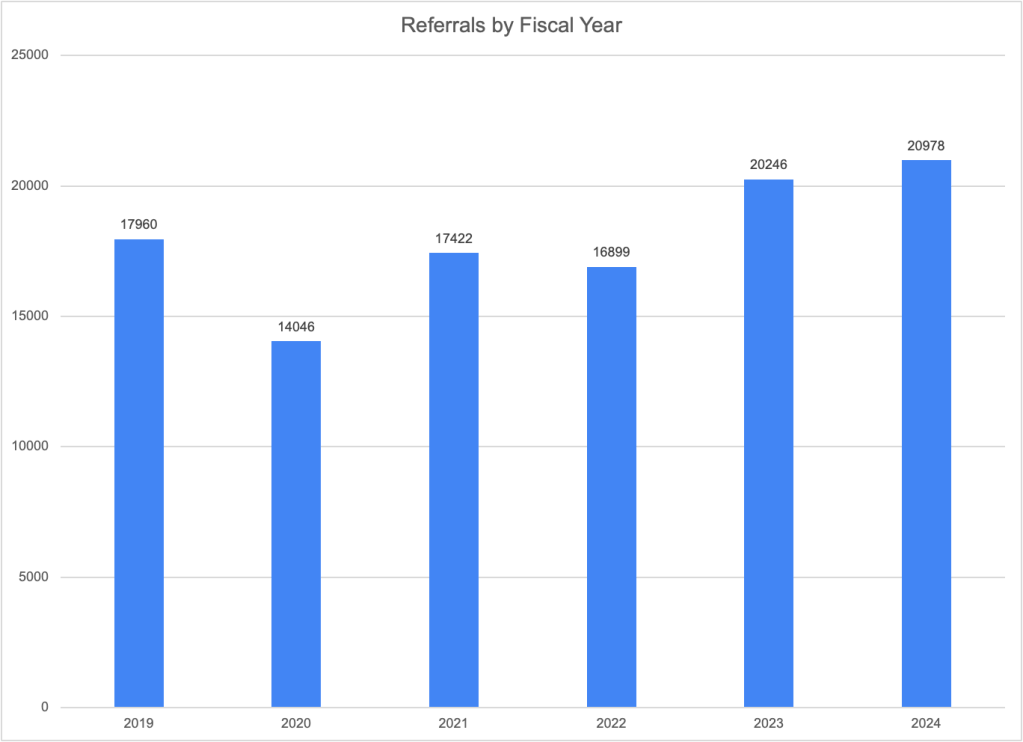
Total referrals (or calls to the CFSA hotline) have increased for the second year in a row. After falling in 2020 and remaining below 2019 levels in 2021 and 2022, the number of referrals jumped from 16,899 in FY2022 to 20,246 in FY2023 and then rose more modestly to 20,978 in 2024โ€“an increase of 3.6 percent. Prominent child welfare scholars like Emily Putnam-Hornstein have concluded that referrals are the best available indicator of actual maltreatment due to the strong correlation between referrals and future reports (regardless of the outcome of any associated investigation) and also evidence of the difficulty of correctly determining whether maltreatment has occurred. Thus, the increase in referrals may well be a sign of increasing maltreatment. Contributing factors might be the end of COVID-19 assistance programs and the growing mental health, substance abuse, and housing crises in the District.

Source: CFSA Data Dashboard, https://cfsadashboard.dc.gov/page/hotline-calls-referral-type

Childcare and school personnel continued to make more than half of the referrals to CFSA, with another 13 percent coming from law enforcement and 11 percent from friends and neighbors. All three of these groups made more referrals in FY2023 than FY2024, while counselors, therapists, social workers and medical professionals made fewer, suggesting that children may be seeing fewer of these professionals with the disappearance of virtual options spawned by the pandemic.

Looking at CFSAโ€™s response to the referrals, the largest portion, or 73 percent, were screened out. That compares to only 19 percent that were accepted for investigation. The remaining referrals were either linked to an existing investigation (three percent) or classified as an information and referral that does not involve an allegation of abuse or neglect. These percentages are quite similar to those of the previous year.

Source: CFSA Data Dashboard, https://cfsadashboard.dc.gov/page/hotline-calls-referral-type

Investigations

An investigation can have five different dispositions. According to the definitions provided in the Dashboard, unfounded means that there is not enough evidence to conclude that the child has been maltreated or at risk of being maltreated. โ€œSubstantiatedโ€ means that there is enough evidence to conclude that the child has been maltreated or is at risk of maltreatment. โ€œInconclusive,โ€ means that โ€œthere is insufficient evidence to substantiate the report but there still exists some conflicting information that indicate the abuse or neglect may have occurred.โ€ โ€œIncompleteโ€ means that the investigation could not be completed due to barriers like inability to locate the family, a familyโ€™s refusal of access to the home, or finding out that the family lived out of state.

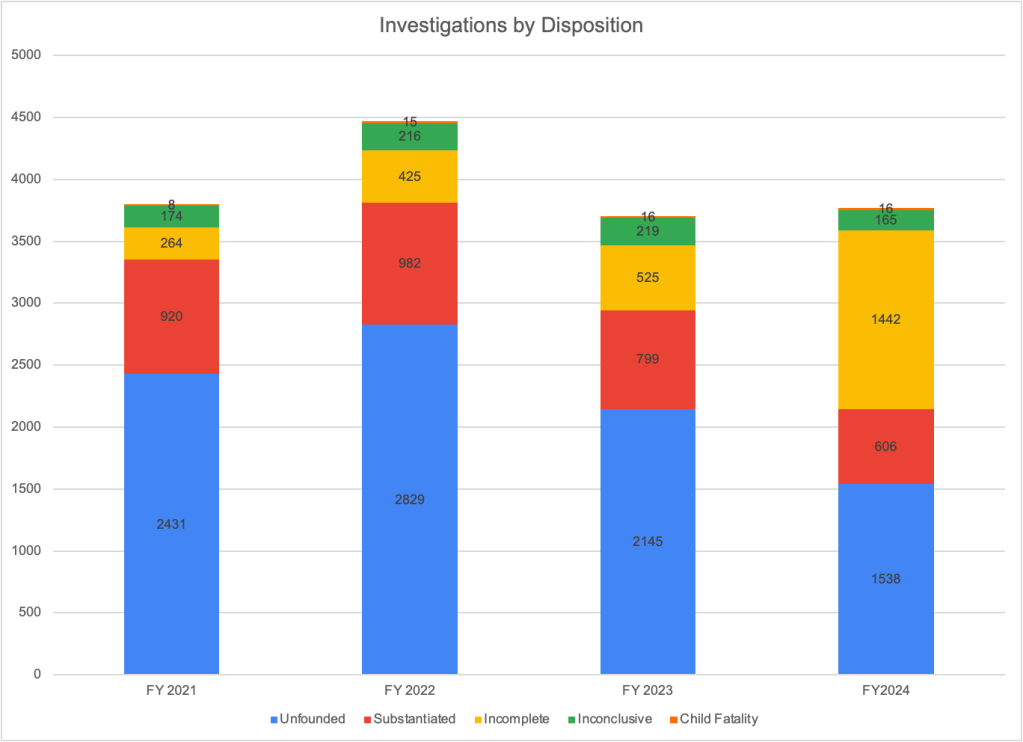
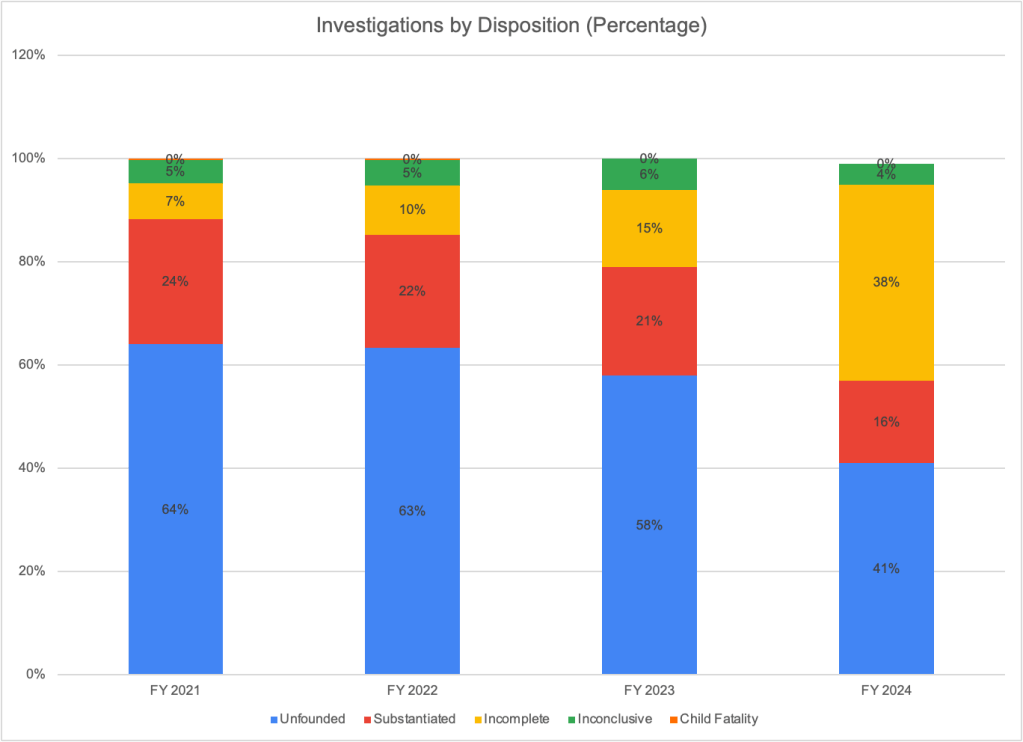
There was a big jump in the number of investigations categorized as incomplete, from 525 in FY2023 to 1,442 in FY2024. That was an increase from 15% of all investigations to 38% of all investigations. As a consequence of the increase in incomplete investigations, the number and percentage of investigations that were unfounded and substantiated dropped drastically. The number of investigations that were substantiated fell from 799 (21 percent of investigations) in FY2023 to 606 (or 16 percent of investigations) in FY2024. Unfounded remained the most common disposition in FY2024, but the proportion of cases that were unfounded dropped from 58 percent to 41 percent.

Source: CFSA Data Dashboard, https://cfsadashboard.dc.gov/page/investigations-abuse-and-neglect

CFSAโ€™s communications director did not respond to several emails asking for an explanation of the the jump in incomplete investigations. But it seems likely that this trend stems from the workforce crisis that is affecting CFSA and other child welfare and human services agencies around the country. A spreadsheet that the agency provided to the DC Kincare Alliance shows 27 out of the 36 social workers performing investigations as of August 2024 were carrying more than theย 12 to 15 casesย that CFSA uses as an indicator of satisfactory performance. This included 19 social workers carrying 20 or more cases and five social workers carrying more than 30 cases. Even more concerning is that the number of social workers doing investigations fell from 42 in January 2024 to 36 in August 2024, according to the spreadsheet.

If social workers are not able to complete the required interviews and collect needed information timely, endangered children may suffer further harm. It is possible that most of the incomplete investigations have been essentially concluded with a determination of findings, leaving only the completion of needed documentation and forms undone as workers hurried to start new investigations. Such a scenario might be somewhat less alarming but would still raise concerns that overburdened social workers are not able to thoroughly investigate allegations, thereby endangering vulnerable children.

In-Home Case Openings and Foster Care Placements

The table below shows the number of in-home case openings and children entering foster care by year. These two numbers cannot be added together because because in-home entries are reported at the case level (with multiple children in many cases) and foster care entries are reported at the child level. However the trends over time can be compared, showing that the number of in-home cases opened dropped between FY2023 and FY2024 while the number of children entering foster care increased. This was the first time the number of children entering foster care increased since FY2021, after the drop in foster care placement due to COVID-19.\

Source: CFSA Data Dashboard, https://cfsadashboard.dc.gov/

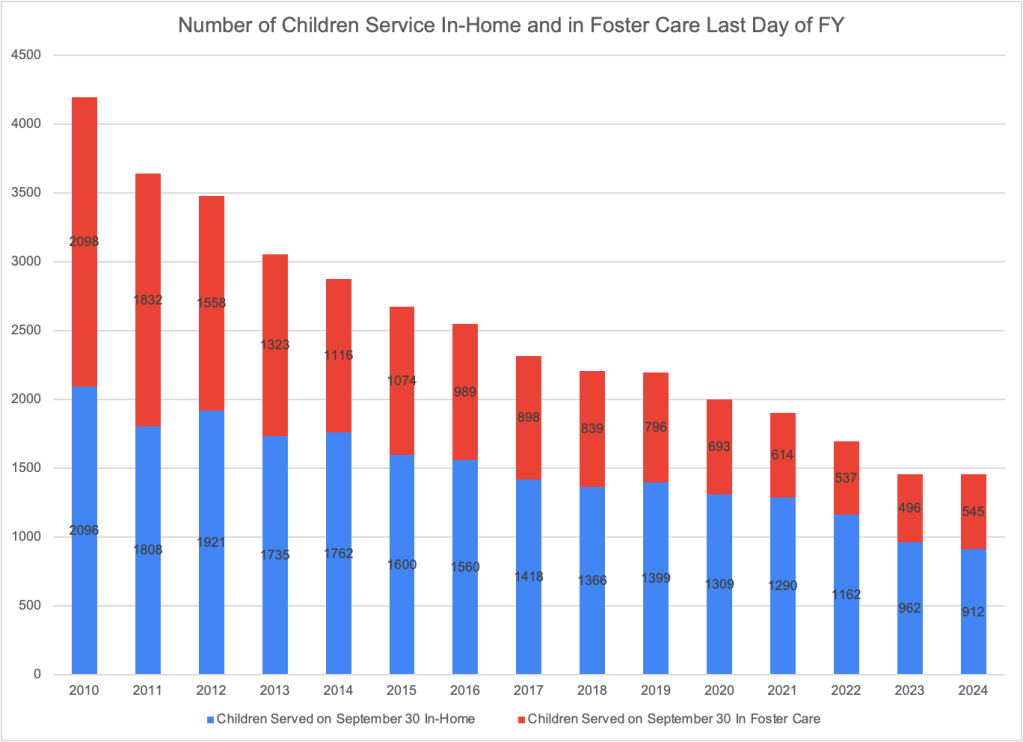
The total number of children served in home and in foster care on the last day of every quarter are available on the CFSA Dashboard and can be added to yield the total number of children served on that date. The chart below shows that the total number of children served on the last day of the fiscal year (September 30) stayed basically the same between FY2023 and FY2024. But the number of children being served in their homes decreased by 50 while the number in foster care increased by 49. FY2024 reverses a trend of annual decreases in the number of children in foster care going back at least as far as 2011.

Source, For 2010-2023, CFSA Annual Needs Assessment, available from https://cfsa.dc.gov/sites/default/files/dc/sites/cfsa/publication/attachments/FY23_Needs_Assessment_and_FY25_Resource_Development_Plan.pdf; ,CFSA Dashboard for FY2024.

The increase in the number of children in foster care between September 30, 2023 to September 30, 2024 reflects an excess of entries to foster care over exits from care during FY2024. Specifically, the number of children in foster care at the end of the fiscal year should reflect the number of children in foster care at the end of FY2023, plus the number of entries to foster care during the year, minus the number of exits from foster care. While there is a discrepancy of two between the results of this calculation and the foster care caseload reported by CFSA, the numbers confirm that there were about 50 more entries than exits, so the caseload increased. A similar calculation cannot be performed for children served in their homes, as the entry data are based on cases, not children.

2023 FC Caseload2024 FC Entries2024 FC Exits2024 FC Caseload
496243196545
Source: CFSA Data Dashboard, https://cfsadashboard.dc.gov/

It may be reassuring that the number of children served by CFSA changed so little in FY2023. One can hope that despite the high percentage of incomplete investigations, CPS workers are doing what is necessary to find the children that need help and simply leaving some of the paperwork for later. However, such a situation is not sustainable without endangering children. And the 3.6 percent increase in the number of referrals between FY2023 and FY2024 was not met with an increase in the number of children served, which may be a result of the incomplete cases.


It is not possible to understand the FY2024 data without further information from CFSA. How alarming the increase in incomplete investigations may be depends on whether these investigations are truly incomplete or basically finished except for forms and documentation. More concerning still, CFSA caseload data indicates that there are fewer than half the number of social workers doing this work now than in previous years. It is good that the total number of children being served has not dropped precipitously along with the drop in completed investigations. But the public needs to know more about how CFSA is functioning and what it is doing to alleviate the workforce crisis.

The Death of Thomas Valva: Almost five years later, we still donโ€™t know the truth

This blog was published on the website of Lives Cut Short on January 6, 2025.

On January 17, 2020, eight-year-old Thomas Valva died of hypothermia in the freezing garage at the home of his father and his fatherโ€™s live-in fiancรฉe. It soon came out that school staff had made multiple calls to theย  state child abuse hotline during the 16 months before Thomasโ€™ death, describing how he and his brother were starved, beaten and forced to sleep in a garage and urinate upon themselves. Almost four years after Thomasโ€™ death, a Suffolk County grand jury issued a report explaining that it had been denied access to records from the child protection system (CPS) concerning ten investigations prior to his death because they were โ€œunfounded.โ€ At no point did the state or the county explain how they had missed this case of chronic abuse, share plans for ensuring the same errors would not occur in the future, or hold any employee accountable for leaving Thomas in the hands of his abusers.

In September 2017, during a bitter divorce battle between Michael Valva and Justyna Zubko-Valva, a judge gave Michael Valva temporary custody of Thomas and his two brothers. The boys joined a household that included their father, his fiancรฉe, Angela Pollina, and her three daughters. As described in the grand jury report, Michael Valva removed six-year-old Thomas, and his older brother Anthony, from their specialized school in Manhattan and enrolled them in a Suffolk County elementary school. Both boys had been diagnosed with autism and were described as โ€œhigh functioning.โ€ 

Repeated calls for Help

According to the grand jury report, Thomas and his brother were the subject of at least ten reports to New Yorkโ€™s child maltreatment hotline between September 2018 and Thomasโ€™ death in January 2020. All of these reports were โ€œunfoundedโ€ by Suffolk County CPS ; โ€œunfoundedโ€ means that the investigator found no credible evidence ofย  alleged abuse or maltreatment. But the New York Daily News obtained records of at least 20 calls by school staff about Thomas and Anthony during that period. We donโ€™t know how many of these additional calls were investigated or screened out at the hotline as not warranting investigation. (Except where otherwise noted, all case details are based on the grand jury report.)

In January 2018, about four months after moving to their fatherโ€™s home, Thomas and Anthony began to complain to school staff that they were hungry, reporting that they were denied breakfast as punishment. The staff alerted the CPS worker who was already investigating allegations against both parents, but it was not clear whether the boysโ€™ hunger was addressed in the investigation.1ย  In September 2018, Thomas and Anthony returned to school looking very thin and both were now wearing pullups, despite having used the toilet without problem the previous year. School staff observed the children eating food from the trash and the floor. It was then that a school staff member made the first call to the state hotline that was documented in the grand jury report. The nine calls that followed during the next 14 months reported that the boys were hungry, had suspicious bruising including a black eye, were coming to school in urine-soiled clothing and shoes, and reported sleeping in an unheated garage, where they urinated upon themselves and were hosed down in the morning.ย 

School staff made four calls in March 2019 in a concerted effort to get a response.ย  But the effort seems to have backfired. When the staff called Suffolk County CPS to follow up, they were told that their multiple reports had โ€œcanceled each other out.โ€ In April 2019, a staff member confronted a county CPS representative at the school. According to staff reports, the CPS representative responded that without broken bones, there was nothing they could do. The last report was made in November 2019 describing bruises on both childrenโ€™s faces and their continuing complaints of hunger.

Thomasโ€™ Death and the Response

On January 17, 2020, the Suffolk County Police Department learned that Thomas had been pronounced dead. The cause was determined to be hypothermia. Video surveillance from the garage the night before Thomasโ€™ death shows Thomas and Anthony shivering in the garage. The low temperature that evening was 19 degrees Fahrenheit. At the time of his death, Thomasโ€™ body temperature was recorded at 76 degrees. Michael Valva and Angela Pollina have been convicted of โ€œdepraved indifference murderโ€ and sentenced to 25 years to life. Justyna Zubka-Valva has sued Suffolk County for $200 million in Thomasโ€™ death.

In the wake of the tragedy, the grand jury was empaneled to identify any failures in CPS conduct and practices, determining whether anyone should be found criminally liable, and potentially making recommendations to improve CPS practices to ensure that future children would be better protected. When the grand jury finally issued its report in April, 2024, its central conclusion was that its ability to investigate the case was โ€œseverely hamperedโ€ by the law governing the disclosure of reports declared by CPS to be โ€œunfounded.โ€ Under that law, these records are sealed and can be provided only for very restricted purposes to a short list of people and agencies under specific circumstances. Thus the grand jury had no access to any information about any of the CPS investigations that occurred in response to calls from the school.2

We know that reviewers in both Suffolk County DSS and New York Stateโ€™s OCFS did have access to the complete records of the case. New York law requires local departments of social services to investigate all fatalities from maltreatment. The stateโ€™s Office of Children and Family Services is required to review each local fatality investigation and issue its own report within six months of the local investigation. Unfortunately, neither the state and county legislatures, the grand jury nor the public had access to these two reviews. The local reviews are never released to the public. OCFS posts its fatality reviews on its website (with names and identifying information redacted), but only when it is determined that โ€œdisclosure would not harm the childโ€™s siblings or other children in the household.โ€ An earlier post by Lives Cut Short discusses this process and shows that about a quarter of these reports on child deaths in 2022 appear to be withheld on these grounds, including most of the cases that had been covered in the media. Not surprisingly, the grand jury confirmed that the OCFS report on Thomasโ€™ death was withheld on these grounds.ย 

The Costs of Secrecy

The grand juryโ€™s central recommendation was that the stateโ€™s law must be changed to expand access to this informationโ€“but only to grand juries and district attorneys prosecuting cases. Actually, a much broader change is needed. At a minimum, the โ€œbest interestsโ€ determination must be eliminated and all of the OCFS child fatality reviews, with appropriate redactions, must be shared with the public. As described in a Lives Cut Short report on state disclosure policies, several other states share such case reviews. These include Pennsylvania (which posts case reviews on all child maltreatment fatalities and near fatalities); Florida, Oregon and Washington (which post case reviews on the deaths of children in families with which the agency had contact within a year); and Colorado, (where cases are posted if the agency has dealt with the family in the past five years). In addition, Arizona and Wisconsin post summaries of all child maltreatment fatalities and near fatalities including a brief description of prior agency requirement.ย 

The public should have access to the full agency file involving its interactions with a family in which a child later dies of abuse or neglect. That includes records of all reports received and agency responses, including decisions not to investigate. These files should be redacted to remove the names of those who reported abuse and of other children in the family, though the names of Thomasโ€™ brothers have long been known through media reports. Laws in Florida and Arizona require the release of redacted case files upon request in cases where a child dies of maltreatment.ย 

The limits of the grand juryโ€™s recommendation may stem from its limited view of why the changes are needed. The grand jury stated that the privacy protections enshrined in the law โ€œhave had the unintended consequence of shielding an entire agency, its leadership, and its hundreds of employees, from criminal investigation and prosecution.โ€ Accountability is certainly necessary. Newsday has reported that three Suffolk County CPS employees that โ€œplayed key rolesโ€ in the investigations of Valva and Pollina were promoted after Thomasโ€™ death. But we donโ€™t need transparency just for the purposes of holding people accountable. Individuals are not always at fault in these cases, and even if they are, there may be systemic flaws as well. Knowing the entire case history is critical to enable legislators, advocates and the public to identify the flaws in the system that caused it to fail.

Without access to the full agency record, It is difficult to understand how so many reports over 14 months could have resulted in no findings of abuse or neglect. The number of reports, the serious nature of the concerns expressed, and the repetition of similar concerns regarding two boys, do make it difficult to understand how all of these reports were screened out or unfounded. Suffolk County officials provided a clue when they stated in a recent press conference that CPS staff may have been biased in favor of Michael Valva because he was a police officer. But other flaws in policy or practice, such as high caseloads, untrained or unqualified staff, an extremely parent-centered culture, or even criminal misconduct by CPS workers or supervisors, may have been present as well.

An Absurd Response to Thomas’ Death

On July 9, 2020, the Suffolk County Legislature enacted the CPS Transformation Act, which was designed to prevent future tragedies. It seems to have been based on a cursory external review by a legislative task force, which apparently did not have access to the internal DSS review. Four years later, Suffolk County officials announced โ€œcomprehensive changesโ€ to CPS in response to Thomas Valvaโ€™s death. Strangely, several of the changes that were cited were completely irrelevant to the conditions that resulted in Thomas Valvaโ€™s death. These included changing the process of removing a child from a family by instituting โ€œblind removals,โ€ returning adult protective services to the Child and Family Services Division of DSS, and a new mobile โ€œpanic buttonโ€ for employees who find themselves in danger.

The most bizarre of these reforms was the adoption of โ€œblind removalsโ€ by Suffolk County. The blind removal process, pioneered in neighboring Nassau County, NY, was created in response to concerns about racial bias leading to the removal of Black children at a disproportionate rate compared to their share of the population. It requires each child removal to be approved by a panel that does not have access to demographic and identifying information on the child and family. The policy gained national attention due to a 2018 TED Talk citing numbers that were later shown to be wrong. The only academic study found no impact for the process; but New York State had already required all counties to develop a blind removal process by October 14, 2020.

County officials at the press conference attempted to connect blind removals with preventing future tragedies by stating that the policy โ€œeliminates the type of “biased decision-making” that kept 8-year-old Thomas Valva in the custody of his police officer father before his death.โ€ But Thomas was never found to be abused and therefore not considered for removal. Moreover, Suffolk County adopted blind removals in response to a state mandate, not Thomasโ€™ death.ย 

Thomas Valva suffered and died because CPS ignored his cries for help and the repeated warnings of staff at his school. Almost five years after Thomas Valvaโ€™s death, the public still does not know why the system set up to protect abused and neglected children failed both him and his brother. In New York and around the country, we need transparency around child fatalities and near fatalities when public agencies were involved with the family and could have stepped in.ย ย 


  1. In February, 2018, Suffolk County CPS โ€œindicatedโ€ (found some credible evidence of maltreatment) a case against Thomasโ€™ mother for โ€œinadequate guardianshipโ€ and against his father for โ€œinadequate guardianship,โ€ โ€œexcessive corporal punishment,โ€ and other charges. These cases apparently stemmed from allegations that Thomasโ€™ parents made against each other and are not further described in the grand jury report.ย 
    โ†ฉ๏ธŽ
  2. It is possible that the grand jury was misinformed that ten reports were investigated and unfounded, The report cites only two visits from CPS workers to the school. Moreover, the grand juryโ€™s report that a CPS worker said the four reports made in one week canceled each other out suggests that they were not investigated at all. If some of these reports were screened out or not investigated, the grand jury should have been informed of this fact and given information about why these reports were screened out.
    โ†ฉ๏ธŽ

The tragic life and death of Gavin Peterson: Utahโ€™s statement leaves many questions unanswered

This post was prepared for and originally appeared on the website of Lives Cut Short, a project to document and analyze child maltreatment fatalities in the United States. See my interview with KUTV about this post here.

On October 10, the Utah Department of Children and Family Services (DCFS) finally released a statement summarizing its involvement with Gavin Peterson, who died on July 9, 2024 at the age of 12.  Gavinโ€™s father, stepmother, and older brother are awaiting trial on reckless child abuse homicide, among other charges.  The much-awaited โ€œCAPTA statementโ€ from DCFS (named for the federal law requiring that states have a policy to disclose โ€œinformation and findingsโ€ about child maltreatment fatalities and near fatalities)  provided some new information but raised new questions, especially when contrasted with media accounts. 

The DCFS statement begins with a disclaimer.  Gavin came from a โ€œtwo-household familyโ€ and was residing with his biological father, Shane Peterson, and fatherโ€™s long-term girlfriend, Nichole Scott, at the time of his death. The agency explains that although  it โ€œworked with each household at several points in Gavinโ€™s life as early as 2013,โ€ the statement includes only โ€œinformation relevant to Gavin in the household where his death occurred.โ€ It is not clear from this disclaimer what information was withheld from the public, either because it was from the other household or because DCFS decided it was not “relevant to Gavin.โ€

Some of that information can be pieced together from media coverage. Gavinโ€™s mother, Melanie Peterson, told a reporter at  KSL TV that she lost custody of all four of herchildren in 2014 or 2015. Court documents obtained by the reporter showed that two-yearโ€“old Gavin was found unsupervised outside of his home in 2014, and that in the same year Melanie pleaded guilty to allowing a child to be exposed to illegal drugs or drug paraphernalia. Melanie told the reporter that she never regained custody of her children from the courts, but that Shane Peterson unofficially returned her third child to her in 2018 and her second child in 2019. (Her first child was apparently Tyler, who is charged in Gavinโ€™s death, and Gavin was the fourth child.) 

DCFSโ€™ statement provides a chronology of abuse and neglect reports and agency responses, which are summarized below along with our commentary in italics.

May 28, 2019

The first report of abuse in Shane Petersonโ€™s home is received. DCFS investigates and finds that Nichole Scott had physically abused another child in the home. The Peterson family accepts voluntary in-home services. After a month of services, DCFS concludes the safety concerns have been resolved and closes the case.

The โ€œother childโ€ was clearly Gavinโ€™s sister Mayloni Peterson, now 19. She told KSL TV that she was abused even more severely than Gavin at the time, and was even punished for his actions.  She described being beaten, tied to her bed, fed only once or twice a day, forced to perform labor in the household and at her grandmotherโ€™s house. She reported that Scott once shaved off all her hair as punishment for combing her hair without permission and strangled her in the car following a failed attempt to run away. On Saturday, May 25, 2019, Mayloni told her father that she accidentally broke a sprinkler while mowing the lawn. Her father took her to her motherโ€™s house without warning and left her there, possibly saving her life. Melanie Peterson reported that Mayloni was malnourished and โ€œwith all her hair buzzed off.โ€ After hearing what her daughter had been through, Melanie made a report to DCFS after the Memorial Day holidayโ€“clearly the May 28, 2019 report. (Mayloni mentioned a report that was made by her school in March; it is not clear whether that report was omitted by DCFS because it was โ€œnot relevant to Gavin.โ€)

February 27, 2020

DCFS receives a call reporting abuse of Gavin in โ€œanother household.โ€ DCFS finds Gavin to be a victim of abuse and files a court petition. On May 27, the court orders both households to participate in DCFS in-home services. 

Melanie Peterson told KSL TV that she took a picture of an emaciated Gavin in February 2020. It would be the last time she saw him. She alleges that Nichole and Shane Peterson found out about the photo and made a false allegation about her, thereby ending her visitation rights pending a judgment by DCFS. That โ€œfalse complaintโ€ was likely the February 27, 2020 report, which resulted in an open case for both households. 

August 24, 2020

While the two households are receiving in-home services, DCFS receives a call reporting concerns about Gavinโ€™s treatment in his fatherโ€™s home. The information does not โ€œmeet the criteria required by Utah state law to open an investigation,โ€ but the intake worker shares the information with the in-home caseworker.

May 21, 2021

The โ€œPeterson familyโ€ successfully completesโ€ in-home services, and the judge closes the case. No information is provided about what these services were. 

September 2, 2022

DCFS receives a report from โ€œsomeone concerned about Gavinโ€™s well-being, after observing some of his behaviors.โ€ The hotline worker decides the report does not meet the legal criteria for opening an investigation. A supervisor approves this decision. 

This report most likely came from Gavinโ€™s school, and his โ€œbehaviorsโ€ included eating food from the trash. Cafeteria worker Rachel Reynolds told KSL TV  that she suspected Gavin was hungry even before the schoolโ€™s COVID-19-era free meal program ended in August 2022 and Gavin began taking leftovers from the trash. Her colleague Jan Davis said that she and a coworker began paying for Gavinโ€™s lunch. That ended when Nichole Scott demanded they stop buying his lunch. But the workers continued to โ€œsneak foodโ€ to him, according to Reynolds.

March 28, 2023

DCFS receives a report regarding physical neglect of Gavin and opens an investigation. Two days later, DCFS receives another report, which is added to the open investigation. Gavin is interviewed at school without his parents and does not disclose abuse. On May 8, 2023, DCFS receives a third report alleging physical abuse of Gavin. The investigator visits the home for a second time, interviews the adults and interviews Gavin outside the presence of the alleged abusers. The case is closed on May 15 with no finding of abuse or neglect.

These three reports likely came from the school.The school district reported the school made โ€œmultiple callsโ€ about Gavin, and Rachel Reynolds said that at least four calls were made by cafeteria workers and the principal. Reynolds personally observed the nurse and school principal call DCFS when she brought Gavin to the nurse with fingers that looked swollen and infected from picking. Jan Davis mentioned that Gavin came to school with a chipped tooth shortly after Nichole Scott learned that cafeteria staff were feeding Gavin. Perhaps that accounted for the abuse allegation. 

In August 2023,  Gavin was withdrawn from school for schooling at home. There are no more reports until July 29, 2024. Utah has no policy in place for monitoring children withdrawn from school following allegations of abuse or neglect,

July 9, 2024

DCF receives a report that Gavin is in the emergency room with injuries that appeared to be the result of abuse or neglect. He dies the same day. 

The police investigation into Gavinโ€™s death has revealed that Gavin was abused for years, was kept locked in an uncarpeted room without bedding or blankets while adults monitored him with multiple cameras, and was often beaten or starved, sometimes given only bread and mustard to eat. Nichole Scott, Shane Peterson, and Tyler Peterson were arrested and charged with child abuse homicide, aggravated child abuse, and endangerment of a child, and are awaiting trial. Gavinโ€™s treatment can be defined as torture, a type of child abuse that some have observed may be increasing in Utah and around the country. These cases often include confinement, starvation, beating, and isolation.

Unanswered Questions

Utahโ€™s report on Gavin Petersonโ€™s death, when compared with the media accounts from Gavinโ€™s mother, sister, and school staff, raises more questions than it answers. 

  • The May 28, 2019 report: The allegations that Mayloni made to her mother, who presumably included them in her May 28, 2019 report, concerned multiple reports of physical abuse, confinement, and forced labor.  Both children should have had a physical exam and a forensic interview. How is it possible that allegations of this magnitude (that turned out to be true) resulted in a case that was closed in a month and that was also described as โ€œvoluntaryโ€? 
  • The February 2020 report: This report about the  abuse of Gavin in another household is clearly the โ€œfalse allegationโ€ stemming from his motherโ€™s photograph of an emaciated Gavin. How did that result in a substantiation against her for abuse? The case was open for more than a year during the height of the COVID-19 pandemic. Were the visits virtual? Does that explain why the caseworker observed nothing of concern? Why did Melanie never get her visitation rights back after the case was closed?
  • The August 24, 2020 report: What concerns were raised and why did they not meet the criteria to open an investigation? Was this report really shared with the in-home worker and did that worker try to determine whether they were true?
  • The September 2022 report: How was this report,  obviously from the school and conveying that Gavin was seeking food in the trash, not judged to meet the legal criteria for an investigation, even by a supervisor?
  • The reports in March and May of 2023: Why did the investigation conducted from March to May 2023 fail to find the abuse of Gavin, which was so obvious to school personnel? Wasnโ€™t Gavin very thin? Shouldnโ€™t he have received a physical examination? If he denied the abuse, was the investigator unaware that is what scared children do? Was there any discussion  of taking him to a Child Advocacy Center for a forensic interview?

Key Takeaways

The first major takeaway of this report is that Utahโ€™s CAPTA report does not tell us whether DCFS did all that it could do to protect Gavin. The information shared in the report complies with state policy, which in turn complies with the very vague requirements of federal law. But much more detail is needed including documentation of the reasoning behind rejecting certain reports as worthy of investigation, the entire record of each investigation including interviews and documents, and a report of every interaction with the family during the in-home case. A few states post โ€œcritical incident reviewsโ€ for some death and near fatality cases. But such reviews are expensive, not all cases get reviewed, and internal reviewers may be biased on behalf of the agency. The only way to ensure accountability and inform needed changes is to release the full case file on the family, with certain names redacted,1 for at least the five years preceding the fatal or near fatal event.

The second major takeaway is that in spite of the lack of detail, the information provided strongly suggests that the problems in this home were longstanding and there were many opportunities for DCFS to discover them. It appears that systemic issues prevented the diagnosis of issues that should have been obvious. A former DCFS caseworker told KUTV that she left the agency “after struggling with overwhelming caseloads and a culture of simply ‘checking boxes.” She explained that while cases demanding immediate action are usually addressed, other cases showing red flags are dismissed too soon as “safe enough.” She placed primary blame on the legislature for not allocating adequate resources, saying that workers want to do their jobs, but they are being placed in impossible situations. “It’s unfair to put them in these situations where they don’t have the time to produce quality work, or if they do decide to put in the time, they’re sacrificing so much.”

The third major takeaway is that Gavinโ€™s fate was sealed once he was withdrawn from school and the reports stopped coming in. In its Make Homeschool Safe Act, the Coalition for Responsible Home Education proposes that a child cannot be withdrawn from school for homeschooling within three years of being investigated for abuse or neglect, regardless of the outcome, unless there is a risk assessment by social services or child welfare that finds that the child will not be endangered by being schooled at home, and the home educator agrees to a monthly risk assessment for the next 12 months.

Gavin Peterson was failed by the agency that was meant to protect him, A few children suffering similar torture have been lucky enough to escape to safety, like the boy who escaped from the home of parenting youtuber Ruby Franke and saved himself and his sister from likely death. But most children in these situations have no recourse unless the people being paid to protect them have the time, training, support and resources to investigate fully and respond appropriately. To ensure that happens, the public must have access to the complete records of cases in which the system has failed. 

  1. For example, the names of children and people who reported maltreatment. โ†ฉ๏ธŽ

School shootings and fentanyl overdoses: the uncounted costs of neglecting maltreated children

A fourteen-year-old boy and a fifteen-year-old girl are charged as adults, one for a mass shooting and the other for selling a fentanyl tablet that killed an older teenager. These two young people had something in common–a long history of neglect (and sometimes abuse) by their parents and a failure to intervene by child welfare services despite multiple reports that children were in danger. Ignoring chronically maltreated children when they could have been saved and then locking them up for life is both inhumane and costly. We must intervene to help maltreated children before they are irrevocably damaged by years of abuse and neglect.

On September 4, 2024, fourteen-year-old Colt Gray shot and killed two teachers and two students at Apalachee High School in Winder, Georgia with an AR-15 style rifle given to him by his father. He has been charged as an adult and is awaiting trial. It did not take long for the media to uncover that Colt had grown up in a chronically abusive and neglectful home. As the Washington Post put it in a devastating article, “Coltโ€™s parents, each addicted to drugs and alcohol, were perpetually inattentive, often cruel and sometimes entirely absent, according to family members, neighbors, investigators, police reports and court records.” In November 2022, Colt’s mother, Marcee Gray, left his father, Colin Gray, and moved to southern Georgia with her two younger children. It appears that DCFS had opened a case at some point because In October of 2023, a spot drug-test revealed Marcee’s renewed drug use. Colin Gray was ordered to retrieve the other children, or they would be placed in foster care. Shortly thereafter, it appears that the case was closed.

There is no information from media reports about whether DCFS evaluated Colin Gray for his fitness to take care of his three children or to monitor their well-being in his care before closing the child welfare case. Yet, relatives reported to the New York Post that Colin Gray relentlessly bullied his son, calling him names like “sissy” and “bitch.” The Washington Post reported that Colt first came to the attention of authorities at the age of 11, when his school flagged him for searching the internet for ideas on how to kill his father. In Colin Gray’s custody, Colt never attended eighth grade and was not even registered for school until February 2 of that year. That Christmas, Colin Gray gave Colt his own AR-15 style rifle, in an attempt to “toughen him up,” as relatives told the New York Post. By his fourteenth birthday in January, Colt’s grandmother reported that he was searching the internet for what was wrong with him; she offered to pay for therapy and take him there but his father never signed him up. In July of 2023, Marcee returned from rehab and Colin allowed her to move back in. Colt’s mental health deteriorated even further after his mother’s return, and he talked of hurting himself or others. He registered for high school two weeks late and rarely attended. โ€œColt was like the thrown-away child,โ€ said his grandmother, who tried in vain to get his father and the school to help him. Five days after his father failed to take him to a crisis mental health center despite his grandmother’s plea, Colt brought his rifle to school and took four lives.

Also charged as an adult was 15-year-old Maylia Sotelo of Green Bay, Wisconsin, the subject of a devastating article by Lizzie Presser of Pro Publica.  Maylia’s home had been a “hangout for users and dealers.” Her three older sisters had all been kicked out or left due to their mother’s violence. Maylia’s had been referred to child protective services 20 times before she was finally removed from her home at the age of 14. In a pattern typical of chronic maltreatment, the reports concerned multiple types of neglect, sexual abuse, and physical abuse. Before Maylia turned one, CPS documents show that her mother overdosed on cocaine and Adderall with seven children in her home. When she was five years old, a caller reported that her mother was โ€œhigh as a kiteโ€ and her boyfriend was violent. The next year, another report indicated that there was no food in the home and that the mother was using heroin in front of her children.

When Malia was seven, CPS substantiated a report that a man โ€œopened his pants, pulled out his penis and masturbatedโ€ in front of one of Mayliaโ€™s sisters. That same year, a woman overdosed on crack in the house and Mayliaโ€™s mother โ€œwould not call rescue or the police because [she] did not want her children removed,โ€ according to a social worker’s notes. And a school employee reported that Maylia missed half the school year. When Maylia was 14 and her mother became psychotic, Maylia and her sister were finally removed from the home and placed with relatives. But they were given no counseling or assistance with school, according to Pro Publica. Maylia had been smoking weed since fifth grade, then began selling it. By the beginning of tenth grade, she was selling “blues,” pills that were billed as percocet but actually contained filler and fentanyl. She sold a pill to an 18-year-old named Jack McDonough. When he died of an overdose, Maylia was arrested for first-degree reckless homicide.

It is obvious that both Colt Gray and Maylia Sotelo were chronically maltreated children who suffered from multiple types of maltreatment over a period of years. It is also obvious that the systems designed to protect them failed both of these young people. Both families clearly required intervention that did not come when it was needed, though we do not have enough details to make an informed critique of the system’s response. When the child welfare system finally intervened in Malia’s case, it may have been hard to change her trajectory, and it appears that she was left with relatives and received monitoring or services to address her traumatic history. In Colt’s case, the intervention may have also come too late to prevent serious psychological damage. And once they became involved, caseworkers appeared to be focused on his mother and ended the case with the placement of all three children with their father, a parent who had been equally neglectful and failed to take action to protect the children from his wife’s abuse.

Perhaps more intensive in-home services provided earlier could have helped Colt’s and Maylia’s parents address the issues that led them to abuse or neglect their children. If not, perhaps Maylia’s earlier removal from her toxic home, and Colin’s removal to a better environment than either of his parents could provide might have saved these children from the sad fate that awaited them. The approach that is currently in fashion – exemplified by the much touted Family First Prevention Services Act (FFPSA) of 2018 – prescribes the avoidance of foster care at almost any cost. It does, however, promise that parents receive support in parenting their children, whether it is mental health, drug treatment, or parenting training. Child welfare systems have long been providing such support to families in the form of in-home services, and FFPSA was supposed to provide the resources to improve these services. Unfortunately, FFPSA did not acknowledge or support the crucial role of frequent home visits to ensure the children are safe and that they can be removed into foster care if the parents do not cooperate with their plans for addressing their issues and improving their parenting.

Sadly, there is no evidence that increases in family support or child safety monitoring are forthcoming. States are proudly citing drops in their foster care caseloads, with no reporting on what is happening to the children left at home. States are not required to release data on the number of cases opened for in-home services, so we have no idea whether the abused and neglected children who are not being removed are getting any supervision or their parents receiving services. But as I have written, data from the states with the largest and third largest foster care caseloads indicates that the number of children receiving in-home services has not increased to make up for the drop in children removed to foster care; instead it has decreased along with foster care placements, resulting in a decline in the number of children being served overall.

Studies have documented the connection between child maltreatment and crime.1 Failing to intervene with at-risk children before they resort to crime and subsequently incarcerating them results in unnecessary human suffering, not to mention greater financial costs, than intervening early. If we do not want to remove more children, we must provide intensive services to parents and close monitoring of their children’s safety–and be ready to remove the children as soon as it becomes clear that parents are not going to change before the children are irreparably harmed. Such monitoring is key, because we really do not know what, if anything, works in preventing future maltreatment among parents who have maltreated their children.

This is not the first time that the failure of CPS has been noted in the wake of a heinous crime. I previously wrote about Lisa Montgomery, who was executed on January 12, 2021. She murdered a pregnant woman, cut out the baby, and took it home. It turned out that Lisa Montgomery had a long and horrific history of physical and sexual abuse throughout her childhood, including beatings and bizarre punishments by her mother, rape by her stepfather, and prostitution by both. Sadly, it seems that we have not made much progress since Lisa’s childhood, and current ideological trends run the risk of leaving even more children unprotected in the future.

Notes

  1. See Janet Currie and Erdal Tekin, Does Child Abuse Cause Crime? NBER Working Paper 12171, https://www.nber.org/digest/jan07/does-child-abuse-cause-crime and Todd I. Herrenkohl et al., Effects of Child Maltreatment, Cumulative Victimization Experiences, and Proximal Life Stress on Adult Crime and Antisocial Behavior, https://www.ojp.gov/pdffiles1/nij/grants/250506.pdf.