Child Maltreatment 2022: reports increase but response lags

Child Maltreatment Victims Have Decreased for the Past Five Years to a New Low,” proclaimed the Administration for Children and Families (ACF) as it released Child Maltreatment 2022, its long-awaited annual compendium of child maltreatment data shared by the states. Contrary to the headline, the report says nothing about the actual incidence of child abuse and neglect. It does show that in Federal Fiscal Year 2022, calls to child protective services hotlines almost rebounded to pre-pandemic levels. But the number of investigations and assessments that CPS undertook in response to these calls did not bounce back as much as calls, and states are confirming even fewer allegations of maltreatment as they did in FFY 2021 and 2022. Moreover, child fatalities are up for the fifth year in a row. Some of the most striking and interesting results are discussed below, though this is not an exhaustive summary of the report’s contents.

Referrals and Reports

The annual Child Maltreatment reports, produced by the Children’s Bureau of ACF are based on data that states submit to the National Child Abuse and Neglect (NCANDS) data system, and this latest report concerns Federal Fiscal Year (FFY) 2022, which ended on September 30, 2022. NCANDS uses the term “referrals” to connote contacts to child protective services (CPS) hotlines. In 2020, the number of referrals dropped sharply as schools closed and children vanished into their homes. In FY 2021, with some opening of schools and society, the referral rate rose slightly but was still much less than in FFY 2019. But in FFY 2022, the referral rate bounced back to 58.6 per 1,000 children, bringing it close to the rate of 59.7 per 1,000 in FFY 2019. Some states mentioned in their commentaries that the pandemic continued to suppress referrals somewhat in FFY 2022, which began in October 2021. That fall and winter in particular, there were still temporary school building closures and increases in absenteeism due to big waves of infection. This continued pandemic effect may help explain the failure of referrals to reach their 2019 level.

Source: Child Maltreatment 2022

As usual, the state-by-state tables document huge differences in referral rates, from 21.1 per 1,000 children in Hawaii to 180.7 per 1,000 in Vermont. Vermont reports in its commentary that its very high referral rate reflects that the state counts all calls to the hotline as referrals, suggesting that most states do not do so. And indeed, Connecticut and Alabama report that none of the calls that are assigned to alternative response are included in NCANDS, resulting in a far lower number of calls than the number they actually receive. Louisiana reports that some referrals are neither screened out nor accepted; these are calls related to open investigations or in-home or out-of-home service cases; it appears that these are not counted as referrals at all. These inconsistencies between states make it difficult to interpret state-by-state differences in referral rates.

Once a state agency receives a referral, it will be screened in or out by hotline staff. In general, referrals are screened out if they are deemed not to contain an allegation of child abuse or neglect, contain too little information to act on, are more appropriately assigned to another agency, or for some other reason do not fall under the mandate of the child welfare agency. In NCANDS, a referral becomes a “report” once it is screened in, and it then is assigned for an investigation or alternative response. The 47 jurisdictions that reported both screened-in and screened-out referrals collectively reported screening in 49.5 percent of referrals and screening out 50.5 percent. The national screened-in referral rate was 29.0 per 1,000 children, an increase of one percentage point from the rate in FFY 2021. In that year, as shown in Child Maltreatment 2021, the 46 states reporting screened in 51.5 percent of referrals and screened out 48.5 percent. So as the number of referrals increased, it appears that the states screened in a lower percentage of them.

State by state differences in the percentage of referrals that are screened in were vast; ranging from 16.9 percent of referrals to 98.7 percent in Alabama. But as discussed above, differences in which calls are reported in NCANDS will affect these percentages, making the data hard to interpret. Some of the very high rates reported, such as the 98.7 percent for Alabama, and Texas’s reported 84.5 percent, are hard to understand.

Indiana’s commentary provides an example of how a state can purposely reduce its screen-in rate. The state reported that the Department of Children’s Services “partnered with the Capacity Building Center for States as well as ran internal events targeted at reducing our screen-in rate.” Added to the types of allegations to be screened out during FFY 2021 were “sexting concerns among adolescents,” “pre-adolescent children exhibiting potentially sexually maladaptive behaviors,” and “educational neglect.” Some child advocates might be concerned about excluding these types of allegations, as all of them could indicate serious problems in the home, and the exclusion of educational neglect is particularly surprising. Perhaps the changed screening guidelines are one reason the number of Indiana children receiving an investigation or alternative response fell from 139,343 in 2020 to to 123,644 in 2022, a decrease of 11.6 percent.

Screened-in Referrals by Referral Source

Before the pandemic, teachers were the most common source of screened-in referrals, submitting 21 percent of all referrals that were screened in in FFY 2019. They lost that position in FFY 2020 with the pandemic school closures, while legal and law enforcement personnel increased their share of reports. It is not surprising that teachers did not recoup their leading role in 2021, since many students were still attending school virtually for some part of the year. But even in 2022, legal and law enforcement personnel still submitted slightly more screened-in referrals than education personnel–21.2 percent of screened-in referrals compared to 20.7 percent for education personnel. Medical personnel submitted 11.2 percent of referrals and social services personnel 9.8 percent. Because these data are available only for referrals that are screened in, they reflect both the number of referrals each group submits and the extent to which they are screened in. It seems likely that teachers submit more referrals than law enforcement but that their referrals are more likely to be screened out.

Source: Child Maltreatment 2022

Child Disposition Rates: The “Footprint” of CPS

In every state, screened-in reports may receive an investigation, which results in a determination (or disposition) about whether or not maltreatment has taken place. Some states assign some reports (often those deemed to be lower risk) to an alternative track (often called “alternative response” or “family assessment”) that does not result in a formal disposition as to whether maltreatment occurred and who was the perpetrator. ACF calls the proportion of children receiving either an investigation or an alternative response the “child disposition rate.” This is an important indicator, because it can be seen as a measure of the “footprint” of CPS–the number of children it actually touches.

For FFY 2022, an estimated 3,096,101 children, or 42.4 per 1,000 children, received an investigation or alternative response, as shown in Exhibit S-1 of the report, reproduced above. That rate has dropped 12.7 percent since FFY 2018. Not surprisingly, the biggest drop was during the pandemic, but it dropped again in 2021 and rose by only one percentage point from 41.4 in FFY 2022, remaining significantly lower than before the pandemic.

The diversity in child disposition rates across states is striking. Disregarding the 15.0 in Pennsylvania, which excludes most neglect cases from NCANDS,1 this rate ranges from a low of 17.1 per 1,000 children in Maryland to a chilling 131.3 in West Virginia (over one out of 10 children!). The opioid crisis and its catastrophic effects on children in West Virginia has received considerable media attention. It is worth noting that West Virginia’s child disposition rate has decreased from 143.2 in FFY 2018. Below West Virginia, Arkansas and Indiana have similar child disposition rates of 79.9 and 78.8 respectively, far above the next group of states at about 66. The five states with the lowest child welfare “footprint,” (other than Pennsylvania) are Maryland, Hawaii, South Dakota, Connecticut and Louisiana.

Some states or jurisdictions, including Alaska, Arizona, the District of Columbia, Indiana, Kentucky, Maryland, Montana, North Dakota, Rhode Island, and South Carolina, had very large decreases in their disposition rates between FFY 2021 and FFY 2022. These may reflect purposeful policy changes to reduce the role of child welfare (such as Indiana’s addition of categories to be screened out), but it may also affect other factors such as the workforce crisis that is affecting child welfare in most states.

CPS Workforce Data and Child Disposition Rates

Child Maltreatment 2022 also provides interesting data on state child welfare workforces although the quality of the data is impossible to assess. Table 2-4 of the report provides the CPS caseload, which is obtained by dividing the number of intake, screening, investigation and alternative response workers by the number of “completed reports,” meaning reports with a disposition. That is not a very meaningful number, because it leaves out all the alternative response cases, while the workers who handle these cases are included in the numerator. In order to get a better sense of the number of children seen by each worker, I divided the number of children receiving an investigation or alternative response by the number of workers in the 20 states with the highest populations, minus the four states that did not provide workforce numbers–Florida, Georgia, New York and Ohio, as well as Pennsylvania.1

Among the 15 states in the table below, there is a staggering variation in the number of children per worker, which ranged from 21.1 in Wisconsin to 199.4 in Indiana. As child welfare commentator Dee Wilson explains in an unpublished analysis, “Differences of this magnitude develop over time when policymakers do not staff child welfare systems in accordance with workload standards.” We must also keep in mind that we do not know if the data are truly comparable between states.

Children Per Worker, FFY 2022

Source: Child Maltreatment 2022

“Victimization”

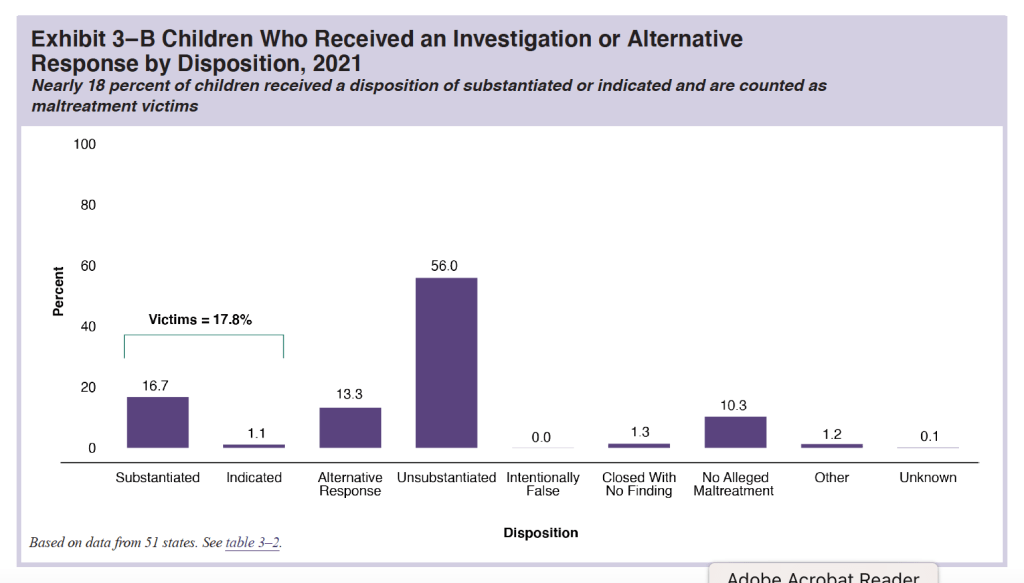
An investigation can result in a variety of dispositions, depending on the state. Most states use the term “substantiated” to indicate that the allegation was verified, but some states use another term, usually “indicated.” In NCANDS, a “victim” is defined as “a child for whom the state determined at least one maltreatment was substantiated or indicated; and a disposition of substantiated or indicated was assigned for a child in a report.” A reader might think the terms “victim” and “victimization” reflect the true number of children who experienced abuse or neglect. But there are many reasons they do not provide such a true count. Many cases of child maltreatment go unreported. Children assigned to alternative response will not be found to be victims unless their case is reassigned to the investigation track. And finally, substantiation is not an accurate reflection of whether maltreatment occurred. Adults can lie, children can lie, perhaps when coached by adults, the youngest children are nonverbal or not sufficiently articulate to explain what happened or didn’t, and making a determination of whether maltreatment occurred is difficult. So it is not surprising that research suggests that substantiation decisions are inaccurate2 and a report to the hotline predicts future maltreatment reports and developmental outcomes almost as well as a substantiated report.3 For all of these reasons, it is widely recognized that the number of children estimated to be victims of maltreatment is likely an underestimate. And over time, events such as the coronavirus pandemic or changes in state policies can be confounded (innocently or cynically) with actual changes in child maltreatment victimization. For that reason I generally put quotes around “victimization” or replace it with “substantiation,” and use the terms “substantiated victims” or “children found to be victims of maltreatment” instead of “victims.”

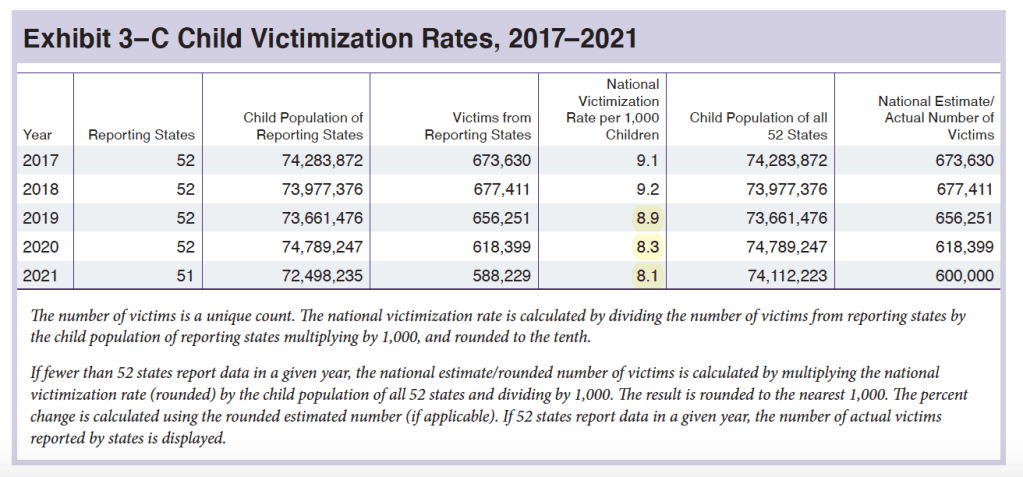
The 2022 report provides an estimate of 558,899 substantiated victims of maltreatment, or 7.7 per 1,000 children, down from 8.2 in FFY 2021. States differed greatly in the “victimization rates” that they found in FFY 2022. Of course these differences can stem from the factors mentioned above, as well as from actual maltreatment. The number of substantiated victims per 1,000 children ranged from 1.6 in New Jersey to 16.5 in Massachusetts. We know that New Jersey has been intent on reducing CPS involvement in the lives of families, no doubt encouraged by its effort to exit a class action suit monitored by the Center for the Study of Social Policy, one of the founders of the upEND movement to abolish child welfare. So its low victimization rate is not surprising (An article by Sarah Font and Naomi Schaefer Riley discusses the New Jersey experience in more detail.) New Jersey’s “victimization” rate has dropped by more than half since FFY 2018.

The number of children found to be victims of maltreatment has declined every year since FFY 2018. The change in state “victimization rates” between FFY 2018 and FFY 2022 ranged from a 48 percent decrease in Kentucky to a 14.5 percent increase in Nevada over those five years. Many things could explain these changes other than an actual change in maltreatment, including policy changes made by state legislatures or agencies. Two of the largest states made it more difficult to substantiate maltreatment in FFY 2022, and both found a decline in the number of maltreatment victims. In Texas, the legislature narrowed the definition of neglect, requiring the existence of both “blatant disregard” for the consequences of a parent’s action or inaction and either a “resulting harm or immediate danger.” Perhaps this helps account for the drop in the number of substantiated victims from 65,253 to 54,207. In New York, the level of evidence required to substantiate an allegation of abuse or neglect was changed from “some credible evidence” to “a fair preponderance of the evidence.” The number of victims found in New York dropped from 56,760 to 50,056. States reported other reasons for changes in their rates of “victimization,” including changes in the use of alternative response, new screening and intake tools, reduction in investigation backlogs, and the continued effects of the pandemic.

It is instructive to look at the changes in the number of referrals, screened-in referrals, child disposition rates, and child “victimization rates” between FFY 2021 and FFY 2022, as the nation came out of the pandemic. Thinking about the process as a funnel starting with referrals and ending with victims, we can see that the effect of the increased referrals is further attenuated at each stage. While the number of referrals increased from 4,010,000 to 4,276,000, an increase of 6.6 percent, the number of screened in referrals increased only 3.3 percent. The number of children receiving an investigation or alternative response increased by only 2.0 percent. And the number of children substantiated as victims decreased by a whopping 7.2 percent. It’s just another way of describing what we have already seen–that the child welfare system’s response is not keeping up with the public’s renewed reporting activity.

Source: Child Maltreatment 2022 and author’s calculations

Demographics and “Victimization”

Younger children are more likely to be substantiated as maltreatment victims. The likelihood of being a substantiated victim of maltreatment is is more than twice as high for an infant younger than one than for a two-year-old, and drops a bit with every one-year increase in age. Girls are more likely to be substantiated as victims than boys, with a rate of 8.2 per 1,000 children, compared to 7.1 for boys. This is probably related to sexual abuse; girls are the overwhelming majority of victims of substantiated sexual abuse, as shown in Exhibit 7-F of the report.

In terms of race and ethnicity, American Indiana and Alaska Native children had the highest rate of substantiation as a victims, at 14.3 per 100,000 children, followed by Black or African-American children with a rate of 12.1 per 100,000 children. The rate for Hispanic children was 7.0 per 100,000 and for White children it was 6.6 per 100,000. Again, the number of substantiated victims is not equal to the number of actual victims. These rates reflect the extent to which these children are reported to CPS, the referrals are screened in, and they are substantiated. If, as many assert, there is systematic bias affecting referral, screening, and investigation, then the total number substantiated will also reflect that bias.

Victimization Rate per 1,000 children by Race and Ethnicity, FFY 2022

  • American Indian/Alaska Native: 14.3
  • Asian: 1.3
  • Black or African-American:12.1  
  • Hispanic: 7.0
  • Native Hawaiian/Pacific Islander: 9.3
  • Two or more races: 9.4
  • White: 6.6

The claim that these rates are biased has resulted in a movement to eliminate racial disproportionality in child welfare or even to eliminate child welfare itself, as promulgated by the upEND Movement. However, evidence confirms that the Black-White difference in substantiation rates is actually less than the disparities in other indicators of child risk and adversity. A group of prominent child welfare researchers led by Brett Drake estimated the “expected rate” of being reported to CPS, using several categories of risk and harm that are known to be highly correlated with the risk of child abuse and neglect, such as poverty, single-parent families, teen birth rate, very low birth weight, and homicide. Drake et al. reported that the disparity in all the measures of risk, and in all of the measures of harm except accidental deaths, were greater than the disparity for CPS reports, as measured by NCANDS. In other words, there was a greater disparity in risk and harm to Black children compared with White children than there was in CPS reporting. Thus, given their likelihood of being abused or neglected, Black children appear to be reported to CPS less than White children, not more. And even when adjusted to account for confounding factors, Black children are less likely to be substantiated (and placed in foster care) than White children. So if anything, the “victimization rates” provided in CM 2022 may underestimate the true disparities in child maltreatment substantiation of Black and White children.

CM 2022 also provides information on the number of substantiated victims with different maltreatment types. Three-quarters of the substantiated victims, or 74.3 percent, were found to have experienced neglect, 17 percent physical abuse, 10.6 percent sexual abuse, 0.2 percent sex trafficking, and another 3.4 percent another type of maltreatment. (These percentages add up to more than 100 because some children were found to be victims of more than one type of maltreatment during the year.) As shown in Table 3-9 of the report, some states diverged from the pattern that substantiated allegations are for neglect–and instead found more (or almost as many) children to be physically abused than neglected. These states include West Virginia, where 76.2 percent of substantiated victims were found to have suffered physical abuse; Vermont, (58.6 percent); Tennessee (51.8 percent), Alabama (53.5 percent), South Carolina (47.5 percent), and Ohio, with 46.6 percent.5 Corporal punishment often opens the door to physical abuse, some of these states are in regions where corporal punishment is known to be more prevalent. But the absence of Mississippi on this list (with only 16.0 percent of victims substantiated for abuse) and the presence of Vermont are surprising. Perhaps liberal Vermont is simply reluctant to find neglect in cases associated with poverty; only three percent of its victims were found to be neglected. And perhaps in Mississippi, a state that allows corporal punishment in the schools, the standard for finding abuse is may be high.

Substantiation by Reporting Source

Chapter 7 of CM 2022 contains an interesting table plotting the number of substantiations for each reporting source. We have seen that legal and law enforcement personnel made only slightly more screened-in reports than education personnel in FFY 2022: Table 7-3 of the report shows that each group made approximately 21 percent of the reports that were screened in. Yet the reports made by law enforcement personnel accounted for 38 percent of the substantiated victims, and the reports of educators accounted for only 11 percent of the substantiated victims. So reports from law enforcement personnel were over three times more likely to be substantiated than reports from teachers. Medical personnel did better but not quite as well as the police: they made 11 percent of screened-in reports, which accounted for 13 percent of substantiated victims. An analysis by The Imprint shows that social services personnel have a slightly higher share of substantiated reports than of total reports, while nonprofessionals have a substantially lower share. The data align with increasing criticisms of teachers as making too many reports that do not rise to the level or abuse or neglect. Whether that is true, or whether reports from teachers are automatically devalued because of their source, cannot be ascertained from this information.

Fatalities Continued to Increase

CM 2022 reports an estimated increase in child maltreatment fatalities for the fifth consecutive year. The report provides a national estimate of 1,990 children who died of abuse or neglect in FFY 2022 at a rate of 2.73 per 100,000 children in the population. That number has increased every year since 2018, and the 2022 estimate is a 12.7 percent increase over the estimate from 2018. The increase in child fatalities started before 2018; Child Maltreatment 2017 reported an 11 percent increase in child fatalities from 1,550 in FFY 2013 to 1,720 in FFY 2017. That amounts to a 28 percent increase between FFY 2013 and FFY 2022.

Source: Child Maltreatment, 2022

There are many caveats to be made about year-to-year comparisons of child fatalities. First, there is nearly universal agreement among experts that the annual estimates of child fatalities from NCANDS dramatically undercount the true number of deaths that are due to child maltreatment. As CM 2022 states, some child deaths may not come to the attention of CPS at all. That can happen if nobody makes a report, perhaps because there are no surviving children in the family, or if the family is not already involved with CPS. For this reason the Child and Family Services Improvement and Innovation Act (P.L. 112-34) requires states to describe in their state plans all the sources used to compile information on child maltreatment deaths, and to the extent that information from state vital statistics departments, child death review teams, law enforcement agencies and medical examiners or coroners is not included in that description, to explain why that information is not included and how it will be included. Most states that comment on fatalities report using at least some of these sources, but the extent to which they are capturing actual fatalities is unclear. Only Virginia reports that it does not collect child fatality data from external sources.

Second, the fatalities reported in the 2022 report did not all occur in 2022. The report explains that child fatalities reported in CM 2022 are generally those that were determined to be due to maltreatment in 2022, not those that actually occurred during 2022. That is because It may take more than a year to find out about a fatality, gather the evidence (such as autopsy results and police investigations) to determine whether it was due to maltreatment, and then make the detrmination. Some states report that the deaths they reported may have occurred as long as five years before 2022. However, each state has its own way of determining which fatalities to report. California, for example, explains that the fatalities reported in the 2022 report were actually fatalities that occurred in FFY 2021 and were known to the state by December 2021, meaning that the estimate is truncated.

The meaning of the increasing fatalities is not obvious. Just like “victimization,” the classification of a death as a maltreatment fatality depends upon whether the fatality was even reported to the child welfare agency as well as whether the correct decision was made to substantiate the fatality as due to maltreatment. As mentioned above, states are supposed to gather the information about fatalities from other sources like medical examiners, but the extent to which they are receiving this information, and the extent to which these other sources are identifying maltreatment, is unclear.6

From the explanations that some states provided in their commentaries, it appears that annual maltreatment fatality counts can reflect a variety of factors. Year-to-year changes are often attributed to random fluctuations due to small numbers or timing issues. In their commentaries, states often explained a year-to-year jump by explaining that many children in one family died, or or that a large group of fatalities that occurred the previous year were reported in the current year.

Some states reported on societal issues that have contributed to increasing child fatalities over time. For example, Washington’s commentary suggests that the opioid crisis has contributed to its increase in fatalities from 19 in FFY 2021 to 31 in FFY 2022. The state reports that between FFY 2021 and FFY 202 the percentage of child fatalities in the state that were due to opioid ingestion or overdose rose from less than one percent to 23 percent of child fatalities. Of the deaths and near-fatalities that qualified for a review because they occurred in families touched by the system in the previous year, that percentage jumped from 28 to 44 percent. Ohio reported that it attributes the increase in child fatalities to an increase in the overall death rate due to violence. Other states commented on the type of deaths that have increased, such as unsafe sleep coexisting with substance abuse.

Changes in how maltreatment fatalities are defined can also affect fatality counts, and in the case of Texas, the change resulted in a decrease in child fatalities from 206 in FFY 2021 to 176 in FFY 2022. Specifically, Texas attributes this decrease to the new law that makes the definition of neglect more stringent. Considering that the new law requires both “reckless disregard” of the consequences of parental action or inaction and actual harm, and given that death is certainly harm, this suggests that those investigating the deaths did not consider that the parents or caregivers exhibited such reckless disregard. Texas reports that deaths from unsafe sleep, drowning, and vehicle-related fatalities declined in FFY 2022 under the new definition of neglect.

Some states attribute increases in reported fatalities to improvements in the accuracy with which they report child fatalities. Commentaries from states that experienced an increase in child maltreatment fatalities in recent CM reports include accounts of their improvements in their ability to identify such deaths. These included several states that reported an increased awareness of unsafe sleep practices and hot car deaths resulting in more reports involving these cases, the creation of a Special Investigation Unit that investigates child fatalities to determine whether they are due to maltreatment (Mississippi); requiring mandated reporters participating on child fatality review boards to report suspected maltreatment fatalities to the local child welfare agency (Ohio); the development of capability to track fatalities at report, during investigation, or in care (Maine); ensuring that documentation of deaths is included in the states CCWIS system (Maryland); increased training of staff and partners on reporting child fatalities (Texas); and implementation of death review panels (Arkansas). Therefore, it is not possible to determine the extent to which the increase in reported child maltreatment fatalities reflects better identification, more maltreatment deaths, or a combination of the two.

Demographics and child maltreatment fatalities

Infants under a year old are more than three times more likely to die of maltreatment than one-year-olds, and the fatality rate generally decreases with age. In contrast to the different rates of substantiated abuse or neglect, boys have a higher maltreatment fatality rate (3.26 per 100,000 boys) than girls (2.25 per 100,000). Black children have by far the highest fatality rate of all the groups for whom information was available; 6.37 per 100,000 black children died of substantiated maltreatment, compared to 3.37 for American Indian or Native American children, 1.99 for White children, and 1.68 for Hispanic children. The maltreatment fatality rate for Black children is over three times as high than the rate for White children, a difference that is even more stark than the difference in the “victimization rate,: which is twice as high for Black children than for White children.

Source: Child Maltreatment 2022

The question of bias has to be addressed again when talking about fatalities from maltreatment. It is theoretically possible that racial bias could play a role in whether a fatality is substantiated as maltreatment. But it is likely that there is less opportunity for bias when it comes to fatalities, as the fact that harm was done cannot be disputed even if the parent’s role may be unclear. Drake et al. found that in 2019 indicators of risk and harm for Black children are usually between two and three times greater than those for White children, while the Black-White homicide disparity was four times as great as that for White children. So while we cannot rule out any role for bias, it is unlikely to be the main cause of the disparities in child maltreatment fatalities.

The data showed that most of the perpetrators of child fatalities were caregivers; more than 80 percent of child fatalities involved “one or more parents acting alone, together, or with other individuals.” NCANDS does not collect the official cause of death, but it does ask for the type of maltreatment that was substantiated in each fatality. Thus, one child can be found to have suffered more than one type of maltreatment, though it is not clear that each maltreatment type that was substantiated must have contributed to the fatality. Over three quarters (76.4 percent) of the children who died were found to have suffered from neglect, and 42.1 percent were found to have endured physical abuse.

It is worth noting that CM 2022 was originally released on or about January 8 without a press release and then disappeared from the internet for about three weeks. It is hard to avoid speculating about the reasons for the removal of CM 2022 and then its publication several weeks later. Could it be that officials were trying to figure out how to spin the five years of increase in fatalities? When the press release finally appeared along with the restored report, ACF had elected to basically recycle last years headline, New Child Maltreatment Report Finds Child Abuse and Neglect Decreased to a Five-Year Low. Once again, the press release failed to explain that victimization is not actual maltreatment. It did mention the increase in child maltreatment fatalities and, surprisingly, did not raise the possibility that better measurement contributed to this increase, which might have helped their case.

In the press release, Children’s Bureau Associate Commissioner Aysha Schomberg is quoted as encouraging “agencies to pay particular attention to data in this report that is disaggregated by race.” There is something perplexing about this suggestion. Paying attention to race means observing the stark disparities in child maltreatment “victimization” and fatal child maltreatment, between White children and Black and Native American children. ACF and its allies at Casey Family Programs, the Center for the Study of Social Policy and other like-minded organizations typically argue that these disparities are not due to different rates of maltreatment but to racial bias built into the system. But ACF’s press release accepts these “victimization” rates as a true indicator of child maltreatment, which suggests that the racial disparities in child maltreatment are real. And if that is indeed the case, as I believe it is, isn’t the right answer to protect Black and Native American children through a stronger and better-functioning CPS, rather than trying to weaken or abolish it?

ACF’s Communications team’s misuse of the term “victimization” to suggest that maltreatment is declining is disappointing in a government agency with a responsibility to inform the public. We will never get an accurate measure of child maltreatment because so much of it occurs behind closed doors. So what is the real meaning of CM 2022? The failure of the child disposition rate to keep up with the increase in reports suggests a decreasing response by child welfare to reports of maltreatment, with the slight uptick after the pandemic disguising a downward secular trend over the entire period. The continuing decline in substantiations despite the increase in referrals, while not indicative of declining maltreatment, shows even more clearly how child welfare systems are seeking to reduce their involvement with families. Could the increase in child fatalities be the consequence of this reduced involvement? It is possible, but the improvement of fatality reporting in some states makes it impossible to answer this question definitively.

Notes

  1. In Pennsylvania, referrals that involve non-serious injuries or neglect are assigned to General Protective Services (GPS), and information on these cases is not reported in NCANDS.
  2. Theodore Cross and Cecilia Casanueva, “Caseworker Judgments and Substantiation,” Child Maltreatment, 14, 1 (2009): 38-52; Desmond K. Runyan et al, “Describing Maltreatment: Do child protective services reports and research definitions agree?” Child Abuse and Neglect 29 (2005): 461-477; Brett Drake, “Unraveling ‘Unsubstantiated,'” Child Maltreatment, August 1996; and Amy M. Smith Slep and Richard E. Heyman, “Creating and Field-Testing Child Maltreatment Definitions: Improving the Reliability of Substantiation Determinations,” Child Maltreatment, 11, 3 (August 2006): 217-236.
  3. Brett Drake, Melissa Jonson-Reid, Ineke Wy and Silke Chung, “Substantiation and Recidivism,” Child Maltreatment 8,4 (2003): 248-260; Jon M. Hussey et al., “Defining maltreatment according to substantiation: Distinction without a difference?” Child Abuse and Neglect 29 (2005): 479-492; Patricia L. Kohl, Melissa Jonson-Reid, and Brett Drake, “Time to Leave Substantiation Behind: Findings from a National Probability Study,” Child Maltreatment, 14 (2009), 17-26; Jeffrey Leiter, Kristen A. Myers, and Matthew T. Zingraff, “Substantiated and unsubstantiated cases of child maltreatment: do their consequences differ?” Social Work Research 18 (1994): 67-82; and Diana J. English et al, “Causes and Consequences of the Substantiation Decision in Washington State Child Protective Services,” Children and Youth Services Review, 24, 11 (2002): 817-851.
  4. The ideal numerator would be the duplicated count of children who received and investigation or alternative response, because even if one child is investigated five times, each investigation needs to be counted. But CM 2022 does not provide that number, and I am assuming that there won’t be enormous differences in repeat responses by state.
  5. Pennsylvania also has a high percentage of abuse findings but that reflects the fact that it does not report General Protective Services cases in NCANDS.
  6. Each state submits both a child and an agency file. The Child File contains case-level data on reports that resulted in a disposition in the reporting year. The Agency File contains data that are not reportable at the child-specific level and often gathered from agencies external to CPS, like medical examiners vital statistics departments and child fatality review teams. Child fatalities can be included in the Child File, which means the entire record of the case from report to disposition is included (as well as any previous cases) or it can be included only as part of the aggregate total in the agency file. States must report as part of the Agency File the total number of victims who were not reported in the Child File, so that those that were reported are not double-counted.

We are not here to save children: abuse and neglect deaths after contact with child welfare services in the District of Columbia, 2019-2021

To my readers: This blog summarizes a report that is the culmination of nine months of work. It is part of my advocacy for children in the District of Columbia, which I share in my blog, Child Welfare Monitor DC. But I think this post and the underlying report will be of interest to child advocates, policymakers and researchers around the country because the findings and issues discussed are widely applicable.

“We are not here to save children.” That is what I was told on the first day of my training as a child protective services worker at the District of Columbia’s Child and Family Services Agency (CFSA). And indeed, the District is on the cutting edge of the current movement in child welfare around the country that considers child protective services as a “family policing system” that unnecessarily harasses and separates families, especially families of color. The problem with this perspective is that some families do not provide a safe environment for children to grow and develop. In some of these families, children die. That is what happened to the 16 children whose cases are discussed in a new report, which is summarized in this post. And indeed, analysis of the limited information provided suggests that CFSA did not take advantage of the opportunities it had to protect children even after long histories of CFSA involvement in their families. As a result, three children were beaten to death, three more were poisoned by opioids, and others died of burns, a car accident, and unknown causes when the deaths might have been preventable if the agency had been more protective.

When a child dies of abuse or neglect after that child’s family has been on the radar of the agency designed to protect children, it is important for the public to know whether and how this death could have been avoided. The essential question is whether the agency could have prevented the death by doing something differently. Did staff miss any red flags, and therefore fail to take action when necessary? If the death was preventable, what factors must be remedied in order to prevent such failures in the future? It is not enough for the agency itself to have access to this information, or to have an internal team review it. Agencies can fail to learn from their mistakes when they are blinded by ideology, self-interest or just inertia.

For those reasons, federal law requires every state to have a law or program that includes “provisions which allow for public disclosure of the findings or information about the case of child abuse or neglect which has resulted in a child fatality or near fatality.” In compliance with this requirement, DC Code requires the Mayor or the Director of CFSA, upon written request or on their own initiative, to provide findings and information related to “[t]he death of a child where the Chief Medical Examiner cannot rule out child abuse, neglect, or maltreatment as contributing to the cause of death.” In March 2023, we requested such findings and information for all the fatalities that met the criteria and were reviewed by CFSA’s internal fatality review team between 2019 and 2021. It took more than six months of meetings and emails to receive the information that is presented in this report. We agreed to restrict our request to cases reviewed in 2019, 2020 and 2021 and to withdraw our request for information on near-fatalities, which CFSA only began tracking in October, 2022.

Not surprisingly, CFSA interpreted the disclosure requirements in a way that restricted the information provided as much as possible. If a medical examiner did not rule the manner of death to be an abuse or neglect homicide or “undetermined,” no information was provided. Therefore, the agency did not release any information on cases where the manner of death was labeled as accidental, even if it found a parent responsible for the death or removed the children. The “accidental” deaths for which information was not provided included one child who died after he was left in a baby swing for two hours, which most ordinary people would consider to be neglect. The death of seven-week-old Kyon Jones, whose mother told police that she threw his body in a dumpster after she rolled over him while high on PCP, was not included because his body was never found and therefore it did not meet the criteria for release of the information–even though CFSA removed the surviving children from their mother.*

In addition to omitting some cases in which neglect or abuse played a role, CFSA heavily redacted the information it did provide, with many pages and large portions of others blacked out. CFSA refused to provide the names of the children, parents and caregivers, providing a rather convoluted interpretation of DC Code, which clearly requires the release of this information. (See the full report for more information about their reasoning). In three cases, the child’s identity was clear from media coverage of the case, and we used the child’s name. A major source of redactions was the exclusion of “personal or private information unrelated to the child fatality.” It appears that CFSA’s legal team interpreted this term much more broadly than a social worker or researcher would, because they redacted almost all information about parents’ history of criminal activity, substance abuse, mental illness, and domestic violence–which are obviously relevant to many of the fatalities we are discussing.

On investigations, it is unfortunate that DC Code requires that the agency release only ”a description of the conduct of the most recent investigation or assessment” rather than all investigations regarding the family in question. It appears that the agency interpreted “the most recent investigation” as the fatality investigation itself rather than the most recent investigation before the fatality, but the law ought to require a description of all previous investigations. The agency also disregarded language that requires it to provide “the basis for any finding of either abuse or neglect.”

For most cases, we received very little information aside from a list of the previous referrals (reports to the CPS hotline) including only the date of the report, the allegation category and the disposition; an account of in-home and foster care case activities for the families that had such cases; and an account of the investigation of the fatality itself. The information about the parents was heavily redacted, and almost the entire history of agency involvement was blacked out in most cases. Despite the limited information provided, the redacted summaries included some new information, some of which was startling and disturbing. The report is based on the 16 case summaries provided by CFSA, occasionally supplemented with information from the agency’s annual fatality reports, which are available to the public. These cases affected 15 families, as one family had two fatalities in one year. Unless otherwise noted, the information is based on the case summaries. The full report, from which this blog is excerpted, contains summaries of each case.

Cause and Manner of Death

CFSA classifies child deaths by cause and manner. “Cause of death” is the specific disease or injury that led to the death. Manner of death refers to the circumstances that caused the death, and falls into five categories: natural, accidental, suicide, homicide, and undetermined. Of the 16 cases for which information was provided by CFSA, three (19 percent) were abuse homicides, six (37 percent) were neglect homicides, and seven (44 percent) were undetermined in manner. The latter were the cases for which CFSA provided information because the Medical Examiner was unable to rule out child abuse or neglect homicide as the manner of death.

The most common causes of death were blunt-force trauma and opioid poisoning, each claiming the lives of three children, as shown in figure below. The remaining children died from a variety of causes, including drowning, asphyxia, thermal and scald injuries, injuries from a car accident, and unknown causes.

Abuse deaths: Blunt Force Trauma

Three of the children died of blunt force trauma–one of the two most common causes of death in the sample. The murders of two of these children – Makenzie Anderson and Gabriel Eason – – became known to the horrified public through press coverage of their deaths in February and April of 2020. Each of them died from head trauma inflicted by a parent or stepparent. Makenzie suffered from multiple contusions to the face and head, skull fractures, and other injuries, and her mother pleaded guilty to manslaughter, receiving a ten-year prison term with seven years suspended on the condition that she obtain mental health treatment and have no unsupervised contact with children. Gabriel’s autopsy found abrasions and contusions to the head, face and torso; contusions to the heart and thymus gland; liver and kidney laceration; new and healing fractured ribs; and a brain hematoma. His stepfather was sentenced to 12 years and eight months in prison and his mother, who did not seek medical help for Gabriel or his critically-injured three-year-old brother, was sentenced to four years of probation and three years of supervised release.

But there was a third homicide by blunt force trauma. A three-year-old girl died of trauma to the abdomen in the home of an aunt where she was placed by CFSA after being removed from her drug-addicted mother. Her injuries included contusions to the forehead and abdomen, a lacerated liver, and blood in the abdominal cavity. No charges were filed against either the aunt or her boyfriend, and the case received almost no public attention.

Neglect deaths: Opioid Poisoning and other causes

Three children (a three-year-old girl, a three-year-old boy, and a three-month-old girl) died of synthetic opioid toxicity, with fentanyl implicated in all three deaths. (One of the children had also ingested a controlled substance called eutylone.) There is no information about how the children might have ingested the drugs, but all lived with parents who were known or alleged to abuse substances. These deaths never became known to the public, which is not surprising since it appears that none of the parents were arrested or charged.

A 17-month-old boy died of “complications of thermal and scald injuries,” and his mother told the investigator that she had no idea how it happened or how he ended up face-down in the bathtub several hours later. A seven-year-old died of injuries from a car accident. His mother was a long-time substance abuser and was arrested for Driving Under the Influence (DUI) in the accident. She was driving from Florida to Washington and her children were not sitting in car seats or belted in. A five-month-old boy died of asphyxia by drowning after being left alone in the bathtub with a one-year-old sibling while their mother searched for her car keys.

Deaths for Which the Manner was Undetermined

Two deaths has known causes but the manner – whether abuse or neglect or something else – was not determined. A twelve-year-old girl with asthma died of an untreated bacterial infection and pneumonia but also had enough bruising from two separate beatings in the previous two days to support a CFSA substantiation of the mother for physical abuse. It is unclear why this was not considered a medical neglect homicide. A ten-month-old girl died of asphyxia but the manner of death was undetermined. Her mother had left her in the care of her father and returned to find her unresponsive.

The cause as well as the manner of death was unknown or undetermined in five cases. These included an 18-month-old boy with a subdural hematoma, which could have been caused by abuse or a fall, an 11-month-old girl whose mother reported leaving her unsupervised on her stomach with a bottle in her mouth for about 40 minutes, a nine-month-old boy put to bed with a bottle and found face-down on a pillow; a two-month-old girl who died while sleeping with her mother, and a three-month-old girl found unresponsive by her parents one morning. Unsafe sleep practices may have contributed to some of these deaths, but other unsafe sleep fatalities were categorized as accidents, for which case summaries were not provided.

Demographics

A quarter of the children who died were younger than six months old and half of them were one-year-old or younger. Another quarter were two or three. This is not surprising as young children are more vulnerable and similar results are found nationally. But older children were not invulnerable to abuse or neglect, including the seven-year-old who died in a car accident and the 12-year-old who died of an untreated bacterial infection and pneumonia.

Fifteen of the decedents were African American and one was classified as “African-biracial.” According to the latest data from Kids Count, 54 percent of children in the District of Columbia are Black. So Black children were overrepresented among the children who died of maltreatment or possible maltreatment. The overrepresentation of Black children among children who died points to Black children’s particular need for protection. And it suggests that current emphasis in the District and around the country on reducing the involvement of Black families in child welfare may cause more suffering and more deaths among Black children.  

The prevalence of large families among those that lost a child due to abuse or neglect is striking. More than two thirds of the mothers of children who died by maltreatment had four or more children. The average mother in the group had 4.6 children, often with more than one father.

Histories of System Involvement

All the families had been the subject of at least one report to the CFSA hotline before the fatality, or else they would not be included in this report. But many of the families that lost a child had experienced a large number of reports prior to the fatality. Among the 16 fatalities included in this report, only six occurred in families that were the subject of five reports or fewer in the last five years. Five occurred in families that had between six and 10 reports, three occurred in families with 10 to 15 reports, and one family had 24 reports. Three of the families had actually experienced a previous child fatality–a shocking statistic considering the rarity of child fatalities overall.

The families of the two children – Makenzie Anderson and Gabriel Eason – whose abuse homicides shocked the District of Columbia in February and April 2020 were both known to CFSA before the deaths, and the last report to the hotline came five months before the fatalities of both children. Makenzie Anderson’s family was reported to the hotline eight times within five years of her death. The last report alleged exposure to unsafe living conditions, inadequate supervision, and substance abuse by a parent, caregiver, or guardian. All those allegations were unfounded (not confirmed) by CFSA. Gabriel Eason’s family was the subject of 17 prior calls to the hotline since 2012, including 12 in the five years preceding Gabriel’s death. The most recent report was for unexplained physical injury in October 2019 and was also unfounded by CFSA.

Substance abuse by the parent or caregiver was the most frequent allegation CFSA received regarding the families in the five years before the deaths, with 30 substance abuse allegations collectively accumulated by the families of the 16 dead children during that period. Another  eight reports concerned positive toxicity of a newborn, a reflection of parental substance abuse. Substance abuse by the parents was observed or alleged in the families of all but four of the victims included in this report. Inadequate supervision was the second most common allegation, with 25 allegations concerning the 15 families. Almost as common was educational neglect, referring to children with excessive school absences, with 24 allegations received in the five years preceding the fatality. Ten of the 15 families had at least one report for educational neglect before the child’s death. Another major theme was exposure to domestic violence, with 17 allegations received by the families. Domestic violence was mentioned in nine of the 16 case histories as the subject of an allegation or in notes from social workers or police.

Most of these families could be described as “chronically neglectful.” According to the Child Welfare Information Gateway, “Chronic child neglect occurs when a caregiver repeatedly fails to meet a child’s basic physical, developmental, and/or emotional needs. Chronic neglect can have long-term, negative consequences for child health and well-being.” Working with chronically neglectful families is especially difficult and requires special training and skills, which many CFSA social workers may lack. Perhaps that is one reason why they struggled so hard to engage some of these families. Four of the children died while an in-home case was open. Three out of four of the in-home case narratives from CFSA portray caregivers who evaded offers of help from CFSA and other providers and refused to cooperate with efforts to monitor conditions in their homes.

System Failures

The information received suggests several areas where failures in policy and practice by CFSA and other agencies may have allowed these deaths to happen. These areas include:

  • Screened out and unsubstantiated reports: Research points to the difficulty of determining correctly whether a child has been maltreated, as well as the absence of significant differences in subsequent outcomes between children with a substantiated allegation of maltreatment and those with an unfounded allegation. Without information on how hotline and investigation decisions were made, we cannot assess the agency’s performance in these areas. But the fact that most previous reports for families with a subsequent death were screened out or unfounded is concerning.
  • Flawed management of in-home cases: Four of the deaths reviewed here happened while an in-home case was open for the family. In three of these cases, workers struggled to complete face-to-face visits with the families because parents evaded these visits. Social workers and supervisors could have filed a petition to involve the court, an option known as “community papering.” But they did not exercise this option–or they started too late, as in the case of the child who died after a meeting was finally scheduled to discuss community papering the case. The meeting was cancelled after the agency received word of the child’s death.
  • Too many chances: The mother of the seven-year-old killed in the 2020 car accident had been given numerous chances to recover from drug addiction and had relapsed many times over 18 years of involvement with CSFA. The family of the 17-month-old who died of complications of thermal and scald injuries had 24 referrals to CFSA between 2016 and 2021. Three in-home cases were opened and closed, but the children were not removed until the little boy died.
  • A fragmented health care system: In its findings on Gabriel Eason’s death, CFSA pointed out that Gabriel was taken to different medical providers for his various injuries. Because they use different information systems, the providers could not see records of the earlier injuries.

The reaction of CFSA and the criminal justice system after the fatalities obviously did not contribute to the fatalities themselves but may illustrate a pattern that contributes to future deaths. Specifically, CFSA’s tendency to place siblings informally after fatalities and the police and US District Attorney’s failure to charge parents raise concerns.

  • Informal placements after fatalities: CFSA, and child welfare agencies around the country, have been criticized for relying on informal placements with family members, rather than formally removing the children, placing them with the relatives, and opening a case to monitor their safety and well-being. In at least four of the 16 cases reviewed here, CFSA did not officially remove the siblings of the children who died but instead relied on informal placements with fathers or other relatives to keep them safe. Nothing was done to assure that the children were not returned to the home from which they had been removed as soon as the investigations closed, or to verify that the parents or caregivers had rectified the conditions leading to the child deaths.
  • Failures by the criminal justice system: The failure to bring charges against some of the parents and caregivers described here is quite concerning, particularly in the case of the three-year-old who died of blunt-force trauma and the infant and two three-year-olds who died of opioid poisoning. There has been considerable criticism of the US Attorney’s office in the District (which handles adult criminal prosecutions) for its low rate of opting to charge people for crimes. We do not know if the problem is the Metropolitan Police Department’s failure to bring the cases to the US Attorney or the latter’s failure to pursue them.

Recommendations

Without seeing the full case studies that were available to CFSA’s internal review committee, we cannot make detailed recommendations about how to avoid child maltreatment fatalities for children known to CFSA. The minimal recommendations that CFSA’s internal review team made show the need for the City Council, advocates and the public to have access to these complete case studies: in its 2021 report the agency made no recommendations other than those dealing with the fatality review process! Therefore, our first recommendation is to the City Council, urging it to require that CFSA release comprehensive case histories on all proven or suspected child maltreatment fatalities. Our next blog post will discuss the legislative changes that are needed.

The lack of information on how screening and investigation decisions in particular were made precludes specific recommendations. Perhaps a new audit of the hotline is in order. Some changes to hotline screening policy might be advisable, especially around educational neglect. School absences should be investigated regardless of the age of the child (requiring a change in the law) and their academic performance. And perhaps investigative workers could benefit from better training in forensic interviewing techniques that might help them better evaluate parents’ and childrens’ statements for veracity and perceive more subtle signs of abuse or neglect.

The case narratives make clear that in-home social workers struggled to complete home visits to the families of the children who later died. The agency must change its policy to encourage “community papering,” making court involvement routine after a certain number of missed visits or other instances of noncooperation. CFSA might also want to consider strengthening its in-home practice, perhaps by reinstating the Chronic Neglect Units, which were eliminated barely a year after they were implemented. These units would employ specially-trained social workers with lower caseloads and longer time periods to work with families.

Despite the current ideology favoring family preservation and reunification at all costs, the agency must also recognize that sometimes it must give up on a parent and find a safe, permanent alternative for the children. Giving parents multiple chances with successive children over many years belies the true purpose of child welfare services – to protect children.

Not all needed changes fall in CFSA’s bailiwick. Reforms in the criminal justice system are also necessary to ensure that parents who killed one child cannot harm more children. Couples who refuse to cooperate with prosecutors, and parents who expose children to opioids due to their own abuse or drug dealing must also be charged. Other jurisdictions do it, and the District must do it as well.

DC Health and medical providers also have a crucial role to play in making children safer. Encouraging the adoption of a comprehensive medical information platform across the region to prevent families from using different doctors to hide abuse and neglect would be a welcome step. A campaign by DC Health to educate young women on how an early pregnancy, especially when followed quickly by others, compromises their future and that of their children, is a crucial necessity. It must be accompanied by improved access to long-acting reversible contraceptive methods.

In summary, even with the very minimal information we received, some conclusions emerge. CFSA’s extreme deference to parents and guardians emerges clearly through the redactions in these narratives. This is in direct contrast to the picture that is being painted by the foundations, advocacy groups and public agencies dominating the child welfare conversation. Their accounts portray interventionist child welfare agencies that remove children rather than giving their families the help they need and want.  We are seeing the opposite here: families who evade offers of help from the agency and providers and refuse to cooperate with efforts to monitor conditions in the home. The goal of such parents often appears to be to avoid surveillance by outsiders rather than to improve their ability to care for their children. And CFSA workers often seem unwilling or unable to intervene in a way that will protect these children.

‘The tragic deaths of children whose families are known to CFSA are the tip of a much larger iceberg. For every child who dies of abuse or neglect, an unknown number of others are living in fear or pain from abuse, suffering chronic neglect that will cause lifelong intellectual an emotional damage, or lacking the loving attention necessary for optimal mental, emotional and physical development. Sadly, it is only the children who die whose cases can be used to learn lessons to prevent similar tragedies in the future. This information must be public, so that the public can push for a system that protects all children who are not receiving the parental care they need to survive and thrive.

*The case, which received media coverage, was included and easily identifiable in

Shiny, happy and homeschooled: the Duggar family and the need to regulate homeschooling

After its premiere on June 2 on Amazon Prime Video, Shiny Happy People: Duggar Family Secrets, reached more viewers in its first nine days than any other Amazon docuseries. The series exposes the fundamental moral corruption underlying the Duggar family, the subject of TLC’s long-running reality series, 19 Kids and Counting, as well a spinoff entitled Counting On. The Amazon series reveals the Duggar family involvement with a fundamentalist Christian movement that endorsed physical child abuse, sanctioned educational neglect, and created a culture of sexual abuse of women and girls. One issue that was not discussed in the series is the key role that unregulated homeschooling plays in allowing the abuse and exploitation of children like the Duggars to occur and persist.

For someone who was hardly aware of the Duggars and their reality-shows empire, Shiny Happy People was a revelation. I learned that the Duggers were the poster children for an organization called the Institute in Basic Life Principles (IBLP), which was formed in the 1960s by a minister named Bill Gothard in reaction to the civil rights, women’s rights, and student protest movements, and to the cultural changes of the period. The first principle of IBLP was “Authority.” Just as God was the ultimate authority over mankind, so did IBLP preach the father’s ultimate authority over his family. Girls remained under the authority of their fathers until they transitioned by arranged marriage to the authority of their husbands.

To reinforce its authority, IBLP preached (and the Duggars used) physical punishment starting from infancy. As babies, the Duggar children were subjected to “blanket training,” promoted by the book To Train Up a Child, which is popular in Christian homeschooling circles. Babies are shown a desirable object, told not to touch it, and hit every time they reach for it. The point is to teach obedience. The survivors interviewed for the series spoke of receiving physical punishment for just about any transgression, no matter how minor.

In 1984, IBLP published a home-schooling curriculum consisting of “wisdom booklets” based on the Bible, which was marketed as an academic curriculum but according to survivors contained little if any actual education. Children learned that all fossils were created by God at the same time and that the rhythm of rock music could be traced to satanic ritual; girls were taught to identify what items of female clothing are provocative and should be avoided. It’s not surprising that many survivors spoke of struggling financially after leaving home without preparation for further education or work beyond the minimum wage level.

The children of IBLP families were brought up with frightening visions of hell and taught to constantly examine their own thoughts for evidence of sin, especially the sin of lust. This practice may have backfired. Survivors interviewed for the series reported that IBLP families were rife with sexual abuse. It was eldest son Josh Duggar’s admitted abuse of his sisters among other girls that put an end to the long running series, 19 Children and Counting. It was replaced by a new series called Counting On, which focused on some of the family’s daughters, but that show in turn was suspended after Josh Duggar was arrested for receipt and possession of child pornography. He is now serving 12.5 years in prison.

IBLP is not the only Christian home schooling movement that promotes physical punishment and educational neglect. The Revolt of the Christian Home-Schoolers, a brilliant article by Peter Jamison in the Washington Post, tells the story of Christina and Aaron Beall, who were brought up in families that were both active in a religious community led by Gary Cox, an evangelical pastor and pioneer of Maryland’s home-schooling movement. (Cox’s son later ran for Governor of Maryland and lost in a landslide to Wes Moore.) Christina and Aaron could not bear to watch their children grow up the way they did – in fear of being beaten several times a week. They rejected corporal punishment for their four children and eventually decided to send them to public school.

Christina and Aaron’s children were lucky. But states’ policies toward homeschooling provide little protection for those who need it, like the Duggar children. The Amazon series did not address the policy context of the abuses suffered by the Duggars and all the other children brought up in IBLP and similar movements, or how future children in these environments could be protected. As Eve Ettinger, the oldest of nine children homeschooled in a fundamentalist Christian home, explains in Salon Magazine, it is the failure of states to meaningfully regulate homeschooling that allows abuse and neglect to take place in these homes.

Before continuing, it is important to note that It is not just fundamentalist Christians who homeschool. Homeschoolers include Black parents who wish to avoid racism in the public schools, parents of elite athletes or musicians whose schedule does not allow for attendance at regular schools, and other parents who simply want to have more input into their children’s education than the public schools allow. And most of these parents are no doubt well-meaning and provide an excellent education. But when homeschooling parents abuse or neglect their children, the protections provided to other students are not available.

According to the Coalition for Responsible Home Education (CRHE), an advocacy group started by homeschool alumni, 11 states require nothing of homeschooling parents, not even notification to the school district when they begin homeschooling. Another 16 states require only that parents who intend to homeschool give notice to state or local officials. The remaining states have some combination of requirements for subjects covered, hours of schooling, academic assessments, parent qualifications, or other provisions. Only nine states require academic assessments that are meaningful because they must be submitted to the government or require a certain level of achievement. Only 11 states require any qualifications (usually a high school degree or GED) for parents who want to homeschool their children, and only two states conduct background checks for parents who want to homeschool their children. Of those two states, Pennsylvania prohibits homeschooling if a parent or other adult in the household has been convicted of any of a range of offenses. Arkansas prohibits homeschooling if a registered sex offender lives in the household, but parents may petition the sentencing court to have this restriction waived. No state provides for monitoring of parents who begin to homeschool during or after a child protective services investigation, or for those with histories of child welfare involvement. Such provisions have been introduced in several states but have failed to become law due to opposition from the homeschool lobby. Shockingly, no state requires that a state employee or contractor ever set eyes on the child once homeschooling is approved.1

The lack of meaningful standards and monitoring of home education opens the door for educational neglect by parents who reject the importance of anything but a biblical education. Such educational neglect was described eloquently by many survivors in the Amazon series, who reported that their learning outside of religious principles was minimal and that they spent most of their time doing chores and caring for their younger siblings. Such children “graduate” from home schools without the knowledge and skills necessary to thrive in American society. A 2013 article in the Washington Post described one Virginia student’s struggle to fill the gaps in his home education. This determined young man needed several years of remedial education and other courses at the local community college before he could fulfill his dream of attending a four-year-college.

Even worse, the lack of contact with educational staff isolates homeschooled children from adults outside their families, churches, and fundamentalist homeschooling circles, leaving them particularly vulnerable to long-term maltreatment. Teachers and other school staff have traditionally been the most common reporters of child abuse and neglect.2 When a child is being abused or neglected at home, it is teachers and others at school who see the bruises or the hunger. If the child does not go to school, that extra set of eyes is missing; there remains only the hope that a doctor or other professional (if the child is lucky enough to see one) will notice something is wrong. The importance of educators as mandatory reporters was illustrated in a chilling manner by the Connecticut Office of the Child Advocate, which found that of children withdrawn from public schools to be homeschooled between 2013 and 2016, 36 percent had at least one prior accepted report for suspected abuse or neglect to the Department of Children’s Services, and the majority of these families had multiple prior reports for suspected maltreatment. So it is not surprising that a disproportionate number of the horrific abuse deaths that make the news (such as the Hart childrenNatalie Finn in Iowa, Matthew Tirado in Connecticut and Adrian Jones in Kansas), involved parents who hid their abuse behind the guise of homeschooling, even though schooling rarely took place in these homes.

Before the 1980’s, homeschooling was not even addressed in state laws. The first achievement of the new homeschooling movement was the legalization of homeschooling in the 1980s and early 1990s in every state, as described by Milton Gaither in his history of American homeschooling. This came about thanks to the work of the Home School Legal Defense Association (HSLADA) and allied groups. Since that time, HSLADA and state-level homeschool lobbies have often been successful in getting legislatures to strike requirements that were included in the original legislation. For example In Virginia, homeschool groups succeeded in removing the requirement that homeschooling parents have a bachelor’s degree, replacing it with the lower requirement of a high school degree or GED. In Arizona, the requirements that parents pass a proficiency exam and that students take annual standardized tests were both removed, and the new requirement that parents have a high school diploma or GED was later removed. In Iowa, homeschooling was completely deregulated in 2013.

Homeschool lobbies have also been successful at thwarting attempts to add regulations to protect children, some of which were inspired by egregious instances of abuse. After the 13 Turpin children and young adults were found imprisoned (some chained to their beds) and emaciated in their home in California, a horrified public learned that their parents had elected to homeschool as an individual private school, an option available in that state. California Assemblyman Jose Medina introduced a bill that would require a fire inspection for all private schools, regardless of size.3 Due to a massive outcry from the homeschooling community, the inspection requirement was eliminated, leaving a bill that required nothing but identification of homeschooling families by name and address. When the eviscerated bill was scheduled for a hearing, hundreds or perhaps thousands of homeschooling families poured into the capitol building, testifying for three hours. No committee member even moved to approve the bill, and it died that day.

The Covid-19 pandemic resulted in a jump in homeschooling enrollment which has not yet subsided. There has been an estimated 30 percent rise in homeschooling enrollment since the beginning of the 2019 school year. This increasing trend makes the need for regulation of homeschooling more urgent. CRHE’s recommendations for protection of at-risk children include prohibiting homeschooling by parents who have committed offenses that would disqualify them from teaching school, requiring that students be assessed annually by trained mandatory reporters, and flagging certain at-risk children (such as those in families with a history of child protective services involvement) for additional protections and support. CRHE also recommends requiring a high school degree or GED for the primary homeschooling parent, instruction in the same subjects as public schools, maintenance of academic records, and assessments of annual progress with interventions in case of inadequate progress, among other recommendations.

With Shiny Happy People, Amazon Prime exposed the abuse and neglect hiding behind the happy facade that the Duggar family presented through its reality shows. But unfortunately the series did not let watchers know how we can protect today’s homeschooled children from such maltreatment by increasing regulation and oversight. I wish the series had ended by urging viewers to contact their state legislators and urge them to mandate reasonable regulation and oversight for homeschooling, so that no more children will be victimized.

Notes

  1. Presentation by James Dwyer, Homeschooling Summit, Harvard University, June 2021. See https://childwelfaremonitor.org/2021/07/06/homeschooling-harvard-conference-highlights-need-for-regulation/
  2. In Federal Fiscal Years 2020 and 2021, teachers lost their top ranking as maltreatment reporters to legal and law enforcement personnel due to Covid-19 school closures. It is my guess that they will gain it back in 2022.
  3. There actually already was a fire inspection requirement for schools with 6 or more children, but there was no record that the Turpin home had been inspected.

The Minnesota Child Maltreatment Fatalities Report: Essential reading for child advocates everywhere

A shattering new report from a Minnesota child advocacy group demonstrates that many of the more than 160 deaths of children from abuse and neglect over an eight-year period ending last May were preventable. These deaths, the report concludes, can be attributed to “a child welfare philosophy which gave such a high priority to the interests of parents and other adults in households, as well as to the goals of family preservation and reunification, that child safety and well-being were regularly compromised.” This report is essential reading for child advocates everywhere, because this philosophy reigns around the country, and the troubling factors identified exist in states where most of the child population resides.

Produced by the child advocacy group Safe Passage for Children of Minnesota, and authored by Safe Passage Executive Director Richard Gehrman and Maya Karrow, a fellow from a local law school, the project collected information about 88 children who were killed between 2014 and 2022. The Minnesota Department of Human Services (DHS) told project staff that it was aware of 161 child maltreatment deaths during a period that mostly coincides with the period studied.1 But DHS refused to provide information on any of these deaths (in violation of state and federal law), so the staff had to rely on news reports, online court records, and information provided by counties for the 88 cases it had identified.

Like child maltreatment fatality victims nationwide, the dead children were young, with 42 percent under a year old and 36 percent between one and three years old. Children under four were 78.4 percent of the Minnesota deaths very similar to the 76.3 percent for child maltreatment fatality victims nationwide. Black children accounted for 26.1 percent of all the fatalities reviewed. In contrast, Black children were 17.8 percent of children involved with child welfare and 10.6 percent of the state’s child population in 2021.2 Based on the statistics and case file reviews, the report’s authors expressed concern that chld welfare agencies in Minnesota “may have tended to leave Black children in more high-risk situations for longer periods of time than children of other races and ethnicities.” The report’s authors are not the first to have asked whether fears of being accused of racism may be leading agencies to leave Black children in harm’s way even more than children of other races.

The most common causes of death among the cases reviewed were blunt force trauma to the head (33 percent) and body (19.3 percent). The other major causes of death were asphyxiation (17.0 percent) and gunshot wounds (8.0 percent). Other causes included drowing, sepsis, poisoning from drugs, stabbing, hypothermia/hyperthermia, fire, and undetermined causes.

The most common perpetrators of child fatalities were mothers (27.3 percent), mothers’ significant others (23.9 percent), and fathers (22.7 percent). In 65.9 percent of the cases, one or more of the perpetrators had a history of substance abuse. Shockingly, there were seven deaths in foster care, of which six were in kinship foster care. In another appalling finding, there were seven cases in which a child was killed along with the mother or while attempting to intervene in an assault on the mother.

A concerning pattern was the evidence of child torture in a surprisingly large number of cases. The project’s reviewers identified 14 cases (or 15.9 percent) that displayed signs of torture, according to criteria outlined by experts. The authors used the case of Autumn Hallow, who was killed at the age of eight, as an illustration. Investigators found that Autumn’s father and stepmother frequently bound her in a sleeping bag as punishment, sometimes with her hands tied behind her back or overnight, and starved her for six months so that she weighed only 45 pounds when she died. A particularly appalling feature of her case was the “chilling indifference by all the authorities involved to the screams of a child [reported repeatedly by neighbors] and the pleas of an increasingly distraught mother.” Autumn’s cause of death was declared to be asphyxia and blunt force trauma. Her father and stepmother were convicted of second-degree unintentional murder in her death.

The project uncovered numerous systemic flaws that contributed to the 88 deaths reviewed. These included inappropriate assignment of reports to a “family assessment” rather than a factfinding investigation; the failure to respond adequately to repeated reports suggesting chronic maltreatment; seemingly endless chances given to parents to address chronic problems; the return of children from foster care to homes where safety had not improved; the placement of children with kin without appropriate vetting; leaving children with mothers who repeatedly failed to protect them from violent partners; and the lack of integration between child welfare and child custody cases.

The repeated inappropriate assignment of cases to the “Family Assessment” (FA) track, which is intended for low-risk cases, was a major recurring theme in the case reviews. Minnesota is one of 34 states that initially adopted a two-track model, often known as differential response, for responding to reports of suspected maltreatment. (Some states have since terminated the practice). The idea was that a less-adversarial response than an investigation would be a better way to engage families with lower-risk cases. But with its practices like informing parents of visits beforehand, interviewing children in front of their parents, and making no finding as to whether maltreatment occurred, the report explains that FA is not appropriate when the risk to children is high. Yet, by 2020, 62 percent of CPS reports in Minnesota were assigned to Family Assessment. The researchers found that 31 of the 59 families with Minnesota child protection history had at least one and as many as six Family Assessment cases prior to the fatality. As the authors point out, “it is self evident that the repeated use of FA in chronically referred families is inconsistent with the policy that FA be used only in low-risk cases.”

Among the examples cited by the authors for the inappropriate use of FA was one that occurred following a report that a mother and her boyfriend were hitting their children with objects and dragging them by their hair. This family was the subject of six previous reports that included allegations of “physical abuse, sexual abuse, and unhygienic and unsafe conditions, including rotten food, garbage, drugs, alcohol, and sharp objects accessible to children throughout the home.” Twenty days after that last FA, two-year-old Lyla Koob was dead. Her mother’s boyfriend admitted to shaking her in frustration after she vomited. Her autopsy revealed bleeding on the brain and injuries behind both eyes. 

Based on analysis of court records, the researchers found that 71.6 percent of the dead children’s families had previous involvement with child protection. The 61 families included 59 with prior history in Minnesota and two with prior history in another state. In view of these percentages, it is not surprising that the project staff found that Minnesota child welfare had a pattern of failure to respond adequately to chronic maltreatment.

In some cases, the researchers noted a pattern of inaction by child welfare agencies in the face of chronic multitype maltreatment, or maltreatment that includes neglect as well as abuse. The case of Tayvion Davis, who died in 2018 at the age of eight, was used to illustrate this type of negligence. Before he was born, Tayvion’s mother was convicted of malicious punishment of a child after she and two adult relatives held down and beat one of her children. From that time until Tayvion’s death, the family was the subject of at least ten reports of physical abuse, sexual abuse, or neglect. According to court records, the children were hit with a hammer and a metal rod, whipped with a belt, burned with boiling water or chemicals, deprived of food and sleep as punishment, and threatened with death if they talked about the abuse. There were multiple reports of sexual abuse of Tayvion or a sibling by the oldest sibling, juvenile and adult relatives, and an unrelated adult.

Tayvion Davis froze to death in 2018 after his mother locked him in the garage overnight in subzero temperatures. The autopsy found numerous scars that suggested years of abuse that may have escalated into torture. Unbelievably, Tavion’s siblings were returned to their mother after being removed in the wake of Tavion’s death. They remained with her for another five months, during which she was the subject of several additional reports. It was not until they were removed again that they told their foster parents that Tavion was deliberately locked in the garage, resulting in murder charges against the mother.

The researchers also found that counties gave parents multiple chances to address chronic problems, while failing to execute effective safety plans for children remaining at home. One example of this tendency was the case of Aaliya Goodwin, who died at the age of five months. There had been eight reports for two older siblings regarding the parents’ substance abuse. Between 2015 and 2021, four safety plans were mentioned in court records, the oldest sibling was placed in foster care and returned home twice, the mother was charged with nine drug-related offenses and convicted of five, and the father was charged seven times with two convictions. The county opened a new FA in January 2022 due to a report of domestic violence and the mother agreed to a substance abuse assessment. Three days later she was found passed out on the couch after using drugs and alcohol. Aaliyah, squashed between her mother and the couch, was dead of positional asphyxia.

Another pattern cited in the report was counties’ tendency to return children from foster care to a home that was still unsafe. The project revealed that 26 percent of the children who died had been previously removed from their parents and then returned. The case of Khamari Golston was provided as an illustration of this pattern. Multiple abuse injuries to four-month-old Khamari resulted in his and his twin sister’s removal and placement in foster care. Their mother was charged with felony malicious punishment and assault. But only two months after adjudicating these children to be in need of protection, the judge sent them home for a “trial visit.” The mother was said to be cooperating with her case plan but there was no documentation of this in the court record. Eight weeks later, Khamari was dead of suffocation or smothering. He also had multiple injuries consistent with physical abuse. Khamari’s ten-year-old sister reported that their mother frequently choked him and covered him up when he cried.

Some children were returned from foster care to parents with serious mental illness. The report cites six-year-old Eli Hart, whose mother killed him with multiple shotgun blasts to the head and torso nine days after he was returned home. Eli was returned home without evidence that his mother’s mental illness was under control. Instead, her mental health remained a concern throughout the year that he was in foster care and during a trial home visit. She received eight traffic-related convictions (including for speeding and reckless driving) and was also charged with theft of pharmaceutical drugs during the time he was in foster care.

The occurrence of seven deaths of children in foster care, of which six were in kinship care, was a startling revelation of this study. There have been concerns raised around the country that the growing focus on kinship placements may be leading to the placement of children with family members who have not been adequately screened and are not appropriate caregivers. And indeed, the project staff found a “lack of due diligence in deciding whether a kinship placement would ensure the safety and well-being of the child.” To illustrate this pattern, the report offers the history of Leila Jackson, a 17-month-old who was killed by her foster father in 2018. Her autopsy showed “extensive subdural hemorrhages and severe brain injury, as well as extensive bruising on her buttocks.” Layla and her brother were placed in the kinship home after their mother’s parental rights were terminated. The foster parents denied having criminal records or substance abuse histories, but a background check (which was never conducted) would have revealed convictions for DWI, theft, possession of drug paraphernalia, and disorderly conduct.

The pressure to keep children with mothers who were victims of domestic violence, even when these mothers showed they were unable to protect their children, was another systemic problem noted by the project team. The authors found that 28.4 percent of the cases involved domestic violence–not surprising in view of the co-occurrence of child maltreatment with domestic violence. But that seven children were killed along with their mothers, or in an attempt to protect them, was shocking indeed. This is a difficult issue, and removals of children from domestic violence victims by CWS have been harshly criticized. But as the report put it, “at a certain point a line is crossed and it becomes imperative to move children to a safe place.”

In Minnesota, public child welfare cases are heard in juvenile court and custody cases in family court, which means that the same family can have two different court cases with different judges. The findings of the report suggest that the failure to consolidate these cases can place children at risk. In the case of Eli Hart, who was killed by his mentally ill mother, the custody case filed by his father was put on hold pending a resolution of the juvenile court case surrounding his mother. This is despite the fact that the mother’s mental health remained a concern and that all reports indicated that the father was a good and safe parent for Eli.

In sum, the report concludes that “the professional norms currently guiding child protection and foster care are out of alignment with those of the broader community.” As a first step, the report recommends that DHS release more information about child maltreatment fatalities, including making public the fatality and near-fatality reports that counties are required to submit to the state; such reports include information about previous reports and investigations on these families. This recommendation is particularly important because if the public knew about the types of egregious failures described in this report, there might be more public support for changes.

The report contains many specific recommendations to correct the systemic flaws found in the case studies. This year, Safe Passages will be distributing the report to legislators and briefing them on its findings and recommendations. Rick Gehrman, Executive Director Rick Gehrman reports that he will be working with legislators to translate some of these recommendations into legislation to be introduced in the next session, addressing at a minimum some of the Family Assessment practices that endanger children. The ultimate goal, Gehrman says, is to “raise public and legislative awareness of the child welfare practices that endanger children and to bring about a change in the overall philosophy of child welfare services in Minnesota.”

In effect, Safe Passages for Children has unofficially implemented the first recommendation of the Committee to Eliminate Child Abuse and Neglect Fatalities in its 2016 final report, Within Our Reach. That report recommended that each state, with federal funding and assistance, identify and analyze all of their child abuse and neglect fatalities from the previous five years in order to identify factors associated with maltreatment fatalities and agency policies and practices that need improvement to prevent fatalities. Based on this report, every state would develop a fatality prevention plan. Unfortunately, legislation supporting this proposal stalled in Congress and no state has elected to do this on their own. Maryland’s Council on Child Abuse and Neglect and its Child Fatality Review Board, inspired by this recommendation, formed a joint subcommittee that produced an excellent review of child maltreatment fatalities in Baltimore between 2012 and 2015 which identified systemic flaws and made recommendations to correct them.3 Other than that report, I am not aware of any other similar project by a state or local government agency. Let us hope that this report encourages other child advocacy groups and community boards to act where governments have not.

The final words of the report deserve to be repeated. “The erosion in professional norms that has gradually caused human services entities to tolerate the current level of neglect and physical abuse of children has developed over the course of decades. A concerted effort by a community of professionals will be required to restore standards that were once taken for granted, and to place appropriate limits on the ability of adults in a child’s life to harm them.”

Notes

  1. The actual number was likely two to three times as high because the manners of so many maltreatment deaths are misclassified.
  2. See Child Maltreatment 2021. Table C-2, Child Population 2017 to 2021 shows the state’s child population rose from 1,300,061 in 2017 to 1,317,567 in 2021. Table C-3, Child Population Demographics, shows that there were 140,129 Black children in Minnesota in 2021. That figure, divided by 1,317,567 gives the Black percentage of all children in Minnesota as 10.6 percent in 2021.
  3. City of Baltimore Health Department, Eliminating Child Abuse and Neglect Fatalities in Baltimore City. January 2017. This report appears to be no longer available online. Please email marie@childwelfaremonitor.org for a copy.

The new Child Maltreatment 2021 Report: Did child maltreatment really decrease?

The federal government’s annual maltreatment report for 2021 was released on February 9, 2023, and the child welfare establishment is celebrating. New Child Maltreatment Report Finds Child Abuse and Neglect Decreased to a Five-Year Low, crowed the Administration on Children and Families (ACF). “Number of Abuse and Neglect Victims Declines Again,” trumpeted The Imprint, a journal that typically reflects the prevailing voices in child welfare today. Left for the body of the ACF press release (and totally omitted by The Imprint) was the fact that in 2021 the nation was still in a pandemic that kept many schools closed for much of the year, and that child maltreatment “victimization” reflects jurisdictions’ policy and practice much more than it reflects actual maltreatment. Thus, there is no reason to celebrate a decrease in child maltreatment based on this report.

Child Maltreatment 2021 , the latest edition in the annual series from the ACF, combines data from the 50 states, the District of Columbia and Puerto Rico about the number of reports or children involved in each stage of the child welfare system in Federal Fiscal Year (FFY) 2021, which ran from October 1, 2020 to September 30, 2021. The data are obtained from the National Child Abuse and Neglect Data System (NCANDS), a national data collection program run by the Children’s Bureau under ACF. Arizona did not submit data in time to have its data included in this report, so only 49 states are included in this year’s report, along with the District of Columbia and Puerto Rico. Commentaries from most of the states regarding policies and conditions that may affect their data are attached in an appendix. The report’s findings are summarized in Exhibit S-2. All of the figures in this post are taken from the report.

A family’s journey through the child welfare system starts with an initial report, known as a “referral.” Figure 2-D below shows that the total number of referrals (the purple line) rose between 2017 and 2019, dropped sharply in the wake of the Covid pandemic in 2020, as schools closed and many families isolated at home, and increased only slightly in FFY 2021. It is important to remember that in FFY 2021, which began in October 2020, many schools were still closed. Most schools opened over the course of FFY 2021, but some remained closed the entire year. Thus, reporting from school personnel was suppressed for the federal fiscal year.

The rate of referrals as a portion of the child population varied greatly by state. Table 2-1 of the report shows that the total referral rate per 1,000 children in 2021 ranged from a low of 17.8 in Hawaii to a high of 137.0 in Vermont in 2021. Such differences exist every year and reflect factors such as public opinion and knowledge of child maltreatment reporting, as well as state practices. Some states do not even report most referrals to NCANDS, as described in the state commentaries. Pennsylvania has a unique system in which most reports that are not for abuse are classified as “General Protective Services” and not reported to NCANDS. Similarly, Connecticut does not report referrals receiving an alternative (non investigation) to NCANDS. In 2021, state-to-state differences may also reflect how soon in-person schooling resumed in the state after the pandemic. Vermont reported in its commentary that it has been receiving more referrals for concerns that do not reflect maltreatment. Vermont also included several reasons for its high referral rate, including the fact that reports on multiple children in the same family are counted separately. Kansas reported a decrease in reports due to “engaging communities to focus on prevention.”

Once a referral is received, it can be screened in or out by agency hotline or intake units. In general, agencies screen out referrals that do not meet agency criteria, which vary by jurisdiction. Reasons for screening out a referral may include that it does not meet the definition of child abuse or neglect, that not enough information is provided, that another agency should more appropriately respond, or that the children being referred are over 18. Despite receiving slightly more referrals than the previous year, child welfare agencies screened out a larger proportion of them in FY 2021, resulting in a slight decrease in screened in referrals (known as “reports“), from 2020 to 2021 – the blue line in Exhibit 2-D. In the 46 states that provided both data points, 51.5 percent of referrals were screened in and 48.5 percent were screened out.

There is great diversity in the proportion of referrals accepted by states. The percentage of referrals that was screened-in ranged from 15.3 in South Dakota to 98.5 percent in Alabama.1 There are many reasons for these variations, mostly associated with differing policies and practices between jurisdictions. For example, Georgia mentioned in its commentary that after hotline calls increased in 2021, it adjusted screening criteria to screen out more of them. Indiana tried to reduce its screen-in rate by changing criteria related to sexual behavior among teens and preteens, marijuana use by children, and educational neglect. Kansas reported a decrease in reports due to a change in the screening process for educational neglect. Missouri, on the other hand, changed screening criteria to screen in more referrals out of concern for children isolated because of the pandemic.

In FFY 2019, teachers were the most common source of referrals, submitting 21 percent of all referrals. They lost that position in FFY 2020 with the pandemic school closures, while legal and law enforcement personnel increased their share of reports. Perhaps it is not surprising that teachers did not recoup their leading role in 2021, since many students were still attending school virtually for some part of the year. Teachers actually submitted a smaller proportion of referrals in 2021 (15.4 percent) than in 2020 (17.2 percent). It is possible that teachers were making more calls but that more of these calls were being screened out than in the year before. But since ACF does not show the distribution of all referrals by reporting source, one cannot use this data to test that hypothesis.

Investigations

In Chapter 3 of Child Maltreatment 2021 the focus shifts from the referral or report to the child. ACF estimates that 3.016 million children or 40.7 children per 1,000 in the population received an investigation or alternative response2 in 2021. This was a slight decrease over 2020, when 42.0 per 1,000 children received an investigation or alternative response. These rates varied greatly by state, from a low of 12.8 per 1,000 in Pennsylvania to a high of 129.8 in West Virginia. The low in Pennsylvania is not surprising due to its unique system in which most neglect referrals are not reported to NCANDS. But Maryland and Hawaii also investigated small proportions of children– 15.7 and 15.9 per 1,000. These investigation rates reflect the number of referrals and how many were screened in, as well as the number of children per referral.

ACF found that of the children who received an investigation or alternative response, 16.7 percent were found to be victims of child abuse or neglect, as shown in Exhibit 3-B.3 The remaining children were not determined to be victims or received an alternative response. Estimating for missing data from Arizona, ACF calculated a national “victimization rate” of 8.1 per 1,000 children. As Exhibit 3-C shows, this rate has been decreasing since 2018 but the greatest decrease was in 2020 with the arrival of the pandemic.

ACF’s use of the term “victimization” can be misleading. An investigator’s decision about the truth of an allegation is based on limited information and is constrained by available time and staff, and evidence indicates that many referrals are unsubstantiated when maltreatment actually exists. Moreover, these rates are dependent on state policies and practices. Because of the misleading nature of the term “victimization,” the term “substantiation” is used for the rest of this commentary. State substantiation rates per 1,000 children ranged from 1.6 in New Jersey (even lower than Pennsylvania’s 1.8) to 17.0 in West Virginia, suggesting that these rates reflect much more than the prevalence of child abuse and neglect.

Among the many factors that can influence state substantiation rates are:

  • Differences in referral rates and screening practices, as decribed above;
  • Different policies about what is considered child maltreatment and different levels of evidence required to substantiate an abuse allegation;
  • Whether and how much a state uses an alternative (non-investigation response);
  • Natural and social disasters that may vary in their impact between states. Some states went back to in-person schooling for the entirety of 2021, others opened midyear, and others were virtual almost all year. West Virginia, with the highest substantiation rate, has been particularly hard-hit by the opioid epidemic. The state has the highest overdose mortality rate in the nation;
  • Differences in the messages coming from an agency’s leadership about the relative importance of child safety versus family preservation;
  • Variations in the use of kinship diversion, the practice of placing children with a relative without court involvement or case opening. If this happens before the investigation is completed, it may result in an “unsubstantiated finding.

All of these factors can change over time, affecting substantiation rate trends from year to year. It is clear that nationwide, the COVID-19 pandemic continued to suppress reports to CPS hotlines, and therefore investigations and maltreatment findings, in 2021. But the effect of the pandemic differed greatly between states: it appears that some states had more in-person days of school in 2021 than in 2020, and others had less. Additionally, several states described changes in their screening practices in 2021, usually to screen in fewer referrals. Delaware and Washington mentioned an increase in reports diverted to differential response as a reason for declining substantiation numbers in FFY 2021. The emphasis on prevention as an alternative to intervention has been increasing in most states, perhaps affecting the likelihood of substantiation. It is possible also that increases in kinship diversion may have reduced substantiation rates: there is no data to prove or disprove this, but concern over this practice is certainly growing.

To state that maltreatment decreased between 2020 and 2021 is to ignore that “maltreatment victimization” is not a measure of actual abuse and neglect. It is the result of a winnowing process that starts even before a referral arrives. At each stage, the numbers remaining may depend on a wide variety of factors, including policy, practice, natural and man-made disasters and more. The vast differences between state data on referrals, reports, investigations and substantiations shows how unlikely it is that the total number of children found to be victims of maltreatment reflects the actual number of maltreated children, and how irresponsible it is to suggest this might be the case.

A note on Child Fatalities

Last year, ACF used a decline in fatalities due to child maltreatment to headline its press release, Child Fatalities Due to Abuse and Neglect Decreased in FY 2020, Report Finds. This year, the number of child abuse and neglect fatalities reported by states increased slightly, a rise that was not the subject of a headline by ACF. Whether there is a small increase like this year or a decrease like last year means very little, for several reasons. As ACF explains, these child fatality counts reflect the federal fiscal years in which the children were determined to have died of maltreatment, which may be different from the year the child actually died. Such determinations may come much later due to the time it takes to complete a death investigation. For example Alabama reported that for the fatalities reported in FFY 2021, the actual dates of death were between FFY’s 2016 and 2021. Michigan even reported that its child fatality data included the child abuse death of twins in 2003 which was revealed by a cold case investigation.

A second problem with the fatality estimates is that they are widely believed to be too low. One reason is that many states report only on fatalities that came to the attention of child protective services agencies. As the report’s authors point out, many child maltreatment fatalities do not become known to agencies when there are no siblings or the family was not involved with the child welfare agency. Moreover, some fatalities resulting from abuse or neglect are labeled as due to accident, “sudden infant death syndrome,” or undetermined or unknown causes because insufficient evidence was found. I recently reviewed the child fatality review report produced by the District of Columbia’s Child and Family Services agency (CFSA). CFSA relied on the decisions of the medical examiner, which chose not to classify as maltreatment deaths an infant who died after a mother who was high on PCP rolled on top of him when sleeping with him in the same bed (counted as “unknown); a baby left on his stomach with a bottle in his mouth when his mother left the apartment (counted as “undertermined); a child who was shot to death by gunmen trying to kill her father, involved in the violent drug trade, outside a liquor store at 11:00 PM (“non-abuse homicide”), and a child who died of an untreated bacterial infection and had beating injuries diagnosed by doctors as due to abuse (“undetermined”). The total number of maltreatment fatalities was estimated at only three for the District in CY 2021, not including those four deaths. Some researchers suggest that the actual number of abuse and neglect fatalities may be as much as twice or three times that given in the Child Maltreatment reports,4 and the District of Columbia data suggest this may well be the case.

Notes

  1. This leaves out three states that are listed as screening in 100 percent of referrals: Illinois, New Jersey and North Dakota. Both Illinois and New Jersey explained in their state commentaries that reports must meet certain criteria to be accepted for investigation, so it is not clear why they responded that they screen in 100 percent of referrals. North Dakota actually screens in all referrals, but that is more semantic than real. Reports that do not meet agency criteria for a report of suspected chlid abuse or neglect are categorized as receiving an “administrative assessment,” and are not investigated. North Dakota does not report the number of referrals receiving an “adminnistrative assessment;” hence the reports that 100 percent of cases are screened in. It is unclear why New Jersey and Ilinois provided this figure of 100 percent but the reason may be similar.
  2. Alternative response is, as defined in NCANDS, the “provision of a response other than an investigation that determines if a child or family needs services. A determination of maltreatment is not made and a perpetrator is not determined.”
  3. NCANDS defines a “victim” as “a child for whom the state determined at least one maltreatment was substantiated or indicated, and a disposition of substantiated or indicated was assigned for a child in a report.” “Indicated” is defined as a disposition that concludes that maltreatment could not be substantiated under state law or policy, but there is a reason to suspect that at least one child may have been maltreated or is at risk of maltreatment.”
  4. Herman-Giddens, M. E., et al. (1999). Underascertainment of child abuse mortality in the United States. JAMA , 282(5), 463-467. Available from http://jama.jamanetwork.com/article.aspx?articleid=190980. Also, Cotton, E. E. (2006). Administrative case review project, Clark County, Nevada: Report of data analysis, findings and recommendations. Crume, T. L., DiGuiseppi, C., Byers, T., Sirotnak, A. P., & Garrett, C. J. (2002). Underascertainment of child maltreatment fatalities by death certificates, 1990-1998. Pediatrics, 110(2). Abstract available from https://pubmed.ncbi.nlm.nih.gov/12165617/. Herman-Giddens et al. estimate actual child abuse and neglect deaths to be as high as three times the national reported amount; Cotton et al. and Crume et al. found the actual number of deaths to be twice that reported.

Book Review: A Place Called Home: a needed antidote to the dominant narrative

It’s Christmas in Manhattan, and five-year-old David Ambroz (then called Hugh), six-year-old Alex and seven-year-old Jessica trudge through the freezing nighttime streets. “I’m only five,” writes Ambroz, “and all I know about Christmas is the stories I’ve heard at the churches where we go for free meals.” “Mom, we’re close to the Port Authority, can we go inside?” asks Hugh. “Walk straight. They’re after us” is the reply he receives. “There’s a calculation I make whenever I talk to Mom: Will she hit me, and is it worth it?” Ambroz explains.

So begins David Ambroz’s harrowing account of life with a mother, Mary Ambroz, whose mental state varies from manic to apathetic to floridly paranoid. A former nurse who was once married to a doctor,* Mary has been in the grips of her untreated mental illness for as long as Hugh can remember. The family bounces back and forth between New York City and Albany, eventually relocating to Western Massachusetts. The children are condemned to a life of sleeping at all-night Dunkin Donuts shops, dining on tiny cups of creamer mixed with sugar packets, and eating out of dumpsters, interspersed with short periods of relative normalcy when the family finds a temporary home. Those periods last until Mary decides the CIA or other pursuer is back on their trail. Some years the children don’t go to school at all, other years they change schools one or more times due to their frequent moves. The children don’t receive medical or dental checkups or vaccinations and visit the occasional clinic only for emergencies. When Hugh breaks his arm at the age of four, he is taken to the emergency room to have it set but never brought back to have the cast removed; when it starts to smell, Mary removes it with a kitchen knife.

Over the years the family has been investigated many times without getting any help, reports Ambroz. Mary Ambroz usually manages to convince authorities that she is a good mother, although she has lost custody more than once–one time when she threw a shoe at a judge in eviction court and was carted off to a psychiatric ward. The children went to a friend’s mother, but were returned to their mother as soon as she was released.

When she finds work as a live-in nurse for an older woman who allows the family to live with them, Mary instructs the children to call their benefactor “Aunt Flora.” Hugh is thrilled to live in an apartment where he can take a bath and to be enrolled in third grade only a month into the school year even though he missed most of second grade. In an apparent effort to ingratiate the family with “Aunt Flora,” Mary tells eight-year-old Hugh he is Jewish, renames him David, and immediately takes him to a doctor to be circumcised. But she does not bring him back for follow-up care and the wound becomes infected. Mary refuses to seek medical care despite “Aunt Flora”‘s pleas, rippimg off the protective mesh that had become stuck to the wound. Dismayed at Mary’s refusal to seek medical care for her son, “Aunt Flora” expels the family and they are living in Grand Central station again.

Even during relatively stable periods, when they are able to rent an apartment in Albany with the help of public assistance, life is far from normal for the children. Mary Ambroz doesn’t cook and when the food stamps start to run low the children have strategies for getting fed, like sneaking into Ponderosa Steakhouse by pretending to be part of a family that has already paid. A kitten they were allowed to adopt during a good period starves to death despite David’s attempt to steal enough food to keep him alive. “He ate his own shit and died,” his mother tells him. “Enough whining, David. You should have taken care of him,” she said, putting the body in a trash bag along with the cat toys and the litter box.

Mary Ambroz uses a gift of $500 to take a taxi to Boston, and the family ends up in a domestic violence shelter in Pittsfield, Massachusetts. Shelter staff try to help her get back on her feet and David tries to assist, accompanying her in selling vacuum cleaners door to door. The children are enrolled in school But that situation falls apart when Mary accuses a 65-year-old staffer groundlessly of sexually abusing David, after beating David up for allowing it to happen. “Nobody wants to tangle with my mother….And so, at this shelter for abused women, the response to our mother’s unhinged behavior is to move us to an apartment where they won’t have to witness the abuse.” And that is the same story, reports Ambroz, that repeats over and over again in their lives. Adults intervene with temporary kindnesses but don’t take steps to rescue the children from what is clearly a dangerous situation.

The children are thrilled with their new apartment, but Mary grows worse, alternating between almost catatonic apathy and violence. Twelve-year-old David realizes that foster care could be his salvation. He and his siblings been have been hiding their bruises for years at their mother’s demand but he finally understands that he must reveal his injuries in order to be saved. He shows his bruises to a DARE officer visiting his school. Two weeks later, two social workers knock on their door. “David, does your mother hurt you?” asks one of them, in front of his mother. As often happens when children are asked this question in the presence of the abusive caregiver, David retracts the allegation and the case is closed.

Mary Ambroz’s violence continues to escalate. She beats Alex severely with a curtain rod when he refuses to make a list of all the men with whom he has had sex. The children hatch a plan: 14-year-old Alex will ride a stolen bike 40 miles over the hills of Western Massachusetts at night to get help from a friend’s mother in Albany. The children gather $40 worth of food stamps, candy, and snacks and Alex is off. The family hears nothing for three weeks, and then the police call. Alex had made his way to Albany and disclosed the abuse to police and social services and is now in foster care. Once again, David is interviewed in front of his mother. Once again, denies the abuse. Once again, the social workers leave him and Jessica at home.

Just a few days later, Mary throws David down the stairs of their apartment building and then kicks his head, and everything goes dark. Covered with blood, David drags himself into the nearby courthouse and collapses into the arms of a bailiff. Finally David has had enough. From his hospital bed, he tells the investigating social worker what happened. His mother insists that he fell down the stairs, but the doctor opines that “it is not impossible, but these are pretty extensive injuries for a fall.” The CPS worker, unbelievably, tells David that while the investigation proceeds, “we think it’s best that you go home with your mom.” But a week later, the police knock on the door. A social worker tells David to pack his things. As he drives away from the apartment, David thinks, “This is it. I’m free.”

And now starts David’s life in foster care, which is only slightly less harrowing than his life with his mother. Jessica is placed in the foster home where Alex is living, but the home is not open to David and he knows why; the social workers can tell that he is gay. David spends his first night in foster care sleeping in the Department of Social Services (DSS) office, an experience of many children in foster care today. Then David is brought to a facility for juvenile delinquents, after being told by a social worker that it was not the right place for him but “we don’t have a place that can accept your kind.” At the facility he is called “fag” and “Ms. Ambroz” by a staffer, loses privileges for talking back, and is beaten up by other residents at the apparent instigation of the homophobic staffer. David’s illusion of safety is gone. “I am destroyed. It took everything I had to escape my mother. I thought nothing could be worse, but now, at twelve years old, I feel like this is it.”

David quickly cycles through several foster and group homes. He is finally placed with his siblings in the home of Buck and Mae, a couple who should never have been accepted as foster parents. After the children go to bed in their basement, they are not allowed upstairs for any reason, not even to go to the bathroom. They can’t use the shower without an escort, they can’t go into the kitchen except for mealtimes, and no snacking is allowed. Abetted by a succession of therapists, Buck and Mae try to suppress David’s homosexuality, forbidding him to close the door to the bathroom all the way and designing “manly” chores like clearing a swamp and digging out a backyard swimming pool. He is sent out to hang up wet laundry in the winter without gloves. They say he is too fat and put him on a starvation diet, and now he is hungry again and scrounging for food.

Thanks to a high school friend of David’s siblings, he is hired to work at a summer camp, and that summer changes David’s life. He bonds with the camp director, Holly, and her small daughter, a camper. Holly senses that something is wrong in David’s home. Knowing he needs support, she visits him weekly after camp ends but the visits eventually stop. Later David learns that Holly stopped visiting him after Mae became furious when she bought him new clothes. Holly called David’s social worker and asked to become his foster parent. She and her husband were working on receiving their foster care license until the social worker told them that Mae and Buck insisted it was better for him to be kept with his siblings.

Finally, Jessica and Alex run away. They disclose abuse at the foster home and refuse to go back. But there is no room in the new foster home for David, and DSS keeps David with Buck and Mae even while recognizing their abuse, requiring them to do additional training and not allowing them to take on new children. (Holly is never told that David is no longer with his siblings or invited to apply for her foster care license). Mae restricts David’s food even more while citing his obesity, even though he is dangerously underweight. Nobody at school appears to notice or care. Even when David faints in school, he does not explain that he is starving and no red flags are raised. Buck and Mae begin taking him out of school to work for an acquaintance, pocketing his pay and that too raises no concerns at school.

The torture escalates until one spring morning in 1995, Mae tells David he is staying home from school and David decides he is not going to take it anymore. He leaves the house and tracks down Holly, learning of her attempt to have him placed with her. Finally, David is placed with Holly, her husband Steve, and their two small children. He cannot believe that he is allowed to freely roam upstairs, or that he is allowed to eat whatever he wants, whenever he wants. Steve teaches David how to drive and laughs when he destroys their mailbox, saying he never liked it anyway. Holly ensures that he, Alex and Jessica get the braces that Mae refused to let them get since her kids could not have them.

David always loved school, but the dislocations imposed by his mother, and the hunger and absences posed by his foster parents, often affected his grades. One he is stable and fed, he gets straight A’s. As a high school junior, he joins the Foster Youth Advisory Council and begins attending annual meetings in Washington. But even with loving foster parents, David is tired of the system. He emancipates himself with the help of a fictitious custody arrangement with his siblings’ father and goes off to Spain for a miraculous year of healing and fun with a loving host mother. He applies and is accepted to his dream school, Vassar, with a generous financial aid package.

Even with his financial aid, David struggles to buy books and to survive during school breaks. (It is not clear why he does not ask Holly and Steve for these things or return to them for the holidays; it seems to be a matter of pride or reluctance to burden them.) He eventually gives up on fulfilling his mother’s dream that he become a doctor and switches his major to political science and his plan to law school, remembering his experience as a White House intern the summer before. At a meeting of the Foster Youth Advisory Council, he agrees to be a liaison to a collaboration working to help gay foster youth. That’s when he comes out as a gay man. The story ends with his graduation from Vassar in May 2002. He is on his way to UCLA to study law and public policy. Now, Ambroz works for Amazon as head of Community Engagement (West) and is the founder of Fostermore.org, an organization that encourages those in the entertainment industry, businesses, and nonprofits to raise money and heighten awareness about the needs of foster children.

A Place Called Home provides some important corrections to the prevailing narrative in child welfare. That narrative features struggling parents who are doing the best they can, and who are being persecuted by an evil “family policing system” that is dead set on removing their children. Clearly, that is not the story of David Ambroz and his siblings. At every stage of the child welfare process–reporting, investigation and reunification–the deck was stacked against the children’s interest in safety and stability and in favor of their mother’s keeping them. While it has been some years since David Ambroz was an abused child (he does not give his date of birth but we know that he graduated from Vassar in 2002 and we can assume he was born close to 1980) the problems he identified are very familiar to those with knowledge of the system and indeed some of them may even have worsened due to the current ideological climate in child welfare.

Failure to Report: The number of people who knew that David and his siblings were suffering but took no action to help them is truly staggering. As Ambroz puts it, “Priests, rabbis, teachers, shelter directors, church members, welfare employees and Aunt Flora have all been witnesses to our bruises and lice, our hunger, a ceaseless tide of neglect and abuse.” David acknowledges that reports were made and the children were even removed once or twice, but the vast majority of people who witnessed their abuse apparently did not report it. We often hear similar stories in the wake of a child’s maltreatment death. For example, eight-year-old Dametrious Wilson was killed by his aunt in June 2022. Though he missed 60 days of school in the year before he died, his Denver Colorado school never reported his absences as required by law, even when his aunt said she was keeping him home “for few weeks” as punishment for his behavior!

And yet, today there is a groundswell of opposition to mandatory reporting and serious proposals to eliminate it, mostly on the grounds that children of color are disproportionately reported. It is true that a staggering proportion of Black children are investigated by CPS; it has been estimated that over half of Black children experience a CPS investigation by the time they turn 18, compared to 28 percent for white children and 37 percent of all children. It is possible that reporting is overused in some communities and underused in others. But it seems more logical to address these problems directly (and also educate ordinary citizens about the need to report suspected maltreatment) rather than eliminating mandatory reporting itself.

Flawed investigations: Even when reports were made, the investigations were often flawed. Ambroz states that “Over the years we’ve been investigated many times without getting help. Mom always fights to keep us, and it’s a battle she’s mostly won.” So what went wrong? Ambroz gives us part of the answer when he explains that social workers and police interviewed him at least twice in front of his mother. Both times he recanted and denied the abuse he had alleged earlier, knowing that he risked severe punishment for telling the truth. It seems obvious that children should be interviewed away from their parents since either love or fear or both will lead them to lie. Yet, this clueless and dangerous practice of interviewing children in front of the alleged perpetrator contnues in many jurisdictions. In Minnesota, a young woman named Maya, who was forced to report her fathers’s sexual abuse while he was listening, worked with an advocacy group to draft Maya’s Law, which required that Minnesota children be interviewed privately regarding allegations of abuse. But like the previous attempts, Maya’s Law failed. Instead, the language was revised to read “When it is possible, and the report alleges substantial child endangerment or sexual abuse, the interview may take place outside the presence of the alleged offender…” Sadly, many “advocates” for Black and indigenous children argued against the requirement for private interviews, fearing that it would increase disproportional involvement of these groups in child welfare.

Unwarranted reunifications: Even when David and his siblings were removed from their mother briefly, they were returned at least twice with no indication they would be safe. When Mary returned from the psychiatric ward after throwing a shoe at a judge, “nobody cared that we are being put in the custody of a homeless woman who’d recently thrown a shoe at a judge in a court of law.” We know that many children are reunified with their parents despite a lack of evidence of any change in their behavior or capabilities. In Lethal Reunifications, I wrote about two such cases that ended in a child’s death, but clearly that is just the tip of the iceberg. We never know about the children left to suffer in silence, unless they decide to write about their experiences.

Necessity of foster care in some cases: The current narrative holds that foster care is almost never necessary. But David Ambroz’s story reveals the stark truth that some children must be removed in order to be saved. Of course every effort should be made to help parents conquer their problems while monitoring children for safety in the home. But in cases of chronic maltreatment, ingrained patterns may be impossible to change. As Dee Wilson put it in his briliiant commentary on chronic multitype maltreatment, “Chronic neglect is marked by the erosion or collapse of social norms around parenting resulting from chronically relapsing conditions.” There is no better example of such collapsed social norms than Mary Ambroz, who had completely lost any sense of responsibility to keep her children clothed, fed, and housed, not to mention to avoid abusing them. In such cases, it is wrong to sacrifice the well-being of the child or children for the general value of family preservation.

Ambroz’s story also provides a needed antidote to the current trope that what child welfare describes as neglect is actually just poverty. The confusion of poverty with neglect is a pernicious misconception being perpetrated today by those who wish to eviscerate the child welfare system. David’s story clearly shows the difference. He says of the mother of friends they make in Albany: “Aurora and her sons are poor like us, and yet she still manages to take care of them. She feeds and clothes them. She cares about where they are when they roam around at night. She gives them a home that is stable in all the ways I’ve never dreamed.” And there, in a nutshell ,is the distinction between poverty and neglect.

The dominant narrative portrays foster care as harmful for children and even abusive at times. That part of the narrative is accurate for the first part of David’s time in care, when the system proved incapable of keeping David and his siblings safe, let alone meeting their needs. Among the major reasons for this failure, Ambroz draws attention to the lack of qualified foster parents and overwhelmed social workers.

Lack of Qualified Foster Parents: David fell victim to one of the scourges of our system, insufficient numbers of good foster parents. For this reason, he was initially placed in a facility for juvenile delinquents where he was abused for being gay, and then in a totally unsuitable home. In Buck and Mae, David provides a classic example of a couple who become foster parents to make ends meet. The foster care payments they received helped Buck and Mae keep their house and clothe their children. It is not surprising that such foster parents exist: some foster care agencies leave recruiting brochures in food stamp offices and laundromats; one that I worked for advertised in in a publication called the PennySaver. And yet, even when David’s siblings ran away and their abuse allegations that were taken seriously enough that the agency decided to send no more children to this couple, they were allowed to keep David. One reason, as Ambroz points out, is that there are not enough foster parents, especially for large sibling groups, so the focus is on finding any “bed” for a child. As a foster care social worker in the District of Columbia, I knew many foster parents who were motivated mainly by money. My recommendations to fire such foster parents were never accepted because the agency needed the beds.

To address the shortage of good foster parents, Ambroz recommends recruiting more middle and upper-income foster parents with higher education degrees. In order to do this, he suggests providing benefits that might attract such parents, such as government pensions, participation in the federal employee health plan, and access to free or subsidized tuition and state colleges and universities. I’m not confident that any of these benefits will attract more educated foster parents, and financial incentives also pose the risk of attracting more educated versions of Buck and Mae. Perhaps the lesson of David’s story lies the willingness of Holly and Steve to be his foster parents and the unresponsiveness of the system to this request. There is now a big push to locate kin who can care for children who are removed–and this may be happening much more frequently than when David and his siblings entered care. Perhaps agencies can do more to find unrelated adults who may have bonded with children as their teachers, parents of their friends, mentors or employers, who might serve as foster caregivers. This is certainly done; I myself agreed when asked by CPS to provide a temporary home to a friend of my son’s. If most children who are removed could be placed with adults known to them, it would be easier to fire the Bucks and the Maes and reserve the great foster parents for the children for whom no known adults are available.

Overwhelmed social workers: One reason David’s social worker did not jump at the chance to move him to Holly’s home may be that she was overwhelmed. “I have a rotating cast of social workers, who don’t have the bandwidth to pay attention to anything but immediate and obvious problems,” Ambroz reports. Based on my experience as a social worker in foster care, I could not agree more. Foster care, especially for older and more troubled children, is plagued with constant crises. With caseloads in most jurisdictions far too high, social workers have no time to deal with anything besides the latest crisis. Contributing to the problem are frivolous paperwork and metrics that have nothing to do with child wellbeing. Between the foster parents who did not perform the most basic parental responsibilities, and the caseloads that were too high for me to pick up the slack, I could not spend the time I needed to ensure that each child received the care they needed to thrive, and I eventually left the job.

David Ambroz recommends attracting more and better social workers by decreasing their caseloads and increasing their pay and benefits by either a salary increase or alternative compensation such as student loan forgiveness and home loan assistance. These are excellent ideas. There are other ideas worth considering, such expanding and publicizing the current Title IV-E social work education program that provides tuition assistance for social worker students who want to go into child welfare. Also worth considering are recruiting among populations that do not traditionally seek these jobs, such as military retirees, and perhaps changing education requirements for social workers in child welfare to allow other backgrounds besides social work.

Flaws in the Analysis

While David Ambroz’s story is powerful and carries many important lessons, his acceptance of the current child welfare zeitgeist may have prevented his drawing the conclusions that logically flow from his story. First, he buys into the currently popular misconception that parents are being found neglectful when they are simply poor. Second, he misses the opportunity to advocate for strengthening child protection services, not weakening them.

Poverty vs. neglect: While I’ve already described how Ambroz’ story contradicts the currently popular assertion that “neglect” is synonymous with poverty, he unfortunately repeats that same trope. Describing the domestic violence shelter staff’s decision to place the family in an apartment after observing Mary Ambroz’s abuse of her children, Ambroz states that “[T]his is a pattern that is repeated across the country–children in poverty are given kernels of assistance but are rarely rescued from their circumstances.” But David and his siblings were abused children, not just children in poverty. As mentioned above, he acknowledges that other poor families were not like theirs. By confusing poverty with maltreatment, Ambroz loses a key opportunity to clarify the difference between these problems and to explain that eliminating maltreatment requires more than just economic assistance .

Child protection failures: In his list of policy prescriptions, included in an appendix to the book, Ambroz does not address any of the problems with CPS that were revealed in his memoir. He focuses mainly on foster care, as if his earlier experience as an abused child did not have policy implications. Ambroz could have thrown his weight behind mandatory reporting in light of the movement to end it and could have argued for education of all citizens on the need to report suspected abuse. He could have supported reforms requiring that children be interviewed away from her parents. But these such policies are opposed to the current climate in child welfare which favors hobbling or eliminating CPS and minimizing interference with families. Ambroz appears to be determined to stay within the mainstream, saying “the best way to reform foster care is to decriminalize poverty and help families remain intact whenever possible with wraparound support–be it jobs, mental health care, or whatever is needed.” If abused and neglected children can remain safe with wraparound support that is clearly the best option, but to receive this support, these children must be identified through reporting and investigation. It is unfortunate that Ambroz did not recognize the discrepancies between some of the lessons of his story and the dominant narrative in child welfare and missed the opportunity to spell them out.

Despite its flaws, Ambroz’s story takes its place with other haunting memoirs of abused children, like Stacey Patton’s That Mean Old Yesterday, Regina Calcaterra’s Etched In Sand, and most famously Educated by Tara Westover, which put the lie to the current narrative of good parents vs. the evil state. If only Ambroz had recognized the conflict between his narrative and the dominant one, his book would be even more useful. But the story speaks for itself; the commentary is secondary. David Ambroz’s story is a must-read for anybody who cares about the abused and neglected children among us, including those who are in foster care.

*The doctor was the father of Alex and Jessica, but Mary Ambroz never told David who his father was.

Chronic maltreatment: A blind spot for child welfare

A CPS supervisor in St. Louis City once told the author about something he called “the 500 families.” When asked what this meant, he said that this referred to the small group of families that we see in the city again and again over many years, and sometimes over generations. They consume most of the time of workers and eat up most of the money available to the agency. These are the FE [frequently encountered] families.

L Anthony Loman, PhD., Families Frequently Encountered by Child Protection Services

It is a fact universally acknowledged that some families are reported to child protective services (CPS) again and again over a period of years. Many or most of these referrals involve some type of neglect, but there are often allegations of physical and sexual abuse as well. But in many cases, CPS fails to recognize families that are experiencing chronic maltreatment and when it does provide services, they may conclude with little or no change in the parents’ behavior or the children’s situation. As a result, children suffer lifetime damage, sometimes extending the cycle of maltreatment to the next generation, and sometimes the maltreatment even results in a child’s death. Sadly, today’s climate of anti-interventionism, combined with the reluctance to spend money and the lack of public concern about maltreated children, makes it unlikely that any relief for these at-risk children is forthcoming in the near future.

What is chronic maltreatment?

Every child welfare social worker seems to know families who have been reported to CPS repeatedly over a period of years. Dee Wilson, a former child welfare worker, supervisor and administrator who writes an essential child welfare blog called Sounding Board, asks participants in his training classes to tell him the highest number of CPS reports they have ever seen on one family. For almost 20 years, he has heard no answer less than 30 in any group of caseworkers, and he has received answers as high as 90 or 100 on several occasions.1 

There are different ways of describing those families who are frequently reported to CPS. The most commonly used term is “chronic neglect,” but this term can be misleading, as Anthony Loman explains. While these families usually have multiple reports of neglect, they often have reports of physical and sexual abuse as well. Loman uses the term “frequently encountered families,” meaning families who are reported again and again to CPS, and Jonson-Reid et al write about “chronically reported families” to refer to the same group. Dee Wilson prefers to focus on chronic multitype maltreatment, which he defines as maltreatment that is both chronic and includes more than one maltreatment type, such as neglect, physical abuse, and sexual abuse. But all of these writers are talking about the essentially the same families, as discussed below.

The case histories of frequently reported families consist of a sequence of reports followed by diverse outcomes. Some reports are screened out by hotline staff. Others receive an investigation or alternative response. Some investigated reports are substantiated, others are ruled as “unfounded” or “inconclusive.”2 The substantiated reports may result in the opening of an in-home case or the removal of.a child or children, or no action may be taken if the children are deemed safe or not at risk. New reports often come in and are investigated even while a case is open. An in-home case may turn into a foster care case based on a new incident or a new investigation. Removed children are returned home and the cycle continues, with new reports, investigations, case openings, and removals. Loman calls this the “replay cycle.”

There is a surprising lack of research about frequently encountered families, and most of it is over two decades old. Loman, in his magisterial study, used a sample of 33,495 Missouri families who were reported to CPS for the first time between July 1997 and June 1998 and followed for five years after that first report. He defined “frequently encountered families” as those that received five or more reports in five years. He also used a smaller sample of 797 families from one Minnesota county who were selected in 2001 or 2002 and tracked for 27 months; for this sample he defined frequently encountered families as those with three or more reports. Jonson-Reid et al used a longitudinal study of children reported for maltreatment in a midwestern metropolitan area in 1993 or 1994. They limited their sample of 6,412 children under the age of ten at the time that they were first reported to CPS to allow a follow-up period of at least seven years. While there are a number of studies that examine maltreatment recurrence, I found no others that focus on families classified according to the number of reports received.3

The limited research available suggests that frequently reported families are a significant part of the population of families known to child welfare. Loman reports that of his sample of 33,395 Missouri families with screened-in CPS reports, one-fifth had five or more reports in five years. Of this group, nearly half had five or six reports during the five-year follow up period, a quarter had seven or eight reports, and the remaining quarter had nine or more reports. It is important to remember that these families were followed for only five years, and that they could have received many more reports after the follow-up period was over, perhaps as high as the 90 or 100 reports some social workers described to Dee Wilson. In their study, Jonson-Reid et al found that 27 percent of their sample had four or more reports by the end of the seven-year followup period.

Using their entire sample of over 33,000 Missouri families, and defining twelve different types of abuse and neglect. Loman found that the type of maltreatment alleged in the first report on a family is not a reliable predictor of the allegations in subsequent reports. In terms of the broad categories of “abuse” and “neglect,” many family histories showed reports of abuse interspersed between neglect reports, and much diversity in the type of abuse and neglect alleged in different reports. It is often observed that neglect by a single mother opens the door to abuse by her boyfriend, especially when he is caring for her children. And indeed, Turner and her co-authors, using 2011 and 2014 responses from 7,852 children or their parents to the National Surveys of Children’s Exposure to Violence, found that both physical and supervisor neglect were “strongly associated with risk of other maltreatment and most other forms of victimization.” These findings suggest that “chronic neglect,” “frequently encountered families,” and “chronic multitype neglect” refer to mostly the same families.

Using mostly his smaller but richer Minnesota dataset in which “frequently encountered” meant three or more reports in 27 months, Loman was able to compare frequently encountered families to those families that were reported less frequently. He found that frequently enountered families were more likely than others to be in extreme poverty and to have no employed adults. Younger parents, younger children, larger numbers of children, domestic violence, substance abuse, children with mental illness and disabilities, and caregivers with low self-esteem were more prevalent among frequently encountered families. Not surprisingly, these are the same factors that are associated with having any re-report or recurrence of maltreatment after the first report, and they are also associated with child maltreatment in general.

As might be expected, frequently encountered families account for a disproportionate share of child welfare spending. Loman found that the one-fifth of families in his Missouri sample that were defined as frequently encountered accounted for half the spending on families over a five-year period. The majority of these expenditures was for foster and group care and residential treatment. Case management and administrative costs for these families, which were probably disproportionate as well, were not included in this estimate.

Source: I Anthony Loman, Families Frquently Encountered by Child Protection Services, Institute of Applied Research, 2006, https://www.iarstl.org/papers/FEfamiliesChronicCAN.pdf

What are the consequences of chronic maltreatment?

Many studies show that exposure to maltreatment is linked to multiple adverse outcomes, and several have found that children exposed to chronic maltreatment tend to experience worse outcomes than those exposed to a single incident.4 In The Science of Neglect, the Harvard Center on the Developing Child explains how chronic severe neglect–defined as “the absence of sufficient attention, responsiveness and protection that are appropriate to the age and needs of a child” –can produce “serious physiological disruptions that lead to lifelong problems in learning, behavior, and health.”

It is also important to note the relationship between reports of child maltreatment and mortality from all causes, which I wrote about in an earlier commentary. There has been a spate of new research demonstrating that children who have been the subject of at least one child abuse or neglect report are more likely than other children to die from many causes, including childhood injury, sudden unexplained infant death, medical causes, suicide and homicide, even when confounding factors are controlled. As a member of the District of Columbia’s Child Fatality Review Committee, I have observed that children who die of all these causes often have long family histories with CPS. For example, the families of many young victims of homicide had a history of CPS reports often starting in the infancy of their first child. Many of these case histories reveal numerous calls to CPS alleging both neglect and abuse, with school absenteeism and lack of supervision being among the most frequent allegations. Eventually, many of these young people became involved in violent and illegal activities, ultimately leading to their violent deaths. There is no evidence of whether chronic maltreatment has worse effects on mortality than a single episode, but common sense suggests that is the case.

In discussing the consequences of chronic maltreatment, it is important to bear in mind the relationship between chronic maltreatment and the placement crisis that is currently plaguing child welfare agencies around the country. Many of the young people currently sleeping in offices and hotels, housed in psychiatric wards after being ready for discharge, and sent out of state, are undoubtedly victims of chronic maltreatment. Because they were allowed to stay in their toxic environments for so long without intervention, they developed cognitive, emotional or physical problems making them difficult to care for in a foster family; some are too hard to handle for most group homes and residential treatment centers and end up being rejected or expelled from those facilities as well.

How does CPS respond to chronic maltreatment?

CPS often fails to respond to chronic maltreatment in a family early enough to help parents make changes in their behavior and prevent serious harm to children. As Dee Wilson describes, many families referred to CPS several times for less serious neglect often receive no services until maltreatment is so ingrained that opportunity for effective early intervention has been lost. Wilson blames CPS’ tendency to focus on the incident alleged in the last report rather than the pattern revealed by a family’s history of reports over time.

And even when CPS responds, the response is often inadequate. The “replay cycle” described by Loman – with repeated reports, case openings, case closures, foster care removals and reunifications – continues because parents’ mental health, substance abuse, domestic violence or parenting style remain problematic. And indeed, research suggests that even when a family receives services as a result of a substantiated report, these services are generally too brief and do not result in behavior change. Chaffin et al, studying parents in home-based child welfare services, found that chronically maltreating parents tend to enter services with high levels of problems and do not improve much as the result of participation in services. They concluded that the “episodic and reactive service model characterizing traditional child welfare services” may be a “mismatch” for chronically matreating families.

Another reason for the “replay cycle” in some jurisdictions may be that at least one of the allegations being investigated must be substantiated in order for the agency to open a case. As a member of the Child Fatality Review Team in the District of Columbia, I have observed that many children who later died were assessed to be at high risk by the CPS investigator but were left at home with no support or monitoring when the allegations were not substantiated. When asked why this happened, agency representatives invariably explain that social workers are not allowed to open a case if an investigation did not result in substantiation of at least one allegation.

Similarly, accounts of child abuse or neglect deaths in states like California and Kansas have revealed that these children were assessed to be at high risk by CPS investigators one or more times but were left at home with no support or monitoring. Again, one reason was the requirement that an allegation be substantiated before a case can be opened.5 In the wake of the horrific child abuse death of Yonatan Aguilar in Los Angeles County, who was kept in closets for three years before he died, after four unsubstantiated allegations, the Office of Child Protection analyzed 1,225 referrals investigated by DCFS between 2012 and 2016 involving a child was later seriously injured or killed. They found that as in the case of Yonatan, more than half of the fatalities and near-fatalities occurred when the allegation was not substantiated. Yet we know from research that whether a report has been substantiated is a poor indicator of future behavior among parents who have been reported to CPS.6 Requiring substantiation to open a case ensures that some at-risk children will remain unprotected.

How can agencies respond better to chronic maltreatment?

There may be some social problems that we know how to solve but cannot do so due to financial or political constraints. But chronic maltreatment is not one of those problems. There are no easy answers to chronic maltreatment. But one thing is clear. The system itself must stop neglecting chronically maltreated children by leaving them at home without monitoring or support. Different commentators have supported different policies and some of these are discussed below.

Early Identification and support: Loman suggests that many families that will go on to become frequently encountered can be identified after the first or second report. These are the families that have many risk factors for child maltreatment and few protective factors against it and therefore score high on risk assessments. Ideally, child welfare agencies would identify these families after the first or second report and intervene to prevent their becoming chronically maltreating families. But, realistically, this is not going to happen in the current ideological climate, which favors restricting rather than expanding the role of child welfare services. However, it should be possible to offer all of these families a referral to high-quality childcare that includes family support services and staff trained to spot signs of abuse or neglect. For example, Educare, a nationwide network of birth-to-five schools, provides high-quality early childhood education, family support services, and links to needed services in disadvantaged neighborhoods around the country. At least in the Washington DC location, children are checked daily for signs of abuse.

Standards for removal based on age: Dee Wilson contends that the requirement of “imminent danger” for child removal is inappropriate in light of what we now know about the damage that long-term maltreatment causes to children’s developing brains and its contribution to mortality from all causes. He suggests considering developmental harm to children, rather than the narrow criterion of imminent danger, in the decision of whether to place the youngest children (those five and under) in foster care. Conversely, he suggests that children aged six to 17, unless they are in extreme physical danger if they remain at home, should be placed out-of-home only when a child welfare agency has a known therapeutic resource for that child, or when there is an extended family member, family friend or professional with whom the youth has a good relationship and who is committed to the youth. But removing more children at any age is unlikely to gain support in today’s ideological climate, which perceives child removal as punitive “family policing.” Removing fewer older children as Wilson proposes may leave many in harm’s way, especially those who might be in danger of self-harm from emotional abuse. Nevertheless, these ideas are worth further attention and exploration.

Reducing the role of substantiation/mandating services: Jurisdictions where substantiation of an allegation is required in order to open a case can consider changing that requirement. Los Angeles’s Office of Child Protection, in the report referenced above, spoke to experts who supported placing more emphasis on risk (instead of on allegation dispositions) when making case decisions, and on offering services and supports to families that may help to reduce this risk. However, agencies may need to do more than “offer” such services. Children who are assessed to be at high or intensive risk and in families that have multiple reports of maltreatment should not be left in their homes without monitoring. When there are three or more reports, and a child or children are found to be at high or intensive risk, a case should be opened for services and a court petition should be filed if the family refuses to participate. Court petitions should also be used more often during in-home cases to oversee parents’ compliance and incentivize their cooperation with services in in-home cases.

Services for Parents

Unfortunately, there is a dearth of interventions that have been found to be effective for parents with histories of chronic child neglect, especially when accompanied by substance abuse and mental health disorders, as well as parents displaying multiple types of maltreatment. Such families need a variety of services to address all of their risk factors, and the services must be sequenced so as not to overwhelm the parent or to provide certain services before a parent is ready for them. Drug treatment and mental health services are major needs for these parents. They also need services to address their financial need and employability, as research has shown that poverty and financial stress make child maltreatment more likely. Adequate housing will have to be provided for some families. Also needed, as Loman describes, are services to bolster protective factors like social supports, for example by trying to reconnect a family with an estranged relative.

Case management itself should be considered one of the most important services that cna be provided to frequently encountered families. Given the serious issues of these families, case managers need to have lower caseloads or work in teams. Dee Wilson recommends the creation of case management teams consisting of a CPS caseworker, substance abuse assessment specialist, mental health therapist, a public health nurse and a parent advocate to work with these families. Another approach is to assign one case manager with a smaller caseload to such families. The District of Columbia’s Child and Family Services Agency implemented chronic neglect units but they were dropped after barely a year. Case managers or teams should be allowed to work with families for at least a year, or even longer when a parent is mentally ill or cognitively impaired. Deep-seated problems that are often multigenerational cannot be solved in a matter of months.

Serving Parents and Children Simultaneously

Therapeutic childcare: An intervention that has not received enough support is therapeutic childcare, such as that offered by the relief nurseries in Oregon. Relief nurseries seek to prevent the cycle of child abuse and neglect through comprehensive and integrated early childhood therapeutic and family support services. Seattle’s Childhaven used to operate a similar model, combining therapeutic childcare with coaching parents in how to interact with their children. Such therapeutic childcare addresses many of the issues with chronic maltreatment. Quality care with family support can replace some of the missing interaction that is so essential to healthy child development, while at the same time training parents to interact this way themselves. Reducing the hours that a child spends alone with the parent, and enabling observation by staff trained to spot signs of abuse or neglect, increase child safety. Stress on parents is reduced by family support and availability of childcare. It is hard to think of an approach that addresses child maltreatment through so many pathways. As mentioned above, high quality childcare should be offered to families reported for the first time and at every subsequent report. But therapeutic childcare designed for children who are the victims of maltreatment should be mandated for those who have an open in-home case.

Residential Services: Keeping parents and children together while parents get treatment can keep children safe while not disrupting the parent-child bond. Drug treatment programs where children can stay with their parent are one approach that deserves more funding. Dee Wilson, in another helpful commentary about in-home services, also suggests trying out the concept of Shared Family Care, widely used in some Northern European countries, in which whole families with a substance abusing or mentally ill parent are placed with resource families.

Services for Children

Mentoring: Every school-aged child with an in-home case or in foster care should be matched with an adult mentor7 providing both another set of eyes on the child and some of the nurturing that the parents may not be providing. Mentors can be volunteers or employees of a professional mentoring program like Friends of the Children, which aims to break the cycle of intergenerational poverty and has a special concentration on children in foster care or involved with child welfare. Credible Messengers is a quickly-spreading model that uses people with similar life experiences to mentor youths involved with juvenile justice, and the District of Columbia’s child welfare agency has begun using it in foster care as well.

Creativity and Mastery: As Dee Wilson suggests,7 agencies managing the cases of abused and neglected school-age children should invest as much in their talent development as in their mental health treatment. Developing a child’s talent in arts, sports or another arena provides multiple benefits, including the psychological benefits of mastery of a skill, and in the case of the arts, the opportunity to process and understand trauma, as described in an Imprint article about an arts programs for incarcerated youth.

Specialized Education: Some public education models are designed to support children with child welfare involvement. Haven Academy in the Bronx is a public charter school that is open to all students but prioritizes admitting children whose families are involved with the child welfare system. Their model integrates family support services with the academic program. Some school-aged children who are candidates for foster care may do well in a boarding school that takes them away from their homes for much of the time while their parents receive needed services. Monument Academy Public Charter School in the District of Columbia is a weekday boarding school designed to serve students who have experienced significant adversity, including involvement or risk of involvement in the child welfare system. The school works to provide its students with the “academic, social, emotional, and life skills to be successful in college, career, and community.”

Coordination with other agencies

Shared Data: The families that come back again and again to every child welfare agency are probably the same families known to other agencies that work primarily with the poor–such as income support, mental health, juvenile justice and probation. The schools probably know these families as well because of their children’s issues with absenteeism, behavior, and disabilities. With a database shared between these agencies, families with issues could be identified early and helped in a more coordinated manner, perhaps allowing earlier intervention (and not always by CPS) with chronically maltreating families. But privacy and other concerns are often used to block any attempt at information-sharing between agencies. In a future commentary, I will discuss how such concerns ended San Francisco’s Shared Youth Database, a successful and award-winning data sharing project.

Shared Case Management: Another way to coordinate services between agencies would be to actually merge case management for child welfare and income support programs, returning to something more like the model that existed when cash welfare was administered by social workers who monitored parents to ensure that they were meeting the needs of their children. This model was phased out between 1968 and 1972 after criticism that it was coercive and also to save money, and it is unlikely to get a good reception in today’s ideological climate. But returning to a shared case management arrangement for cash welfare and child protective services would have many advantages. It would make the receipt of benefits contingent on taking proper care of one’s children and provide an incentive for families to cooperate with their case plans.

Recognizing when to give up on birth families: Finally, child welfare agencies must recognize when it is time to remove a child from a toxic family environment or when the prospect of reunification should be given up for good. It is not appropriate to close an in-home services case or to reunify a family if there is no indication that the parents have changed their behavior, and yet this happens all the time. Many of the most egregious child abuse and neglect deaths have been associated with startling failures to remove a child after long histories of abuse, or incomprehensible reunifications with parents who are clearly dangerous. Social workers and judges should be more rigorous about demanding evidence of change before putting a child in harm’s way by closing a case or sending a child home. When starting work with frequently encountered families, social workers should immediately seek out relatives or family friends who could serve as sources of support as the parents try to improve and as alternative caregivers if the children must be permanently removed.

Dee Wilson provides several reasons why there little motivation to find effective responses to the problem of chronic maltreatment. There is certainly no great public concern with the emotional and developmental damage to children from growing up with chronic abuse and neglect. Child welfare commentators in the spotlight today are clamoring for a narrower standard for child welfare intervention, not a broader one. And finally, understaffed and underfunded child welfare agencies are not looking to expand their services to maltreating families, although paradoxically many of them apparently want to expand their mission to encompass prevention of maltreatment among the group of families not yet known to them. The combination of public indifference, resistance to government spending (traditionally the province of the right wing) and resistence to any sort of “family policing or regulation” regardless of the danger to children (now the province of the left wing), is particularly toxic. Nevertheless, those who care for children must keep raising our voices, hoping one day that those in power will understand the need to protect the most vulnerable children and thereby interrupt the transmission of chronic maltreatment from generation to generation.

Notes

  1. Dee Wilson, email to this author, November 29, 2022.
  2. Substantiated means that there is credible evidence that abuse or neglect has occurred. Unsubstantiated or unfounded generally means there is not credible evidence concluding that abuse or neglect has occurred. Some states have an intermediate finding of “inconclusive” or “indicated” meaning that there is some evidence that maltreatment has occurred but not enough to substantiate the case. See Children’s Bureau, Child Protective Services: A Guide for Caseworkers 2018, p. 8-0.
  3. Jonson-Reid, M., et al. (2010). Understanding chronically reported families. Child Maltreatment, 15 (4):271-281. http://www.ncbi.nlm.nih.gov/pmc/articles/PMC3628675/. Jonson-Reid et al were able to find only one study (the Loman study) that focuses on these chronic cases. To determine if there were any such studies later, I went through the list of articles citing the Reid et al paper and found no more estimates of the proportion of families that are chronically reported by any definition.
  4. English, D. J., Upadhyaya, M. P., Litrownik, A. J., Marshall, J M., Runyan, D. K., Graham, J. C., & Dubowitz, H. (2005). Maltreatment’s wake: The relationship of maltreatment dimensions to child outcomes. Child Abuse and Neglect, 29,597-619; Ethier, L.S., Lemelin, J.P., and Lacharite, C. (2004). A longitudinal study of the effects of chronic maltratment on children’s behavioral and emotional problems. Child Abuse & Neglect, 28, 1265-1278; Jaffee, S., and Malkovich-Fong, A.K (2011). Effects of chronic maltreatment and maltreatment timing on children’s behavior and cognitivec abilities. Journal of Child Psychology and Psychiatry, 52(20, 184-194; Lemmon, J. H. (2006). The effects of maltreatment recurrence and Child Welfare services on dimensions of delinquency. Criminal Justice Review, 31, 5-32.
  5. See my commentary, Risk not substantiation should drive services to families. But not all jurisdictions require substantiation in order to open a case for in-home services or foster care. In Washington State, an allegation does not need to be substantiated for an agency to file a neglect petition in court; the purpose of filing a petition is to “prevent harm” and there is no need to prove that harm already occurred. Nevertheless, we know from Dee Wilson that despite this possibility, families continue maltreating long enough to accrue 30 or more reports, so clearly it is not the only answer. In Michigan and Minnesota, a case can be opened or a child removed because of “threatened harm,” which can be substantiated as a type of maltreatment.
  6. See Drake, Jonson-Reid, Way, & Chung, Substantation and Recidivism; Kohl, Jonson-Reid, and Drake, Time to leave substantiation behind: Findings from a National Probability Study; Putnam-Hornstein et al., Risk of re-reporting among infants who remain at home following alleged maltreatment.
  7. Dee Wilson, Email to the author, December 21, 2022.

A tragic ignorance: support for corporal punishment in certain communities

Photo: Montgomery County Police Department

In March 2021, political and community leaders in progressive Montgomery County, Maryland recoiled in horror at the release of a video showing two Black police officers screaming at a Black five-year-old boy who had thrown objects at his teacher, scratched her when she tried to stop him, and ran out of his school in January 2020. The officers’ behavior – including forcing the tiny child into a chair and screaming at full volume only inches from his face – was appalling enough that it resulted in brief suspensions for the two officers and the settlement of a lawsuit filed by the child’s mother, as recently revealed by the Washington Post. This incident drew attention to the fact that bad police behavior extends beyond inappropriate use of their guns. But there has been little focus on another systemic issue raised by this incident – one that may be even more destructive to at-risk children – and that is the widespread acceptance and promotion of corporal punishment among authority figures such as police.

The video of the 2020 incident is difficult to watch. It shows the two police officers, one male and one female, forcing the child into a chair and screaming into his face as he cries, coughs and hyperventilates. While disparaging and threatening him, they repeatedly prescribe corporal punishment as the remedy for the child’s behavior. “So this is why people need to beat their kids,” states Officer Dionne Holliday as she marches the boy into the building.” I hope your mama lets me beat you,” “Oh my God I’d beat him so bad!” Officer Kevin Christmom chimes in telling the child he misbehaves “because you don’t get no whupping.” “He’s bad. That’s what it is. Because no-one is correcting him,” adds Officer Holliday. As the child cries, gasps, and coughs, the officers continue to lament his bad behavior and upbringing, saying he should be “crated” since he was acting “like a beast.

When she arrives, the little boy’s mother’s top priority is not to comfort him but rather to order him to take off his shirt to demonstrate the lack of marks. It appears that, while on the telephone with the school, she heard one of the officers wondering what was going on in her home, so she wanted to show them that she was not abusing her son. The two officers hasten to reassure her. Says Officer Christmon: “We believe it is the exact opposite.” And the Officer Holliday chimes in, saying “Yeah, we want you to beat him.” The harassed mother insists she cannot beat her son because she does not want to go to prison or lose her child, but the officers insist that there is no such risk. The officers take the mother into a conference room in order to continue their discussion of appropriate discipline away from the child. The boy’s mother insists that she had been told by two school staff that they would call CPS if she spoke about beating her son. Officer Christmom said “you have two uniformed police officers telling you the law,” adding that “when my girlfriend beat her daughter, the officer said do what you need to do, just don’t kill her. Added Officer Holliday, “All I’m telling you is beat that ass.” The mother and the officers appear to bond over their belief that Black people discipline differently from Whites and the officers suggest that she disregard the statements of White school staff.

The child is brought into the room to face his mother’s wrath. After chastising him for his behavior, his mother asks, “What mommy gonna do?” “Beat me on the butt,” responds the little boy. You want me to keep beating your ass?” asked Mom. “You want her to let me do it?” asks Officer Holliday. “I don’t like bad children. Bad, disrespectful children. I think they need to be beaten.” The mother confesses that she has been so frustrated with her son’s behavior at school that she considered finding a therapist. But the officers discarded that option quickly. “He’s just bad,” says Officer Holliday. The officer adds that her mother beat her with anything at hand, including a telephone cord, and told her children, “When CPS comes let them take all of you.” Officer Christmom reiterates: “you can beat your child, just don’t leave no cuts, no cigarette burns…..” The boys’ mother parts with the officers on good terms, and a school staff member lets her know that her son has received two days suspension, clearly adding to the beating she has been licensed to give.

The degree of ignorance displayed by these police officers cannot be overstated. Researchers have been unanimous in finding that corporal punishment is harmful to children and worsens behavior rather than improving it. In an updated policy statement that strengthened its opposition to corporal punishment, the American Academy of Pediatrics found no evidence in the research literature of long-term benefits from corporal punishment and “a strong association between spanking children and subsequent adverse outcomes.” These bad outcomes include a greater likelihood of physical injury among the youngest children; negative impact on the parent-child relationship; increased aggression and defiance among children; increased risk of mental health disorders and cognition problems; and an increased likelihood of adult health problems.

In her book, Spare the Kids: Why Whupping Children Won’t Save Black America, the Black child advocate Stacey Patton contends that corporal punishment in the Black community grew out of the struggle to survive centuries of enslavement followed by Jim Crow and continued state violence. As she explains in a brilliant article about this case, the use of corporal punishment to ensure survival continues today as “many Black parents invoke their fear of their children being harassed, arrested, beaten or killed by police to justify whupping their children. Corporal punishment of Black children is widely considered a necessary step in protecting them from police violence.” But in fact, as Patton points out, corporal punishment has the opposite effect, leading to more problematic behavior at school and in the community, not less. As she puts it, “The last thing any police officer should be telling parents, especially Black parents, is to hit their children.”

Thankfully, the use of corporal punishment appears to be declining in the US. But poor and marginalized families are often late in adopting social trends, whether it be smoking cessation or diet and exercise. Moreover, nineteen states, mostly in the south, allow corporal punishment by school staff. It’s unlikely that police training can change officers’ ingrained beliefs, just as parents can attend any number of parenting classes without changing their minds about the value of corporal punishment. What is needed is a national effort to change social norms around corporal punishment.

Such an initiative already exists but needs more support from governments. Several organizations have collaborated on a national initiative to end corporal punishment, which is working to change social norms about the hitting of children. This alliance has announced a free virtual conference on October 14, 2022. One of the workshops will highlight a creative new intervention called “No Hit Zones,” which are institutional policies adopted by hospitals, courts, libraries and other institutions, that promote employee intervention when parents hit, or threaten to hit, their children. Other workshops, including one by Stacey Patton on how to talk about the harms of corporal punishment with African-American parents, will help professionals talk more effectively with parents about this issue. Approaches such as no-hit zones, professional training, and public health messaging campaigns, need support from federal, state and local governments.

Perhaps I have spent too much time analyzing one video, which may be atypical. But the tone of it rings true with what I have seen and heard as a social worker in the District of Columbia, and read in the writings of authors like Stacey Patton. This video sheds light on the language and thinking of people with whom many policymakers and analysts have little contact. We are rarely given this opportunity to hear what people are saying when they don’t expect it to be publicized. It is important that we learn from this disturbing video. With a widely-acknowledged mental health crisis among American children and youth, this is no time to ignore the promotion of corporal punishment by police and other authority figures.

Using child welfare data to learn from the past: why is it so unpopular?

Photo by Rene Asmussen on Pexels.com

Miracle Jackson, a seven-month-old in Detroit, died with a sock stuffed down her throat and her face covered in duct tape at the hands of her father in 2000. During the same week in the same city, a five-month-old named Jamar was severely beaten. It turned out that Miracle’s mother and Jamar’s parents had abused or neglected their previous children seriously enough that their rights to parent those children were terminated. Yet, when Miracle and Jamar were born, nobody checked on them to make sure they were safe. But that was about to change in Michigan, which became the first state to match birth and child welfare data to identify new children born to parents who had severely abused or neglected previous children – a practice that has become known as “birth match.”

The logic behind birth match is simple. Research suggests that in parenting as in other areas, past behavior is often the best predictor of future actions. Current technology makes it possible to match existing databases maintained by the child welfare and health agencies in order to identify infants born to parents who have had their parental rights terminated, been convicted of a crime against a child or have other history identifying them as a safety risk to a newborn. So it is not surprising that the Committee to Eliminate Child Abuse and Neglect Fatalities (CECANF) in its 2016 report recommended birth match as one strategy to identify children at high risk of maltreatment so that action can be taken to keep them safe. Yet, only four other states have adopted birth match, and only one (Missouri) has adopted it since the CECANF recommendation.

In a report called Learning from the Past: Using Child Welfare Data to Protect Infants Through Birth Match Policies, published by the American Enterprise Institute, I discussed what we know about birth match in the five states that use it. As the report illustrates, birth match policies and procedures varied widely from state to state.

All of the states that use birth match identify infants born to parents who had their rights terminated because of abuse or neglect, with some specific differences. It is not surprising that they all identify parents with a termination of parental rights (TPR), because a TPR usually means that there has been severe abuse or neglect and and the parent has been given multiple chances to ameliorate the behaviors or conditions that caused the child’s removal.

Each state has chosen to include certain other parents in addition to those who had a TPR. Maryland has the most limited policy, including (in addition to those who had their rights terminated) only parents who have been convicted of the murder, attempted murder, or manslaughter of a child. Minnesota includes the broadest group of parents–all those who were determined to have committed “serious maltreatment,” the highest of four categories of severity that are assigned to all substantiated instances of maltreatment. States also differ in how far back they look in time for evidence of dangerous parental behavior: Texas looks back only two years, Maryland and Missouri look back ten years, and Michigan and Minnesota match all available records, regardless of when the maltreatment or termination occurred.

States also differ in whether they treat birth match referrals as allegations of abuse and neglect, requiring a regular CPS investigation. The first two states to adopt birth match, Michigan and Minnesota, already had a category of child maltreatment called “threatened harm” or “threatened injury.” Birth matches in those cases receive a CPS investigation of an allegation of threatened harm or injury. In Texas, matched infants and their families also receive a regular investigation, but the type of allegation depends on the content of the report.1 In general, investigations result in a finding on the truth of the allegation; if it is “substantiated,” or found to be true, it may result in the removal of a child or children into foster care, the provision of in-home services and monitoring to ensure their safety, or a possibly a placement with a relative or family friend with the consent of the parent.

In contrast to the other three states, Maryland and Missouri treat birth match referrals differently from allegations of child abuse and neglect. In Missouri, birth match referrals are treated as “Non-Child Abuse/Neglect Referrals” and receive a “Newborn Crisis Assessment,” a special type of investigation that was designed to respond to calls from hospital personnel who are hesitant to release newborns from the hospital because of safety concerns. If no safety concerns are identified, parents can decline any services that are offered; if safety concerns are identified, social workers have the same choices as in a regular investigation: they may go to court to request immediate custody, allow the child to stay at home under a safety plan supervised by the department, or negotiate a voluntary placement with a relative.

In Maryland matched families receive an “assessment,” which is less comprehensive than a regular investigation. Families can refuse to participate, unless there is “reason to believe a child has been abused or neglected or is at substantial risk of abuse or neglect,” in which case the local department of social services is directed to make a report to CPS. Similarly, the department is directed to call CPS if there is such a concern at any time during the birth match assessment process.

The lack of data makes it difficult to assess the impact of existing birth match processes. Other than Missouri, where birth match has been in use for less than a year, none of the states publishes data on the results of these programs as part of their regular reporting, and it appears that administrators do not review this data internally. In response to the request for data for the report, child welfare officials had to generate new tables from their databases. But the data raised many questions and without knowing exactly how it is obtained, one cannot judge its accuracy. There were some anomalies that state administrators were unable to explain, like the fact that the total number of matches in Michigan dropped from 1186 in FY 2019 to to 873 in FY2020 and then down to 515 in FY2021–a drop of 50 percent in two years! It appeared that state administrators were unaware this anomaly before being asked about it, and they were unable or unwilling to provide an explanation. 

If the data provided by the states is approximately accurate, birth match is identifying significant numbers of children. The number of matched infants identified in FY2019 (before the pandemic) was 1,188 in Michigan, 1,138 in Texas, 420 in Minnesota, and 243 in Maryland. Between half and two-thirds of these children already had an open investigation or case. It is encouraging that so many of these infants were known to CPS without birth matching, but it also shows that a sizable number and proportion of infants at risk due to their parents’ earlier behavior would be unidentified in the absence of this tool.

But the effectiveness of birth match depends on the quality of the investigations or assessments that are conducted and whether they result in actions to ensure child safety. The limited evidence is not encouraging. The number and percentage of matched children and families reported to be actually receiving services was surprisingly low. In Texas, of the 302 families investigated due to birth match in FY2019, only 70 received in-home services and 28 had a child or children removed. In Michigan, of the 484 investigations due to birth match, only 49 cases opened for services and 24 had a removal of a child. In Maryland, only four of the 89 families investigated due to birth match were documented to have received services. Minnesota provided no data beyond the number of matches. Without better data and case reviews, it is impossible to know why so few families received services.

The fact that the data requested had to be specially generated suggests that child welfare administrators in birth match states have little interest in the implementation and effects of of birth match. That was not always the case, at least in Michigan. One former CPS director in Michigan, who had served as a CPS worker and supervisor earlier in his career, had a strong belief in the potential of the process to protect children if correctly implemented. He conducted an internal review of birth match cases and found that 75 percent of the investigations resulted in no finding of threatened harm to the child, and only 6.5 percent of the cases eventually went to court for removal or court-ordered services. He concluded that investigative workers were not following agency policy and that supervisors were nevertheless approving the findings of the flawed investigations. He was working on ways to improve implementation through oversight of supervisory decisions. But with a change of personnel, those efforts never came to fruition. Now, birth match is under review in Michigan as part of a “front end redesign” of the child protection system.

Many former birth match advocates appear to have lost interest as well. In Texas, birth match was adopted in response to a recommendation by the State Child Fatality Review Team (SCFRT). But after requesting updates on implementation in FY2013 (which were never provided) and recommending expanding the program to look back five years in FY2018 (a recommendation which DFPS rejected), the SCFRT stopped making recommendations about the program. In Maryland, advocates pushed to strengthen the program by increasing the “lookback” period from five to ten years. But after such legislation was passed in 2018, it does not appear that advocates asked about its implementation nor about the effects of the expansion. Moreover, in passing the 2018 legislation, the legislature included a provision that appears to be aimed at finding less controversial alternatives to birth match.

The changing ideological climate might be the reason for the loss of interest in birth match among officials and advocates in the first four states to adopt it. In today’s atmosphere, identifying parents based on their past involvement in child welfare or criminal justice is likely to be criticized because these systems involve Black people at a rate that is disproportionate given their share of the population, though proportionate to their rate of abuse and neglect compared to other populations. There is no escaping the conclusion that birth match is simply at odds with the current zeitgeist in child welfare. Missouri was the only state to institute birth match since it was recommended by CECANF in 2016.

The report makes three recommendations. Due to its support in research and common sense, birth match should be added to every state’s set of tools to prevent child abuse and neglect and Congress should consider mandating birth match as a requirement to receive funds under the Child Abuse Prevention and Treatment Act (CAPTA). Birth match provisions should include all parents who committed severe abuse or neglect whether or not they had a TPR or criminal conviction. And finally, states with birth match programs should track and publish data on the children matched and should conduct case reviews to assess the implementation of their programs. But it is not likely that any of these recommendations will be widely adopted until the pendulum swings toward the needs of children living in unsafe homes.

When a new baby is born to parents who had their rights terminated to a previous child due to severe abuse or neglect, or who killed or severely harmed another child, the child welfare agency should be notified, and a professional should make contact with the family to ensure the child is safe and offer the parents any assistance needed. It is such a commonsense idea that it’s hard to imagine anyone would oppose it. Nevertheless, only five states have adopted such a program, and and the four states with programs that have been in effect for more than one year have displayed what appears to be little interest in assessing or improving their implementation; on the contrary, there seems to be some interest in eliminating the programs among administrators and legislators in some states. The current ideological climate in child welfare may be be responsible for our failure to use a simple tool to protect children.

Notes

  1. How the allegation type is determined and by whom, and how maltreatment can be found before it has occurred are unclear. Birth match is not mentioned in the department’s policy manual and DFPS’ Media Relations Director was not able or willing to answer these questions.

Where is the outrage at the death of Chase Allen in Detroit?

Source: The Mirror

On June 24, the decomposing body of Chase (also spelled Chayse or Chayce) Allen was discovered in a freezer in the basement of a rundown house in Detroit. It did not take long for the media to learn that Chase’s mother had a history of child abuse, including a conviction in court, resulting in the removal of all six of her children by Children’s Protective Services (CPS). Nevertheless the children were returned over the objections of their grandmother and aunts, whose continued calls to the hotline to report suspected incidents of abuse were to no avail. The last time CPS came out in response to one of their calls, it was too late to save Chase. Shockingly, media interest in this story dropped off after a few days, and legislators and community activists have been totally silent. There have been no demonstrations, no vigils, nobody demanding justice for Chase. One doesn’t have to look far for the reason for this appalling lack of concern. Chase’s story does not fit into the prevailing narrative, which features CPS wresting Black children from their loving parents simply because they are poor.

The discovery of Chase’s body was first reported by media outlets including the Detroit News on June 24. On June 26, Channel 7 and others reported that Chase’s mother, Azuradee France, was charged with first-degree murder, child abuse and torture and concealing the death of an individual, and was jailed. In the next few days, the Detroit News reported that France had a history with the Children’s Services Division of MDHHS dating back at least to 2017 and had been involved with the agency at least seven times as a parent. She had been arrested and convicted for child abuse of a nephew for whom she was caring temporarily, serving two years of probation, and her children had been removed from her. When she gave birth to a fifth child in 2020, MDHHS obtained a court order to take custody of that child, citing her failure to address the conditions (including untreated mental illness) that brought her children into care. Nevertheless, all five children were inexplicably returned to her only three months later, and she apparently gave birth to a sixth child about two months ago. Relatives reported making multiple calls to the child abuse hotline since the return of the children. One visit, due to a burn to Chase, resulted in no action by CPS; the next visit in response to a CPS call resulted in the finding of Chase’s body.

The last bit of media coverage appeared on July 3, when Karen Drew of Channel 4 reported on Chase’s grandmother’s belief that CPS could have prevented his death if he had not been returned to his mother. But since July 3, Chase’s story appears to have totally disappeared. Shockingly, there is no mention of Chase on the website of the city’s paper of record, the Detroit Free Press and the Metro Desk did not respond to a tip from this writer. And amazingly there has been no coverage anywhere of the preliminary court hearings on the case. Even worse, there has been no response to the tragedy from the Detroit City Council, the Michigan Legislature, or community activists.

Is Chase’s story an outlier? Not likely. Several families and attorneys told Kara Berg of the Lansing State Journal earlier this year that Michigan children are often left in abusive households due to inadequate investigations and a failure to act by state employees. An audit of CPS investigations in Michigan published in 2018 by the Michigan Auditor General found that MDHHS’s efforts to ensure “the appropriate and consistent application of selected investigation requirements” such as starting investigations in a timely manner, conducting required child abuse and criminal history checks of adults in the home, and assessing the risk of harm to children were “not sufficient” and that ineffective supervisory review of investigations contributed to the deficiencies they found. Such an inadequate response to children’s suffering almost invariably results in lifelong damage to children, but can also result in severe injury or death as in Chase’s case. Michigan reported 43 children died of abuse or neglect in 2020 (undoubtedly a gross underestimate1) but was not able to report how many of these children were known to CPS. Nationally, the Commission to Eliminate Child Abuse and Neglect Fatalities estimated that one-third-to one half of children killed by maltreatment were known to CPS.2

So what is the explanation for this lack of outrage about Chase’s death, given that evidence of problems already exists? In the wake of George Floyd’s murder, the ensuing “racial reckoning,” and the movement to defund the police, a parallel narrative and associated movement has sprung up in child welfare. Funded by deep-pocketed foundations led by Casey Family Programs and embraced by the US Administration for Children and Families, this narrative portrays CPS as a family policing system that wrests helpless children from parents only because they are poor. Perpetrators of this narrative have devoted obsessive attention to the disparities in the proportion of Black and White children who are involved with the child welfare system at every stage–reporting, investigation, case opening and child removal. There is a problem with this analysis. The evidence suggests that Black children’s higher likelihood of being reported, investigated and removed reflects their higher tendency to be abused and neglected. Reducing their involvement in the system to a rate comparable to that of White children would mean to establish separate, lower standards for the safety of Black children.

But nowadays there appears to be little concern about Black children who are killed by their parents. B As one Black woman told reporter Kara Berg of the Lansing State Journal about her failure to interest CPS on the neglect and sexual abuse of her nephew, “They think this is how Black children are supposed to live.” What could be more racist than disregarding Black children’s suffering and deaths at the hands of their parents, when such suffering and death would be cause for massive protest if it happened to White children? Do Black lives matter only when taken by a White police officer, and not by a Black parent?

If Black lives matter, then surely Black children’s lives matter. More than twice as many Black children are killed by their parents every year as the total number of Black people of all ages killed by police. in 2020, 504 Black children were killed by parental or caregiver abuse or neglect, according to annual child maltreatment report of the US Children’s Bureau, which is widely considered to be an understatement of the actual number of child fatalities.3 That is more than twice the number (243) of Black people of all ages who were killed by police in the same year, according to the Washington Post‘s police shootings database.

The lack of public outrage at the death of yet another Black child means there is no pressure on MDHHS to release information on Chase’s family’s history with its children’s services division. A public information officer for MDHHS has told WXYZ (Channel 7) Detroit, that “The department, by law, cannot release specifics about Children’s Protection Services (CPS) investigations or confirm whether or not CPS has received complaints about a specific family or individual.” The exact opposite is true. The agency is actually required to release certain information in a child abuse or neglect case in which a child who was a part of the case has died.” That information includes anything in the case record related specifically to the department’s actions in responding to a complaint of child abuse or child neglect.”3

The public needs access to the case files in order to understand what went wrong and what policies and practices need to be changed. In addition, the case files are necessary to ensure that public officials, including investigators, supervisors, and court personnel, are held accountable for their decisions. Some of the many questions that need answers include the following:

  • What caused Chase to go blind? (Relatives indicated he lost his sight “over a year ago.”) Was this the result of some sort of maltreatment? Was he targeted for abuse because he was disabled? Did CPS ever ask these questions?
  • Why were the children returned to their mother three months after MDHHS filed a petition to take custody of the newest baby she was deemed to be far from ready to parent them? And did the juvenile court referee named by Channel 7 and the Detroit News make this decision at the behest of MDHHS or against its recommendation?
  • The children were returned to their mother “under the supervision of the department,” according to the court record cited by the Detroit News. Exactly what did this supervision consist of? How long did it last? Who agreed to the end of supervision and why? What does the record state about the mother’s improvement and readiness to parent? What “intensive reunification supports” were provided?.
  • Why did CPS take no action after the most recent report, when the grandmother reported that three CPS investigators came to the home?
  • How many calls from Chase’s family were screened out and did not even receive an investigation?

Receiving no response to my emails to local reporters urging them to request the the files on MDHHS’s involvement with Chase and his family, I contacted the agency’s public information office on July 11 to make the request. On July 25, I received a denial of my request based in part on the fact that the investigation of Chase’s death is not complete. It is unclear why the fact of an incomplete investigation is a reason for the denial of my request; the agency could send me the records of all previous investigations now and I would be happy to wait for the latest one. It’s a shame that several media outlets, who have attorneys who can appeal decisions by agencies to withhold information, did not choose to seek this information. Readers can help by sharing this post with their contacts in Michigan and asking them to urge their state and local legislators to demand answers.

The reaction, or lack thereof, to the death of Chase Allen shows a blatant disregard for Black children’s suffering and death at the hands of parents or caregivers, in large part because it does not fit within the prevailing narrative of CPS snatching children from loving Black parents. Anyone who believes Black lives matter should be asking why CPS and the courts left this vulnerable child unprotected in such a dangerous home. We’ve already let Chase die. Let us at least learn from his death how to save children in similar situations.

Endnotes

  1. This is almost certainly an understatement for several reasons. As Michigan describes in its notes for the 2020 Child Maltreatment report, only deaths that are found to be due to maltreatment by a CPS investigation are counted. Second, the count of 43 is considerably lower than the estimates for previous years (63 in 2019, for example), suggesting that the Covid pandemic delayed completion of child death investigations by CPS.
  2. See footnote 14 on page 35 of Within Our Reach: A National Strategy to Eliminate Child Abuse and Neglect Fatalities.
  3. As reported by the Commission to Eliminate Child Abuse and Neglect Fatalities in its final report, this number is considered to be an understatement because not all states currently report on fatalities and in some states the death is not reported to the federal system if the child was not known to the CPS agency.
  4. MCLS Section 722.627c states that “The director shall release specified information in a child abuse or neglect case in which a child who was a part of the case has died.” “Specified information” is defined in Section 722.622bb  as “information in a children’s protective services case record related specifically to the department’s actions in responding to a complaint of child abuse or child neglect.”