A Reality Check on Family First: It Has Nothing to Do with the 50% Decline in Indiana’s Foster Care Caseloads

by Emily Putnam-Hornstein (University of North Carolina at Chapel Hill), Sarah Font (Pennsylvania State University), and Brett Drake (Washington University in St. Louis).

I am honored to publish this post by three of the leading academic researchers in child welfare. As often is the case in this blog, they are writing about the flawed use of data to support the user’s claims about a policy or program. In this essay, the authors discuss last year’s testimony by Indiana’s deputy director of child welfare services claiming success for the state’s family preservation program in reducing foster care caseloads without compromising child safety while also reducing racial disparities.

On May 22, 2024, the U.S. Senate Committee on Finance held a hearing titled “The Family First Prevention Services Act (FFPSA): Successes, Roadblocks, and Opportunities for Improvement.” The testimony was striking for its still-aspirational tone 6 years after the law passed and its sanitized depiction of why children enter foster care. As researchers, however, the statistics offered by Indiana’s deputy director of child welfare services, David Reed, caught our attention. Reed’stestimony indicated that FFPSA and associated investments in intensive family preservation services and concrete supports had produced: (1) a 50% decline in the state’s foster care caseload, alongside improved child safety; and (2) a two-thirds decrease in racial disparities among children entering foster care.

These claims are striking and beg the question: How?

On their very face, such dramatic numbers should invite skepticism. Despite continued efforts to move “upstream,” empirical studies of maltreatment prevention programs generally generate null or small effects. But one way for an agency to achieve a rapid reduction in foster care caseloads is to increase the threshold for intervening, leaving children in environments from which they would have been previously removed.

Below, we review data for Indiana and conclude that available evidence does not support the testimony offered.1 This is problematic not only for Senate Committee Members, but also the field at large. Bold causal claims based on flawed interpretations of data too often lead policymakers, and the public, to conclude that there are easy fixes to complex problems. 

Reducing Entries to Foster Care and Improving Child Safety

The ideal way to reduce foster care entries is by reducing the community incidence of child abuse and neglect. Other than a brief drop during the COVID-19 pandemic, and despite investments in voluntary programs such as Healthy Families Indiana, referrals to Indiana’s child maltreatment hotline were largely stable pre- and post-FFPSA implementation (i.e., 168,919 in 2017 vs. 172,077 in 2023). There is no evidence of a decrease in suspected maltreatment identified by community members.

Of note, data indicate that Indiana is now screening in a smaller percentage of referrals (75.0% in 2017 to 57.9% in 2023). Certainly, it is possible that Indiana was responding to allegations of maltreatment that were unwarranted. Indiana issued guidance in 2021 designed to change the state’s response to allegations of “educational neglect.” But if such changes led to the reduction, one would expect that as more “low-risk” referrals were screened out, children who were screened in would have higher risk and a greater share would be identified as victims requiring services.

Yet that is not what the data show. Among children who were screened in, the number of substantiated victims declined by roughly 30% between 2017 and 2023. This decline is particularly notable, given that during this same period, overdose deaths in Indiana were increasing and parental substance abuse is one of the most well-established risk factors for child maltreatment. It would appear that in addition to reducing the number of children who received a response, Indiana also increased its threshold for substantiating maltreatment. Importantly, changes in substantiation thresholds affect not only overall child victim counts, but also the federal measure of repeat maltreatment, which is the indicator of safety cited in Reed’s testimony. The easiest way to document improvements in child safety is to raise the bar for substantiation, thereby reducing both the initial victim count and the likelihood of identifying repeat incidents. 

Short of successful efforts to reduce the incidence of maltreatment in the community at large, a second way an agency could theoretically—and safely—reduce the number of children in foster care is by expanding efforts to prevent placement by providing more families with effective services and resources. Yet once again, Indiana’s data show that fewer rather than more children reported for maltreatment have received in-home services. State data suggest a reduced number of children receiving in-home services in absolute numbers (Figures 1 and 2, Table 1) and no change in the proportion (Figure 3). Moreover, as depicted in all three figures and consistent with screening and substantiations, steep declines in in-home services and foster care caseloads began in 2017, before FFPSA was implemented.

A third possibility is that the services provided have become more effective, thus reducing the rate of children entering foster care. Yet the major program touted by Reed in his FFPSA testimony—an intensive family preservation program called Indiana Family Preservation Services—appears to have no effect on removal and a near-zero effect on repeat maltreatment.2 Indeed, the program is described as having “0 favorable effects” by the federal clearinghouse for evidence-based programs. There is simply no way to attribute a 50% foster care reduction to Indiana’s prevention services. 

Finally, because the number of children in foster care is a function of the number of children entering care relative to the number of children exiting care, an additional possibility is that Indiana found ways to transition children out of its foster care system faster or in greater numbers. However, foster care entries declined from 12,826 in 2017 to 6,212 in 2023. underscoring that the bulk of the 50% caseload reduction likely stemmed from fewer entries.

Decreasing Racial Disparities

Senate committee members also heard about data suggesting that Indiana’s Black–White disparity in foster care entries declined by two thirds. The statistics presented, however, were quite unusual. The typical approach—both in the health literature and as a longstanding practice in child welfare—is to measure disparities as a ratio of rates (known as relative risk). In the context of the testimony presented, this would have been presented as the Black foster care entry rate divided by the White foster care entry rate.

But this is not what was used.

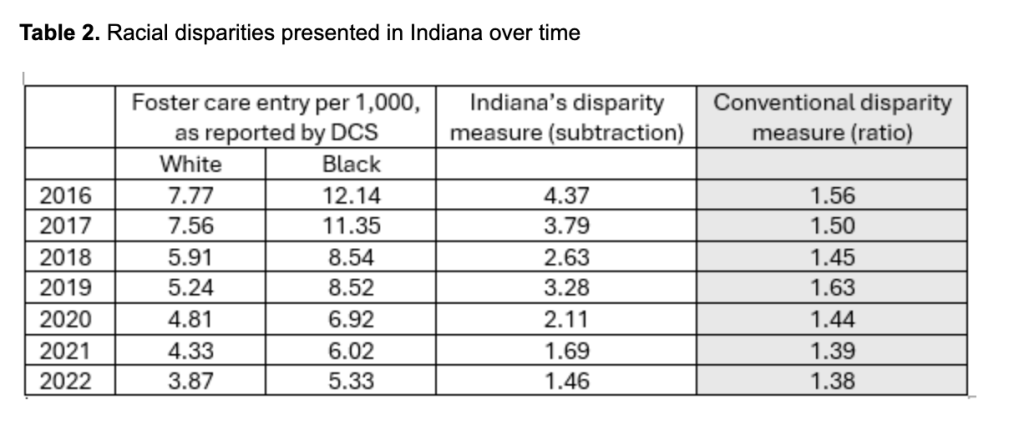
Rather, Indiana’s numbers were presented as the subtracted difference: the Black foster care entry rate minus the White foster care entry rate. The problem with this approach is that it is very sensitive to base rates. Imagine that rates of removal were 10 per 1,000 Black children and 1 per 1,000 White children, then those rates decreased to rates of 1 per 1,000 for Black children and 0.1 per 1,000 for White children. In both cases, the relative risk of removal is 10 times higher for Black children than White children (a 0% change in disparity). But using Indiana’s subtraction-based measure, it would appear that the disparity declined from 9 to 0.9: a 90% reduction. 

Using the conventional disparity ratio formula, the Black–White removal rate disparity declined only slightly in 2021–2022 compared with 2016–2017—a reduction of roughly 12%, not the “66.9% decrease” indicated in Reed’s testimony (see Table 2).

Summary

Available data do not support testimony that FFPSA implementation and Indiana’s Family Preservation Services program led to a 50% decline in foster care cases. Likewise, any reported improvements in child safety are likely an artifact of changed thresholds for classifying child maltreatment victims. We also believe that this testimony indicating dramatic reductions in racial disparities is quite overstated.

Of course, it is always possible that we have misunderstood the numbers Reed referenced—which is why we contacted him almost a year ago and shared our analysis. We received no response. If there is additional data that supports the testimony provided, we hope it will be made available. Until then, it is only reasonable to conclude that the striking claims made do not hold up to even modest scrutiny.

Note: On June 3, 2025, the IndyStar published an op-ed by Emily Putnam-Hornstein and Sarah Font summarizing the analysis in this post.

Notes

  1. Regarding data published by Indiana’s Department of Child Services, we relied on publicly available information published as of June 2024 to align with what would have been available at the time this testimony was prepared. We also used data submitted by Indiana and found in the annual Child Maltreatment Reports. We focused on trends from 2017 (before FFPSA) through 2023 (the most recent year available).
    ↩︎
  2. To elaborate, the intervention produced no “direct effect” on children entering foster care (i.e., no statistically significant reduction occurred in placements among families who were served). Published research has indicated that the intervention may have led to a small reduction in repeat maltreatment. To be generous, Indiana officials might argue that despite no direct effect on removals, the reduction in repeat maltreatment led to reduced removals over time. However, the estimated reduction in repeat maltreatment is only 4%, meaning that any indirect effects on removals cannot be more than this 4%. It is also worth noting that the declines in foster care caseloads began long before the program was implemented at any scale in Indiana. ↩︎

Figures and Tables

What is the cause of racial disparity in child welfare?

There is no doubt that Black children and families are reported to child abuse hotlines, investigated, and removed from their homes more than White children. But many leading voices in child welfare today have made the dubious assumption that racial bias in reporting and child protective services is the underlying reason for these disparities. Unfortunately, based on this assumption, they propose policy solutions that risk destroying existing protections for Black children or even for all abused and neglected children. A star-studded group of researchers has collaborated on a paper that ought to put this presumption to bed for good. I hope that this brilliant paper is able to change the minds of some who have unquestionably adopted the fashionable theory that is being promoted by the child welfare establishment.

There is no dispute that Black children are reported to authorities, investigated for abuse or neglect, and placed in foster care at a higher rate than White children. The federal publication, Child Maltreatment 2021, reports that Black children are nearly twice as likely as White children to be the subject of a screened-in report and almost twice as likely to be substantiated as a victim of child abuse or neglect. In 2020, Black children were 14 percent of the child population but 20 percent of the children entering foster care. Kim et al estimated that 53 percent of Black children will experience a CPS investigation by the age of 18, compared with 28 percent for Whites. But are these disparities greater than what would be expected given the higher rates of poverty and other social problems among Black children? That’s the question that a group of 13 researchers addressed in a recent article on racial and ethnic differences in child protective services reporting, substantiation and placement, published in the leading child welfare journal, Child Maltreatment. The authors include most of the top researchers in the field, such as lead author Brett Drake and his co-authors Richard Barth, Sarah Font, Emily Putnam-Hornstein, Jill Duerr-Berrick, and Melissa Jonson-Reid–an accumulation of starpower rarely seen collaborating on a single article.

Previous studies cited in the paper have already concluded that when adjusting for income and family context, Black children were actually reported to CPS at similar or slightly lower rates than White children and that Black children who are the subject of investigations were no more likely to be substantiated or placed in foster care than White children. Despite these results, the belief that racial disparities are due to anti-Black bias in reporting and child protective services (CPS) decisionmaking has been asserted as established fact in publications by the federal government, numerous child welfare groups, the American Bar Association, the American Civil Liberties Union and Human Rights Watch, and many media outlets. A report by a leading legal advocacy group and the Columbia Law School Human Rights Institute urged the UN to investigate the American child welfare system for racial discrimination. After conducting its own review, a UN Committee recommended that the United States “take all appropriate measures to eliminate racial discrimination in the child welfare system, including by amending or repealing laws, policies and practices that have a disparate impact on families of racial and ethnic minorities.” Rather than advocating for reform of child welfare systems, some individuals and organizations, such as upEND, press for the extreme step of abolishing the entire child welfare system.

The new paper provides a needed antidote to the certainty that racial bias is the principal source of racial disproportionalities in reporting, substantiations, and foster care placements, and provide compelling evidence against it. The authors use universal national data to ask two questions:

  1. Are Black-White and Hispanic-White disparities in CPS reporting lower than, similar to, or higher than disparities in non-CPS measures of social risk and child harm?
  2. Once referred and accepted for investigation, do Black or Hispanic children experience substantiation and removal into foster care at rates lower, similar or higher than White children?

The authors focused on Black, White and Hispanic populations. Native American populations, which are also disproportionately involved in child welfare, are difficult to study because many are served by tribal child welfare systems and may not be reflected in the national data that the authors use. The authors used CPS data from the National Child Abuse and Neglect Data System (NCANDS), which gathers information from all 50 states, the District of Columbia, and Puerto Rico about reports of child abuse and neglect and their handling by child welfare agencies. Data from certain states and years had to be eliminated because of data quality problems and missing data. The elimination of all data from New York and Pennsylvania is unfortunate, but it is unlikely that these omissions changed the overall trends. Data for income and other indicators of risk and harm came from the Census Bureau, the Kids Count Data Center, National Vital Statistics records, and the Centers for Disease Control.

Question One: Reporting Disparities

The authors posit that the “expected rate” of Child Protective Services (CPS) involvement for a particular group of children should be “the rate at which children in that population experience child abuse, neglect, or imminent risk thereof.” But the authors explain that we cannot actually observe the incidents of abuse or neglect, as they are not always reported to authorities. And when reports are made, the system may not always make the correct decision when it decides whether or not to “substantiate” or confirm the allegations made by the reporter. To estimate the “expected rate” of being reported to CPS, Drake and colleagues used several categories of risk and harm that are known to be highly correlated with the risk of child abuse and neglect. Indicators of “social risk” included the numbers of children in poverty, children in single parent families, teen birth rate, and adults without a high school degree. To indicate harm to children, the authors used “very low birthweight,” “very preterm births,” infant mortality, homicide injury, and “unintentional death.”

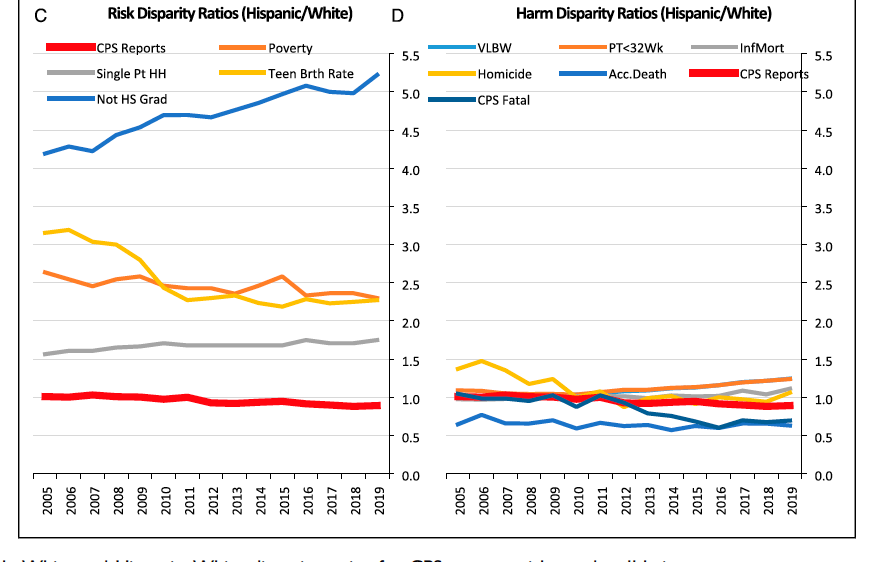
Drake and his colleagues calculated “disparity ratios (DR’s),” by dividing the incidence of social risk or harm for Black or Hispanic children by the rates for White children by year. They found that the DR’s for all the measures of risk, and all of the measures of harm except accidental deaths, were greater than the DR’s for CPS reports. In other words, there was a greater disparity in risk and harm to Black children than there was in CPS reporting. Thus, given their likelihood of being abused or neglected, Black children appear to be reported to CPS less than are White children.

The tables below illustrate the incidence of risk, harm and CPS reports for Black children compared to White children. While Black children were reported to CPS at a rate close to twice the rate of White children throughout the period studied, their poverty rate was three times that of White children in 2019, the proportion of Black children in single-parent households was 2.5 times as as that of Whites, and the disparity in the rate of single-parent households and adults without a high school degree was almost as great. In terms of harm, Black children were four times as likely to be a homicide victim in 2019, nearly three times as likely to have a very low birth weight, and more than twice as likely to die of maltreatment, in 2019.

Disparities in Substantiation and Removal

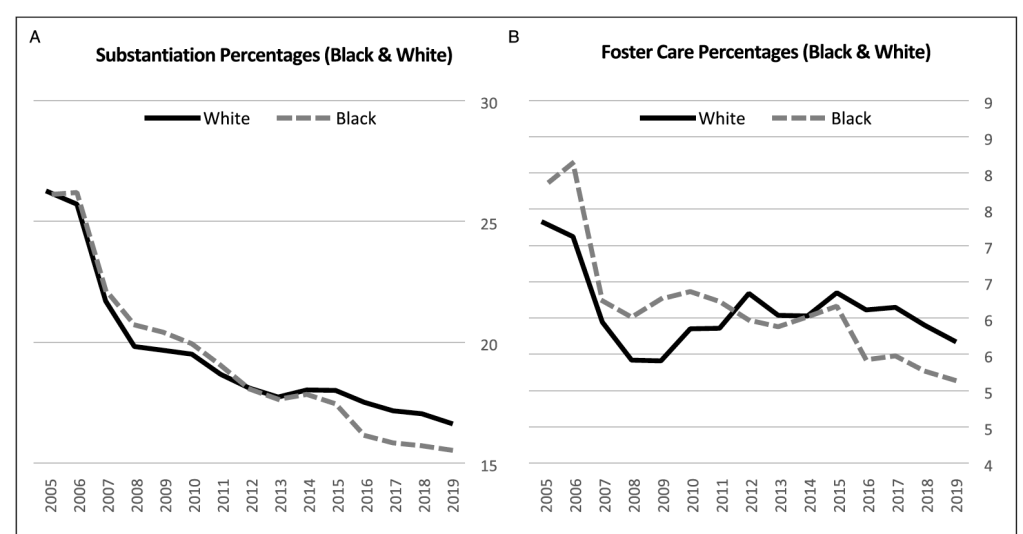
To address disparities in substantiation and removal following investigation, Drake and coauthors compared the raw data and also ran regressions to adjust for demographic factors that might affect placement, such as poverty. They found that in both adjusted and unadusted estimates, Black children, once investigated, have been less likely to be substantiated and placed in foster care in more recent years. Before 2011, Black children were slightly more likely to be substantiated and placed in foster care than White children before the trend reversed. The unadjusted estimates are shown below.

When they compared Hispanic children to White children, the authors found a very different pattern. While Hispanic children face much more exposure to social risks like poverty than White children, they experience harm and CPS reporting at about the same rate as White children. This pattern is consistent with what is known as the “Hispanic paradox.” This term describes a well-documented phenomenon in the child welfare and medical literatures wherein Hispanic children and families have indicators of well-being similar to their White non-Hispanic counterparts, despite having much higher indicators on risk factors like poverty. For Hispanic children, there were slightly greater unadjusted rates of substantiation and placement than for White children, but these differences disappeared when statistical controls were added.

Conclusions and Implications

The authors draw two primary conclusions from their research. First, “Black-White CPS reporting disparities were consistently lower than Black-White disparities in external indicators of social risk and child harm.” Black children were exposed to more risk and experienced harm at greater rates than White children, and these disparities were consistently greater than the disparities in reporting. If either group is overreported in relationship to their risk it is White children. It is still possible, the authors point out, that all children are overreported to CPS in relation to external indicators of risk and harm. But “if there is systemic overreporting, it is not specific to Black children and thus, unlikely to be driven by racial animus.” They also found no evidence that once investigated, Black children were disproportionately substantiated or placed in foster care.

Second, the authors found continued evidence for the “Hispanic paradox” in CPS reporting compared to observed risk exposure. Although Hispanic children face substantially greater social risks than White children, they experience harm and CPS reporting at about the same rate as White children. This supports the well-documented pattern whereby more recently immigrated Hispanic families, despite having higher risk factors, tend to have indicators of well-being similar to Whites.

In the authors’ own words:

It is indisputable that despite progress in certain areas, the United States has not overcome the legacy of slavery, segregation and Jim Crow. This legacy lingers most clearly in the patterns of segregation that emerge in many of our metro areas…To assert that these patterns, and the poverty and chronic stress they perpetuate, would have no impact on behavioral and psychosocial functioning among the individuals and families in those neighorhoods is to reject decades of scientific consensus on human development. Indeed, this history and its unresolved legacy is essential to understanding why Hispanic families face similar individual socioeconomic disadvatage but appear to have sigificantly lower rates of CPS involvment than Black children.

If I have one quibble with the authors of this brilliant and essential article, it is their lack of attention to the possile psychological impacts of intergenerational trauma from the history of slavery, Jim Crow, and racial hatred and violence. As the child of Holocaust survivors, I can attest that the six years of trauma that my parents suffered after the Nazis invaded Poland has affected me and even my daughter. For families in which nearly every generation going back almost 400 years suffered the trauma imposed by living within slavery, Jim Crow, or a culture of virulent and violent racism that continues in some form today, it would be surprising if there was no current mental health impact on the generation that is parenting children today. Such a impact might include elevated levels of mental illness as well as self-medication through drugs and alcohol, both of which are associated with child maltreatment.

In the section on Implications, the authors assert the need to address the factors that underlie the differing rates of risk and harm to Black children, outside the CPS system itself–factors such as poverty and racial segregation. The belief that abolition of child protections would in and of itself help Black children, the authors point out, relies not only the assumption that CPS is racially discriminatory, which this paper has debunked. It also relies on the assumption that CPS provides no protection to children. Certainly there is room for improvement in our child protection systems, particularly in the quality of care they provide to children removed from their homes. Yet, foster youth testimonies such as “being placed in a foster home saved me,” or “Using my voice is the reason I am no longer in a household that is broken,” as well as the silent testimony of the more than two thousand children who die of abuse and neglect every year,1 are a testament to the untruth of this statement.

The authors suggest three courses of action for the future. First, we should acknowledge and address the true drivers of racial inequity among families, such as multigenerational poverty, underresourced schools, and lack of access to quality substance abuse and mental health treatment programs. Second, despite their results, we must acknowledge that racial bias may exist in certain localities and be prepared to address it. And third, “there is clearly room to consider restructuring child and family policy generally to include a focus on providing preventive services, including material assistance, to families. (See my discussion of universal yet targeted programs to prevent child maltreatment.)

The authors go on to state that “It is possible that a narrow focus on reducing Black children’s CPS involvement without addressing the pronounced inequities documented by the external indicators will result in systematic and disproportionate unresponsiveness to abuse and neglect experienced by Black children.” And indeed, there are already reports that professionals are already more reluctant to report Black children and CPS employees are more reluctant to substantiate or remove them.2 Or to put it more bluntly, the standards for parenting Black children will be lowered, and the level of maltreatment that Black children are expected to endure before getting help will be raised. Ironically, this calls to mind some manifestations of racism that have been cited by scholars and advocates, such as treating Black children as if they are older than their actual age, and thinking that Blacks have a higher pain threshhold than Whites. Of course if the child welfare abolitionists have their way, the entire system will be abolished, destroying protections for all children. That is unlikely to happen, but what is more likely is a weakening or repeal of critical laws like the Child Abuse Prevention and Treatment Act or the Adoption and Safe Families Act, which are both currently under attack, to eliminate or weaken provisions like mandatory reporting.

Sadly, few leaders on either side of our increasingly polarized political scene will be open-minded enough to read, understand and accept the conclusions of this important paper. While the progressive mainstream (and even many others in the child welfare establishment) has blindly accepted the notion that racial bias is the primary driver of child welfare disparities, conservatives remain obsessed with reducing the size of government and cutting taxes, refusing to recognize the need for massive spending, even a domestic Marshall Plan, to rectify the result of centuries of slavery and anti-Black racism in America.

Notes

  1. States reported 1,820 child maltreatment fatalities to NCANDS in 2021. But experts cied by the National Commission to Eliminate Child Abuse and Neglect Fatalities (p. 9) estimate that the actual number is at least twice as many as that reported to NCANDS.
  2. See, for example, Safe Passage for Children of Minnesota, Minnesota Child Fatalities from Maltreatment, 2014-2022. The report authors found evidence that raised the question of whether Minnesota child welfare agencies may have tended to leave Black children in more high-risk situations for longer periods of time than children of other races and ethnicities. See also Stacey Patton, The Neglect Of 4 Texas Brothers Proves That The Village It Takes To Raise A Black Child Is The Same Village That Stands By And Watches Them Die, Madamenoire, November 2, 2021. She states that “To reduce the number of Black children entering into foster care as a result of abuse, child welfare professionals are increasingly “screening out” calls for suspected child abuse.  There haven’t been any state or national level studies to show whether disproportionately higher numbers of calls of Black child abuse are being screened out to avoid claims of racial discrimination.  However, in my work as a child advocate, I keep hearing stories of non-Black child welfare professionals who don’t report abuse because they either don’t want to be accused of racism, or they just accept that beating kids is an intrinsic part of Back culture.”