
A Home for Every Child: an inadequate framework for assessing state child welfare programs

On December 19, 2025, the Administration for Children and Families (ACF) released CFSR Technical Bulletin No. 14, the first step in its plan to replace the the existing process by which it reviews state child welfare performance with one that is less burdensome and more useful. The replacement is long overdue. But ACF’s attempt to reorganize all outcomes under one slogan–A Home for Every Child–is highly problematic. It disregards the need for larger homes for sibling groups and residential treatment for some young people. And it devalues and disincentivizes the central function of child welfare–protecting children from harm.

In an article in The Imprint called Why We Are Putting the PIP on a PIP, Alex Adams, the Assistant Secretary for ACF, explains the shortcomings of the Child and Family Services Reviews (CFSR’s), which are the periodic federal reviews of state child welfare systems to assess their performance and ensure they are in compliance with federal requirements. In 25 years, no state has been in substantial compliance with all the outcomes and systemic factors that are evaluated, and every state has been placed on a Performance Improvement Plan (PIP). Meanwhile, the administrative burden is heavy. Adams rightly states that “this is busywork–expensive, repetitive, punitive busywork–and it has not improved child or family outcomes.” I don’t think many child welfare stakeholders would disagree. It is time for the CFSR’s to be put out of their misery.

But what will replace the CFSR’s? As a first step to a solution, ACF has announced a pilot PIP process that states can opt to follow instead of the standard PIP procedure. As described in the Technical Bulletin, “this Administration is creating a pilot opportunity for states….to center their program improvement efforts around the A Home for Every Child goal.” Interestingly, the goal is not defined in the Technical Bulletin;1 the definition is found in several other places including a press release stating that “A Home for Every Child sets an ambitious goal of achieving a foster home-to-child ratio greater than 1:1 in every state. The initiative will focus on both sides of the equation — increasing the availability of safe homes through diligent recruitment, prioritizing kin, and improving retention of existing caregivers while reducing entries into foster care through effective prevention and faster pathways to permanency.” This sounds reasonable at first, but there are problems with centering program improvement planning around this goal–problems with the concept itself and with the implications of using it as an organizing principle in the assessment and improvement of child welfare performance.

A Flawed Concept

A Home for Every Child as a goal of child welfare seems to make sense on its face. To take a child into foster care when there is no place to put that child seems like folly, and a state that cannot equalize the supply and demand for foster care might need to rethink its rules about when to remove a child. But ACFs definition of that goal–one licensed home per foster child– makes no sense. Many foster homes can accommodate more than one child, and we need more larger homes to welcome sibling groups. And some young people in foster care need residential treatment before they can flourish in a foster home. For these reasons, child welfare administrators tend to use the concept of “beds” rather than “homes” when counting available placements for foster youth. What matters is not how many homes there are, but how many children can be accommodated in a placement that meets their needs. The two issues of multi-child homes and placements that are not foster homes are discussed below.

Foster homes with more than one child

As mentioned above, many if not most foster homes can accommodate more than one child. Many children come into care as part of sibling groups, and child welfare agencies hope to place as many of them together as possible. Despite their efforts, siblings are often separated in foster care for lack of homes that can accommodate them. We need more programs like Together California, a new community of 12 homes each built to house up to six siblings with full-time, professionally trained foster parents. Similar programs exist in Illinois, Florida and other states. Such homes could also be offered to relatives who are do not have room to take in larger sibling groups. The requirement of one home per child encourages states to focus on assembling as many foster homes as possible, rather than developing programs to keep sibling groups together.

Placements that are not foster homes

Secondly, A Home for Every Child should not include just foster homes. Most experts acknowledge that some children and youth need residential treatment before they can thrive in a foster home. Secretary Adams wrote in The Imprint that when the number of foster homes exceeds the number of children needing them, “[c]hildren avoid sleeping in offices or cycling through short-term rentals.” But most of the children sleeping in hotels, offices, short-term rentals, and other inappropriate placements have complex behavioral health needs and have been through many foster homes already. Media reports from California, Colorado, Hawaii, Illinois, Kentucky, Maryland, Massachusetts, Michigan, Missouri, New Mexico, North Carolina, Ohio, Oregon, Pennsylvania, Rhode Island, South Carolina, Tennessee, Texas, Washington, West Virginia, and Wisconsin document the preponderance of high-needs children among those in unlicensed, inappropriate placements.2 In Adams’ own state of Idaho, the child welfare agency under his leadership reported that short-term rentals were until recently used to “temporarily house children with complex needs.” Many of these high-needs young people need residential treatment, maybe for six months or a year, before they can live in a foster home. Otherwise, they will simply be bounced from home to home until they end up in another inappropriate placement or worse.

Unfortunately Adams gives short shrift to the need for residential treatment. He writes in The Imprint that “I saw firsthand the power of this ratio [of licensed homes to children] when I ran Idaho’s child welfare system. In just one year, Idaho increased from 74 to 104 foster homes per 100 children—eliminating emergency short-term placements, expanding kinship care, augmenting prevention services, improving licensing timeliness, reducing congregate care, lowering costs, and restoring public trust.” But the press release announcing the end of Idaho foster youth being placed in short-term rentals also credited the opening of a new 16-bed assessment center which “immediately reduced the department’s reliance on temporary housing.” The center is “designed to serve as a homelike setting for foster youth until an ideal placement in a foster home or residential treatment facility [my italics] is located.” Another such center is planned. So reducing the child-to-home ratio may have helped in closing the short-term rentals, but it certainly was not the only factor that allowed these rentals to be closed.

Moreover, Idaho is still struggling to find treatment for the youth with the most complex needs, the Idaho Press reported in October 2024, shortly before the last short-term rental closed. The article concluded that “Many of the youth require residential care for mental health, substance abuse disorder or other behavioral health issues, and there still isn’t enough of this treatment available in the state.” As of December 30, 2025, DHW reports having 173 children in “congregate care,”3 of which 32 were out of state.4 If Idaho is like most states, it is the lack of high-quality, trauma-informed residential treatment facilities, rather than foster homes, that is the main cause of the stays in inappropriate placements. The Family First Prevention Services Act defined a new option for providing such care–a Qualified Residential Treatment Program (QRTP). But based on a recent listing of residential facilities, Idaho appears to have only two QRTP’s. Having a goal like “A Home for Every Child” provides no incentive to develop the needed therapeutic placements for youth with complex needs.5

Equalizing the number of licensed homes with the number of children in foster care is an arbitrary goal that does not encourage the development of needed resources, like larger foster homes and residential treatment programs. But replacing it with a one-to-one ratio of available placement slots to youth is not a good idea either. A well-functioning system needs a sizable excess capacity, because existing vacancies may not be in the right geographical area or in the right type of placement for a child who comes into care. Moreover, many existing homes and residential treatment programs are probably substandard and should be closed.6 A Home for Every Child encourages states to maximize the number of homes, regardless of quality, capacity, or the need for residential treatment.

What about safety?

The ratio of homes to children can be improved in two ways, as ACF has stated: increasing the number of foster homes or decreasing the number of children in foster care. But the latter means taking fewer children into foster care. An easy way to do this is to redefine “safety” to make it harder to find a child unsafe. It appears that states have been doing this already, driving foster care numbers down to their lowest level in years and raising concerns about children being left in unsafe conditions in states as diverse as Washington, Texas, Indiana and New Jersey. As Naomi Schaefer Riley puts it, “foster care numbers are close to record lows and there are plenty of reasons to think that states are pushing them lower and sacrificing child safety in the process. If the federal government provides them with an excuse to double down on their plans to reduce the number of kids in care, many states will jump at the chance.”

The Technical Bulletin states that A Home for Every Child “provides a unifying construct that reflects the full continuum of good practice in child welfare—from prevention and family strengthening to permanency and post-permanency support—offering a cohesive framework for aligning state efforts with what works.” “From prevention to permanency” conveniently leaves out the screening and investigation of child maltreatment reports. With A Home for Every Child as the metric, the incentive is clearly to reduce entries into foster care regardless of trends in child abuse and neglect.

Some language in the Technical Bulletin suggests that other factors can be considered outside of the child-to-home ratio. States participating in the pilot must also include in their PIP’s “wraparound measures related to safety, permanency, and child and family well-being, such as adverse placement scores.” But the next sentence is “Wraparound measures should be chosen such that they will show performance improvement in areas that are expected to lead to improvements in the ratio of homes to child.” But, again, the only way child protective services can do that is reducing foster care removals. Clearly, A Home for Every Child does not center child safety.


The leadership of ACF is to be commended for seeking to reduce the burden imposed by the Child and Family Services Reviews. But the attempt to build a new quality review around a simplistic slogan like A Home for Every Child is not adequate for such a complex and serious problem as child abuse and neglect. It ignores the needs for larger foster homes to keep siblings together and for high-quality residential placements. It also creates an incentive to reduce foster care entries regardless of safety. One hopes that the current pilot will be succeeded by a more comprehensive approach that keeps safety in the forefront and recognizes the diverse needs of foster youth.

Note: After this post was published, Dr. Sarah Font of Washington University in St. Louis reminded me of another problem with A Home for Every Child. Many states rely heavily on unlicensed relatives to care for children who need placements. These states can greatly increase their count of licensed homes simply by licensing these relatives, without actually increasing the number of available placements.

Notes

  1. It does appear in the technical bulletin as an adverbial phrase in the following sentence: “In furthering efforts to achieve the 1:1 ratio of licensed foster homes to children in foster care, states will not be required to address every item or practice area identified in the CFSR Final Report.” ↩︎
  2. In New York, these young people are often sent to residential programs that are not equipped to provide the level of care that they need. ↩︎
  3. “Congregate care” is a term used, often pejoratively, to describe placements that are not foster homes. ↩︎
  4. Email from A.J. AJ McWhorter, Public Information Officer, Office of the Director |Idaho Department of Health and Welfare, December 30, 2025. ↩︎
  5. The Technical Bulletin does say that “The 1:1 ratio does not preclude states from pursuing placements outside of foster homes or from placing multiple children, for example, siblings, in one home but rather is intended to serve as an indicator spanning the full child welfare spectrum.” But the meaning of “intended to serve as an indicator spanning the full child welfare spectrum” is unclear. Placements outside of foster homes, or of more than one children in one home, do not count toward the goal of A Home for Every Child as defined by ACF. ↩︎
  6. This statement is based on my own personal experience in the District of Columbia and Maryland as well as personal accounts from youth around the country and media reports of abuse and neglect in foster care. ↩︎

The new Child Maltreatment 2021 Report: Did child maltreatment really decrease?

The federal government’s annual maltreatment report for 2021 was released on February 9, 2023, and the child welfare establishment is celebrating. New Child Maltreatment Report Finds Child Abuse and Neglect Decreased to a Five-Year Low, crowed the Administration on Children and Families (ACF). “Number of Abuse and Neglect Victims Declines Again,” trumpeted The Imprint, a journal that typically reflects the prevailing voices in child welfare today. Left for the body of the ACF press release (and totally omitted by The Imprint) was the fact that in 2021 the nation was still in a pandemic that kept many schools closed for much of the year, and that child maltreatment “victimization” reflects jurisdictions’ policy and practice much more than it reflects actual maltreatment. Thus, there is no reason to celebrate a decrease in child maltreatment based on this report.

Child Maltreatment 2021 , the latest edition in the annual series from the ACF, combines data from the 50 states, the District of Columbia and Puerto Rico about the number of reports or children involved in each stage of the child welfare system in Federal Fiscal Year (FFY) 2021, which ran from October 1, 2020 to September 30, 2021. The data are obtained from the National Child Abuse and Neglect Data System (NCANDS), a national data collection program run by the Children’s Bureau under ACF. Arizona did not submit data in time to have its data included in this report, so only 49 states are included in this year’s report, along with the District of Columbia and Puerto Rico. Commentaries from most of the states regarding policies and conditions that may affect their data are attached in an appendix. The report’s findings are summarized in Exhibit S-2. All of the figures in this post are taken from the report.

A family’s journey through the child welfare system starts with an initial report, known as a “referral.” Figure 2-D below shows that the total number of referrals (the purple line) rose between 2017 and 2019, dropped sharply in the wake of the Covid pandemic in 2020, as schools closed and many families isolated at home, and increased only slightly in FFY 2021. It is important to remember that in FFY 2021, which began in October 2020, many schools were still closed. Most schools opened over the course of FFY 2021, but some remained closed the entire year. Thus, reporting from school personnel was suppressed for the federal fiscal year.

The rate of referrals as a portion of the child population varied greatly by state. Table 2-1 of the report shows that the total referral rate per 1,000 children in 2021 ranged from a low of 17.8 in Hawaii to a high of 137.0 in Vermont in 2021. Such differences exist every year and reflect factors such as public opinion and knowledge of child maltreatment reporting, as well as state practices. Some states do not even report most referrals to NCANDS, as described in the state commentaries. Pennsylvania has a unique system in which most reports that are not for abuse are classified as “General Protective Services” and not reported to NCANDS. Similarly, Connecticut does not report referrals receiving an alternative (non investigation) to NCANDS. In 2021, state-to-state differences may also reflect how soon in-person schooling resumed in the state after the pandemic. Vermont reported in its commentary that it has been receiving more referrals for concerns that do not reflect maltreatment. Vermont also included several reasons for its high referral rate, including the fact that reports on multiple children in the same family are counted separately. Kansas reported a decrease in reports due to “engaging communities to focus on prevention.”

Once a referral is received, it can be screened in or out by agency hotline or intake units. In general, agencies screen out referrals that do not meet agency criteria, which vary by jurisdiction. Reasons for screening out a referral may include that it does not meet the definition of child abuse or neglect, that not enough information is provided, that another agency should more appropriately respond, or that the children being referred are over 18. Despite receiving slightly more referrals than the previous year, child welfare agencies screened out a larger proportion of them in FY 2021, resulting in a slight decrease in screened in referrals (known as “reports“), from 2020 to 2021 – the blue line in Exhibit 2-D. In the 46 states that provided both data points, 51.5 percent of referrals were screened in and 48.5 percent were screened out.

There is great diversity in the proportion of referrals accepted by states. The percentage of referrals that was screened-in ranged from 15.3 in South Dakota to 98.5 percent in Alabama.1 There are many reasons for these variations, mostly associated with differing policies and practices between jurisdictions. For example, Georgia mentioned in its commentary that after hotline calls increased in 2021, it adjusted screening criteria to screen out more of them. Indiana tried to reduce its screen-in rate by changing criteria related to sexual behavior among teens and preteens, marijuana use by children, and educational neglect. Kansas reported a decrease in reports due to a change in the screening process for educational neglect. Missouri, on the other hand, changed screening criteria to screen in more referrals out of concern for children isolated because of the pandemic.

In FFY 2019, teachers were the most common source of referrals, submitting 21 percent of all referrals. They lost that position in FFY 2020 with the pandemic school closures, while legal and law enforcement personnel increased their share of reports. Perhaps it is not surprising that teachers did not recoup their leading role in 2021, since many students were still attending school virtually for some part of the year. Teachers actually submitted a smaller proportion of referrals in 2021 (15.4 percent) than in 2020 (17.2 percent). It is possible that teachers were making more calls but that more of these calls were being screened out than in the year before. But since ACF does not show the distribution of all referrals by reporting source, one cannot use this data to test that hypothesis.

Investigations

In Chapter 3 of Child Maltreatment 2021 the focus shifts from the referral or report to the child. ACF estimates that 3.016 million children or 40.7 children per 1,000 in the population received an investigation or alternative response2 in 2021. This was a slight decrease over 2020, when 42.0 per 1,000 children received an investigation or alternative response. These rates varied greatly by state, from a low of 12.8 per 1,000 in Pennsylvania to a high of 129.8 in West Virginia. The low in Pennsylvania is not surprising due to its unique system in which most neglect referrals are not reported to NCANDS. But Maryland and Hawaii also investigated small proportions of children– 15.7 and 15.9 per 1,000. These investigation rates reflect the number of referrals and how many were screened in, as well as the number of children per referral.

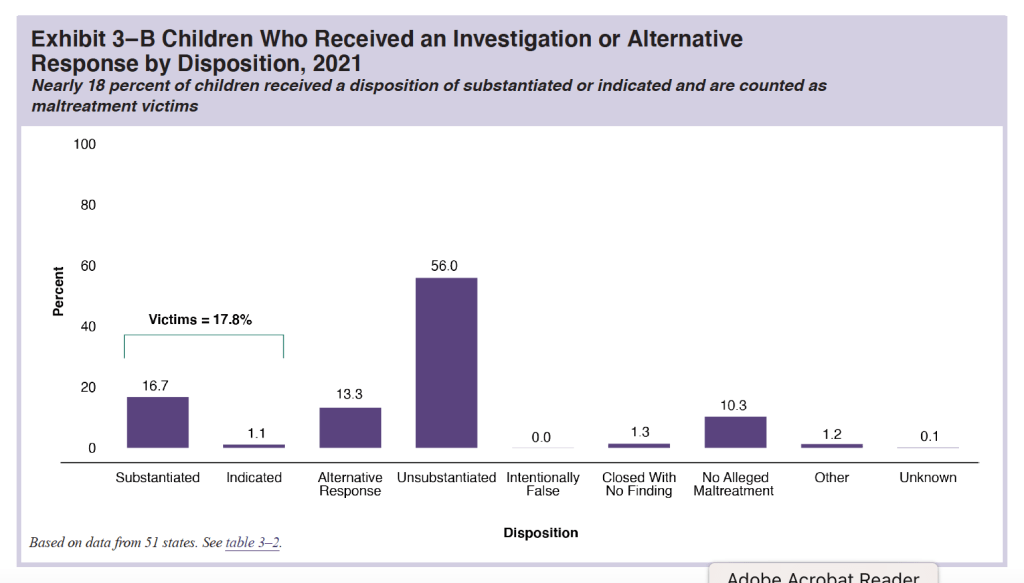
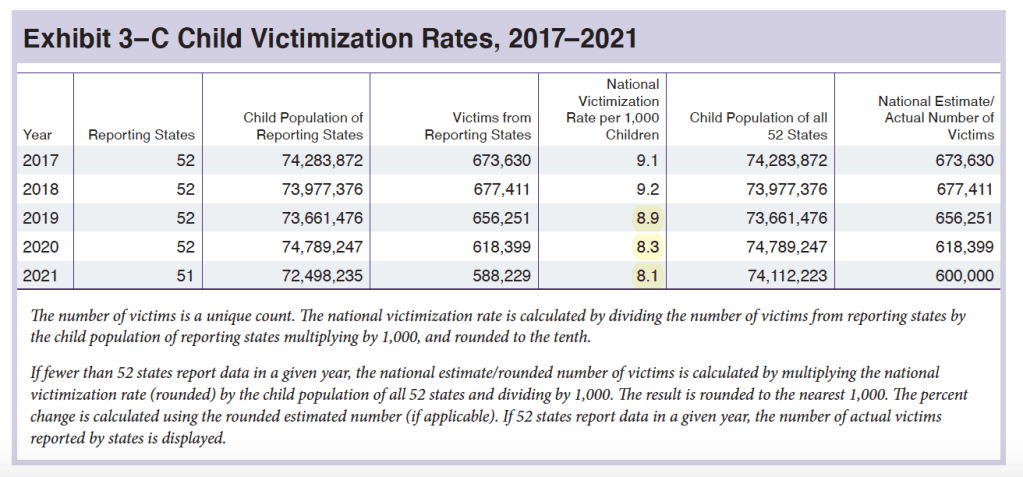
ACF found that of the children who received an investigation or alternative response, 16.7 percent were found to be victims of child abuse or neglect, as shown in Exhibit 3-B.3 The remaining children were not determined to be victims or received an alternative response. Estimating for missing data from Arizona, ACF calculated a national “victimization rate” of 8.1 per 1,000 children. As Exhibit 3-C shows, this rate has been decreasing since 2018 but the greatest decrease was in 2020 with the arrival of the pandemic.

ACF’s use of the term “victimization” can be misleading. An investigator’s decision about the truth of an allegation is based on limited information and is constrained by available time and staff, and evidence indicates that many referrals are unsubstantiated when maltreatment actually exists. Moreover, these rates are dependent on state policies and practices. Because of the misleading nature of the term “victimization,” the term “substantiation” is used for the rest of this commentary. State substantiation rates per 1,000 children ranged from 1.6 in New Jersey (even lower than Pennsylvania’s 1.8) to 17.0 in West Virginia, suggesting that these rates reflect much more than the prevalence of child abuse and neglect.

Among the many factors that can influence state substantiation rates are:

  • Differences in referral rates and screening practices, as decribed above;
  • Different policies about what is considered child maltreatment and different levels of evidence required to substantiate an abuse allegation;
  • Whether and how much a state uses an alternative (non-investigation response);
  • Natural and social disasters that may vary in their impact between states. Some states went back to in-person schooling for the entirety of 2021, others opened midyear, and others were virtual almost all year. West Virginia, with the highest substantiation rate, has been particularly hard-hit by the opioid epidemic. The state has the highest overdose mortality rate in the nation;
  • Differences in the messages coming from an agency’s leadership about the relative importance of child safety versus family preservation;
  • Variations in the use of kinship diversion, the practice of placing children with a relative without court involvement or case opening. If this happens before the investigation is completed, it may result in an “unsubstantiated finding.

All of these factors can change over time, affecting substantiation rate trends from year to year. It is clear that nationwide, the COVID-19 pandemic continued to suppress reports to CPS hotlines, and therefore investigations and maltreatment findings, in 2021. But the effect of the pandemic differed greatly between states: it appears that some states had more in-person days of school in 2021 than in 2020, and others had less. Additionally, several states described changes in their screening practices in 2021, usually to screen in fewer referrals. Delaware and Washington mentioned an increase in reports diverted to differential response as a reason for declining substantiation numbers in FFY 2021. The emphasis on prevention as an alternative to intervention has been increasing in most states, perhaps affecting the likelihood of substantiation. It is possible also that increases in kinship diversion may have reduced substantiation rates: there is no data to prove or disprove this, but concern over this practice is certainly growing.

To state that maltreatment decreased between 2020 and 2021 is to ignore that “maltreatment victimization” is not a measure of actual abuse and neglect. It is the result of a winnowing process that starts even before a referral arrives. At each stage, the numbers remaining may depend on a wide variety of factors, including policy, practice, natural and man-made disasters and more. The vast differences between state data on referrals, reports, investigations and substantiations shows how unlikely it is that the total number of children found to be victims of maltreatment reflects the actual number of maltreated children, and how irresponsible it is to suggest this might be the case.

A note on Child Fatalities

Last year, ACF used a decline in fatalities due to child maltreatment to headline its press release, Child Fatalities Due to Abuse and Neglect Decreased in FY 2020, Report Finds. This year, the number of child abuse and neglect fatalities reported by states increased slightly, a rise that was not the subject of a headline by ACF. Whether there is a small increase like this year or a decrease like last year means very little, for several reasons. As ACF explains, these child fatality counts reflect the federal fiscal years in which the children were determined to have died of maltreatment, which may be different from the year the child actually died. Such determinations may come much later due to the time it takes to complete a death investigation. For example Alabama reported that for the fatalities reported in FFY 2021, the actual dates of death were between FFY’s 2016 and 2021. Michigan even reported that its child fatality data included the child abuse death of twins in 2003 which was revealed by a cold case investigation.

A second problem with the fatality estimates is that they are widely believed to be too low. One reason is that many states report only on fatalities that came to the attention of child protective services agencies. As the report’s authors point out, many child maltreatment fatalities do not become known to agencies when there are no siblings or the family was not involved with the child welfare agency. Moreover, some fatalities resulting from abuse or neglect are labeled as due to accident, “sudden infant death syndrome,” or undetermined or unknown causes because insufficient evidence was found. I recently reviewed the child fatality review report produced by the District of Columbia’s Child and Family Services agency (CFSA). CFSA relied on the decisions of the medical examiner, which chose not to classify as maltreatment deaths an infant who died after a mother who was high on PCP rolled on top of him when sleeping with him in the same bed (counted as “unknown); a baby left on his stomach with a bottle in his mouth when his mother left the apartment (counted as “undertermined); a child who was shot to death by gunmen trying to kill her father, involved in the violent drug trade, outside a liquor store at 11:00 PM (“non-abuse homicide”), and a child who died of an untreated bacterial infection and had beating injuries diagnosed by doctors as due to abuse (“undetermined”). The total number of maltreatment fatalities was estimated at only three for the District in CY 2021, not including those four deaths. Some researchers suggest that the actual number of abuse and neglect fatalities may be as much as twice or three times that given in the Child Maltreatment reports,4 and the District of Columbia data suggest this may well be the case.

Notes

  1. This leaves out three states that are listed as screening in 100 percent of referrals: Illinois, New Jersey and North Dakota. Both Illinois and New Jersey explained in their state commentaries that reports must meet certain criteria to be accepted for investigation, so it is not clear why they responded that they screen in 100 percent of referrals. North Dakota actually screens in all referrals, but that is more semantic than real. Reports that do not meet agency criteria for a report of suspected chlid abuse or neglect are categorized as receiving an “administrative assessment,” and are not investigated. North Dakota does not report the number of referrals receiving an “adminnistrative assessment;” hence the reports that 100 percent of cases are screened in. It is unclear why New Jersey and Ilinois provided this figure of 100 percent but the reason may be similar.
  2. Alternative response is, as defined in NCANDS, the “provision of a response other than an investigation that determines if a child or family needs services. A determination of maltreatment is not made and a perpetrator is not determined.”
  3. NCANDS defines a “victim” as “a child for whom the state determined at least one maltreatment was substantiated or indicated, and a disposition of substantiated or indicated was assigned for a child in a report.” “Indicated” is defined as a disposition that concludes that maltreatment could not be substantiated under state law or policy, but there is a reason to suspect that at least one child may have been maltreated or is at risk of maltreatment.”
  4. Herman-Giddens, M. E., et al. (1999). Underascertainment of child abuse mortality in the United States. JAMA , 282(5), 463-467. Available from http://jama.jamanetwork.com/article.aspx?articleid=190980. Also, Cotton, E. E. (2006). Administrative case review project, Clark County, Nevada: Report of data analysis, findings and recommendations. Crume, T. L., DiGuiseppi, C., Byers, T., Sirotnak, A. P., & Garrett, C. J. (2002). Underascertainment of child maltreatment fatalities by death certificates, 1990-1998. Pediatrics, 110(2). Abstract available from https://pubmed.ncbi.nlm.nih.gov/12165617/. Herman-Giddens et al. estimate actual child abuse and neglect deaths to be as high as three times the national reported amount; Cotton et al. and Crume et al. found the actual number of deaths to be twice that reported.

Declining child abuse? The misuse of data in child welfare

Lowest number of maltreatment victims in five years, crowed the Administration on Children and Families (ACF), summarizing its annual report, Child Maltreatment 2019. Child welfare newsletter The Imprint eagerly repeated the claim, claiming that the Number of Child Abuse and Neglect Victims Reached Record Low in 2019. The venerable Child Welfare League of America followed suit in its Children’s Monitor saying “Data Shows Decline in Child Abuse in FY2019.” It is only by reading the report that one learns that the decline was not actually in the number of victims of abuse or neglect. Instead, it was a decline in the number of children who were found by Child Protective Services (CPS) to be abused or neglected, which is not the same thing at all.

Child Maltreatment, the Children’s Bureau’s annual report on child abuse and neglect, is based on data from the states, the District of Columbia, and Puerto Rico collected through the National Child Abuse and Neglect Data System (NCANDS). Child Maltreatment 2019 is based on data from Federal Fiscal Year (FFY) 2019, which ended September 30, 2019. (Note that these data reflect the year before the inception of the coronavirus pandemic.) Displayed below is a summary of four key national rates reported by ACF between 2015 and 2019. The first indicator shown is the referral rate, which describes the number of calls and other communications describing instance of child maltreatment per 1,000 children. Next is the screened-in referrals rate, which includes referrals that are passed on for investigation or alternative response. Once screened in, only some reports are referred for investigation, and the third set of bars represents children who received an investigation per 1,000 children. The fourth group shows the rate of children found to be abused or neglected–or those who received a substantiation. Let us go over these numbers in more detail.

*Note that Investigation and Substantiation Rates are based on number of children, not referrals
Source: Child Welfare Monitor tabulation of data from Child Maltreatment 2019, available from
https://www.acf.hhs.gov/sites/default/files/documents/cb/cm2019.pdf

Total referrals: A referral is a call to the hotline or another communication alleging abuse or neglect. In 2019, agencies received an estimated total of 4.4 million referrals, including about 7.9 million children. The “referral rate” was 59.5 referrals per 1,000 children in FFY 2019. This rate has increased every year since 2015, when it was 52.3 per 1,000 children. It is worth noting that the referral rate differs greatly by state, ranging from 17.1 referrals per 1,000 children in Hawaii to 171.6 per 1,000 children in Vermont, as shown in the report’s state-by-state tables. These differences in referral rates may stem from cultural differences regarding the duty to intervene in other families, differences in publicity for child abuse hotlines and ease of reporting, or temporal factors like a recent highly-publicized recent child abuse death.

Screened-in referrals (reports): A referral can be either “screened in” or screened out because it does not meet agency criteria. In FFY 2019, agencies screened in 2.4 million referrals, or 32.2 referrals per 100,000 children. This was a decrease in the rate of screened-in referrals per 1,000 children after three straight years of increases. This percentage of referrals that were screened in varied greatly by state, ranging from 16 percent in South Dakota to 98.4 percent in Alabama. States reporting a decrease in screened-in referrals gave several reasons, such as a change in how they combine multiple reports and a decision to stop automatically screening in any referral for a child younger than three years old.

Children who received an investigation (child investigation rate): Once a report is screened in, it can receive a traditional investigation or it can be assigned to an alternative track, which is often called “alternative response” or “family assessment response.” (Two-track systems are often labeled as “differential response.”) This rate represents the number of children who received an investigation as opposed to an alternative response. Only an investigation can result in a finding of abuse or neglect; an alternative response generally results in an offer of services. Like the referral rate, the investigation rate increased from 2015 to 2018 and then decreased in 2019. This rate also varies widely between states and over time. Some states eliminated or expanded their differential response programs in 2019, resulting in more or fewer investigations, as described in the report.

Substantiation: A “victim” is defined in NCANDS as a “child for whom the state determined at least one maltreatment was substantiated or indicated; and a disposition of substantiated or indicated was assigned for a child in a report.” The report’s authors refer to the number of such children per 1,000 as the “victimization rate.” But clearly substantiation does not equal actual victimization. The difficulty of making a correct decision on whether maltreatment has occurred is well-documented. Stories of families with repeated reports that are never substantiated or not confirmed until there is a serious injury or even death are legion. So are reports of parents wrongly found to be abusive or neglectful. Therefore, we have chosen to use the term “substantiation rate” instead of ‘victimization rate.” This rate varies greatly by state, from 2.4 per 1,000 children in North Carolina to 20.1 in nearby Kentucky.[1] The national substantiation rate in FFY 2019 was 8.9 per 1,000 children, down from 9.2 per 1,000 in FFY 2019 and FFY 2015. States reported a total of 656,000 (rounded) victims of substantiated child abuse or neglect in FFY 2019–a decline of four percent since 2015.

So does this decline in the number and rate of substantiations really connote a decline in child abuse and neglect? The range in substantiation rates among states argues against this idea. Unless states differ by almost a factor of 10 in the prevalence of child abuse and neglect, these numbers must reflect factors other than the actual prevalence of maltreatment. And indeed the report’s authors acknowledge that “[s]tates have different policies about what is considered child maltreatment, the type of CPS responses (alternative and investigation), and different levels of evidence required to substantiate an abuse allegation, all or some of which may account for variations in victimization rates.” Changes in these policies and practices can account for changes in these rates over time. Moreover, changes in all the earlier stages of reporting, screening, and assignment to investigation or alternative response contribute to changes in the substantiation rate. In 2019, screened-in referrals and investigations per thousand-children both decreased, which clearly contributed to the decrease in the substantiation rate.

It is interesting to note that while referrals increased every year between FFY 2015 and FFY 2019, both screened-in referrals and investigations decreased in FFY 2019. This suggests a general tendency among states to be less aggressive in responding to allegations of maltreatment, perhaps in accord with the prevalent mindset among child welfare leaders nationally and around the country, as discussed below.

Understanding the difference between “victimization” and “substantiation” and the many possible causes of a decrease in this rate reveals the deceptiveness of ACF’s statement that “[n]ew federal child abuse and neglect data shows 2019 had the lowest number of victims who suffered maltreatment in five years.” Lynn Johnson, the HHS assistant secretary for children and families, is quoted in ACF’s press release as saying that “[t]hese new numbers show we are making significant strides in reducing victimization due to maltreatment.” Unless Johnson and the ACF leadership intended to mislead, it appears they are woefully ignorant of the meaning of these numbers.

Most regular leaders of this blog already know why ACF wants to support the narrative of declining child maltreatment. The current trend in child welfare policy, regardless of political party, is to oppose intervention in families. Republicans who oppose government spending and interference in family life have made common cause with Democrats who think they are reducing racial disparities and supporting poor poor families by allowing parents more freedom in how they raise their children, even if it means leaving children unprotected. Members of both parties came together to pass the Family First Act, which encoded this family preservation mindset into federal law.

Child Welfare Monitor has pointed out many other instances where ACF or by other members of the child welfare establishment in the interests of supporting the family preservation mindset. For example, we wrote about the Homebuilders program, which was classified by a federally-funded clearinghouse as “well-supported” despite never having been proven effective for keeping families together. In fact, Homebuilders had to be classified as well-supported because it was one of the key programs touted by ACF and others in promoting the Family First Act and other policies promoting family preservation.

So if ACF’s “victimization” data do not in fact tell us what is happening to abuse and neglect rates, what else is available? We call on Congress to pass an overdue re-authorization of the Child Abuse Prevention and Treatment Act and include a fifth National Incidence Study of Child Abuse and Neglect. Data for the last study was collected in 2005 and 2006; it is high time for an update which should put an end (at least temporarily) to the misuse of NCANDS data as an indicator of trends in child maltreatment.

President Biden has called for ending a “culture in which facts themselves are manipulated and even manufactured.” We hope that ACF under its new leadership, as well as the rest of the child welfare establishment, will take these words to heart and commit themselves to truth and transparency from now on.

[1]: Pennsylvania has a substantiation rate of 1.8, even lower than that of North Carolina, but in Pennsylvania, many of the actions or inactions categorized as “neglect” are classified as “General Protective Services” and not included in the substantiation rate, making its data not comparable to that of the other states and territories.

[2]: Massachusetts did not provide data on FFY 2019 child maltreatment fatalities.