
by Sarah Font (Washington University in St. Louis) and Emily Putnam-Hornstein (University of North Carolina at Chapel Hill)
I am honored to publish this post by two of the leading academic researchers in child welfare. They are also the Principal Investigators of the Lives Cut Short project, which documents child abuse and neglect fatalities around the country.
Armani Evans. Zemar King. Leviathan Froust. These are just three of Wayne Countyโs children who have been killed by their caregivers in recent years. Wayne County is the home of Michiganโs largest city, Detroit.
As part of the Lives Cut Short project, which aims to document child abuse and neglect fatalities nationwide, we requested and reviewed the Wayne County Medical Examiner records for child deaths since 2022. At least 52 children died due to abuse or neglect in the last 3.5 years, accounting for more than 1 in 10 of all child deaths in the county. Nearly two-thirds of child maltreatment deaths involved children ages 3 years and under.
At least nine children under the age of 3 died of illicit drug poisonings โ involving fentanyl, heroin, and methamphetamine.
Equally disturbing, more than half of the child maltreatment deaths โ 27 โ involved intentional injury rather than negligence: children who were shaken, stabbed, beaten, and smothered. Many young childrenโs deaths received no media attention โ all that is known is that they were killed by homicide, with the injury description merely stating โfound beaten.โ
The 52 children who died of maltreatment in Wayne County are likely the tip of the iceberg โ these deaths are challenging to identify due to limitations in the death investigation process, minimal release of information, and other factors.
What would prevent children from dying at the hands of caregivers and family members?
Wayne County recently announced an expanded partnership with RxKids to provide thousands in no-strings-attached cash to all new and expectant mothers in 6 cities within the county. The countyโs $7.5 million investment adds to a statewide investment of $250 million in RxKids for 2025-2026 alone. The governorโs FY2026 budget recommendation further includes $27 million to provide โeconomic and concrete supportsโ with the goal of reducing or avoiding involvement with Child Protective Services.
The leaders of RxKids imply on their website and other materials that their cash transfers can produce a large decline in child maltreatment and reduce the need for CPS intervention. Fortunately, a rigorous evaluation of the program was conducted in Flint.
The punchline? No impact.
Such findings should come as little surprise when we take seriously the threats that children face. Neither drug addiction nor extreme violence seems likely to be ameliorated with short-term monthly checks. And many children died after CPS ignored clear warning signs. A wrongful death lawsuit filed on behalf of murdered Detroit toddler Chayce Allen reveals that relatives asked CPS to intervene on at least 13 occasions.
The likely reason so many kids are left to die in horrifying circumstances is that Michigan has a severe shortage of child protection caseworkers. Statewide vacancy rates are 20% and the problem is worse in Wayne County, which has 46 fewer caseworkers than intended, leading to high caseloads and turnover. High caseloads were one of the systemic problems that the state was expected to address as part of the Dwayne B. settlement โ a case filed nearly two decades ago. Michigan seeks to exit court supervision as soon as this summer, despite their continued failure to adequately staff their system.
Before massive expansions of cash assistance โ much of which is going to families who are not impoverished โ perhaps the state should fulfill its existing obligations to kids.
Note: some deaths handled by the Wayne County Medical Examiner may stem from incidents occurring in surrounding counties (from which children were brought to and then died at a Wayne County hospital).ย Our data do not provide the location of the maltreatment incident.
This summer, I was asked by a reporter to comment on a terrible case in the District of Columbia. Twenty-month old Kemy Washington died of starvation and dehydration, after her mother had had overdosed on a mix of MDMA, cocaine, ethanol and the animal sedative xylazine. An older sibling had been removed from Kemy’s mother due to her neglect and that child’s guardianship with a relative had been ratified only days before Kemy was born. Yet, Kemy was never on the radar screen of the Child and Family Services Agency until her grandmother made two calls, which were apparently screened out as not involving child abuse or neglect. When I read the more than 600 comments on the article, I was struck that over and over again, commenters asked the same question. How is it that a mother who had a previous child removed from her due to neglect could give birth to another child without triggering an investigation, close monitoring, or even removal of the child? The reporter asked me the same question and I explained that such a policy, though clearly logical to members of the community, would never be accepted by the current child welfare establishment, where it would be viewed as an unacceptable infringement on parents’ rights.
I have often remarked on situations where child welfare policy or practice departs from general community norms. Whether it is the continued screening out of calls on the same family, even if a child was previously removed; the refusal to consider policies that would trigger investigations when a new child is born to a parent who committed severe abuse or neglect; the push to “reunify” children with parents who have proved over and over again that they cannot keep them safe or even stop harming them, it seems that policymakers and practitioners of child welfare are operating from a different set of norms than the public. What would be clear to a grandparent, a neighbor, or a random layperson do not seem so evident for those who are charged with protecting our children. This was made very clear in a devastating report on child fatalities in Minnesota. As the authors put it,
Members of the public often express dismay and outrage to us over stories such as those recounted in this report. We infer from this that the professional norms currently guiding child protection and foster care are out of alignment with those of the broader community.
Examples of this divergence abound, and I am sharing just a few here.
“B.B.” was born in the State of Washington in 2022 and died of fentanyl poisoning in March, 2023. Starting in 2014, the Department of Children, Youth and Families (DCYF) had received 30 reports about B.B.’s family for the use of heroin, marijuana and alcohol in the home; lack of supervision of the children; domestic violence; an unsafe adult living with the family; an unsafe and unclean physical environment; unsecured guns in the home, “out-of-control” behaviors by B.B.’s older siblings at school to which the mother was unresponsive, seeming “out of it;” concerns about the children’s hygiene; and the mother driving under the influence of marijuana. A few days before B.B.’s death, a caseworker told B.B.’s mother that the agency was closing a voluntary services case that had been open for about half a year. But the family was already under investigation again at the time B.B. died.
There have been multiple cases around the country of child protection workers disregarding reports of hungry children eating food from the floor or the garbage, until a child finally died or escaped from the torturers. School staff in Utah reported making at least four calls in the 2022-2023 school year (confirmed by a timeline released by DCFS) to CPS alleging that Gavin Peterson was always hungry and eating food from the trash. School staff were buying his lunch but had to stop after his father and stepmother forbade it. One school staffer “said Gavinโs father and stepmother justified Gavinโs small frame and constant desire for food as side effects from his medication, but she didnโt buy it.” Why did CPS? That summer, Gavin was withdrawn from school. A year later he was dead after years of starvation and beatings.
Seven-month-old Emmanuel Haro is missing and presumed dead. Investigators believe that he was abused for an extended period of time before he was killed. But his suffering and death could have been avoided. His father had been arrested for abusing a child from a previous marriage in 2018–abuse so serious that the child is now bedridden. A simple “birth match” policy could have prevented the death of Emmanuel Haro. If birth records were linked to criminal and CPS records, Emmanuel’s birth could have triggered a mandatory investigation and monitoring because the father had been convicted of child abuse–the kind of policy that commenters in the Kemy Washington case were asking for. It is hard to think of a more common-sense idea than birth match. Yet, only five states had such a policy in 2022, according to my report on birth match for the American Enterprise Institute. And most of these programs are very limited both in terms of which parents are covered and of the state response.
Even a birth match policy would not help in cases where a parent’s violent history is known but disregarded. Four-year-old Rykelan Brown died from a beating by his father, Joshua Emmons, in May 2024, two months after he was removed from a loving foster home to be placed with Emmons. The foster parents had repeatedly reported that Rykelan came home from visits with his father bruised and saying his father hit him and he never wanted to go there again. The local Department of Social Services knew that in 2019 Emmons had beat his then-girlfriend’s three-year-old son so severely that he damaged the child’s liver, which must now be checked regularly. But the social services commissioner told an interviewer that the event occurred too long ago to be considered. Really? Even when paired with Rykelan’s bruises and reports of beatings?
As the above examples show, some things that are intuitive to ordinary people – -like that a child going to school hungry (and not because of poverty) – is a sign that something is deeply wrong at home–seemed to be missed by people engaged in child welfare practice, administration and policymaking. Much of the problem stems from a dominant ideology that preaches that abused and neglected children are almost always better off with their own families. The same viewpoint holds that what child welfare calls neglect is just poverty, as if all poor parents neglect their children, and that child welfare is a a racist system that was created to destroy Black and Brown families.1 Social work schools have adopted and promulgated these positions and agencies have incorporated them in the training for new social workers. Deep-pocketed groups like Casey Family Programs have used their money to foster this ideology through training and technical assistance to state and local agencies. The entire child welfare community in many states has found itself endorsing policies and practices that defy common sense thinking.
We must bring child welfare policy and practice back into alignment with community norms. But that is easier said than done. The public pays little attention to child welfare until there is a tragic fatality or egregious incident that is covered in the media. But many of these cases are never known to the media and therefore to the public. And even when they are, child welfare agencies often refuse to release information about their past involvement with the family, in violation of federal law. So the press, the public and legislators cannot identify what went wrong and what would be needed to prevent future tragedies in the future.
A small but useful first step to align child welfare systems with community norms would be to make the public aware of decisions that clearly violated these norms and harmed children. The federal government should enforce the requirements of the Child Abuse Prevention and Treatment Act (CAPTA), which as interpreted in the federal Child Welfare Policy Manual, requires states to issue specific information and findings on all child maltreatment fatalities and near fatalities caused by maltreatment. That includes information about past dealings between the children’s families and the child welfare agency. Ultimately, the requirement must be expanded to cover all “egregious incidents” where maltreatment is suspected.2 Increased public awareness how child welfare agencies knowingly and routinely leave children in harm’s way may help elevate child welfare into a major issue, not a backwater that gets addressed only when there is a tragedy.
Three family members are awaiting trial for murdering 11-year-old Arabella McCormick in August 2022 and torturing her sisters. A kindergarten aide in Arabella’s class told a reporter that she got a disturbing note from Arabella’s foster mother, who went on to adopt her and then allegedly participate in her murder. โIn the envelope, it said, โArabella is,โ and it was line items such as โa terrible child,โโ she said. โโShe’s a liar. You can’t believe anything she says. She’s a thief. She steals everything. Don’t trust her.’ It was just one thing after another of horrible things that you would never say about a 6-year-old.” The teacher’s aide told the grand jury that she contacted child protective services (CPS) after Arabella arrived at school school in the same dirty clothes on several occasions. She also told CPS that Arabella wasnโt allowed to eat fruit, accept rewards or participate in recess with other children. โAnd the lady from CPS said to me on the phone โ after I told her everything, she said, โWell, it could be worse,โโ the teacherโs aide told the grand jury. Really? I don’t think most members of the public would agree.
Notes
In fact, child welfare systems initially involved White children only. Black children were originally excluded from public child welfare systems. โฉ๏ธ
Both Colorado and Wisconsin release information on cases meeting this description. โฉ๏ธ
The last time Evgeny and Evgenia saw their eight-year-old son Maksim was on May 15. That’s the day that the couple refused to board a commercial flight taking them back to Russia, from which they had fled fearing persecution for their opposition to Valdimir Putin. On August 24, Maksim will turn nine years old in foster care. He has not seen his parents since May 15 and has given up hope for a reunion. Maksim’s family is not unique. The New York Times found a total of nine cases in which parents have been separated from their children after refusing to comply with deportation orders in this new version of the family separation policy that generated such a strong backlash in the first Trump Presidency.
As reported by Hamed Aleaziz in the New York Times and its podcast, The Daily, Evgeny and Evgenia, who prefer not to have their last name revealed, fled Russia because of their political activism. As supporters of Putin’s murdered enemy Alexei Navalny, they felt that they were at risk of losing their freedom, their livelihood or even their lives if they remained in Russia. They fled to Mexico, with the hope of getting an appointment to apply for asylum in the US through a cellphone app created by the Biden Administration to enable asylum-seekers to schedule an appointment from outside the country. But Trump shut down that program when he took office. Seeing no other option, the family went to a port of entry on the southern border and explained that they were there to seek asylum. But asylum applications had been shut down completely at the southern border, and the family was detained in Border Patrol custody. After two weeks, they were taken to JFK airport to be deported.
At the airport, ICE officials told Maksim’s parents that they would be separated from their son if they did not board the flight to Russia. But Evgeny was trying to prevent a longer separation in Russia since he expected to be detained there. With many tears on all sides, Evgeny and Evgenia were taken to detention and Maksim was taken to a shelter for unaccompanied immigrant children. It was May 15, 2025.
In the first Trump administration, thousands of families were separated at the border as a way to deter people from entering the country illegally. Parents were arrested and criminally charged for illegally entering the country and their children were taken away. This policy created a massive outcry worldwide and Trump ended it in 2018. Today, border crossings have slowed to a trickle and the new administration is focused on deporting those who have already crossed. Migrants from many countries can be shackled, cuffed, and loaded onto chartered flights. But for those who came from countries like Russia that do not accept deportation flights from the US, the government must use commercial flights to deport unwanted migrants. And commercial airlines do not accept passengers in restraints or who make a scene. Hence the choice offered to Maksim’s parents.
As Aleaziz puts it for the Times, “the new cases suggest that the administration has decided to use family separation as a tool, at least in some instances, to persuade families to leave and to create a powerful deterrent for those who might come to the United States illegally.” He found nine families who have refused deportation and been separated. But he does not know how many families have faced this choice, including those who have agreed to return to the countries from which they came. A spokeswoman for the Department of Homeland Security told him that there is no family separation policy and that “these families had the right and the ability to depart the country as a family and willfully choose to not comply.”
Evgeny and Evgeniia have not given in–a fact which lends credence to their fear of persecution in Russia. Since Maksim was taken from them, they have passed the rigorous screening for the validity of their asylum claim. Now the government cannot deport them to Russia but can send them to a third country if one can be found. Maksim has been transferred to foster care. His conversations with his parents are heartbreaking; At first he was counting the days that he has been apart from his parents but has now stopped. At this point, he has given up hope that he will see his parents again. Maksim will turn nine on August 24 and it looks like he will not be with his parents on that special day.
My regular readers know that, unlike some people who want to abolish foster care, I support the separation of children from their parents when there is abuse or neglect that is so severe that the child cannot be protected without removal. But perverting these practices in order to deter asylum-seekers is state-committed child abuse. Allowing Maksim to spend his ninth birthday in foster care as a lesson to families with valid asylum claims not to enter the United States is heartless beyond belief. Can a groundswell of opposition be generated and end this family’s ordeal and that of others in a similar situation? I certainly hope so.
Reactive Attachment Disorder (RAD) is a diagnosis that is included in the DSM and often applied to foster and adopted children. While RAD refers to a pattern of inhibited, withdrawn behavior, some controversial therapies (often described as varieties of “Attachment Therapy”) are based on a distorted definition of RAD, or on an unauthorized diagnosis of “attachment disorder” that includes a deep-seated rage that if unaddressed will result in antisocial and even criminal behavior.
Among the practices included these controversial therapies are severe disciplinary methods including the establishment of total parental control over children’s actions, including eating, drinking and using the toilet.
Many of these Attachment Therapy technique include a component that involves forcing the child to express underlying rage through physically coercive methods that may include being held down by several adults for as much as three to five hours. Several child deaths have been attributed to such methods.
In order to prevent more damage to children, it is necessary to adequately vet prospective adoptive parents for their readiness to parent children with challenging behaviors due to early trauma and deprivation. Even for parents who are able to meet the challenge, training and continued support are necessary.
Unbelievably, some adoptive parents have not been charged even when their parenting techniques have led to the deaths of their children. It is absolutely necessary for parents who use abusive parenting techniques to be charged and tried in court. Adequate investigations are necessary in order to ensure that the conditions that lead to such cases are identified and remedied.
On January 5, 2023, according to a police warrant filed in Surry County, North Carolina, Joseph Wilson received a text from his wife telling him that something was wrong with their four-year-old adopted son Skyler after he was “swaddled.” She attached a picture of Skyler lying face down on the floor, wrapped in a sheet or blanket with duct tape attaching him to the floor. “Swaddling” is a practice used in many cultures to comfort infants, but Wilson told police he was referring to a parenting technique learned from a parenting expert named Nancy Thomas. (Court documents also state that one of the Wilsons’ former employees described recorded Zoom counseling sessions the couple had with Thomas.) Skyler died at Brenner Childrenโs Hospital in Winston-Salem on Jan. 9 of a “hypoxic, anoxic brain injury,” meaning that oxygen was unable to reach his brain due to the “swaddling.” Skyler’s adoptive parents, Jodi and Joseph Miller, have been charged with murder and felonious child abuse and are awaiting trial, which has recently been postponed–for the second time–from June 2 to December 1, 2025.
After Skyler’s death, police recovered surveillance cameras and arm and ankle restraints that Wilson had told them his wife used on Skyler during “swaddling.” A former foster parent of Skyler and his brother told police that Jodi Wilson had told her about using practices like “food restriction, the gating of Skyler in a room for excessive โaloneโ time, and the exorcisms of both children.โ The former foster parent was concerned enough to call Child Protective Services a month before the incident that killed Skyler.
Nancy Thomas, mentioned as the source of the swaddling technique and as a counselor to Skyler’s parents, is perhaps the most prominent exponent of a group of approaches to that the American Professional Society on the Abuse of Children (APSAC) described in a 2006 report as “controversial attachment therapies.” These therapies are generally directed at children with “attachment disorders.” The only such disorder that is officially recognized by the mental health community is “Reactive Attachment Disorder” (RAD), a diagnosis that is included in the Diagnostic and Statistical Manual of Mental Disorders (DSM-5). This diagnosis involves “a consistent pattern of inhibited, emotionally withdrawn behavior toward adult caregivers” as well as a “persistent social and emotional disturbance characterized by behaviors like minimal responsiveness to others, limited positive affect, and “episodes of unexplained irritability, sadness or fearfulness.” To be diagnosed with RAD, the child must have “experienced a pattern of extremes of insufficient care,.” which explains why this diagnosis is often applied to children who were adopted from orphanages abroad or foster care in the US. Some practitioners of these controversial attachment therapies, like Nancy Thomas, prefer to speak of children with “attachment disorder,” which is not included as a diagnosis in the DSM. Others use the term RAD but ascribe to that term a variety of symptoms that are not part of the DSM definition.
Whatever term they use, practitioners of controversial attachment therapies tend to believe that children who experience early adversity become “enraged at a very deep and primitive level.” This suppressed rage is said to prevent the development of attachment to caregivers and others and to lead to severe behavioral problems, such as violent behavior. These children are described as failing to develop a conscience, not trusting others, seeking to manipulate and control others, and at risk of developing criminal and antisocial behaviors. According to Nancy Thomas, some famous people with “Attachment Disorder” who did not get help in time include Adolph Hitler, Saddam Hussein, Jeffrey Dahmer, and Ted Bundy.
As described in the APSAC report, these controversial attachment therapies suggest that “parenting a child with an attachment disorder is a battle, and winning the battle by defeating the child is paramount.” Parents are often counseled to start by establishing total control over all the child’s actions, and requiring immediate obedience to parental commands. Nancy Thomas’s book, When Love Is Not Enough: A Guide to Parenting Children with RAD-Reactive Attachment Disorder, includes advice like “In the beginning, your child should learn to ask for everything. They must ask to go to the bathroom, to get a drink of water, EVERYTHING. When it starts to feel that they must ask to breathe, you are on the right track.” Another quote: When given directions it is unacceptable for the child to ask ‘”‘why?” or ‘what?’ NEVER answer these questions….Remember, have a consequence ready when a rule is challenged.” Thomas also recommends putting an alarm on a child’s bedroom door, and the window if necessary. Other techniques that have been recommended by attachment therapists include keeping the child at home (even counseling home schooling), barring social contact with others, assigning hard labor or repetitive tasks, and requiring prolonged motionless sitting.
Many proponents of controversial attachment terapies also believe that a child’s rage must be “released” before he or she can function normally. This release is often provided through physically coercive methods that may include being held down by several adults for as much as three to five hours. These techniques can be traced to “holding therapy,” a technique developed by a child psychiatrist named Foster Cline, who was ackhowledged as a mentor by Nancy Thomas in her book. Cline was admonished and restricted from using parts of his holding therapy model by the Colorado Board of Medical Examiners after members saw video of an 11-year-old being subjected to physical and verbal abuse while being restrained.
“Holding therapy” and similar methods designed to address “attachment disorder” have been implicated in the deaths of several adopted children, including that of three-year-old Krystal Tibbets, who died in 1997 when her adoptive father “applied the full weight of his body on the girl by lying across her and pressing his fist into her abdomen,” a technique he said he was taught by a therapist; four-year-old Cassandra Killpack, who in 2002 was forced to guzzle two quarts of water while her arms were bound, and 10-year-old Candace Newmaker, who suffocated in 2000 by a “therapist named Connell Watkins during a 70-minute “rebirthing ceremony” that was supposed to treat her attachment disorder. Nancy Thomas was working for Watkins at the time of Candace’s death. The “swaddling” technique that killed Skyler Wilson is an example of such a method.
Advocates of controversial attachment therapies have come to the defense of Skyler Wilson’s parents. The President of the Board of a nonprofit called Attach Families, Inc. shared an article on Facebook about Skyler’s death with the following preface: “These tragedies are always written one sided with no Investigative reporting, sadly…They obviously were using a swaddling technique that some Professionals promote for Attachment. This is a tragedy. But before these parents are “burned at the cross” our Families want more information.” The Page also posted this: “As we have seen hundreds of others making our Families look like monsters. When the truth is we try and will try ANYTHING to help our children. This is what we are trying to help them heal from before they get too big for us to physically handle their rages. Rages in which they inflict self harm. Rages where they slam their heads over and over on purpose. Rages in which we try to protect them from themselves and others around them. If you don’t live it 24 hours a day you have no idea what it is like.” Attached was an article about a Kansas teen who was arrested in the killing of his mother. The article contained no details about the teen or his mother. It is hard to understand how this talk of rage would apply to four-year-old Skyler. His former foster parent told a reporter that Skyler โwas so tiny and small but had a heart three times bigger than he was…โย
In some cases, the parents themselves, after reading misleading literature about children with RAD may invent their own disciplinary practices or use those inherited from their own upbringings or family traditions. The Denver Post recently wrote about Isaiah Stark, a seven-year-old who died in 2020 from ingesting too much sodium, likely from drinking olive brine. The newspaper learned that Isaiah’s adoptive parents were forcing him to eat olives and drink olive brine as a form of punishment for his behavior. According to a report from the state’s Child Fatality Review Team, the mother blamed all of Isaiah’s difficult behaviors on RAD and both parents attributed his actions to “manipulative behaviors and wilfulness.” At the funeral, she described Isaiah’s death as “God rescuing him.”
Isaiah Stark’s parents were never charged for his death. Since there was no trial, the public never learned whether the parents received any sort of parenting advice from an “expert.” The failure to charge parents who have tortured and killed adoptive children is all too common: witness the case in Florida of Begidu Morris, whose parents were not charged after starving, confining and beating him for years, ostensibly because the person who actually killed him could not be determined. As developmental psychologist Jean Mercer writes, plea bargains and the failure of investigators to follow up on the development of abusive parenting practices mean that we often don’t know whether abusive parents drew on outside influences or their own family histories or imaginations for the practices that led to a child’s injury or death.
Concern about controversial theories and methods of “Attachment Therapy” about twenty years ago prompted the formation of a task force of the American Professional Society on the Abuse of Children, the leading professional society of professionals who deal with child abuse and neglect. Its 2006 report, mentioned above, concluded that “attachment parenting techniques involving physical coercion, psychologically or physically enforced holding, physical restraint, physical domination, provoked catharsis, ventilation of rage, age regression, humiliation, withholding or forcing food or water intake, prolonged social isolation, or assuming exaggerated levels of control and domination over a child are contraindicated because of risk of harm and absence of proven benefit and should not be used.” The report cautioned child welfare systems not to tolerate any such techniques by foster or adoptive parents. It also stated that “[p]rognostications that certain children are destined to become psychopaths or predators should never be made based on early childhood behavior.” It also condemned “intervention models that portray young children in negative ways, including describing certain groups of young children as pervasively manipulative, cunning or deceitful.”
Some adults are simply not suited to raise challenging children. Yet, agencies desperate to get children adopted, especially children with special needs in foster care, have placed children with such parents despite red flags, or even returned them after abuse was uncovered. In an extreme case in 2016, the 12-year-old adopted daughter of Eugenio and Victoria Erquiaga ran away from home. Neighbors found her with her hands zip-tied and her feet bound. She reported that she was locked inside a small playhouse for long periods of time with no bathroom. The story became national news and it became known that the parents had sought help from a mental health counselor who oversaw a program called “Radical Healing,” which no longer exists. The state charged the parents with child abuse. However, they then offered to drop all of the charges and expunge their records if the Erquiagas agreed to take their daughter back into their home, which they did. The girl ended up in a group home after she turned 18.
Twenty years since the APSAC report, children continue to suffer and die because they have been diagnosed by “experts” or parents with RAD or “attachment disorder.” To prevent more damage to children, state governments must adopt policies to ensure that all adoptive parents are adequately vetted. Agencies must be prepared to screen out potential adoptive parents who lack the patience, self-control and emotional intelligence to raise challenging children, and those who might be susceptible to practitioners offering controversial methods involving harsh discipline and physical restraint to cope with behaviors stemming from previous trauma or deprivation. In 2012, a committee led by Washingtonโs child welfare agency and childrenโs ombudsman published a Severe Abuse of Adopted Children Committee Report, which made several recommendations for improving assessment of assessing prospective adoptive families. These included strengthening qualifications for individuals conducting adoption home studies and post-placement reports and enhancing minimum requirements for these home studies and reports.
Training and ongoing support must also be provided to those adoptive parents who are deemed capable of accepting the challenge of raising children with histories of trauma and deprivation. These parents must be prepared to understand the needs and possible behaviors of the children they adopt, given their backgrounds. They also must be educated about the existence of parenting practices and therapies which are not supported by research and potentially harmful to children. And finally, they need ongoing support. The need for a greater investment in post-adoption services has been publicized by authorities like the Donaldson Adoption Institute (now closed) in its major report, Keeping the Promise: The Critical Need for Post-Adoption Services to Enable Children and Families to Succeed. Even RAD parent advocacy organizations like Attach Families Inc. are also asking for ongoing support.
Parents caught confining, starving, or otherwise abusing their children through adherence to “attachment therapies” must receive a criminal trial. This is, not only to ensure that justice is done, but also to provide an understanding of the factors that allow such tragedies to occur. The failure to try cases of parents who were obviously responsible for the torture and death of a child is a national stain and must be addressed.
That vulnerable children who have already been traumatized or deprived in early childhood in have met suffering or even death in licensed foster or adoptive homes should be a source of shame to all Americans. It is time to put an end to the suffering of children who have suffered enough. These tragedies can and must be prevented.
Just before this article went to press, the author became aware of media reports about the arrest of the adoptive parents of a 15-year-old boy, who for the past ten years has been locked in his bedroom for most of the day with no access to food, water or a bathroom. The adoptive father is a former employee of the El Paso County, Texas sheriff’s office. So far there has been no information about the genesis of the situation and whether a diagnosis or behavioral problem was involved. But it seems that hardly a week goes by without news of an egregious case of abuse against and adopted child. There is no time to waste in taking action to prevent more such suffering and damage to children.
This post was edited on June 24, 2025 to add a reference to the Washington report on severe abuse of adopted children and its recommendations and again on June 26 and 27 to correct several small errors and typos.
The original version of this post was published on April 4, 2022.I decided to update and re-publish it after reading a press release from Prevent Child Abuse America stating that “PCAAโs signature home visiting program, Healthy Families America, has been proven to reduce child abuse and intimate partner violence while improving long-term health and educational outcomes.”While I cannot evaluate the claim about domestic violence, the post below show that Healthy Families America has not been “proven” to reduce child abuse.
I have written before about the power of wishful thinking and how it causes people to disregard research and real-life results. A program called Healthy Families America (HFA) offers a good example of the power of wishful thinking. The nation’s oldest and largest charity (now called Prevent Child Abuse America or PCAA) dedicated to the prevention of child abuse launched HFA based on weak evidence that a program in Hawaii could prevent child maltreatment. The first experimental study of the Hawaii program found no impact on child maltreatment but did nothing to derail the launch of HFA, which grew into the centerpiece of PCAA. Studies of HFA programs around the country have found little evidence of reductions in child maltreatment, but the program has continued to grow. The story of HFA is a lesson in the power of wishful thinking and the failure of evidence (or lack thereof) to counteract it.
As told in a helpful history of home visiting, all modern programs can trace their origins to Henry Kempe, whose book, The Battered Child, brought about the recognition of child maltreatment as a national problem. To address child abuse, Kempe called for universal prevention through a network of home health visitors. Inspired by Kempe, modern home visiting began with Hawaii’s implementation of the Healthy Start Project (HSP) in 1975. HSP was developed on the island of Oahu. It had two components: early identification (at the birthing hospital) of families with newborns at risk of child abuse and neglect and home visiting by trained paraprofessionals for those families classified as at-risk who agreed to participate. This initial program was never evaluated, but anecdotal information suggested it was successful in promoting effective parenting, and six similar programs were established on neighboring islands.
The Hawaii Legislature authorized a three-year pilot program focusing on one neighborhood in Oahu, which began in 1985. There was no control group in the pilot study, and the researchers used CPS reports and changes in family stress in participating families to measure program effectiveness. During the three-year pilot, there were few reports of physical abuse, neglect or imminent harm for program participants. Because evaluations of other home visiting programs had found much higher rates of reported maltreatment in comparison group families, these results were viewed as evidence that the program had a positive impact. According to the authors of the first rigorous evaluation of HSP, “The pilot study results might have been given too much weight, given the lack of a control group and the short period of follow-up for most families.” Nevertheless, the results of this unpublished study were enough evidence for the Legislature to expand HSP throughout Hawaii starting in 1989.
Home visiting in general was gathering steam in the 1980s and early 1990’s. In 1990, the U.S. General Accounting Office (GAO) issued a report promoting home visitation as a “promising early intervention strategy for at-risk families.” In its summary of research evidence, GAO focused mostly on health and developmental benefits for children, rather than maltreatment prevention. In 1991, the U.S. Advisory Board on Child Abuse and Neglect issued a report recommending a pilot of universal voluntary neonatal home visitation, stating that the efficacy of home visiting as a preventive measure was “already well-established.” The Board cited the results of a federally-funded demonstration begun 17 years earlier as well as the the nurse home visitation program started by David Olds in 1977. But HSP was not mentioned.
Despite the lack of a rigorous evaluation, the National Committee to Prevent Child Abuse (NCPCA, now called Prevent Child Abuse America), which bills itself as the nation’s “oldest and largest organization committed to preventing child abuse and neglect before it happens,” had become interested in using HSP as the nucleus of a national home visiting program. But first, NCPCA conducted a one-year randomized trial of HSP. The trial suffered from severe methodological limitations, including “less than ideal followup,” differential dropout rates in the program and control groups, the failure to blind interviewers to experimental or control status, and reliance on program staff rather than researchers to measure some outcomes. Nevertheless, the trial concluded that HSP reduced child maltreatment, and this apparently gave NCPCA the assurance it needed to invest in the model.
NCPCA launched Healthy Families America in 1992, with financial support from Ronald MacDonald House Charities. Rather than impose a single service model, HFA was based on a set of principles or critical elements, which included initiation of services prenatally or at birth, assessment of the needs of all new parents in the target area, voluntary nature of services, at least weekly services for families with the highest needs, availability of services for three to five years, comprehensive nature of services, and cultural competence, among others. The typical HFA program included an assessment of all new or first-time parents in a given community at the time their babies are born or prenatally.”
In the meantime, the Hawaii Department of Health recognized the limitations of both the pilot study and the NCPCA study and initiated a more rigorous evaluation of HSP in 1994. This was a randomized controlled trial, with at-risk families identified at the hospital and randomly assigned to the experimental and control groups. In 1999 the results of the Evaluation of Hawaii’s Healthy Start Program were released as part of an issue of the Future of Children journal containing evaluations of six different home visiting models. No overall positive program impact emerged after two years of service in terms of child maltreatment (according to maternal reports and child protective services reports). Early HFA evaluation results, published in the same issue, also failed to find effects on abuse and neglect in three randomized trials, which included the HSP evaluation discussed above and another Hawaii HSP study.
David Olds had had begun testing his Nurse Home Visiting Program in 1977 and already had long-term results on the program in Elmira, NY, as well as shorter-term results for a replication in Memphis, Tenn. That program, now known as Nurse Family Partnership, was very different from HFA. It was restricted to first-time teenage mothers and the home visitors were nurses rather than paraprofessionals. The nurses followed detailed protocols for each visit. The researchers found that among low-income unmarried women (but not other participants), the program reduced the rate of childhood injuries and ingestions of hazardous substances that could be associated with child abuse or neglect. Follow-up of the Elmira group when the children were 15 found that the nurse-visited mothers were significantly less likely to have at least one substantiated report of maltreatment. These results are particularly impressive because they overrode a tendency for nurse-visited families to be reported for maltreatment by their nurse visitors. The researchers concluded that the use of nurses, rather than paraprofessionals, was key to the success of the program.
In their analysis of all six studies published in the Future of Children volume on home visiting, Deanna Gomby et al. concluded that while the HFA and HSP evaluations showed some change in maternal attitudes and self-reported behaviors related to abuse and neglect, only the Nurse Home Visiting Program showed impacts on abuse and neglect other than from self-reports. Gomby and her co-authors also concluded that the results of all six home visiting evaluations were discouraging for those who had high hopes for home visiting for solving an array of problems. All the programs “struggled to enroll, engage and retain families.” Program benefits generally accrued to only a subset of enrolled families and were often quite modest. The authors explained the disappointing results by concluding that human behavior is hard to change, particularly when problems are community-wide. They recommended that “any new expansion of home visiting programs be reassessed in light of the findings presented in this journal issue” and stated that home visiting services are “best funded as part of a broad set of services for families and children.”
But the home visiting juggernaut was already in motion nationwide. And NCPCA, renamed Prevent Child Abuse America in 1999, had already made HFA its centerpiece program. Home visiting grew, and HFA grew with it. In 2010, Congress created the Maternal, Infant and Early Childhood Home Visiting Program (MIECHV), which was re-authorized in 2018 with funding of $400 million per year through FY 2022. HFA is one of the models that are most frequently implemented with MIECHV dollars. Home visiting programs can also receive funding through Medicaid, Title IV-B and IV-E of the Social Security Act, and many other funding sources. HFA now serves over 70,000 families per year at an average cost of over $3,000 for a family in its first year of home visiting.
The infusion of funding for HFA research resulted in a multitude of research projects (both randomized trials and less rigorous studies) and resulting publications. Nevertheless, research has yet to find solid evidence that these programs have an impact on child maltreatment: The California Evidence-Based Clearinghouse for Child Welfare (CEBC), the pre-eminent child welfare program clearinghouse, reviewed 19 research reports on HFA. Its website as of April 2022 gave the program a rating of “4” on a scale of 1 to 5 for prevention of child abuse and neglect, meaning the evidence fails to demonstrate that HFA has an effect on abuse and neglect. Interestingly, that rating no longer appears on the CEBC website, but the earlier version is preserved by the Wayback Machine. As of April 2025, HFA is no longer listed at all in the CEBC’s document titled Home Visiting Programs for Prevention of Child Abuse and Neglect. When I emailed the CEBC to ask about the missing rating, I received an email stating that Healthy Families America “is still currently under review in the Prevention of Child Abuse and Neglect topic area. The rating for this topic area was pulled from the website during the rereview process. Some programs take longer to review due to the amount of research and other factors.”
HFA was not designed to work with families that have already been found to abuse or neglect their children but that did not stop child welfare agencies from spending federal and state funds delivering HFSA to families under the Family First Prevention Services Act (FFPSA). Despite the lack of evidence of its impact on maltreatment, HFA received a rating of “Well Supported” from the clearinghouse established by FFPSA to determine whether a program can receive federal funding under Title IV-E of the Social Security Act. To get such a rating, the program must show improved outcomes based on at least two randomized trials or rigorous quasi-experimental studies. But these outcomes could be any sort of “important child and parent outcome,” (not just reduction of child abuse or neglect) and there is no standard for how to measure each outcome. Based on its review of all HFA studies that met their criteria for inclusion, the Clearinghouse found 23 favorable effects, 212 findings of no effect, and four unfavorable effects across 16 outcomes. This included five favorable effects on child safety based on parents’ self-reports of maltreatment, with no favorable effects on other measures of child safety. Self-report is generally frowned upon as a measure of child maltreatment, for obvious reasons. A positive impact of HFA might reflect that participants in HFA were more eager than control group members to provide the “right answer” to questions about maltreatment.
The “well-supported” rating from the Title IV-E clearinghouse allowed states to spend Title IV-E funds on services to families with a child welfare in-home case. To take advantage of this new market, HFA announced in September 2018 that families referred by the child welfare system were now able to enroll as long as the child in question was 24 months of age or younger, as opposed to the original requirement that services start at or before birth. To serve these families, HFA introduced special child welfare protocols. HFA advertises these protocols on its website, stating that “HFAโs evidence and the flexibility of enrollment make HFA a great prevention choice for states and child welfare organizations seeking to strengthen families and reduce the number of children placed in foster care.” (Note that there is no mention of reducing abuse and neglect!)
Today, the diversity of HFA programs makes evaluation of the program as a whole impossible. According to the website, “HFA puts communities in the driverโs seat. Local HFA programs are able to choose their eligibility criteria, parenting materials, and hire the staff they deem best to do the job. With the amount of flexibility offered, HFA has been able to be successfully implemented in a wide variety of communities.” It is hard to imagine what the evaluation of one HFA program means about the effectiveness of other programs under the same name.
Critical examination of the HFA website shows that the organization skews its portrayal of available research to present it in the most favorable light and avoids direct statements that the program prevents child abuse and neglect. On its Evidence page, HFA claims the “highest rating possible from CEBC in the category “Home Visiting Programs for Child Well-Being,” without mentioning that in the category “Home Visiting Programs for the Prevention of Child Abuse and Neglect,” HFA is currently unrated after the statement that it was unable to demonstrate an effect was removed. The page goes on to group the effects of HFA into three categories, stating that participants “build nurturing relationships with their children,” “champion their children’s health and development,” and “cultivate a flourishing future for their family.” Reductions in abuse and neglect are not mentioned in the description of how parents “build nurturing relationships with their children.”
It is disappointing that an organization that defines its mission as child abuse prevention, decided to fund HFA before it was proven to prevent child maltreatment and continued with this commitment even after the disappointing evaluations of 1999 might have led them to diversify their investment. That PCAA continues to use charitable contributions made for the prevention of child abuse and neglect to fund a program that has not been proven to accomplish this goal, raises serious ethical questions. Twenty-three members of the 45-person staff (which has grown by five staff in three years !) listed on the Prevent Child Abuse website have duties linked to Healthy Families America.
The story of HFA is not an unusual one. I have written about the similar disregard for evidence in the promotion of models such as Homebuilders and blind foster care removals. Such stories are all too frequent. They show us how wishful thinking can drive leaders to disregard research, especially after they have made a premature decision to commit to one program or course of action.
The Texas Department of Family and Protective Services has reported a dramatic decline in child maltreatment fatalities from 199 in FY 2021 to 99 in FY in 2024. Perhaps most surprising about the purported decline in fatalities is that it occurred alongside a massive drop in the number of children placed in foster care from 16,028 in Fiscal Year 2021 to 9,623 in Fiscal Year 2022, with similar numbers of children placed in 2023 and 2024.
Supporters of recent changes in Texas law regarding child maltreatment were quick to highlight these findings as evidence that foster care can be greatly reduced or eliminated with no adverse effects on child safety.
But these claims do not stand up under careful scrutiny. Changes to policy and practice can result in dramatic year-to-year changes in official counts of child maltreatment fatalities, and Texas has implemented at least three significant policy or practice changes during this period.
First, a Texas law that took effect September 21, 2021 tightened the definition of neglect to require the presence of โblatant disregardโ for the consequences of an act or failure to act that results in harm to the child or that creates an immediate danger to the childโs physical health or safety. This new requirement means that deaths that would have been attributed to maltreatment prior to the law change are now not investigated at all or not confirmed as maltreatment. Indeed, DCF cites this changed definition as one cause of the decline in reported fatalities between FY 2021 and FY 2024.
Child fatality numbers were also affected by a practice change implemented by DCF that involves the way the agency handles reports of child fatalities. Previously, DCFS assigned all child death reports it received for a full investigation. But starting in September 2022, reports to the Texas Child Abuse Hotline that involve a child fatality but include no explicit concern for abuse and neglect are treated as โCase Related Special Requests,โ requiring field staff to confirm that the reporter or first responders had no concern for abuse or neglect. If there are any concerns for abuse or neglect, the child fatality is then sent for a full investigation, but otherwise there is no further action. DFPS reports that the number of child fatalities it investigated decreased from 997 in FY2022 to 690 in FY2023 and 587 in FY 2024. DFPS attributes this decline in investigations to both this practice change and to the legislatureโs change in the definition of neglect.
There is one newer policy change that DFPS announced in its recent report. Investigations that are closed โwith a disposition of reason to believe for neglect with a fatal severity codeโ receive a further level of review. It seems possible that this level of review may be reducing the number of reported cases even further.
Given all these policy and practice changes affecting the count of child maltreatment fatalities, It seems highly likely that Texas did not see an actual reduction in these deaths, but rather reclassified them as not due to child maltreatment. Perhaps it is not surprising that neither DFPS nor the supporters of weaker child protection are interested in exploring what is really happening to vulnerable children in the aftermath of the drastic decline in the use of foster care.
“New Federal Report Demonstrates Reduction in Child Maltreatment Victims and Underscores Need for Continued Action,” the Administration on Children and Families (ACF) of the US Department of Health and Human Services proclaimed in releasing the latest annual report on the government response to child abuse and neglect. As in the past several years, ACF’s language suggested that child abuse and neglect are decreasing. But with states around the country changing law, policy and practice to reduce child welfare agencies’ footprint, the number of “child maltreatment victims” cited by ACF is likely more a reflection of policy and practice than an indicator of actual maltreatment.
The annualย Child Maltreatmentย reports, produced by the Childrenโs Bureau of ACF, are based on data that states submit to the National Child Abuse and Neglect (NCANDS) data system. The new report, Child Maltreatment 2023 (CM2023), provides data for Federal Fiscal Year (FFY) 2023, which ended on September 30, 2024. The report documents the funnel-like operations child welfare protective services (CPS), which at each stage select only a fraction of the cases or children to proceed to the next stage. Exhibit S-2 summarizes the findings of the newest report. Child welfare agencies received 4.399 million “referrals” alleging maltreatment in Federal Fiscal Year (FFY) 2023 and “screened in” 2.1 million of them as “reports” for “disposition” through an investigation or alternative response. The investigation or assessment of those reports resulted in a total of 546,159 children determined to be victims of child abuse and neglect. (The final stage of the funnel involves services and is not covered in this post.) State and local policies and practice affect every stage of this process, as explained in detail below.
Referrals
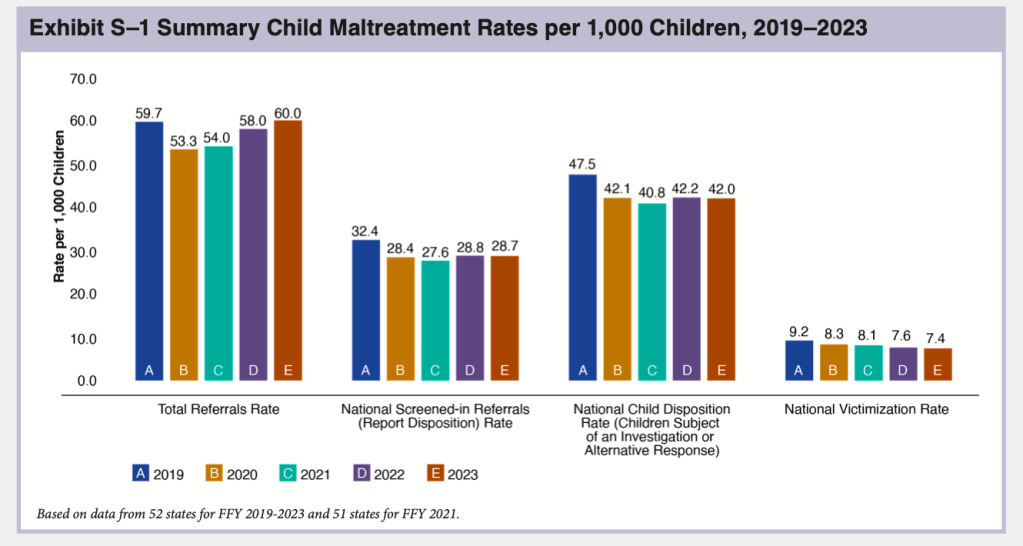
NCANDS uses the term โreferralsโ to mean reports to child welfare agencies alleging maltreatment. Agencies received an estimated total of 4,399,000 referrals through their child abuse hotlines or central registries in FFY 2023, according to CM 2023. This is a very slight increase over the previous year and represents about 7.8 million children, or 60 per 1,000 children. As shown in Exhibit S-1, the total number of referrals has been increasing since 2020, when the COVID-19 pandemic resulted in a large drop in referrals. In FFY 2023, the number of referrals surpassed the pre-Covid 2019 total for the first time as the lingering effects of the pandemic, which acted to suppress reports, finally dissipated.
As in past years, the state-by-state tables document large differences in referral rates, from 19.9 per 1,000 children in Hawaii to 171.2 per 1,000 in Vermont–also the top and bottom states in 2022. These differences reflect not just different numbers of calls to child abuse hotlines but also state policy and practice. Vermont reports that it counts all calls to the hotline as referrals, while other states do not do so. For example, Connecticut reported in CM2022 that none of the calls that are assigned to alternative response are included in NCANDS, resulting in a far lower number of calls than the number they actually receive. Referral rates may also affected by a state’s policy on who is required to report and what must be reported. Such policies are disseminated to mandatory reporters through training and agency communications. New York reported implementing in FFY 2023 a new training for mandated reporters that helps them identify when concerns do not rise to a level legally requiring a report be made.” The training also focuses on implicit bias in order to “reduce the number of SCR reports influenced by bias about race or poverty.” The number of referrals in New York dropped by a very small fraction in FFY 2023. Missouri reported in CM2022 that it stopped accepting educational neglect referrals in 2021 as the COVID emergency ended, resulting in a decreased number of referrals received the following year.
Reports
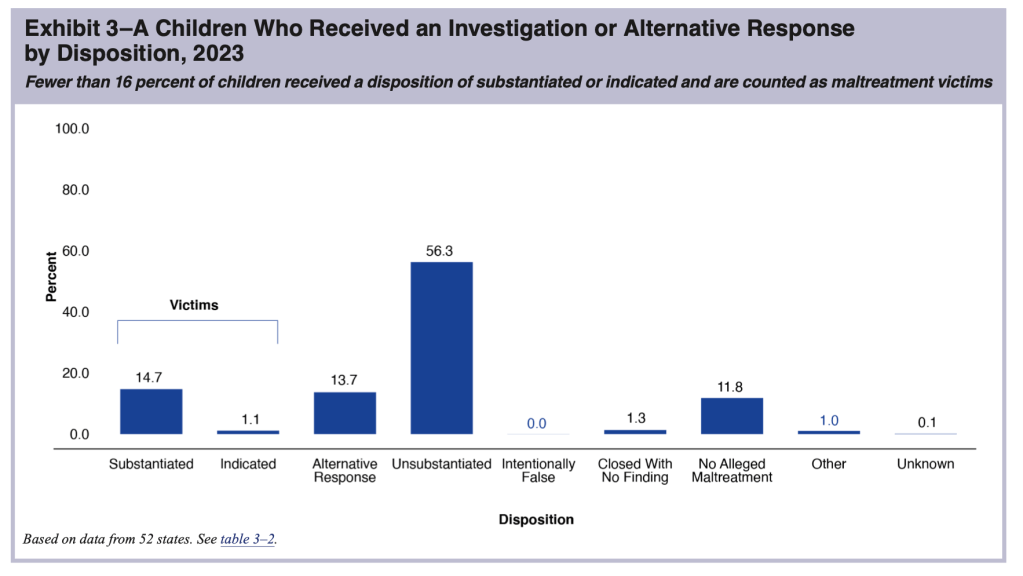
Once a state agency receives a referral, it will be screened in or out by agency staff. In general, referrals are screened out if they are deemed not to contain an allegation of child abuse or neglect, contain too little information to act on, are more appropriately assigned to another agency, or for some other reason do not fall under the mandate of the child welfare agency. In the language used by NCANDS, a referral becomes a โreportโ once it is screened in. “Reports” are assigned for an investigation or “alternative response.” State data indicates that child welfare agencies screened in 2.1 million referrals, about 47.5 percent of referrals for an investigation or alternative response, and “screened out” the other 52.5 percent as not warranting a response. The number of screened-in referrals was 11.6 percent less than in FFY 2019 and slightly less than in FFY 2022.
A total of 42 states reported a decrease in the number of screened-in referrals in FFY 2023. In their commentaries, several of these states described policy and practice changes that led to their screening out more referrals. Ohio reported that two of its major metropolitan counties, which had significantly higher screen-in rates than the rest of the state, adjusted their screening procedures to be consistent with the rest of the state, resulting in a lower screen-in rate in those counties and statewide. Mississippi reported an increasing the amount of screening it conducted, especially when a report was received regarding a case that was already open; perhaps this is why its screen-in rate dropped from 41.3 to 36.5 per 1,000 children. Nebraska reported dropping a policy to require accepting all referrals from a medical professional involving children under six. Some states explicitly reported that their screening changes were adopted in order to decrease the number of screened in referrals. Kentucky reported adopting a new SDMยฎ screening tool designed to decrease the number of referrals that are “incorrectly accepted for investigation.” Nevada reported a decrease in screened-in referrals because it established new intake processes to ensure that referrals are screened out when they do not meet criteria for acceptance.
“Victims”
The next phase in the funnel of CPS is the determination of whether abuse or neglect has occurred. At this stage, the level of analysis shifts from the case to the child, and the number of “victims” is the result. In NCANDS, a โvictimโ is defined as โa child for whom the state determined at least one maltreatment was substantiated or indicated1; and a disposition of substantiated or indicated was assigned for a child in a report.โ “Victims” include children who died of abuse or neglect if the maltreatment was verified. Some children receive an “alternative response”2 instead of an investigation; these children are not counted as victims. According to CM2023, states reported a total of 546,159 victims of child abuse and neglect in FY 2023, producing a “victimization rate” of 7.4 per 1,000 children.
The number of “victims” reported by states according to the NCANDS definition does not represent the true number of children who experienced abuse or neglect, which is unknown. Many cases of child maltreatment go unreported. Children assigned to alternative response are not found to be victims unless their case is reassigned to the investigation track. And finally, substantiation may not be an accurate reflection of whether maltreatment occurred. Making a determination of whether maltreatment occurred is difficult. Adults and children do not always tell the truth, the youngest children are nonverbal or not sufficiently articulate to answer the relevant questions. So it is not surprising that research suggests that substantiation decisions are inaccurate3 and a report to the hotline predicts future maltreatment reports and developmental outcomes almost as well as a substantiated report.4
State “victimization rates” range from a low of 1.5 per 1,000 children in New Jersey to a high of 16.2 in Massachusetts. It is unlikely that Massachusetts has more than ten times more child abuse and neglect victims than New Jersey–a not dissimilar Northeastern state. Policy and practice must be at play, including different definitions of abuse or neglect, levels of evidence required to confirm maltreatment, and policies regarding the use of alternative response or “Plans of Safe Care”5 to divert children from investigation, among other factors. Maine reported the second highest “victimization rate.” The Maine Monitor asked experts why this might be so. Among the reasons suggested were the definition of maltreatment; Maine allows abuse or neglect to be substantiated when there is a “threat” of maltreatment, even if there is no finding that it already occurred. In view of the deceptiveness of these terms, I have put the terms “victims” and “victimization rates,” when not preceded by the word “reported,” in quotation marks in this post.
The national “victimization rate” of 7.4 per 1,000 children, is a small decrease from 7.7 in FFY 2022 and the total number of reported “victims” was 19.3 percent less than the total reported in FFY 2019. This “victimization rate” has declined every year since FFY 2018. Of course, this decline is in part a result of the decline in the number of screened-in referrals that was discussed above. Any referral that is screened out is one less reported “victim,” even though some percentage of the screened-out referrals almost certainly reflected actual incidents of maltreatment.6 It is also clear that changes in policy and practice have contributed to the decline in the number of “victims” reported by states, as described below.
Policy and practice changes affecting “victimization” numbers
The change in the number of “victims” between FFY 2019 and FFY 2023 ranged from a 52 percent decrease in North Dakota to a 32 percent increase in Nevada, suggesting that these changes may reflect policy and practice more than actual trends in abuse and neglect. And indeed, two of the largest states made it more difficult to substantiate maltreatment in FFY 2022, and both found a decline in the number of maltreatment victims. In Texas, the legislature narrowed the definition of neglect, requiring the existence of both โblatant disregardโ for the consequences of a parentโs action or inaction and either a โresulting harm or immediate danger.โ Perhaps this helps account for the drop in the number of reported victims from 65,253 in FFY 2021 to 54,207 in FFY 2022. But the number of victims actually rose very slightly in FFY 2023. Perhaps the new definition had been assimilated into practice and was no longer resulting in a decrease in substantiations. In New York, the level of evidence required to substantiate an allegation of abuse or neglect was changed from โsome credible evidenceโ to โa fair preponderance of the evidenceโ in FFY 2022. The number of victims found in New York dropped from 56,760 in FFY 2021 in to 50,056 in FFY 2022, which the Office of Child and Family Services attributed in its CM 2022 commentary to that change in evidentiary standards. The number of reported victims fell further to 46,431 in FY2023; perhaps the changed evidentiary standards were continuing to take hold or other state policies affecting other parts of the funnel–such as the attempt to rein in mandatory reporting–were contributing factors. The agency did not address this issue in its 2023 commentary.
A few states did mention in their CM 2023 commentary changes in policy or practice that might have contributed to changes in the number of “victims” in FFY 2023. North Dakota attributes a decrease partly to a change in state statute and policy which allows protective services to be provided when impending danger is identified, even without a substantiation. The agency appears to believe that workers are not substantiating as many reports now that they do not need a substantiation to provide services. Arkansas attributed a decrease in victims to the adoption of a new assessment tool that may have contributed to the routing of more reports to the differential response pathway. Kentucky reported that the adoption of new “Standards of Practice” may have contributed to the increase in the number of “victims” reported in FFY 2023.
Fatalities
Based on reports from 49 states (all but Massachusetts), the District of Columbia, and Puerto Rico, CM2023 estimated a national maltreatment fatality rate of 2.73 per 100,000 children. That rate was then applied to the child population of all 52 jurisdictions and rounded to the nearest 10 to provide a national estimate of 2,000. But experts agree that the annual estimates of child fatalities from NCANDS significantly undercount the true number of deaths that are due to child maltreatment. I discussed this in detail in A Jumble of Standards: How State and Federal Authorities Have Underestimated Child Maltreatment Fatalities.
The annual fatality estimates presented in the report increased by 12.3 percent between FFY 2019 and FFY 2022 and then fell slightly from 2,050 to 2,000 in FFY 2023, a fact that ACF mentioned in its press release. Such a small reduction of less than three percent over the previous year cannot be statistically distinguished from random fluctuation, especially because it is based on much-smaller numbers from the individual states. State commentaries illustrate the randomness of these year-to-year changes. In CM 2022, two individual states explained year-to-year jumps in fatalities by explaining that many children in one family died and that a large group of fatalities that occurred the previous year were reported in the current year. But even aside from statistical fluctuations, there are many reasons one cannot rely on year-to-year changes. These include the timing of reports and changes in policy and practice.
Timing
According to CM 2023 (and previous reports), “The child fatality count in this report reflects the federal fiscal year (FFY) in which the deaths are determined as due to maltreatment. The year in which a determination is made may be different from the year in which the child died.” The authors go on to explain explain that It may take more than a year to find out about a fatality, gather the evidence (such as autopsy results and police investigations) to determine whether it was due to maltreatment, and then make the determination. Alabama, for example, explained in its commentary that the deaths reported in a given year may have occurred up to five years before.
To add to the uncertainty around timing, the writers of CM 2023 are not exactly correct when they state that all states report on the fatalities determined in the reporting year. In their annual submissions to NCANDS, several states add fatalities for the previous year, implying that their practice is to report on fatalities that occurred in a specific time period, not those determined in the applicable year. Four states revised their number of 2022 fatalities in their submissions to CM2023. This suggests that their 2023 reports are in turn incomplete and will be revised in succeeding years. California, for example, explained that:
Calendar Year (CY) 2022 is the most recent validated annual data and is therefore reported for FFY 2023. It is recognized that counties will continue to determine causes of fatalities to be the result of abuse and/or neglect that occurred in prior years. Therefore, the number reflected in this report is a point in time number for CY 2022 as of December 2023 and may change if additional fatalities that occurred in CY 2022 are later determined to be the result of abuse and/or neglect.
So California is reporting (for CM 2023) a truncated count of child maltreatment deaths for Calendar Year 2022. But it did add 12 fatalities to the count of fatalities that it reported for FFY 2022, raising its total from 164 to 176. California reported 150 fatalities for FY2023; one can assume that additional deaths will be reported in the next report. The four states together added 56 deaths for FFY 2023. Arizona’s total increased from 14 to 39, Maine from three to 10 and Virginia from 39 to 51. .
Policy and Practice: Fatality Definition and Measurement
In addition to timing issues, year-to-year changes in fatality counts can reflect changes in how states screen or define child maltreatment fatalities. In previous issues of CM, states have reported on improvements in their collection of fatality information. Over time, some states have eliminated obsolete practices in screening and information collection. West Virginia reported in its 2016 commentary that it had begun investigating child fatalities in cases where there were no other children in the home. North Carolina ended its restrictive policy of reporting only fatalities determined by a chief medical examiner to be homicide, and it also began efforts to incorporate vital statistics and criminal justice data.
During FY 2023, some states reported changes that may have resulted in a reduced number of child fatalities reported.
Texas did not submit commentary for FFY 2023. But as reported above, it changed its screening policy so that reports involving a child fatality but include no explicit concern for abuse and neglect are not investigated if the reporter and other pertinent sources had no concern for abuse or neglect. DFPS reports that the number of child fatalities it investigated decreased from 997 in FY2022 to 690 in FY2023 (a 31 percent decrease) due to this new screening policy. And the number of child maltreatment fatalities fell from 182 to 164. But with a drastic drop in foster care placements in Texas, there is reason to fear that maltreatment fatalities increased rather than decreased. If that is the case, this change screening policy may have resulted in the failure to investigate and confirm actual maltreatment deaths..
The Illinois Division of Child Protection reported that it added a new administrative review process for sleep-related deaths. A senior administrator reviews the investigation to ensure that death included evidence of โblatant disregard.โ DCF links this new policy with a decrease of 24.6% in reported child fatalities in FFY 2023.
Other states reported changes that might result in an increased number of child fatalities reported. Maryland attributed an increase in reported fatalities to a policy change requiring local agencies to screen in sleep-related fatalities as part of its prevention effort. Alaska reported a change that may affect fatality counts in future years: in December 2023 the agency dropped its practice of screening out cases where no surviving children remained in the home; from now on the agency will be making maltreatment findings even when there are no surviving children.ย
It is regrettable that most state commentaries do not include explanations for the changes in their reported number of referrals, reports, and victims. Worse, several states do not even submit commentaries in time to be included in each year’s report. In CM023, commentaries are missing for Arizona, Hawaii, Kansas, New Hampshire, North Carolina, Oregon, Texas, and West Virginia. Given the importance of the state commentaries for understanding the data they submit, the preparers of the CM reports should reach out to agency personnel in states that have not submitted commentaries by a certain date or have not answered the important questions and ask the questions directly directly. This information is too important to be left out.
It is unfortunate that ACF continues to misuse term โvictimizationโ and “victimization rate” to suggest that child maltreatment (including fatalities) is declining, particularly in its press release and executive summary, which do not provide any explanation of the true meaning of the terms. The deceptive language is not a surprise given the previous Administration’s desire to take credit for ostensible and support the prevailing narrative regarding the need for a reduction in interventions with abusive and neglectful families. One does not have to be a statistician or data scientist to realize that we will never get an accurate measure of child maltreatment because so much of it occurs behind closed doors. Finding fewer victims is one way to reduce CPS intervention in the lives of vulnerable children–and to deny that the reductions are harmful. Sadly, this report will be used as evidence to support policies that continue to roll back protections for our most vulnerable children.
Notes
Substantated is defined as “supported or founded by state law or policy.” “Indicated” is a less commonly used term meaning a “disposition that concludes maltreatment could not be substantiated understate law or policy, but there is a reason to suspect that at least one child may have been maltreated or is at risk of maltreatment.” โฉ๏ธ
An “alternative response” includes an assessment and referral to appropriate services if the parent agrees to participate. There is no determination on whether abuse or neglect occurred and no child removal unless the case is transferred to the investigative track. โฉ๏ธ
Theodore Cross and Cecilia Casanueva, โCaseworker Judgments and Substantiation,โย Child Maltreatment, 14, 1 (2009): 38-52; Desmond K. Runyanย et al, โDescribing Maltreatment: Do child protective services reports and research definitions agree?โย Child Abuse and Neglectย 29 (2005): 461-477; Brett Drake, โUnraveling โUnsubstantiated,’โย Child Maltreatment, August 1996; and Amy M. Smith Slep and Richard E. Heyman, โCreating and Field-Testing Child Maltreatment Definitions: Improving the Reliability of Substantiation Determinations,โย Child Maltreatment, 11, 3 (August 2006): 217-236. โฉ๏ธ
Brett Drake, Melissa Jonson-Reid, Ineke Wy and Silke Chung, โSubstantiation and Recidivism,โย Child Maltreatmentย 8,4 (2003): 248-260; Jon M. Husseyย et al., โDefining maltreatment according to substantiation: Distinction without a difference?โย Child Abuse and Neglectย 29 (2005): 479-492; Patricia L. Kohl, Melissa Jonson-Reid, and Brett Drake, โTime to Leave Substantiation Behind: Findings from a National Probability Study,โย Child Maltreatment, 14 (2009), 17-26; Jeffrey Leiter, Kristen A. Myers, and Matthew T. Zingraff, โSubstantiated and unsubstantiated cases of child maltreatment: do their consequences differ?โย Social Work Researchย 18 (1994): 67-82; and Diana J. Englishย et al, โCauses and Consequences of the Substantiation Decision in Washington State Child Protective Services,โย Children and Youth Services Review, 24, 11 (2002): 817-851. โฉ๏ธ
Plans of Safe Care are voluntary plans offered to the families of substance-exposed infants under the Comprehensive Addiction and Recovery Act (CARA). โฉ๏ธ
We. know this from child fatality reviews that many children who die have been the subject of previous referrals, which were not substantiated but later found in fatality investigations to have been correct. See discussions of the deaths of Thomas Valva and Gavin Peterson, for example. โฉ๏ธ
โB.B.โ was born in 2022 and died of fentanyl poisoning in March 2023. During the ten years before B.B.โs death, DCYF had received 30 reports on B.B.โs family (many before B.B. was born) for issues including use of heroin, marijuana and alcohol in the home; lack of supervision of the children; domestic violence; an unsafe caregiver living with the family; an unsafe and unclean living environment unsecured guns in the home โout-of-controlโ behaviors by B.B.โs older siblings at school, with the mother described as โout-of-itโ and unresponsive to school concerns; concerns about the childrenโs hygiene; and the mother driving under the influence of marijuana. An in-home services case that had been open since January 2023 was closed days before B.B.โs death.
On August 24, 2024, the Washington Department of Children, Youth and Families (DCYF) proudly announced in a press statement that it had reduced the number of children in out-of-home care by nearly half since 2018. Specifically, the number of children in foster care had fallen from 9,171 in 2018 to 4,971 as of August 14, 2024. โOutcomes like this demonstrate our agencyโs commitment to keeping families together and children and youth safe,โ DCYF Secretary Ross Hunter said. โAlthough the number of reports we are receiving remain [sic] consistent, we are seeing fewer children and youth in out-of-home care as families are being referred to support services rather than having children removed from their homes. Indeed, โsafely reduce the number of children and youth in out of home care by halfโ (without a baseline date from which this can be measured) is one of DCYFโs six strategic priorities. But treating the decline in foster care (the direct result of government actions) as a desirable outcome in itself can contribute to a disregard of actual child welfare outcomes like safety and permanency.
How did DCYF reduce foster care by nearly 50 percent?
How did DCYF manage to slash its foster care rolls so radically in such a short time? Without providing specifics, the press release cites DCYFโs implementation of the Family First Prevention Services Act (FFPSA) and its emphasis on โsupporting and collaborating with families by providing access to services and programs.โ A DCYF spokesperson told the Seattle Timesthat the department was using services to avoid removing children or to reunite families sooner, citing efforts to connect parents to substance use or mental health treatment programs, bring a social worker into the home to โproblem solve,โ or โoffer practical items, like diapers, car seats and beds.โ
Apparently not satisfied with the changes implemented by DCYF, the Washington legislature in 2021 passed the Keeping Families Together Act (KFTA, also known as HB 1227), which took effect on July 1, 2023. Among other provisions, KFTA increased the standard for the court to order removal of a child from the home, which previously required the agency to demonstrate that โreasonable grounds that the childโs โhealth safety or welfare will be seriously endangered if not taken into custody and that at least one of the grounds set forth demonstrates a risk of imminent harm to the child.โ As amended by KFTA, the law now requires the agency to demonstrate โthat removal is necessary to prevent imminent physical harm to the child due to child abuse or neglect.โ The petition for removal is required to contain โa clear and specific statement as to the harm that will occur if the child remains in the care of the parent, guardian or custodian, and the facts that support the conclusion.โ Moreover, the court must consider whether participation by the parents or guardians in โany prevention servicesโ would eliminate the need for removal. If so, they must ask the parent whether they are willing to participate in such services and shall place the child with the parent if the parent agrees.
On a page dedicated to KFTA implementation, DCYF explains that it has implemented the law by adopting new policies and procedures to determine whether to remove a child and by training and supporting staff to implement the new procedures and determine whether there is an imminent risk of serious harm to the child. DCYF reports that internal reviews show that staff are โtaking additional steps to prevent removal of a child and to support a safety plan for the family.โ
Shortly before KFTA took effect, DCYF, along with the Department of Health, the Health Care Authority, and the Washington State Hospital Association issued new guidelines to birthing hospitals and mandatory reporters. These guidelines stated that infants born substance exposed, but for whom there are no other safety concerns, can receive โvoluntary wrap-around services from a community organizationโ without being reported to CPS. These voluntary services are being provided through federally-mandated โPlans of Safe Care (POSC).โ Healthcare providers identifying a substance-exposed infant are instructed to access an online portal where they are directed to call DCYF if safety concerns are identified and to complete a POSC referral if not.
DCYF has been issuing quarterly data updates to assess the impacts of the KFTA. According to the most recent (October 2024) update, the law is having the intended impact of further reducing removals to foster care. DCYF reports a 16 percent decrease in the number of children removed in the July through September quarter of 2024 compared to the same quarter of 2022, before passage of KFTA. However, comparing foster entries for all ages in July through September 2024 to those in the same quarter of the previous year, the data indicate that foster care entries actually increased! Will this be the beginning of the end of the foster care reductions? That remains to be seen.
A longer-term view raises questions about the difference KFTA made, compared to the previous and ongoing efforts by DCYF to reduce foster care placements. Entries into foster care in Washington have decreased annually from 2017 to 2024, as shown in the chart below. The rate of decrease remained about the same between 2019 and 2024, while KFTA was not implemented until July 2023. Perhaps more children would have entered care if not for KFTA, but there is no way to assess the impact of KFTA as compared with DCYFโs ongoing effort to reduce removals.
The reduction in foster care placements was supposed to be accompanied (and made possible) by an increase in in-home services (which DCYF calls Family Voluntary Services or FVS), and DCYF reports that the number of cases receiving FVS increased by nine percent from 1,809 in SFY2023 to 1,994 in SFY2024. This increase in FVS cases cannot be compared to the 17-percent decrease in children placed in foster care over the same period, as the unit of analysis is different (families rather than children). But the key question is the nature and intensity of these services and whether they really kept the children safe.
The cost of foster care reductions
The purpose of foster care is to keep children safe when they cannot be protected at home. So the essential question is whether the reduction in foster care placements has occurred without any cost to children. Trends in child fatalities and โnear fatalitiesโ1 due to child abuse or neglect can provide a clue. These deaths and serious injuries are the tip of the iceberg of abuse and neglect. For each child who dies or is seriously injured, there are many more that are living in fear, pain, or hunger, and incurring lifelong cognitive, emotional, and physical damage. There are troubling signs of an increase in child fatalities and near fatalities over the past several years. In its most recent quarterly update, DCYF reports on the number of “critical events” or child fatalities and near fatalities that met its criteria for receiving an โexecutive review.โ These include the deaths of any minor that had been in DCYF custody or received services within a year of the death that were suspected to be caused by child abuse or neglect.2 They also include near fatality cases in which the child has been in the care of or received services from DCYF within three months preceding the near fatality or was the subject of an investigation for possible abuse or neglect. DCYF reports that the number critical events it reviewed increased from 23 in 2019 to 51 in 2023 and projects that it will increase to 61 in 2024.3
The increase in critical events reflects, in part, the growing opioid crisis in Washington, as well as decisions Washington has made regarding how it intervenes to protect children. Opioid related emergencies have โdramatically increased for the entire population (adults and children) in Washington,โ and children have not been immune. Fentanyl is particularly dangerous to young children because it takes only a tiny amount to kill a baby or toddler, who can mistake the pills for candy or put straws or foil meant for smoking the drug in their mouths. The number of fatalities and near fatalities reviewed by DCYF that involved fentanyl climbed from four in 2019 to a projected 35 in 2024. Since 2018, Washingtonโs Office of the Family and Childrenโs Ombuds (has observed an annual increase in child fatalities and near fatalities involving accidental ingestions and overdoses. Fifty-seven (or 85 percent) of the 67 incidents examined in 2023 involved fentanyl. Over half of these incidents involved children under three years old and a shocking 14 out of the 85 infants were 12 months old or less. As Dee Wilson and Toni Sebastian point out, the limited mobility and motor skills of infants suggests that some of these infants may have been given a small amount of fentanyl as a means of sedation.
The Washington Legislature was concerned enough about the possibility that KFTA is contributing to an increase in child fatalities and near fatalities in the context of the fentanyl epidemic that it passed a new law (SB 6109) in 2024. The law provides that a court must give โgreat weightโ to the โlethality of high-potency synthetic opioids.โฆ.in determining whether removal is necessary to prevent imminent physical harm to the child due to child abuse or neglect.โ However, it appears that there is confusion about exactly what that means.
Has DCYF given up on protecting children?
“We know that supporting and collaborating with families by providing access to services and programs increases their number of protective factors, leading to better outcomes,โ said DCYF Assistant Secretary Natalie Green. โGiving families the tools they need to thrive and safely parent means more children and youth remain safely at home.”
But the work of DCYFโs own analysts, in their quarterly KFTA updates, raises doubts about whether DCYF is adequately performing its child protection function. These updatesย acknowledge that the agency is not removing as many children with a high risk of future encounters with child welfare (in other words, those who have a high risk of being harmed). And they also report that the department has seen โan increasing percentage of moderately high to high risk cases being re-referred to CPS within 90 days of the risk assessment. DCYF also reports that the overlap between KFTA and Plan of Safe Care (POSC)ย is resulting in fewer screened-in intakes involving substance-exposed newborns because these infants are now being referred to voluntary services under POSC.
There has been a chorus of voices alleging that DCYF is abdicating its child protection responsibilities. One foster parent told the Seattle Times that โshe and other foster parents are finding children who now come into their care are in worse shape than they used to be, with more serious mental health conditions or greater exposure to lethal drugs like fentanyl.โ She contends theyโve been left too long in unsafe conditions because of the heightened legal standard for removal.In The Erosion of Child Protection in Washington State, Toni Sebastian and Dee Wilson have cited the weakness of the management of Family Voluntary Services, which is often employed as an alternative to foster care.
A survey of executive reviews of 2023 and 2024 child maltreatment child fatalities with DCYF involvement within a year provided examples of problems with screening, investigations, and case management, including the following:
Hotline issues. Reviews documented multiple intakes screened out on the same family even when the family had been the subject of multiple calls. The reviews also suggest that too many cases may be assigned to the Family Assessment Response (FAR) pathway, an alternative to a traditional investigation designed for lower-risk cases. In FAR cases, a social worker assesses the family and refers it to voluntary services. There is no finding about whether maltreatment has occurred and no child removal unless the case is transferred to the investigative track.
Premature closure of FAR cases. Reviewers noted instances in which FAR cases were closed after parents failed to cooperate, without caseworkers considering a transfer to the investigative track or before determining that the parent had followed through with services.
Assessment failures: Reviewers noted multiple failures to adequately assess parents for domestic violence, mental health, and substance abuse; failures to contact collaterals (relatives and friends) and instead relying on parental self-reports; lack of recognition of chronic maltreatment; ignoring evidence of past problems if not included in the current allegation; and failing to anticipate future behavior based on historical patterns.4
Inadequate understanding of substance abuse: Reviewers noted the failure to conduct a full assessment of substance abuse including history, behavioral observations, and collateral contacts; disregarding the unique danger to children posed by fentanyl; downplaying the significance of marijuana use, particularly as an indicator of relapse from harder drugs; and disregarding alcohol abuse because it is legal.
Failure to obtain information from treatment and service providers. The failure to communicate with service providers about clientsโ participation in services like drug treatment and relying on clientsโ self-reports was noted by more than one review team. Sometimes the providers refused to cooperate. Staff told the team reviewing one case about a substance abuse treatment provider that routinely refuses to cooperate, even when parents sign release forms, and routinely tells clients not to cooperate with DCYF.
Lack of subject matter expertise. Reviewers pointed to the lack of deep knowledge about domestic violence, substance use disorder, and mental health among staff doing investigations, assessments, and case management and the need to provide access to subject matter experts when needed.
Failure to remove a child despite safety threats. The team reviewing the case ofa four-year-old who died after ingesting fentanyl reported that there were at least two different times where an active safety threat was present that would have justified filing a petition in court to place the child in foster care. However, the staff believed, based on past experience, that the court would have denied the petition and therefore did not file.
Delayed Reunifications: โP.L,.โ a toddler allegedly beaten to death by his mother, was in foster care for over three years but his motherโs rights were never terminated. He was on a trial return to his mother for just over five months when he was found dead with bruises and burns all over his body.
Staff shortages and high turnover were mentioned as contributing to the observed deficiencies in case practice in almost every fatality review. In B.B.โs case, the reviewers noted that the office had been functioning with a 50 percent vacancy rate for the last several years, stating that such a vacancy rate leads to high turnover, high caseloads, caseworkers with little experience, and supervisors forced to carry cases rather than support their caseworkers. Even caseloads that comply with state standards may be too high. The standard of 20 families per caseworker in FVS was noted to be unmanageable by one review panel, which noted that FVS cases are often discussed as high risk cases and require multiple contacts per month with family members, services providers, and safety plan participants. As Dee Wilson and Toni Sebastian put it, โ[b]etting young endangered childrenโs lives on in-home safety plans developed and implemented by inexperienced and overwhelmed caseworkers is reckless, ill-advised public policy.โ
Conclusions and Recommendations
Treating the decline in foster care as a desirable outcome in itself, as Washington and other states have done, is both disingenuous and dangerous. Any government can slash the foster care rolls reducing or ending child removals, as many โchild welfare abolitionistsโ recommend. The central purpose of child welfare services, including foster care, is to protect children from child abuse and neglect. A reduction in foster care placements that results in the failure to protect children is no kind of success.
DCYF told King5 that โthe increase in child fatalities and near fatalities in Washington is not being driven by the change in removal standards under House Bill 1227 or the reduction in the number of children in foster care. It is being driven by the increased availability of a highly addictive and hazardous drug and a lack of substance use disorder treatment in our communities.โ But whether the agencyโs policy or the drug epidemic is more at fault is not the right question. It is DCYFโs job to protect children given the circumstances that exist, including the drug epidemic and the lack of sufficient treatment, keeping in mind that treatment often does not work the first, second, third or subsequent times.
What can be done? DCYF needs to address the workforce crisis, which will probably require increasing pay and improving working conditions, or even possibly relaxing requirements for employment as a caseworker in investigations, assessment, and FVS. DCYF should consider policy and practice changes such as reducing the FVS caseload cap from 20 cases per worker; Instituting a chronic neglect unit, with expert caseworkers and even lower caseloads, for chronic cases; finding a way to limit the use of FAR to cases that are truly low-risk; and promoting the use of dependency petitions for court supervision when children remain in the home, as suggested by two fatality review committees.5 DCYF should request and the legislature should fund a variety of ancillary services for families, starting with therapeutic childcare for all preschool aged children with FVS cases as well as those who have been reunited with their parents. Such childcare would give parents a break and parenting support, keep children safe for a large part of the day, and ensure another set of eyes on the child, among other benefits. Also needed are more residential drug treatment centers where parents can live with their children.
Finally, more transparency is needed so that legislators, advocates and the public have access to the findings of DCYFโs executive review teams. Washington deserves credit for sharing its executive child fatality reviews. But there is no reason that the DCYF should not share its near-fatality reviews as well. We know something about how DCYF failed B.B. and the other children who died. But the public needs access to the reviews of those children who narrowly escaped death as well as those who did not. It is only through such transparency that the public can see the actual impact of all the self-congratulatory proclamations about โsafely reducing the number of children in out-of-home care.โ
Notes
A โnear fatalityโ is defined by state law as โan act that, as certified by a physician, places the child in serious or critical condition.โ โฉ๏ธ
DCYF relies on the Office of the Family and Childrenโs Ombuds (OFCO) to determine whether the fatality appears to have been caused by abuse or neglect, therefore requiring DCYF to conduct a review. โฉ๏ธ
Data collected by OFCO are more confusing. OFCO reviews all fatalities and near fatalities in which the childโs family was involved in Washingtonโs child welfare system within 12 months of the fatality. There number of near-fatalities reviewed by OCFO increased annually from 21 in 2018 to 70 in 2023, according to its most recent annual report on Child Fatalities and Near Fatalities in Washington State. But fatalities reviewed by OFCO did not show the same pattern. They reached a peak of 87 in 2018 and fell sharply in 2019, then rose yearly until they reached 85 in 2022 and then dropped to 79 in 2023. Nevertheless, adding fatalities and near fatalities together shows an alarming increase in critical incidents from 108 in 2018 to 149 in 2023. โฉ๏ธ
For example, in the case of โR.W.,โ a child who died at age four after ingesting fentanyl, an investigation was closed because the children were staying with relatives, despite the motherโs history of repeatedly removing the children from relatives with whom she had left them. A month later the child was found dead at a motel in the custody of the parents.ย โฉ๏ธ
At least 1,800 children die from abuse and neglect every year, and the total is probably considerably greater. Between a third and a half of these deaths may involve families that were already known to Child Protective Services (CPS) through previous reports of maltreatment. In addition, an unknown number of children are severely injured due to maltreatment every year. Legislators, advocates, and the public need timely information about the circumstances leading to these events so they can identify policy and practice changes necessary to protect children. Decades ago, Congress recognized this need and required states to have a policy allowing for disclosure of information and findings about these tragic events. But due to the weakness of the requirement and the federal government’s lack of enforcement, only a few states make meaningful disclosures in the wake of these horrific events, as documented in a new report.
Federal Law and Policy Regarding Disclosure
In 1996, Congress amended the Child Abuse Prevention and Treatment Act (CAPTA) to ensure that information from child fatalities and near fatalities that are caused by abuse or neglect can be used to correct systemic problems and prevent future occurrences. This provision โ42 U.S.C. 5106a(b)(2)(A)(x)โrequires that “every state’s plan for spending CAPTA funds contain “an assurance in the form of a certification by the Governor of the State that the State has in effect and is enforcing a State law, or has in effect and is operating a statewide program, relating to child abuse and neglect that includes . . . provisions which allow for public disclosure of the findings or information about the case of child abuse or neglect which has resulted in a child fatality or near fatality.”
This provision has many weaknesses, as described in more detail in a new report called Keeping the Public in the Dark: How Federal and State Laws and Policies Prevent Meaningful Disclosure about Child Maltreatment Fatalities and Near Fatalities, which was prepared for Lives Cut Short, a project to document and direct attention to child maltreatment fatalities. First, the provision requires only that the governor certify the existence of a disclosure requirement, not that it actually exist. Moreover, the language is so vague that it leaves all details to the individual jurisdictions. To make matters worse, the US Department of Health and Human Services (HHS) never wrote regulations to flesh out the vague statutory requirements. Instead, HHS provided guidance in the form of questions and answers in its Child Welfare Policy Manual (CWPM). The CWPM does not have the same force as federal regulations, but some states clearly pay attention to it and have mirrored it in their laws and policies.
Unfortunately the CWPM leaves many questions unanswered and even adds new ones. There are several federal confidentiality requirements embodied in different laws, and the CWPM does not explain the order of preference. Instead, different sections of the CWPM actually contradict each other, with one answer stating that the disclosure requirement trumps previously enacted confidentiality laws and several other answers reminding states to comply with existing confidentiality requirements. To make matters worse, revisions in 2012 introduced new opportunities to avoid disclosure, specifically letting states allow exceptions “in order to ensure the safety and well-being of the child, parents and family or when releasing the information would jeopardize a criminal investigation, interfere with the protection of those who report child abuse or neglect or harm the child or the childโs family.” The exception for “safety and well-being of the child, parents and family” completely undercuts the previous language in the CWPM.
The 2012 revision also included a list of the information and findings to be disclosed, which would have been extremely helpful had it not added a new opportunity to withhold certain information. Specifically, the CWPM (Section 2.1A.4, Question 8) prescribes that states must release:
“information describing any previous reports or child abuse or neglect investigations that are pertinent to the child abuse or neglect that led to the fatality or near fatality; the result of any such investigations; and the services provided by and actions of the State on behalf of the child that are pertinent to the child abuse or neglect that led to the fatality or near fatality.”
This language allows states to withhold information that is actually relevant to the question of whether and how a fatality or near fatality could have been prevented. For example, a state could decide a prior incident of neglect was irrelevant if the cause of death was abuse. But the same parent often perpetrates multiple types of maltreatment, especially chronically maltreating parents who have had multiple encounters with the child welfare system. A state’s decisive intervention in response to prior maltreatment may save a child from death or near-death by another form of maltreatment.
State Laws and Policies Regarding Disclosure
The report reviews state laws and policies governing disclosure of information and findings in cases where child maltreatment resulted in a child fatality or near fatality. The review shows that many state laws and policies fall far short of what is needed to ensure adequate public information about how child protections may have failed. The major findings include:
Despite the federal requirement, not every state has a policy for publicly disclosing findings or information about child fatalities and near fatalities. Out of the 50 states and the District of Columbia, four states appear to have no such policies. Another four states have a policy for fatalities but not near fatalities.
Among the 47 jurisdictions that do have laws or policies for disclosing maltreatment fatality and near-fatality information, only 35 require the release of findings and information about child maltreatment fatalities, and all but four of those require that of near fatalities as well. Twelve allow but do not require the release of findings and information about these incidents.
Many state laws and policies are vague, and many contain restrictions that violate the Congressional intent to make information about child maltreatment and agency operations publicly available.
Seventeen states have laws or policies that require releasing some information without request. These releases vary from a few basic facts on each incident to a comprehensive review of the victimโs familyโs history with child welfare. Only nine issue notifications of fatalities or near fatalities that are suspected to be due to maltreatment.1 Without such notifications, the public may not even know an incident has occurred, so they certainly will not ask for information about it.
Recommendations
CAPTA should be amended to clarify the language regarding child fatalities and near fatalities due to maltreatment and establish parameters for states in interpreting the law. The new language should make clear that states must release findings and information about fatalities and near fatalities, and disclosure must be required rather than simply allowed. The law should prescribe the types of information that can be withheld and when disclosure can be postponed, and it should deny states the option of withholding other information or refusing to release information altogether. It should spell out the findings and information that must be released. It should clarify that the CAPTA language overrides other confidentiality provisions in federal law. It should also require that states notify the public of child fatalities and near fatalities that are reported to child abuse hotlines and accepted for investigation.
But recent attempts to reauthorize CAPTA have failed, and these changes seem unlikely in today’s ideological climate, where child safety often takes a back seat to other concerns. It is probably more realistic to focus on changes to state legislation. A good state disclosure policy, in compliance with CAPTA, should cover fatalities and near fatalities. It should be mandatory and contain no vague terms, conditions, or exceptions. Permitted redactions should be limited to the names of living children in the family and reporters of maltreatment and (temporarily) any information that would cause specific material harm to a criminal investigation. There should be no prohibition on sharing information deemed to be against the best interests of or harmful to the injured child or any other child in the household.
At a minimum, a disclosure policy should require prompt public notification of all fatalities and near fatalities reported to the hotline and accepted for investigation, along with a documented rationale for not investigating others. The notifications should include whether the family had past involvement with CPS and a brief summary of prior reports and responses by the agency. There should be no requirement that the historical information be “pertinent to the abuse or neglect that caused the fatality,” as suggested by the CWPM. Upon completion of the investigation, if it is determined that the fatality resulted from abuse or neglect, the department should be required to release a detailed summary of prior reports involving the family or household and of agency responses, including investigations, in-home cases, child removals, and family reunifications, The agency’s complete files on the perpetrators and their children, with certain identifying information redacted, should be available to any person upon request.
A study of the policies of 50 states and the District of Columbia toward disclosing information regarding child maltreatment fatalities and near fatalities shows that many fall drastically short of embodying Congressโs intent in adding Section 106(b)(2)(B)(x) to CAPTA. Most of these difficulties stem from the deficiencies of the language itself and the guidance provided in HHSโs CWPM. While changing CAPTA’s language would be the most efficient way to enable improvement around the country, it is more likely that legislators and child advocates at the state level will collaborate on legislation requiring full transparency around these deaths. We cannot make progress in preventing severe and life-threatening child maltreatment unless legislators, advocates, and the public can access comprehensive information about what led to these tragic events.
Rhode Island provides notifications of suspected maltreatment only for fatalities and near fatalities only if the child was the subject of an open case; other notifications occur only after maltreatment is confirmed. โฉ๏ธ
This post was prepared for and originally appeared on the website of Lives Cut Short, a project to document and analyze child maltreatment fatalities in the United States. See my interview with KUTV about this post here.
On October 10, the Utah Department of Children and Family Services (DCFS) finally released a statement summarizing its involvement with Gavin Peterson, who died on July 9, 2024 at the age of 12. Gavinโs father, stepmother, and older brother are awaiting trial on reckless child abuse homicide, among other charges. The much-awaited โCAPTA statementโ from DCFS (named for the federal law requiring that states have a policy to disclose โinformation and findingsโ about child maltreatment fatalities and near fatalities) provided some new information but raised new questions, especially when contrasted with media accounts.
The DCFS statement begins with a disclaimer. Gavin came from a โtwo-household familyโ and was residing with his biological father, Shane Peterson, and fatherโs long-term girlfriend, Nichole Scott, at the time of his death. The agency explains that although it โworked with each household at several points in Gavinโs life as early as 2013,โ the statement includes only โinformation relevant to Gavin in the household where his death occurred.โ It is not clear from this disclaimer what information was withheld from the public, either because it was from the other household or because DCFS decided it was not “relevant to Gavin.โ
Some of that information can be pieced together from media coverage. Gavinโs mother, Melanie Peterson, told a reporter at KSL TV that she lost custody of all four of herchildren in 2014 or 2015. Court documents obtained by the reporter showed that two-yearโold Gavin was found unsupervised outside of his home in 2014, and that in the same year Melanie pleaded guilty to allowing a child to be exposed to illegal drugs or drug paraphernalia. Melanie told the reporter that she never regained custody of her children from the courts, but that Shane Peterson unofficially returned her third child to her in 2018 and her second child in 2019. (Her first child was apparently Tyler, who is charged in Gavinโs death, and Gavin was the fourth child.)
DCFSโ statement provides a chronology of abuse and neglect reports and agency responses, which are summarized below along with our commentary in italics.
May 28, 2019
The first report of abuse in Shane Petersonโs home is received. DCFS investigates and finds that Nichole Scott had physically abused another child in the home. The Peterson family accepts voluntary in-home services. After a month of services, DCFS concludes the safety concerns have been resolved and closes the case.
The โother childโ was clearly Gavinโs sister Mayloni Peterson, now 19. She told KSL TV that she was abused even more severely than Gavin at the time, and was even punished for his actions. She described being beaten, tied to her bed, fed only once or twice a day, forced to perform labor in the household and at her grandmotherโs house. She reported that Scott once shaved off all her hair as punishment for combing her hair without permission and strangled her in the car following a failed attempt to run away. On Saturday, May 25, 2019, Mayloni told her father that she accidentally broke a sprinkler while mowing the lawn. Her father took her to her motherโs house without warning and left her there, possibly saving her life. Melanie Peterson reported that Mayloni was malnourished and โwith all her hair buzzed off.โ After hearing what her daughter had been through, Melanie made a report to DCFS after the Memorial Day holidayโclearly the May 28, 2019 report. (Mayloni mentioned a report that was made by her school in March; it is not clear whether that report was omitted by DCFS because it was โnot relevant to Gavin.โ)
February 27, 2020
DCFS receives a call reporting abuse of Gavin in โanother household.โ DCFS finds Gavin to be a victim of abuse and files a court petition. On May 27, the court orders both households to participate in DCFS in-home services.
Melanie Peterson told KSL TV that she took a picture of an emaciated Gavin in February 2020. It would be the last time she saw him. She alleges that Nichole and Shane Peterson found out about the photo and made a false allegation about her, thereby ending her visitation rights pending a judgment by DCFS. That โfalse complaintโ was likely the February 27, 2020 report, which resulted in an open case for both households.
August 24, 2020
While the two households are receiving in-home services, DCFS receives a call reporting concerns about Gavinโs treatment in his fatherโs home. The information does not โmeet the criteria required by Utah state law to open an investigation,โ but the intake worker shares the information with the in-home caseworker.
May 21, 2021
The โPeterson familyโ successfully completesโ in-home services, and the judge closes the case. No information is provided about what these services were.
September 2, 2022
DCFS receives a report from โsomeone concerned about Gavinโs well-being, after observing some of his behaviors.โ The hotline worker decides the report does not meet the legal criteria for opening an investigation. A supervisor approves this decision.
This report most likely came from Gavinโs school, and his โbehaviorsโ included eating food from the trash. Cafeteria worker Rachel Reynolds told KSL TV that she suspected Gavin was hungry even before the schoolโs COVID-19-era free meal program ended in August 2022 and Gavin began taking leftovers from the trash. Her colleague Jan Davis said that she and a coworker began paying for Gavinโs lunch. That ended when Nichole Scott demanded they stop buying his lunch. But the workers continued to โsneak foodโ to him, according to Reynolds.
March 28, 2023
DCFS receives a report regarding physical neglect of Gavin and opens an investigation. Two days later, DCFS receives another report, which is added to the open investigation. Gavin is interviewed at school without his parents and does not disclose abuse. On May 8, 2023, DCFS receives a third report alleging physical abuse of Gavin. The investigator visits the home for a second time, interviews the adults and interviews Gavin outside the presence of the alleged abusers. The case is closed on May 15 with no finding of abuse or neglect.
These three reports likely came from the school.The school district reported the school made โmultiple callsโ about Gavin, and Rachel Reynolds said that at least four calls were made by cafeteria workers and the principal. Reynolds personally observed the nurse and school principal call DCFS when she brought Gavin to the nurse with fingers that looked swollen and infected from picking. Jan Davis mentioned that Gavin came to school with a chipped tooth shortly after Nichole Scott learned that cafeteria staff were feeding Gavin. Perhaps that accounted for the abuse allegation.
In August 2023, Gavin was withdrawn from school for schooling at home. There are no more reports until July 29, 2024. Utah has no policy in place for monitoring children withdrawn from school following allegations of abuse or neglect,
July 9, 2024
DCF receives a report that Gavin is in the emergency room with injuries that appeared to be the result of abuse or neglect. He dies the same day.
The police investigation into Gavinโs death has revealed that Gavin was abused for years, was kept locked in an uncarpeted room without bedding or blankets while adults monitored him with multiple cameras, and was often beaten or starved, sometimes given only bread and mustard to eat. Nichole Scott, Shane Peterson, and Tyler Peterson were arrested and charged with child abuse homicide, aggravated child abuse, and endangerment of a child, and are awaiting trial. Gavinโs treatment can be defined as torture, a type of child abuse that some have observed may be increasing in Utah and around the country. These cases often include confinement, starvation, beating, and isolation.
Unanswered Questions
Utahโs report on Gavin Petersonโs death, when compared with the media accounts from Gavinโs mother, sister, and school staff, raises more questions than it answers.
The May 28, 2019 report: The allegations that Mayloni made to her mother, who presumably included them in her May 28, 2019 report, concerned multiple reports of physical abuse, confinement, and forced labor. Both children should have had a physical exam and a forensic interview. How is it possible that allegations of this magnitude (that turned out to be true) resulted in a case that was closed in a month and that was also described as โvoluntaryโ?
The February 2020 report: This report about the abuse of Gavin in another household is clearly the โfalse allegationโ stemming from his motherโs photograph of an emaciated Gavin. How did that result in a substantiation against her for abuse? The case was open for more than a year during the height of the COVID-19 pandemic. Were the visits virtual? Does that explain why the caseworker observed nothing of concern? Why did Melanie never get her visitation rights back after the case was closed?
The August 24, 2020 report: What concerns were raised and why did they not meet the criteria to open an investigation? Was this report really shared with the in-home worker and did that worker try to determine whether they were true?
The September 2022 report: How was this report, obviously from the school and conveying that Gavin was seeking food in the trash, not judged to meet the legal criteria for an investigation, even by a supervisor?
The reports in March and May of 2023: Why did the investigation conducted from March to May 2023 fail to find the abuse of Gavin, which was so obvious to school personnel? Wasnโt Gavin very thin? Shouldnโt he have received a physical examination? If he denied the abuse, was the investigator unaware that is what scared children do? Was there any discussion of taking him to a Child Advocacy Center for a forensic interview?
Key Takeaways
The first major takeaway of this report is that Utahโs CAPTA report does not tell us whether DCFS did all that it could do to protect Gavin. The information shared in the report complies with state policy, which in turn complies with the very vague requirements of federal law. But much more detail is needed including documentation of the reasoning behind rejecting certain reports as worthy of investigation, the entire record of each investigation including interviews and documents, and a report of every interaction with the family during the in-home case. A few states post โcritical incident reviewsโ for some death and near fatality cases. But such reviews are expensive, not all cases get reviewed, and internal reviewers may be biased on behalf of the agency. The only way to ensure accountability and inform needed changes is to release the full case file on the family, with certain names redacted,1 for at least the five years preceding the fatal or near fatal event.
The second major takeaway is that in spite of the lack of detail, the information provided strongly suggests that the problems in this home were longstanding and there were many opportunities for DCFS to discover them. It appears that systemic issues prevented the diagnosis of issues that should have been obvious. A former DCFS caseworker told KUTV that she left the agency “after struggling with overwhelming caseloads and a culture of simply ‘checking boxes.” She explained that while cases demanding immediate action are usually addressed, other cases showing red flags are dismissed too soon as “safe enough.” She placed primary blame on the legislature for not allocating adequate resources, saying that workers want to do their jobs, but they are being placed in impossible situations. “It’s unfair to put them in these situations where they don’t have the time to produce quality work, or if they do decide to put in the time, they’re sacrificing so much.”
The third major takeaway is that Gavinโs fate was sealed once he was withdrawn from school and the reports stopped coming in. In its Make Homeschool Safe Act, the Coalition for Responsible Home Education proposes that a child cannot be withdrawn from school for homeschooling within three years of being investigated for abuse or neglect, regardless of the outcome, unless there is a risk assessment by social services or child welfare that finds that the child will not be endangered by being schooled at home, and the home educator agrees to a monthly risk assessment for the next 12 months.
Gavin Peterson was failed by the agency that was meant to protect him, A few children suffering similar torture have been lucky enough to escape to safety, like the boy who escaped from the home of parenting youtuber Ruby Franke and saved himself and his sister from likely death. But most children in these situations have no recourse unless the people being paid to protect them have the time, training, support and resources to investigate fully and respond appropriately. To ensure that happens, the public must have access to the complete records of cases in which the system has failed.
For example, the names of children and people who reported maltreatment. โฉ๏ธ