Declining child abuse? The misuse of data in child welfare

Lowest number of maltreatment victims in five years, crowed the Administration on Children and Families (ACF), summarizing its annual report, Child Maltreatment 2019. Child welfare newsletter The Imprint eagerly repeated the claim, claiming that the Number of Child Abuse and Neglect Victims Reached Record Low in 2019. The venerable Child Welfare League of America followed suit in its Children’s Monitor saying “Data Shows Decline in Child Abuse in FY2019.” It is only by reading the report that one learns that the decline was not actually in the number of victims of abuse or neglect. Instead, it was a decline in the number of children who were found by Child Protective Services (CPS) to be abused or neglected, which is not the same thing at all.

Child Maltreatment, the Children’s Bureau’s annual report on child abuse and neglect, is based on data from the states, the District of Columbia, and Puerto Rico collected through the National Child Abuse and Neglect Data System (NCANDS). Child Maltreatment 2019 is based on data from Federal Fiscal Year (FFY) 2019, which ended September 30, 2019. (Note that these data reflect the year before the inception of the coronavirus pandemic.) Displayed below is a summary of four key national rates reported by ACF between 2015 and 2019. The first indicator shown is the referral rate, which describes the number of calls and other communications describing instance of child maltreatment per 1,000 children. Next is the screened-in referrals rate, which includes referrals that are passed on for investigation or alternative response. Once screened in, only some reports are referred for investigation, and the third set of bars represents children who received an investigation per 1,000 children. The fourth group shows the rate of children found to be abused or neglected–or those who received a substantiation. Let us go over these numbers in more detail.

*Note that Investigation and Substantiation Rates are based on number of children, not referrals
Source: Child Welfare Monitor tabulation of data from Child Maltreatment 2019, available from
https://www.acf.hhs.gov/sites/default/files/documents/cb/cm2019.pdf

Total referrals: A referral is a call to the hotline or another communication alleging abuse or neglect. In 2019, agencies received an estimated total of 4.4 million referrals, including about 7.9 million children. The “referral rate” was 59.5 referrals per 1,000 children in FFY 2019. This rate has increased every year since 2015, when it was 52.3 per 1,000 children. It is worth noting that the referral rate differs greatly by state, ranging from 17.1 referrals per 1,000 children in Hawaii to 171.6 per 1,000 children in Vermont, as shown in the report’s state-by-state tables. These differences in referral rates may stem from cultural differences regarding the duty to intervene in other families, differences in publicity for child abuse hotlines and ease of reporting, or temporal factors like a recent highly-publicized recent child abuse death.

Screened-in referrals (reports): A referral can be either “screened in” or screened out because it does not meet agency criteria. In FFY 2019, agencies screened in 2.4 million referrals, or 32.2 referrals per 100,000 children. This was a decrease in the rate of screened-in referrals per 1,000 children after three straight years of increases. This percentage of referrals that were screened in varied greatly by state, ranging from 16 percent in South Dakota to 98.4 percent in Alabama. States reporting a decrease in screened-in referrals gave several reasons, such as a change in how they combine multiple reports and a decision to stop automatically screening in any referral for a child younger than three years old.

Children who received an investigation (child investigation rate): Once a report is screened in, it can receive a traditional investigation or it can be assigned to an alternative track, which is often called “alternative response” or “family assessment response.” (Two-track systems are often labeled as “differential response.”) This rate represents the number of children who received an investigation as opposed to an alternative response. Only an investigation can result in a finding of abuse or neglect; an alternative response generally results in an offer of services. Like the referral rate, the investigation rate increased from 2015 to 2018 and then decreased in 2019. This rate also varies widely between states and over time. Some states eliminated or expanded their differential response programs in 2019, resulting in more or fewer investigations, as described in the report.

Substantiation: A “victim” is defined in NCANDS as a “child for whom the state determined at least one maltreatment was substantiated or indicated; and a disposition of substantiated or indicated was assigned for a child in a report.” The report’s authors refer to the number of such children per 1,000 as the “victimization rate.” But clearly substantiation does not equal actual victimization. The difficulty of making a correct decision on whether maltreatment has occurred is well-documented. Stories of families with repeated reports that are never substantiated or not confirmed until there is a serious injury or even death are legion. So are reports of parents wrongly found to be abusive or neglectful. Therefore, we have chosen to use the term “substantiation rate” instead of ‘victimization rate.” This rate varies greatly by state, from 2.4 per 1,000 children in North Carolina to 20.1 in nearby Kentucky.[1] The national substantiation rate in FFY 2019 was 8.9 per 1,000 children, down from 9.2 per 1,000 in FFY 2019 and FFY 2015. States reported a total of 656,000 (rounded) victims of substantiated child abuse or neglect in FFY 2019–a decline of four percent since 2015.

So does this decline in the number and rate of substantiations really connote a decline in child abuse and neglect? The range in substantiation rates among states argues against this idea. Unless states differ by almost a factor of 10 in the prevalence of child abuse and neglect, these numbers must reflect factors other than the actual prevalence of maltreatment. And indeed the report’s authors acknowledge that “[s]tates have different policies about what is considered child maltreatment, the type of CPS responses (alternative and investigation), and different levels of evidence required to substantiate an abuse allegation, all or some of which may account for variations in victimization rates.” Changes in these policies and practices can account for changes in these rates over time. Moreover, changes in all the earlier stages of reporting, screening, and assignment to investigation or alternative response contribute to changes in the substantiation rate. In 2019, screened-in referrals and investigations per thousand-children both decreased, which clearly contributed to the decrease in the substantiation rate.

It is interesting to note that while referrals increased every year between FFY 2015 and FFY 2019, both screened-in referrals and investigations decreased in FFY 2019. This suggests a general tendency among states to be less aggressive in responding to allegations of maltreatment, perhaps in accord with the prevalent mindset among child welfare leaders nationally and around the country, as discussed below.

Understanding the difference between “victimization” and “substantiation” and the many possible causes of a decrease in this rate reveals the deceptiveness of ACF’s statement that “[n]ew federal child abuse and neglect data shows 2019 had the lowest number of victims who suffered maltreatment in five years.” Lynn Johnson, the HHS assistant secretary for children and families, is quoted in ACF’s press release as saying that “[t]hese new numbers show we are making significant strides in reducing victimization due to maltreatment.” Unless Johnson and the ACF leadership intended to mislead, it appears they are woefully ignorant of the meaning of these numbers.

Most regular leaders of this blog already know why ACF wants to support the narrative of declining child maltreatment. The current trend in child welfare policy, regardless of political party, is to oppose intervention in families. Republicans who oppose government spending and interference in family life have made common cause with Democrats who think they are reducing racial disparities and supporting poor poor families by allowing parents more freedom in how they raise their children, even if it means leaving children unprotected. Members of both parties came together to pass the Family First Act, which encoded this family preservation mindset into federal law.

Child Welfare Monitor has pointed out many other instances where ACF or by other members of the child welfare establishment in the interests of supporting the family preservation mindset. For example, we wrote about the Homebuilders program, which was classified by a federally-funded clearinghouse as “well-supported” despite never having been proven effective for keeping families together. In fact, Homebuilders had to be classified as well-supported because it was one of the key programs touted by ACF and others in promoting the Family First Act and other policies promoting family preservation.

So if ACF’s “victimization” data do not in fact tell us what is happening to abuse and neglect rates, what else is available? We call on Congress to pass an overdue re-authorization of the Child Abuse Prevention and Treatment Act and include a fifth National Incidence Study of Child Abuse and Neglect. Data for the last study was collected in 2005 and 2006; it is high time for an update which should put an end (at least temporarily) to the misuse of NCANDS data as an indicator of trends in child maltreatment.

President Biden has called for ending a “culture in which facts themselves are manipulated and even manufactured.” We hope that ACF under its new leadership, as well as the rest of the child welfare establishment, will take these words to heart and commit themselves to truth and transparency from now on.

[1]: Pennsylvania has a substantiation rate of 1.8, even lower than that of North Carolina, but in Pennsylvania, many of the actions or inactions categorized as “neglect” are classified as “General Protective Services” and not included in the substantiation rate, making its data not comparable to that of the other states and territories.

[2]: Massachusetts did not provide data on FFY 2019 child maltreatment fatalities.

The Detroit Prevention Project: Preventing child maltreatment by supporting at-risk families

Connect With Us - Brilliant Detroit

The current mainstream discourse in child welfare is all about prevention: reaching families before maltreatment occurs instead of intervening afterwards. Many jurisdictions pay lip service to this mantra by making services available to high-risk communities but not targeting these services to the families who need them most. The Detroit Prevention Project, launched by the Michigan Department of Health and Human Services (DHHS) in conjunction with an innovative organization called Brilliant Detroit, is different. It reaches out to families at risk of child maltreatment with an intensive case management and peer mentorship intervention aimed at preventing child abuse and neglect.

“One of the top priorities of the new administration when it comes to the child welfare system is to connect with families and provide them with support and resources before there is a need for Children’s Protective Services to file court petitions,” said JooYeun Chang, who served previously as the head of the Children’s Bureau and Managing Director of Casey Family Programs and came to Michigan in 2019. “We believe children are better off when they are with their families as long as we can work with families to make sure the children are safe.”

Interest in preventing child maltreatment before it occurs has been increasing in child welfare. But the drop in CPS reports under virtual schooling, which deprives the current system of its main trigger for action, has led to even more interest in prevention.  In Michigan, DHHS had already begun to formulate plans for shifting toward a more proactive approach but COVID-19 accelerated those efforts, according to a recent article from Second Wave Media.

The new program, called the Detroit Prevention Project, pairs families at risk for child maltreatment with two workers, each performing a different function. Peer mentors, also known as “parent partners,” are community members who have experience in navigating the child welfare system in Detroit. They receive training in mental health peer support and how to work within MDHHS systems. Benefits navigators connect families to community resources such as food, housing assistance, education, and employment. The use of peer mentors or counselors is a newer approach in child welfare that has been shown to produce positive effects on outcomes associated with reduced child maltreatment. While many other programs use either peer mentors or benefits navigators, combining the two is an innovative approach.

DHHS decided to pilot its new approach in two of the zip codes with the highest rates of referrals of child abuse and neglect in the state. They chose to work with Brilliant Detroit, an organization founded in 2015 to “provide a radically new approach to kindergarten readiness in neighborhoods,” according to its website. The program has created family centers in neighborhoods which attempt to provide families of children aged 0 to 8 with all the services (emphasizing health, family support and education) needed to ensure school readiness and provided needed family support. Co-Founder and CEO Cindy Eggleton was awarded a 2021 Purpose Prize from AARP for her work in founding and directing Brilliant Detroit.

Families are also given access to a variety of programs already offered by Brilliant Detroit. These range from anger management and GED classes to nutrition workshops and fitness activities. Also offered are community based playgroups, intensive tutoring for the kids, family literacy programs, “parent cafes” to help parents connect, workforce and financial literacy training, free sports for children, and more.

The program is strictly voluntary and is being offered to a group of families drawn from two sources. DHHS is referring families that were the subject of a child protective services investigation in the past year based on their score on its Structured Decision Making (SDM) Tool. SDM is an actuarial assessment system, used by many states, to assess risk and make decisions about how to handle a case. Families that had an investigation closed with a score of III (evidence of abuse or neglect but a low or moderate level of risk to the child) or IV (insufficient evidence to show that abuse occurred but future risk of harm to the child) are normally referred to community services. These families will be invited to participate in the Detroit Prevention Project. Brilliant Detroit is also offering the program to families that it already knows from its neighborhood work.

The goals of the program are as follows, according to the document provided by Brilliant Detroit:

  • Reduce the number of at-risk families in zip codes 48205 and 48288 that are reported from child abuse and neglect;
  • Align existing MDHHS programs with Brilliant Detroit’s network of partners to create a comprehensive continuum of services.
  • Provide data on the efficacy of the model
  • Construct a model that can be scaled up through additional funding and community based partnerships.

The Detroit Prevention Project was jointly developed with leadership from the Skillman Foundation and Casey Family Programs. Skillman suggested that MDHHS talk to some of their partners on the ground, including Brilliant Detroit, to flesh out the ideas, which led to the partnership. The funding is being provided by MDHHS, Casey and Skillman. When it reaches full scale, the program will serve 400 families.

The Detroit Prevention Project embodies the prevailing sentiment in child welfare in favor of preventing abuse and neglect before they occur. This push has been led from the top by the Children’s Bureau, where Chang’s successor Jerry Milner has been a forceful advocate for this approach. Many states have responded with enthusiasm and new programs. However, some states have created new programs (like the Family Success Centers recently opened by the District of Columbia based on New Jersey’s model) without targeting them to children that are at risk of child abuse or neglect. Without a systematic effort to reach out to the families who need these services most, there is no assurance that these families will receive the services.

DHHS might want to consider using the Detroit Prevention Model to reach further upstream, following the example of Allegheny County, Pennsylvania. Allegheny County’s Hello Baby program reaches out to parents of new babies to offer them a tiered set of services. Families with the most complex needs based on a predictive risk model are offered the most intensive approach which, similar to the Detroit Prevention Program, matches each family with a peer counselor and a case manager. Given Brilliant Detroit’s mission of focusing on children from zero to eight and DHHS’s focus on prevention, this would be a natural step for both partners.

Participation in the Detroit Prevention Program is strictly voluntary, which means that some of the most troubled families will refuse to participate. Research indicates that it is difficult to engage the highest-risk families in voluntary services. We hope that the program will collect and report on the number of families refusing to participate and track their future maltreatment reports, in order to assess the extent of this problem. If it is extensive, leaders may need to consider using a family’s refusal to participate as the trigger to initiate an investigation.

Michigan DHHS should be commended for the implementation of the Detroit Prevention Program. We hope that child welfare leaders in other states are watching this initiative carefully. We also hope that DHHS will subject this program to intensive evaluation so that we can learn from this experiment experiment.

Hidden child maltreatment: One more reason to vaccinate teachers and open schools

With the end of the holiday break, about half the nation’s public students are not returning to school buildings but instead are continuing with virtual education. The impacts of school building closures on education, the economy and student mental health have been widely covered. But there is another consequence of virtual education that has not been as widely reported–the loss of the protective eye on children that their teachers and other school staff provide. Now that the COVID vaccine is becoming available, it is urgent that we get teachers vaccinated and students back to school.

In the wake of the coronavirus emergency beginning last March, almost all public school buildings in the nation closed, with few if any reopening before the end of the term. Many systems reopened buildings for fully in-person education or “hybrid” (partially virtual) models in August or September, and others opened their buildings later. As of Labor Day, 62 percent of U.S. public school students were attending school virtually, but only 38 percent were still online-only by early November, according to a company called Burbio, which monitors 1,200 school districts around the country. However, a spike in COVID cases beginning in November resulted in many systems returning to virtual education, with 53 percent of students attending virtually by January 4, 2021. Burbio expects a decrease in this percentage over the next six weeks as systems open up again after the virus spikes abate.

Almost immediately after the school closures last spring, reports began rolling in about the failure of online education to reach many students, especially those who were poor and most at risk of school failure. Some students lacked computers or internet access; others were unable to engage remotely in education. There is deep concern about the long-term impact of school building closures on young people’s academic performance, particularly for those at most risk of poor outcomes. With the passage of time, more information began to flow in about other consequences to children of missing school, such as worrisome impacts on their mental health.

But many child welfare professionals and advocates have long shared another concern. They worried about unseen abuse and neglect among the children stuck at home with increasingly stressed parents and not being seen by teachers and other adults. This is especially concerning for younger children, who are less likely to seek help on their own. And indeed, as soon as schools closed around the country last March due to the COVID pandemic, almost every state reported large drops in calls to their child abuse and neglect hotlines. The loss of reports from teachers (who make one in five of reports nationwide) was probably the major contributor, combined with the loss of reports from other professionals, friends, and family members seeing less of children due to stay-at-home orders and physical distancing.

After the academic year ended, data became available that that allowed comparison of reports, investigations, and findings of maltreatment in the pandemic spring compared to the spring of 2019. These analyses showed a large difference between reports, investigations, and substantiations of maltreatment in 2020 relative to 2019, followed by a convergence in data during the summer when schools are normally closed. In our local blog, we analyzed data from the District of Columbia Child and Family Services Agency (CFSA). For this post we used our DC data and information from three other jurisdictions for which data was readily available: New York City, Los Angeles, and Florida.[1]

In the District of Columbia, schooling has remained virtual since the onset of the pandemic, with a small number of students joining their virtual classrooms from school buildings while supervised by non-teaching staff. Figure One shows the number of reports received at the CFSA hotline in January through September 2019 and 2020. The contrast between the two years is obvious. In the “typical” year of 2019, the number of reports increased every month until May,[2] dropped to a much lower level in July and August when schools were closed, and then bounced up in September after schools reopened. The pandemic year of 2020 looked very different. The number of calls fell from February to March with the closure of schools, followed by a much larger drop in April, and stayed fairly flat until a modest rise in September with the opening of school. It’s as if summer vacation started in March, with a slight increase of reports when virtual school started again. In every month of the pandemic, the number of hotline calls in 2020 was considerably less than its counterpart in 2019. The total number of hotline calls received between March and June and in September (roughly the period affected by COVID-19) fell from 7916 in 2019 to 4681 in FY 2020, a decrease of 40.8 percent.

Source: CFSA Data Dashboard, https://cfsadashboard.dc.gov/, data analyzed by Child Welfare Monitor DC.

New York City data show a similar picture, as shown in a report from the Administration for Children’s Services (ACS) comparing hotline calls in 2020 to those in previous years. It is clear that 2020 is the outlier, with reports in 2017 through 2019 displaying similar seasonal patterns. In contrast to the previous years, reports fell in March 2020 with the schools closing on March 16 and then plunged in April during the first full month of school closure. There was a slight uptick in May and then reports remained basically flat before jumping up in October (when school buildings reopened) and falling again in November after schools closed again on November 19. ACS does not provide the numbers for each month but for January through November of 2020, there were 46,375 reports compared to 59,539 during that period in 2019. That is a difference of 22 percent; this difference would clearly be greater if we were able to look only at the weeks when schools were closed due to COVID-19.

Figure Two

Source: NYC Children, Flash Monthly Indicators Report, December 2020, available from https://www1.nyc.gov/assets/acs/pdf/data-analysis/flashReports/2020/12.pdf

Data from Los Angeles, where school buildings have not yet reopened, tell a similar story–a decline in reports in March after the pandemic emergency and school closures and then a big drop in April, the first full month when schools were closed. Referrals remained below the previous year for the rest of 2020, though the difference narrowed. The total number of referrals was 44,959 in March through November of 2020, compared to 61,515 in the same period of 2021–a decrease of 26.9 percent, and the decrease would be greater if only the weeks of school were included.

Figure Three

Data from Los Angeles Department of Children and Family Services, https://dcfs.lacounty.gov/resources/data-and-monthly-fact-sheets/, analyzed by Child Welfare Monitor

It is interesting to look at Florida, where the governor mandated that school buildings open in the fall semester. Florida data for last spring looks a lot like that for DC, New York City, and Los Angeles. But referrals almost matched 2019 during June and July, with the onset of summer break. August 2020 referrals were slightly lower than those in August 2019, perhaps because many schools opened virtually, but the gap narrowed again in September, October and November as more schools opened in person. And the shape of the fall curves was nearly identical in both years, with referrals rising in October.

Figure Four

Data from Florida Department of Children and Families, https://www.myflfamilies.com/programs/childwelfare/dashboard/intakes-received.shtml?Landing%20Page%20InvRec=2, analyzed by Child Welfare Monitor

Not everybody agrees that the loss of reports from school staff is a problem. Teachers have sometimes been criticized for making too many reports, and some analysts have suggested that the COVID closures might serve a useful function by eliminating frivolous or inappropriate reports. Indeed, some analyses have shown that the reports that are being made tend to be more serious or high-risk, suggesting that more of the less serious reports are being suppressed. If there was a large increase in the percentage of reports accepted for investigation or found to be substantive, there might be less reason to worry. But this does not appear to be the case.

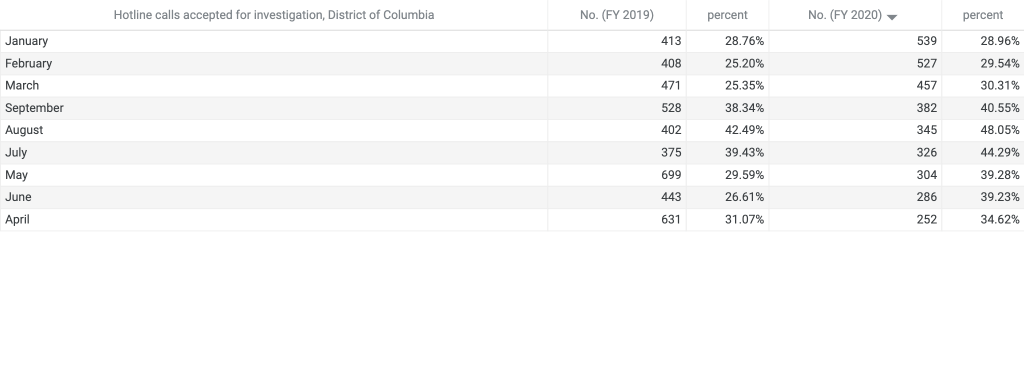
  • In the District of Columbia, as shown in Table One at the bottom of the article, the percentage of reports accepted for investigation was slightly greater in 2020 than in the previous year. But as Figure Five shows, this percentage increase in accepted reports was not enough to substantially narrow the large gap between the number of accepted reports in the two years. Both the number of hotline calls accepted for investigation and the number of substantiated investigations showed the same sharp decrease as the number of reports to the hotline.
  • Similarly, the number of investigations in New York City showed the same precipitous drop from 2019 to 2020 as did the number of reports, as Figure Seven shows. And the percentage of investigations that “showed some credible evidence of abuse or neglect” in January through September 2020 was actually one point lower than that in the same period of 2019.
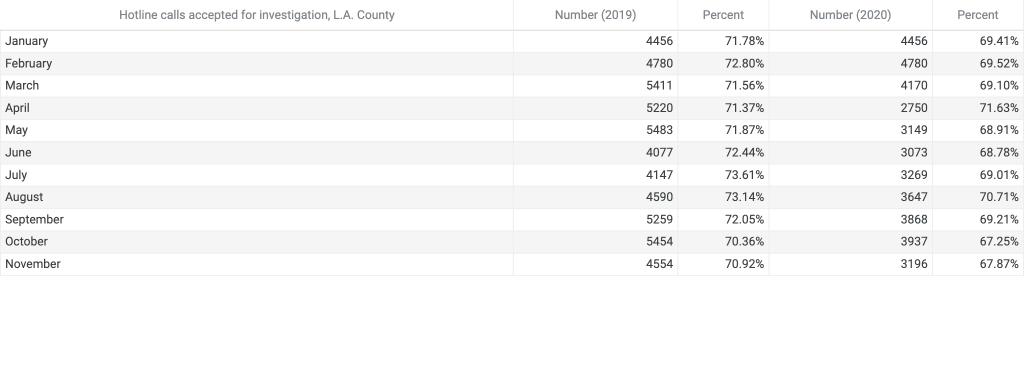
  • In Los Angeles, the percentage of referrals accepted for investigation actually declined during the pandemic, as indicated in Table Two below. So the year-to-year gap in number of referrals accepted for investigation (see Figure Seven) was even greater than the gap in total referrals. (Los Angeles does not provide data on substantiated reports.)
  • In Florida, as indicated in Table Three, there was a very slight increase in the percent of of intakes accepted for investigation during March-May 2020 compared to the same period in 2019. But as Figure Eight shows, the total numbers were much lower than in the previous year. (Florida does not provide data on the number of reports that were substantiated.)

It is clear from data in the four jurisdictions described here that reports to child abuse hotlines fell steeply in all four jurisdictions after the pandemic school closures, absolutely and relative to the same months of the previous year. In Florida, where schools reopened in September, reports increased to almost the level of the year before. It seems indisputable that measures imposed to fight COVID-19 were behind these changes and highly likely that school building closures were a large factor behind the reporting reductions. Moreover, as reports decreased, so did the numbers of reports investigated and substantiated, thus dashing any hope that only frivolous reports were being weeded out by the school closures.

Now that a vaccine is available, some Governors in states that have not reopened schools have proposed plans to prioritize teachers for vaccines and finally reopen buildings. Governor Gavin Newsom of California has offered a reopening plan including prioritization of school staff for vaccinations throughout spring 2021. West Virginia Governor Jim Justice has announced his plan to open pre-K, elementary, and middle schools for in-person learning on Tuesday, Jan 19. High school students will return to in-person school only in less-heavily-infected counties. Justice announced that the state will vaccinate all teachers and school personnel over the next two to three weeks as part of Phase One of the state’s vaccination plan.

Data from around the country clearly show that child welfare agencies received fewer reports, conducted fewer investigations, and made fewer findings of child abuse or neglect in times and places where schools were virtual. This fact adds to the many other reasons to open all closed school buildings as soon as possible. Opposition from teachers and their unions has been a major reason for keeping schools virtual. It is understandable that teachers were reluctant to return to buildings. But now, availability of vaccines makes it possible for schools to reopen throughout the country without endangering teachers–as long as all teachers are offered the vaccine before returning to classrooms. The high costs to to students of closed school buildings, among which undetected abuse should be included, mean that we should not wait any longer to bring students back to school in person.

[1]: These jurisdictions were chosen as large state or county child welfare systems that had readily available about reports, investigations and substantiations. Many other large jurisdictions do not post such data.

[2]:DC’s pattern of increasing reports from January through May is different from the other jurisdictions and may be related to its law requiring schools to report educational neglect when a student accumulates ten unexcused absences in a school year.

Table One: Hotline Calls Accepted for Investigation, District of Columbia

Source: https://cfsadashboard.dc.gov/; Data analyzed by Child Welfare Monitor DC

Figure Five

Source: https://cfsadashboard.dc.gov/; Data analyzed by Child Welfare Monitor DC

Figure Six

Source: NYC Children, Flash Monthly Indicators Report, December 2020, available from https://www1.nyc.gov/assets/acs/pdf/data-analysis/flashReports/2020/12.pdf

Table Two

Source: https://cfsadashboard.dc.gov/; Data analyzed by Child Welfare Monitor DC

Figure Seven

Table Three: Intakes Accepted for Investigation, Florida

Source: https://www.myflfamilies.com/programs/childwelfare/dashboard/intakes-received.shtml?Landing%20Page%20InvRec=1; Data analyzed by Child Welfare Monitor

Figure Eight

Data from https://www.myflfamilies.com/programs/childwelfare/dashboard/intakes-received.shtml?Landing%20Page%20InvRec=1; Data analyzed by Child Welfare Monitor